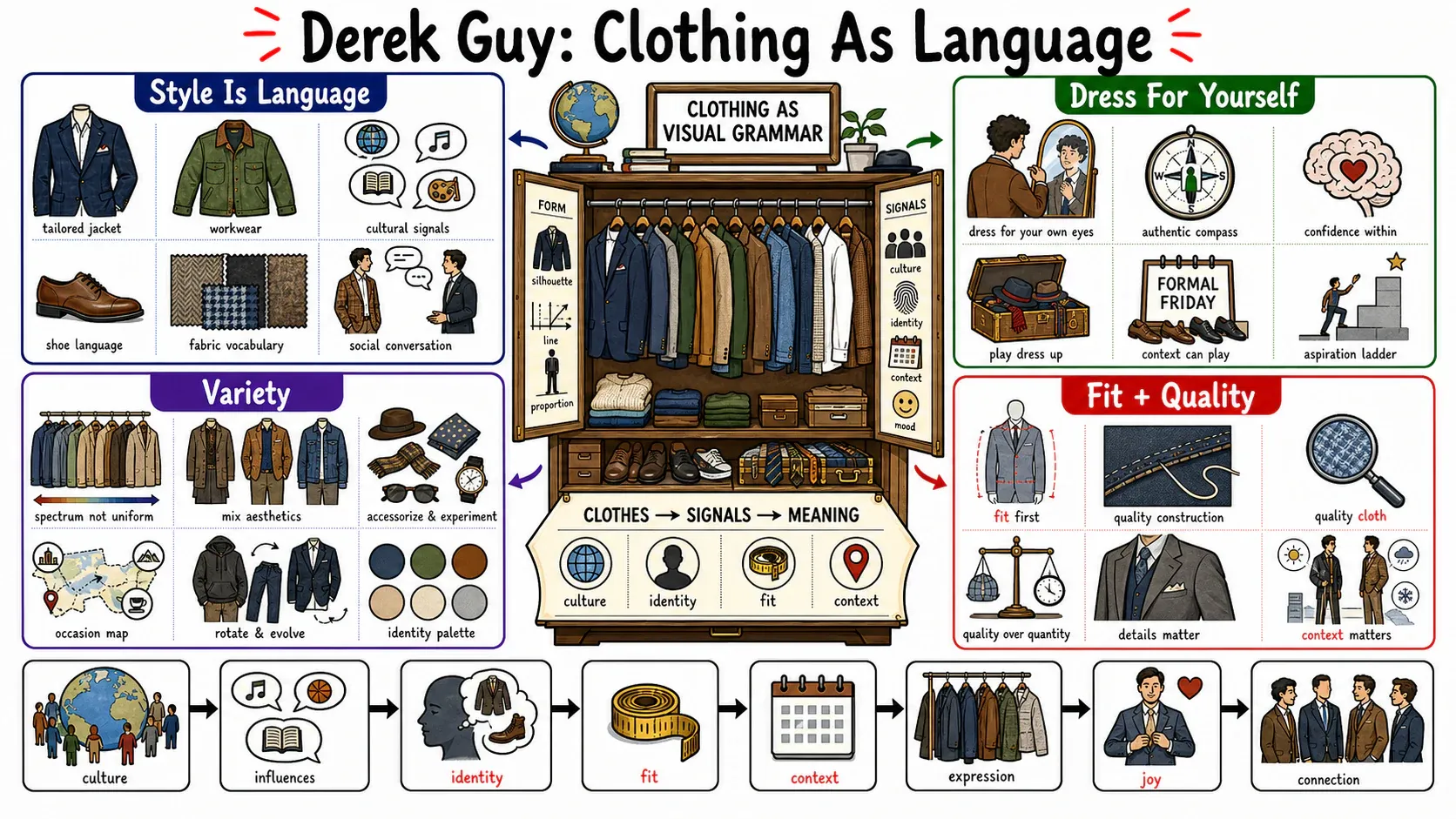
Derek Guy writes about menswear through Die, Workwear! and Put This On. His approach treats clothing as a cultural language: style communicates identity and connects to wider histories, communities and politics. These lessons collect directly sourced ideas from his essays and interviews. — Sanpetuna interview.
On Personal Style and Authenticity
- Fashion as a language: Guy treats dress as a cultural and social language: clothing can communicate background, identity and aspirations, so an outfit makes more sense when its pieces express a coherent meaning. — Sanpetuna interview.
- Dress for the pleasure of it: Guy says he now wears casual suits for ordinary outings—including cafes, restaurants and visits with friends—because he enjoys them, not because the occasion demands a suit. — Put On a Happy Suit.
- Bridge tailored and casual styles: Guy admires dressers who move confidently between traditional tailored clothing and casualwear, and uses his interview to explore how a varied wardrobe can work. — Get You a Man Who Can Do Both.
- Make an occasion to dress up: If everyday dress feels too casual for tailoring, Guy suggests organizing a recurring dinner with friends who also enjoy dressing up. — Mr Porter — Don’t Be Shy.
- Clothes communicate socially: Guy argues that clothes convey identity, aspiration and mood within cultural conventions; even choices made without much thought can carry social meaning. — Mindscape interview transcript.
On Quality and Value
- Buy for use and enjoyment: Guy says the best purchase may cost a little more than planned if it is the item you genuinely want and will enjoy wearing; he warns that a cheaper compromise can ultimately cost more. — How to Shop on a Budget.
- Quality must also be accessible: Guy argues that well-made clothing carries real costs, while calling for better quality to become more accessible without exploiting workers or the planet. — Boss Hunting interview.
- Don’t buy merely because it is on sale: Guy advises planning purchases before sales and resisting discounts on things that do not actually fit your wardrobe or needs. — How to Shop on a Budget.
- Let your taste develop before splurging: For a new wardrobe, Guy recommends a small flexible base and mid-tier purchases while you learn what you enjoy, rather than assuming you already know your permanent style. — How to Shop on a Budget.
On Tailoring and Fit
- Avoid dress-sneaker hybrids: Guy dislikes shoes that combine a dress-shoe upper with an obvious sneaker sole, arguing that the hybrid usually fits neither tailoring nor casualwear. He explicitly makes room for people with mobility needs. — Dress Sneakers Are Alarmingly Popular.
- Use jacket length to consider proportion: Guy’s rule of thumb is that a very short jacket can make a wearer look heavier; he also warns that broad body-type rules have many counterexamples. — The Extended Shoulder.
- Drape can flatter a less athletic build: Guy suggests that some extra room through a jacket’s shoulders and chest can flatter a less athletic figure, while emphasizing that such fit advice is a rule of thumb. — The Extended Shoulder.
- Start tailoring with a sport coat: Rather than begin with a full suit, Guy suggests a navy sport coat that can be worn with a light-blue Oxford shirt, chinos or suitable jeans. — Mr Porter — Don’t Be Shy.
- Choose intentionally casual tailoring: Guy recommends easing into tailoring through suits in casual fabrics and relaxed combinations, such as a polo or fine sweater in place of a dress shirt. — Mr Porter — Don’t Be Shy.
- A T-shirt can relax a sport coat: Guy suggests a plain fine-cotton white tee—or a fitting graphic tee—to make a navy sport coat feel more casual. — Mr Porter — Don’t Be Shy.
- Bespoke is not automatically the best value: Guy warns that custom tailoring can be rewarding but uncertain and expensive; for a budget-conscious buyer, ready-to-wear with alterations is often safer than assuming bespoke guarantees a better result. — How to Shop on a Budget.
- Make fit guidance accessible to larger men: Guy has published practical guidance for larger male figures and says that sharing basic fit advice can help readers who are new to menswear. — British GQ interview.
- Armani changed the shape of the suit: Guy writes that Armani advanced deconstructed tailoring through extended shoulders, lower gorges and fluid fabric, emphasizing silhouette, drape and proportion. The phrase “soulful, sophisticated simplicity” is Armani’s description, not Guy’s own maxim. — How Giorgio Armani Transformed Tailoring.
On Menswear Culture and Community
- Make menswear more accessible: Guy wants approachable entry points so people unfamiliar with menswear can discover enjoyment in clothes, rather than finding the field forbiddingly niche or expensive. — Sanpetuna interview.
- Give beginners a useful entry point: Guy names familiar items such as an Oxford-cloth button-down or raw denim as possible entry points; a person can stay with those basics or explore more specialized styles later. — Sanpetuna interview.
- Connect clothing to broader stories: Guy links clothing to history, sociology and politics to make style relevant to people who are not already menswear enthusiasts. — Sanpetuna interview.
- Learn style through communities: Guy’s interest grew through friends who were Lo Heads, then through classic menswear, blogs and online forums. — British GQ interview.
- Music can open a style world: Guy says musician friends in the Lo Head scene first made him aware of dress as self-expression; jazz and film later contributed to his interest in suits. — British GQ interview.
- Praise good style as well as criticize bad style: Guy’s public commentary is not only negative: he also highlights well-shaped, well-draped looks such as Colman Domingo’s and praises makers whose designs he values. — Boss Hunting interview.
- Use a springboard wardrobe: Guy proposes a small flexible base—not a forever list of universal essentials—from which a beginner can try tailoring, workwear and other aesthetics and develop personal taste. — The Springboard Wardrobe.
- Let a critique teach a principle: When Guy challenged a public figure’s “bespoke” claim, he contacted the tailor and asked about the making process before explaining why the jacket was made-to-measure rather than bespoke. — Boss Hunting interview.
- Fashion is not merely frivolous: Guy traces the stigma around men’s interest in fashion to gender expectations and historical changes, rather than treating dress as an inherently trivial subject. — Mindscape transcript.
- Even indifference to clothing communicates: Guy observes that someone who says he dresses only for comfort still chooses garments within social expectations, often signalling gender, class or cultural identity. — Mindscape transcript.
- Dress carries political and class meaning: Guy uses the hoodie after Trayvon Martin’s death to explain that people project class and racial meanings onto clothing; the meaning is not inherent in a garment alone. — Boss Hunting interview.
- Verify a bespoke claim before criticizing it: Guy’s “Asian Calling About Bespoke” joke accompanies a serious practice: when he doubted a jacket was bespoke, he called the tailor to check how it was made before publishing the correction. — Boss Hunting interview.
- The Lo Head scene shaped his taste: Guy says friends in the Lo Head dance/streetwear scene introduced him to Ralph Lauren and its links to tailoring, workwear and prep; he distinguishes Lo Heads from the original Lo Lifes crew. — Boss Hunting interview.
- Clothing can foster place and identity: Guy argues that local, enthusiast-run shops and walkable communities can give fashion a stronger sense of place and identity. — Boss Hunting interview.
- Adapt advice to a broader audience: Guy says his social posts shifted from niche brand jokes toward practical explanations such as evaluating cashmere or a suit as his audience widened. — Sanpetuna interview.
- Learn both casualwear and tailoring: Guy observes that many strong casual dressers are less fluent in tailoring, and vice versa; his interview asks how to develop comfort with both modes. — Get You a Man Who Can Do Both.
- Look beyond domestic shops: Guy’s signed guide identifies European and Canadian menswear shops as options for people seeking different footwear and clothing selections, subject to practical shipping and import considerations. — Great Menswear Shops in Europe and Canada.
- The suit’s place is changing: Guy writes that the coat-and-tie uniform has declined sharply since World War II, yet was still associated with finance, law, government and formal settings even as those environments grew more casual. — Mr Porter — Don’t Be Shy.
- The suit and liberal individual choice: Guy connects the decline of compulsory suit-wearing to wider freedom of self-determination and changing gender norms; he welcomes that freedom while noting the harder task of choosing a coherent wardrobe. — Guy on liberalism and the suit.
- Accept being unusually absorbed in a craft: Guy recalls being called “weird” for his detailed menswear investigations; he reflects on the remark while explaining why he verified a disputed bespoke claim. — Boss Hunting interview.
- Be selective about where to spend: Guy describes himself as frugal outside buying nice clothes, illustrating that his menswear interest is not a general preference for expensive consumption. — Boss Hunting interview.
- Shop secondhand when it serves the wardrobe: Guy recommends used clothing through thrift shops and online resale marketplaces such as eBay, Etsy and Grailed, with cleaning and fit considerations. — How to Shop on a Budget.
- From forums to Die, Workwear!: Guy says his interest led him through menswear blogs and forums; a direct British GQ interview dates the start of Die, Workwear! to about 2010, rather than the old unsourced precise 2011 claim. — British GQ interview.
- Human stories include clothing: Guy argues that clothing can be a route into history, politics and sociology because the way people dress is part of their lived context. — Sanpetuna interview.
Learn more:
- 5 Questions with Derek Guy — Sanpetuna
- Dress Sneakers Are Alarmingly Popular — Put This On
- Don’t Be Shy: You Can Wear a Suit Whenever You Want — Mr Porter
- Get You a Man Who Can Do Both — Put This On
- Derek Guy on the Theory and Practice of Dressing Well — Mindscape
- How to Shop on a Budget — Put This On
- Derek Guy Has Entered the Chat — Boss Hunting
- The Extended Shoulder — Die, Workwear!
- @Dieworkwear, Twitter’s “Menswear Guy,” Is Just as Perplexed as You Are — British GQ
- How Giorgio Armani Transformed Tailoring — GQ
- The Springboard Wardrobe — Put This On
- Put On a Happy Suit — Put This On
- Derek Guy on Liberalism and the Suit — Substack
- Great Menswear Shops in Europe and Canada — Put This On