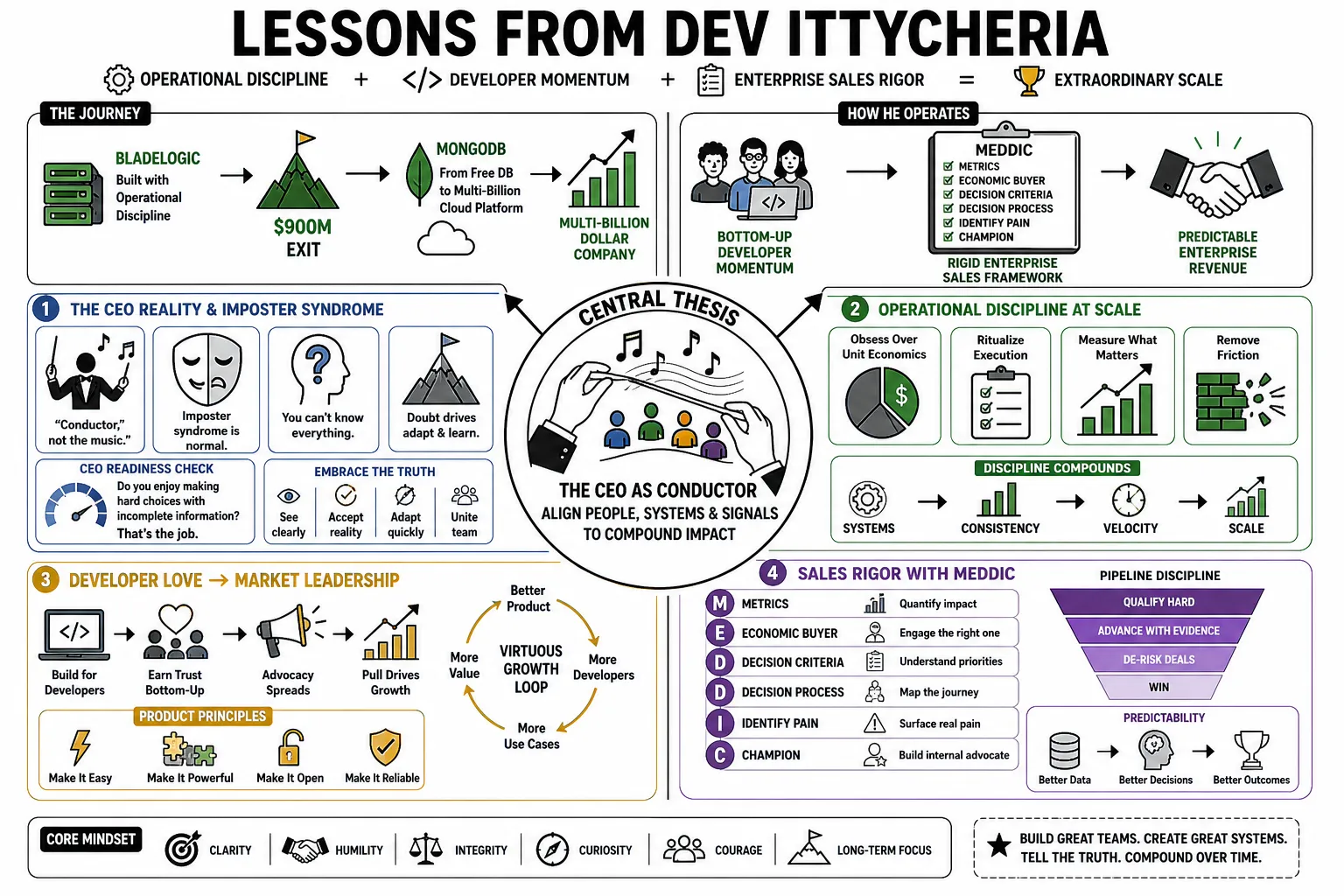
Dev Ittycheria led BladeLogic through its 2007 IPO before its $900 million sale to BMC Software, and later became MongoDB’s CEO. His interviews describe how he combined developer adoption with enterprise sales and guided MongoDB’s transition to Atlas, its managed cloud service. — Forbes Interview with Dev Ittycheria.
Part 1: The CEO Reality and Imposter Syndrome
- The CEO sets direction and clears obstacles: Dev describes the CEO’s job as clarifying strategy, assembling the right leaders and removing obstacles so the team can execute. — Forbes Interview with Dev Ittycheria.
- A CEO need not know everything: Logan Bartlett’s interview memo describes Dev’s early pressure to appear knowledgeable about everything and his later emphasis on asking questions and relying on a capable team. — Logan Bartlett Episode Memo.
- Stay a student of the game: Dev warns that executives who think they have mastered a repeatable formula stop adapting; strong leaders retain some doubt and learn from each company’s changing circumstances. — Hunters + Unicorns — Dev Ittycheria Interview.
- Make hard decisions despite discomfort: Dev says leaders often know a product, pricing or personnel change is needed but avoid the painful decision; he gives direct feedback and role changes as examples. — Kleiner Perkins — Dev Ittycheria Interview.
- Develop into the CEO role: A participant’s notes from a conversation with Dev record his view that CEOs are developed through experience rather than born ready for the role. — Notes from a Conversation with Dev Ittycheria.
- Admit uncertainty to invite candor: Dev says acknowledging confusion in a meeting makes others more willing to speak openly, improving clarity and alignment. — Seven Questions with Dev Ittycheria.
- Use the team’s complementary expertise: Dev says a CEO does not need to know everything; different leaders bring different skills, and hearing their concerns improves the dynamic. — Forbes Interview with Dev Ittycheria.
- Treat embarrassment as evidence of growth: Dev says he is embarrassed by some decisions he made years earlier and takes that as a sign that he has grown. — Grit Podcast — Dev Ittycheria.
- Reassess leaders as the company changes: Dev says leaders who fit an early high-growth stage may not fit a later one, so the CEO must continually assess the leadership team. — Forbes Interview with Dev Ittycheria.
Part 2: Intellectual Honesty and Information Flow
- Bad news moves slowly upward: Dev observes that bad news can travel slowly up an organization even while it spreads quickly downward. — SaaStr CEOs Fireside.
- Assume early bad reports understate the problem: When Dev receives a bad report, he assumes it may be only the visible part of a larger issue and investigates further. — SaaStr CEOs Fireside.
- Surface bad news while it is actionable: Dev encourages people to disclose problems early, when the team still has time to address them; waiting until the last moment can foreclose options. — SaaStr CEOs Fireside.
- Treat people leadership as core to the business: Dev says software companies are ultimately people businesses and advises CEOs to work closely with a strong chief people officer on team dynamics. — Kleiner Perkins — Dev Ittycheria Interview.
- Seek bad news through spot checks: Because bad news is often filtered on its way upward, Dev uses spot checks and deeper questioning to uncover problems early. — Seven Questions with Dev Ittycheria.
- Look to a leader’s team for the clearest signal: Dev says direct reports see a leader’s effectiveness more clearly than superiors; departures, frustration and weaker recruiting can reveal a leader who is no longer scaling. — The Logan Bartlett Show — Dev Ittycheria Interview.
- Watch whether leaders attract and retain talent: Dev treats a leader’s inability to recruit or retain strong employees as a warning that the leader is not serving the team well. — Seven Questions with Dev Ittycheria.
Part 3: The Talent Imperative and "A's Hire A's"
- Practice rather than merely accumulate years: Dev says a person can repeat a job for years without learning; deliberate exploration of new ideas and problems is what develops capability. — Seven Questions with Dev Ittycheria.
- Strong leaders raise the hiring bar: Dev says strong leaders recruit strong people, while weaker leaders can degrade the talent level of subsequent hires. — Seven Questions with Dev Ittycheria.
- Treat a bad senior hire as consequential: Dev says a failed senior hire has a larger impact on the business than a junior mistake, so leaders must assess skills and stage fit carefully. — SaaStr CEOs Fireside.
- Use performance management before broad cuts: Dev says broad reductions can be an easy way to cut costs while avoiding the harder management work of setting expectations, holding people accountable and recognizing strong performance. — This Week in Startups — Dev Ittycheria Interview.
- Talent advantage can compound: Dev compares early access to stronger teams, customers and capital to a flywheel that improves a startup’s future opportunities. — Seven Questions with Dev Ittycheria.
- Make expectations and feedback explicit: Dev advises managers to define expectations clearly, then give feedback against those expectations so employees are not surprised by a weak review. — This Week in Startups — Dev Ittycheria Interview.
Part 4: Sales Discipline and MEDDIC
- Recruiting is a leadership duty: Dev argues that leaders must attract people who believe in the mission and fit the company’s stage, not merely inherit a team. — SaaStr CEOs Fireside.
- Inspect work, not just intended outcomes: Dev says people respond to what leaders inspect, and describes reviewing team work and coaching employees on calls, code and plans. — This Week in Startups — Dev Ittycheria Interview.
- Forecast from qualified deals: Dev says a sales leader must understand customer pain, influence, likely timing and deal size so the business can forecast credibly. — SaaStr CEOs Fireside.
- Write a stage-specific sales playbook: A head of sales should build a qualification process around the company’s own customers, deal sizes and sales cycles rather than copy a previous employer’s playbook. — SaaStr CEOs Fireside.
- Find the customer’s real pain: Dev asks founders to identify the problem their product solves, who cares about it, and whether customers actually use it. — Forbes Interview with Dev Ittycheria.
- Qualify business pain and the buyer: Dev recommends distinguishing real business problems from technology curiosity, while winning developer adoption and explaining ROI to an economic buyer. — SaaStr CEOs Fireside.
- Let customer revenue fund early growth: Dev says BladeLogic built much of its early business using cash from customer wins while keeping total outside financing limited. — Forbes Interview with Dev Ittycheria.
- Match sales channels to customer size: MongoDB used inside sales for smaller firms, direct field sales for large enterprises and self-service for very small customers. — Forbes Interview with Dev Ittycheria.
Part 5: Strategy, Vision, and Platform Evolution
- Listen before applying a playbook: Dev says adaptable founders listen carefully to feedback, even when they do not adopt every suggestion. — SaaStr CEOs Fireside.
- Work backward from outcomes: Dev recommends defining the desired outcome, identifying the few points of greatest leverage, and executing those well. — Sequoia Crucible Moments Transcript.
- Remove customers’ database operations burden: Dev says MongoDB launched Atlas after customers asked to hand off provisioning, upgrades, scaling and backup so their teams could focus on differentiated development. — Forbes Interview with Dev Ittycheria.
- Act despite skepticism about a cloud pivot: Dev recalls substantial skepticism that MongoDB could operate an independent cloud infrastructure service, yet the company committed to Atlas. — Sequoia Crucible Moments Transcript.
- Protect an open-source business model from cloud cloning: Dev says MongoDB feared cloud providers could offer its freely available code as a service, weakening the independent business; that concern motivated a license change. — Sequoia Crucible Moments Transcript.
- Accept tradeoffs in a license change: Dev says MongoDB changed to SSPL despite concern about users’ reaction and later explained the decision to customers; he viewed it as important to the business’s future. — Sequoia Crucible Moments Transcript.
- Use open availability to lower adoption friction: Dev describes MongoDB’s original open-source strategy as a freemium path to make the database easy for developers to try and spread. — Sequoia Crucible Moments Transcript.
- Broaden the platform when customers need it: Dev says customers asked MongoDB to combine search and other data functions so they could do more in one place rather than stitch together point tools. — Sequoia Crucible Moments Transcript.
Part 6: Building and Adapting Organizational Culture
- Keep AI application choices flexible: Dev describes MongoDB’s AI application program as providing architectures and integrations without forcing developers to commit to one large language model. — theCUBE — Dev Ittycheria AI Interview.
- Treat trust as a scarce asset: Firsthand notes from a conversation with Dev say he urged leaders to consider whether their choices build trust, not merely to profess that trust matters. — Notes from a Conversation with Dev Ittycheria.
- Build a psychological edge: Dev argues that long-term orientation, delayed gratification, resilience and comfort with low status can be durable advantages because they run against common impulses. — Kleiner Perkins — Dev Ittycheria Interview.
- Set the cultural example deliberately: Dev says leaders’ behavior is mirrored across the organization, making it important to model candid communication and the values they expect from the team. — Hunters + Unicorns — Dev Ittycheria Interview.
- Let the best idea win: Dev says teams should debate decisions candidly and constructively, then judge proposals by merit rather than the seniority of the person proposing them. — The Logan Bartlett Show — Dev Ittycheria Interview.
- Use hybrid work deliberately: Dev describes a hybrid approach that gives employees remote flexibility while bringing teams together for meetings, planning, mentoring and coaching. — This Week in Startups — Dev Ittycheria Interview.
- Repeat priorities as the team grows: Dev learned that leaders must communicate goals and priorities repeatedly, especially as headcount and geographic spread increase. — Seven Questions with Dev Ittycheria.
- Be operationally ready for public markets: Dev says a company considering an IPO should be able to deliver on what it forecasts consistently and have a financial profile suitable for public investors. — SaaStr CEOs Fireside.
Part 7: Operational Execution and "Trust But Verify"
- Give a new product its own focus: MongoDB treated Atlas as a startup within the company, assigned a directly responsible leader, and tracked its tiny early numbers separately from the core business. — Sequoia Crucible Moments Transcript.
- Sell both to developers and economic buyers: Dev says developers can veto a database but may not authorize the purchase, so MongoDB had to earn user adoption and make the ROI case to senior buyers. — SaaStr CEOs Fireside.
- Make forecasting dependable: When resetting MongoDB’s go-to-market operation, Dev prioritized a sales process able to forecast the business and meet or exceed those forecasts. — The Logan Bartlett Show — Dev Ittycheria Interview.
- Expect adversity after a consequential choice: Dev says leaders should listen to challenges and test assumptions, then persist through the adverse period after a high-stakes decision. — Sequoia Crucible Moments Transcript.
- Product strength does not replace sales execution: Dev warns that in complex B2B markets a strong product will not simply sell itself; disciplined selling is part of scaling. — SaaStr CEOs Fireside.
- Bring the board bad news first: Dev says he opens board discussions with problems and tries to ensure directors hear bad news from him before anyone else, building trust and inviting help. — The Logan Bartlett Show — Dev Ittycheria Interview.
Part 8: Ambition, Growth, and Mentorship
- Let the scale of ambition expand: Dev credits Roelof Botha with pushing MongoDB’s leadership to think beyond its first $100 million in annual revenue. — Sequoia Crucible Moments Transcript.
- Find mentors who can see around corners: Dev says CEO work can be lonely, and trusted mentors with relevant experience help a leader recognize blind spots and anticipate what is coming. — Kleiner Perkins — Dev Ittycheria Interview.
- Use mentors to test self-perception: Dev credits mentor Steve Walske with teaching that leaders should keep the gap between their self-image and others’ perception narrow. — Grit Podcast — Dev Ittycheria.
- Adapt past experience to the new context: Dev cautions sales leaders against copying a prior company’s playbook because customers, products and deal cycles differ. — SaaStr CEOs Fireside.
- Use fear of irrelevance as a prompt to adapt: Dev describes feeling anxious about becoming irrelevant after leaving BladeLogic and says he keeps learning so he can connect with younger builders and changing technology. — Kleiner Perkins — Dev Ittycheria Interview.
- Choose long-term orientation: Dev says a durable business requires a leader who is willing to think beyond short-term interests, delay gratification and adapt through setbacks. — Kleiner Perkins — Dev Ittycheria Interview.
- Choose a career at the intersection of fit and life goals: Firsthand notes from an intern’s conversation with Dev say he advised weighing personal strengths, passion and desired quality of life when choosing a career. — Notes from a Conversation with Dev Ittycheria.