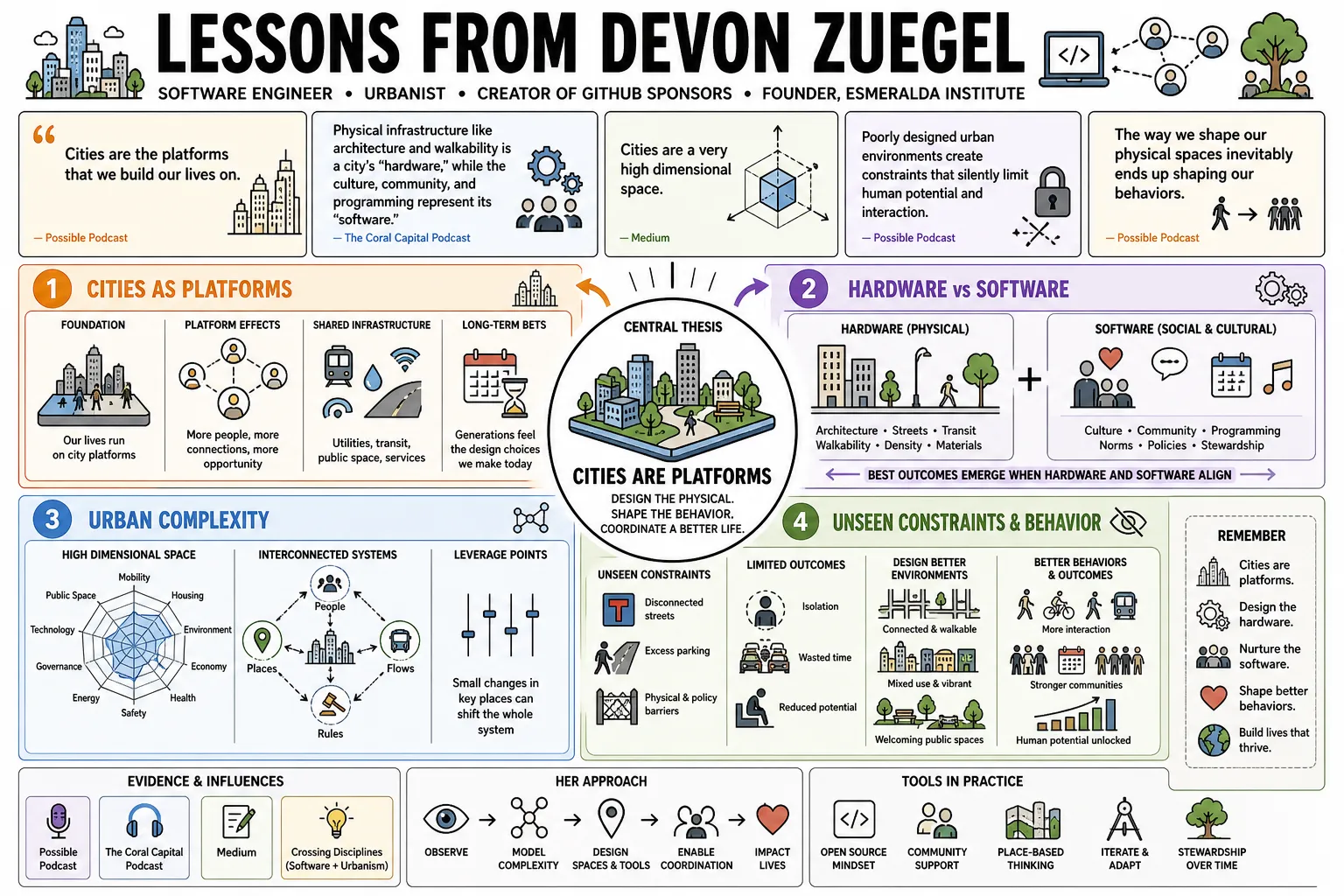
Lessons from Devon Zuegel
Devon Zuegel founded GitHub Sponsors and is building Esmeralda, a proposed walkable town. Her work and writing connect incentive design, tools for thought, and the design of physical places. — Possible: Devon Zuegel on Cities.
Part 1: Cities as Platforms & Physical Infrastructure
- Cities as Platforms: Zuegel describes cities as platforms for daily life: their physical and social design shapes what residents can do and whom they encounter. — Possible: Devon Zuegel on Cities.
- A Town’s Hardware and Software: She distinguishes the built “hardware” of a town from its social “software,” including the activities and norms people create within it. — Coral Capital: Building a Town From Scratch.
- Urban Complexity: She cautions that cities are too multidimensional to rank along one simple best-to-worst scale; residents value different combinations of features. — Possible: Devon Zuegel on Cities.
- Land-use Barriers: Zuegel argues that restrictive land-use rules can prevent communities from building housing and neighborhoods people want. — Henry Faarup: Startup Cities Interview.
- Cities as Labor Markets: She emphasizes that cities connect people to jobs and collaborators, making their economic role more than a collection of buildings. — Allume: Cities with Devon Zuegel.
- Remote Work and Place: Remote work gives more people a choice of where to live, but Zuegel still treats face-to-face relationships as a reason that place matters. — Allume: Cities with Devon Zuegel.
- Coordination Problems: She applies a coordination lens to both open-source communities and new towns: incentives and institutional design shape whether people can build together. — Henry Faarup: Startup Cities Interview.
- Walkable Proximity: Esmeralda’s plan puts everyday destinations within walking distance to create more chances for neighbors to meet. — Colossus: Devon Zuegel Is Building a New Town.
Part 2: Village Urbanism & The Esmeralda Vision
- The Chautauqua Model: Childhood summers at Chautauqua helped shape Zuegel’s vision for a town with learning, arts and everyday multigenerational life close together. — Colossus: Devon Zuegel Is Building a New Town.
- Intergenerational Design: Esmeralda aims to make ordinary public life welcoming to children, parents and older residents rather than designing for one age group. — Coral Capital: Building a Town From Scratch.
- The Opportunity of New Towns: Starting a town offers a chance to design streets, shared spaces and social practices coherently, while still operating within the law and existing institutions. — Devon Zuegel: What Are Startup Cities For?.
- Village Inspirations: Zuegel draws inspiration from Mediterranean and Japanese villages when describing compact, human-scale development for Esmeralda. — Coral Capital: Building a Town From Scratch.
- Compactness and Nature: Her village-urbanism vision combines walkable compactness with nearby countryside and open landscape. — Coral Capital: Building a Town From Scratch.
- Children’s Independence: One design test Zuegel describes is whether parents could comfortably let children walk to the town piazza on their own. — Colossus: Devon Zuegel Is Building a New Town.
- The Esmeralda Vision: Esmeralda is planned as a walkable, multigenerational town combining learning, family life and repeated neighborly encounters. — Colossus: Devon Zuegel Is Building a New Town.
- Prototype Before Building: Zuegel used the month-long Edge Esmeralda gathering to test social programming and place-making ideas before committing to the permanent town. — Devon Zuegel: Edge Esmeralda Recap.
Part 3: Open Source & Incentive Design
- Funding Open Source: Zuegel founded GitHub Sponsors to make it easier for people and companies to financially support developers whose work they rely on. — GitHub: Announcing GitHub Sponsors.
- The Commons Problem: She frames open-source funding as a coordination problem: widely used projects create shared value, but relying on voluntary contributions can leave maintainers unsupported. — The Changelog: Making GitHub Sponsors.
- Funding in the Workflow: GitHub Sponsors places financial support within the developer platform itself, reducing the need for supporters to find and arrange a separate payment channel. — GitHub: Announcing GitHub Sponsors.
- Reducing Giving Friction: Zuegel saw easier sponsorship—especially for organizations—as a way to unlock support that existing payment and approval processes discouraged. — The Changelog: Making GitHub Sponsors.
- Governance Burden as Projects Grow: She observes that open-source maintainers may begin with technical experimentation but later face disputes, funding decisions and communication work they did not expect. — Devon Zuegel: OSS Lazy-loads Governance.
- The Work Behind Dependencies: Projects can depend on maintainers whose ongoing work is not reliably funded; Sponsors was designed to make that support more direct. — GitHub: Announcing GitHub Sponsors.
- Aligning Beneficiaries and Maintainers: Her Sponsors work aimed to connect organizations benefiting from open-source code with the people maintaining it. — The Changelog: Making GitHub Sponsors.
- Corporate Sponsorship: Zuegel argues that companies relying on open source can support its maintainers more directly when sponsorship is simpler to arrange. — The Changelog: Making GitHub Sponsors.
Part 4: Tools for Thought & Computing as a Medium
- Computing as a Living Medium: Zuegel likens personal computing to a garden: notes, relationships and tools can develop together rather than remain fixed in separate files. — Possible: Devon Zuegel on Cities.
- Tools Shape Thought: She is interested in tools for thought because their design can expand or constrain the ways people organize ideas. — Uses This: Devon Zuegel.
- Alternative Computing Futures: Through her Tools & Craft interviews, Zuegel explores earlier computing visions as alternatives to current interface conventions. — Tools & Craft: Alan Kay.
- Spatial Interfaces: Zuegel wishes digital tools offered more of the spatial freedom of physical surfaces, rather than confining everything to a single screen. — Uses This: Devon Zuegel.
- Unlocking Potential: She describes unlocking human potential as the through-line of her interest in tools, incentives and cities. — Uses This: Devon Zuegel.
- Shared Work and Siloed Notes: Zuegel uses Notion for shared work but wishes her notes and clippings were less siloed across tools. — Uses This: Devon Zuegel.
- Exploring Visual Interaction: In her Tools & Craft interviews, Zuegel probes alternatives to typing and flat screens, including more visual and spatial ways to work with ideas. — Tools & Craft: Omar.
Part 5: Social Technology & Coordination
- Social Technology: Zuegel argues that social technology—the rules and institutions shaping cooperation—deserves attention alongside conventional technology. — Henry Faarup: Startup Cities Interview.
- Coordination Failures: She treats many difficulties in building communities and open-source projects as coordination problems that design can help address. — Henry Faarup: Startup Cities Interview.
- Designing Interaction: She compares online platforms and towns as environments whose affordances influence which interactions become easy or likely. — Allume: Cities with Devon Zuegel.
- Participation and Emergence: Zuegel is interested in communities with room for participation and experimentation, while acknowledging that collective decision-making can create tradeoffs. — Henry Faarup: Startup Cities Interview.
- Repeated Encounters: The Edge Esmeralda prototype gave participants shared spaces and recurring activities, creating opportunities to know and work with one another. — Devon Zuegel: Edge Esmeralda Recap.
- Institutions Are Designed: Zuegel views institutions as changeable social technologies and sees new towns as a place to test different arrangements. — Devon Zuegel: What Are Startup Cities For?.
- Affordances and Behavior: The choices built into a platform or place influence how people interact; changing those affordances can change the opportunities people have. — Allume: Cities with Devon Zuegel.
- Digital Reach, Physical Ties: Zuegel sees online and remote work as expanding who can collaborate, while continuing to value in-person relationships and local community. — Devon Zuegel: Remote Work and Talent.
- Low-cost Feedback in Conflict: Zuegel argues that online disputes often lack subtle social feedback; she has sometimes used private, constructive messages to make conversations more productive. — Devon Zuegel: The Silence Is Deafening.
Part 6: Crypto & Emergent Economics
- Crypto as a Practical Option: In Argentina’s inflationary and restricted currency environment, Zuegel observed some people using crypto and stablecoins as additional ways to move or hold value. — Devon Zuegel: Argentina’s Currency Markets.
- Informal Financial Infrastructure: She describes unofficial exchange networks that help some Argentinians obtain dollars and move funds when formal channels are restricted. — Devon Zuegel: Argentina’s Currency Markets.
- Everyday Uses of Informal Markets: Her reporting shows that people use Argentina’s unofficial currency markets for ordinary financial needs, not only speculative trading. — Devon Zuegel: Argentina’s Currency Markets.
- Stablecoins in Context: She found USD-pegged stablecoins more useful for some Argentine payments and savings than volatile bitcoin or ether, while recognizing issuer and exchange risks. — Devon Zuegel: Argentina’s Currency Markets.
- Convenience Versus Permissionlessness: Her Argentine reporting finds that users often choose convenient centralized exchanges even when the appeal of crypto includes moving value outside conventional banking constraints. — Devon Zuegel: Argentina’s Currency Markets.
- Parallel Exchange Markets: Zuegel’s 2022 account shows how Argentina’s exchange controls and rate gap supported a parallel market for obtaining foreign currency. — EconTalk: Devon Zuegel on Argentina and Crypto.
- Adoption Follows Local Needs: Her Argentina reporting emphasizes concrete local reasons to use stablecoins—exchange restrictions, cross-border work and currency instability—over abstract crypto ideology. — Devon Zuegel: Argentina’s Currency Markets.
- Resilience Has Tradeoffs: She treats alternative financial tools as useful in some constrained settings while warning that stablecoin issuers and centralized exchanges can themselves fail or be seized. — Devon Zuegel: Argentina’s Currency Markets.
Part 7: Productivity & Overcoming Minor Barriers
- Keep Ideas in View: Zuegel says she puts subjects she is thinking about on her walls, using physical visibility to keep them present in her workspace. — Uses This: Devon Zuegel.
- Lower the Barrier to Starting: Her Pomodoro practice addresses the activation energy of beginning work by making the first focused interval manageable. — Devon Zuegel: Pomodoro.
- Make Thought Spatial: Zuegel wishes digital work could remain visible across surfaces around her, as physical objects do, rather than being confined to one screen. — Uses This: Devon Zuegel.
- Reduce Writing Friction: She favors a personal knowledge system that makes it easy to capture and revise ideas without forcing every note into a rigid structure. — Devon Zuegel: My Personal Knowledge Base.
- Capture Before Organizing: She notes that a fleeting thought can disappear while she opens a note-taking app, so capture speed sometimes matters more than elaborate organization. — Devon Zuegel: Text Editing Methods.
- Paper Can Be the Better Drafting Surface: For some early drafts Zuegel prefers handwriting, even while relying on digital tools for other kinds of writing and editing. — Devon Zuegel: Text Editing Methods.
- Protect Focused Momentum: She compares productivity to a heat engine: repeated context switches can interrupt the sustained attention needed to make progress. — Devon Zuegel: Productivity Is Like a Heat Engine.
Part 8: Community Building & Intentional Living
- Prepare Questions, Leave Room for People: In her unconference guide, Zuegel advises hosts to prepare useful questions and make space for participants to shape the discussion. — Devon Zuegel: The Unconference Toolbox.
- Design a Container for Community: At Edge Esmeralda, organizers created a lightly structured setting and shared activities while leaving room for attendees to organize their own sessions. — Devon Zuegel: Edge Esmeralda Recap.
- Pop-ups as Fast Feedback: The month-long Edge Esmeralda gathering let Zuegel test town ideas and observe new friendships and collaborations on a much shorter cycle than permanent construction. — Devon Zuegel: Edge Esmeralda Recap.
- A Town for Different Life Stages: Her Esmeralda vision aims to bring children, working adults and older residents into shared everyday places rather than separating them by life stage. — Colossus: Devon Zuegel Is Building a New Town.
- Steward the Setting, Let Programming Emerge: Zuegel describes setting up Edge Esmeralda’s initial structure, then allowing participants to propose and run many activities themselves. — Devon Zuegel: Edge Esmeralda Recap.
- Public Spaces for Casual Encounters: She criticizes layouts that isolate neighbors and favors porches, walkable streets and a central piazza that make casual encounters easier. — Colossus: Devon Zuegel Is Building a New Town.
- Create the Conditions for Collaboration: Her Edge Esmeralda recap says organizers gathered people and supplied a shared setting while participants generated much of the programming and many projects. — Devon Zuegel: Edge Esmeralda Recap.
- Unlocking Human Potential: Zuegel says unlocking human potential motivates her interest in cities, tools for thought and incentive design. — Uses This: Devon Zuegel.