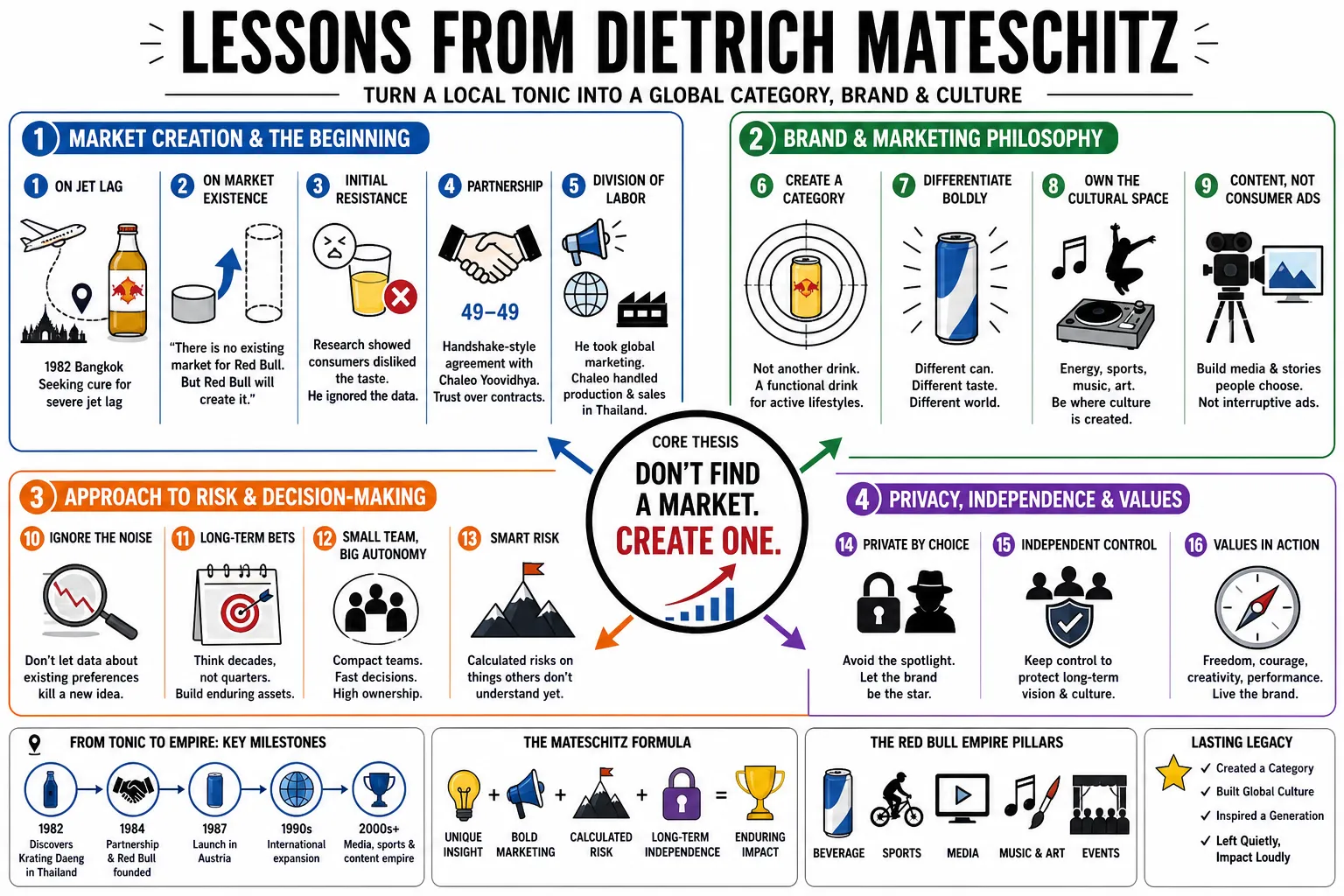
Lessons from Dietrich Mateschitz
Dietrich Mateschitz and Chaleo Yoovidhya founded Red Bull GmbH in 1984, adapting the Thai Krating Daeng drink for an Austrian launch in 1987. The business later expanded into sports and media. — Formula 1 Mateschitz Obituary.
Part 1: Market Creation & The Beginning
- Discovering a Drink During Asian Travel: During Asian business travel in 1982, Mateschitz encountered Krating Daeng and saw potential for a Western version. Accounts differ on the exact encounter location, so the old Bangkok/jet-lag scene is not preserved as a precise fact. — Formula 1 Mateschitz Obituary.
- Create a Market Rather Than Assume One: Mateschitz entered with a drink for which no established Western energy-drink category existed, and described the task as creating a market for Red Bull. — Independent Mateschitz Interview.
- Ignoring a Failed Market Test: Before Red Bull’s Austrian launch, market research rejected its taste, logo and name. Mateschitz nevertheless proceeded with the launch. — Forbes — The Soda With Buzz.
- Structure the Founding Partnership: Mateschitz and Chaleo Yoovidhya each held 49% of Red Bull GmbH, while Chaleo’s son Chalerm held the remaining 2%; Mateschitz ran the company from Austria. — Formula 1 Mateschitz Obituary.
- Premium Pricing: Mateschitz distinguished Red Bull from ordinary soft drinks as a functional product and said its price was several times higher than Coca-Cola in some markets. — BILANZ Mateschitz Interview.
- Commit Founding Capital: Mateschitz and Chaleo Yoovidhya each invested $500,000 when establishing Red Bull GmbH in 1984. — Formula 1 Mateschitz Obituary.
- Adapt Krating Daeng for Europe: Mateschitz and his partners adapted the Thai drink for European consumers, including carbonation and a new Red Bull brand presentation. — Formula 1 Mateschitz Obituary.
- Spend Time Developing the Launch: Red Bull’s official history says Mateschitz worked from 1984 to 1987 on the formula, positioning, packaging and marketing concept before the Austrian launch on April 1, 1987. — Red Bull Company Profile.
- The First-Year Deficit: Red Bull sold about one million cans in its first year but recorded a roughly $1 million deficit. Sales doubled in each of the next two years, and the company recouped its early losses. — Forbes — The Soda With Buzz.
Part 2: The Media & Marketing Philosophy
- Building a Media Business: Mateschitz set a goal for Red Bull Media House to make and distribute content across print, television, mobile, music and digital channels. — Fast Company Mateschitz Interview.
- Outsourcing Production: Mateschitz said Red Bull contracted out beverage production while retaining finance, administration, logistics, marketing, organization and IT in-house. — BILANZ Mateschitz Interview.
- A Brand Beyond the Can: Mateschitz described Red Bull as a brand philosophy expressed through both its drink and its sports, culture and media work. — Fast Company Mateschitz Interview.
- Advertising Alongside Experiences: Red Bull combined conventional cartoon advertising with product sampling and its own events from its early years; Mateschitz did not describe a refusal to buy traditional ads. — Fast Company Mateschitz Interview.
- Beverage and Media Together: Mateschitz rejected an either-or view of Red Bull as a beverage company or a media company, saying the drink and content both expressed the Red Bull world. — Fast Company Mateschitz Interview.
- The Brand Slogan: The “Red Bull gives you wings” slogan came from a friend of Mateschitz during the pre-launch brand-development period. — Forbes — The Soda With Buzz.
- An Invitation to Act: Mateschitz explained the brand promise as an invitation to be active, alert and performance-oriented across work, study, sport and leisure. — Fast Company Mateschitz Interview.
- Protecting Distinctiveness: In 2004 Mateschitz argued against extending Red Bull into unrelated categories while its international rollout was incomplete, because he feared diluting its distinctiveness. — BILANZ Mateschitz Interview.
- Student-Led Sampling: Instead of relying only on conventional advertising, Red Bull paid trend-setting students to host parties and supplied the drink, helping it reach young consumers through their own social networks. — Forbes — The Soda With Buzz.
- Red Bull Media House: Mateschitz said Red Bull Media House would produce and distribute content for Red Bull channels and partners, with a long-term aim to become profitable. — Fast Company Mateschitz Interview.
Part 3: Sports, Events, and Ownership
- Creating Events: Mateschitz said Red Bull created its own Flugtag event alongside sampling and advertising early in the brand’s history. — Fast Company Mateschitz Interview.
- Sports From Personal Participation: Mateschitz said early athlete partnerships grew from sports he and his friends actually practiced, including mountain biking, windsurfing and snowboarding. — Fast Company Mateschitz Interview.
- Red Bull Stratos: Red Bull backed Felix Baumgartner’s Stratos jump, a major multi-year aviation project that reached a vast global audience. The old claim about Mateschitz’s private reason for funding it is not documented. — Red Bull Stratos Project.
- Sport and the Brand Promise: Mateschitz linked the energy-drink idea to adventure and outdoor sports, while describing the brand promise broadly as encouraging activity and performance. — Fast Company Mateschitz Interview.
- Creating Air Racing: Red Bull developed the Air Race series, which began in 2003 after two years of planning and introduced specially designed Air Gates. — Red Bull Air Race History.
- Support Beyond Sponsorship: Red Bull’s athlete support went beyond a sponsorship payment: its Athlete Performance Center provided specialist medical, physical, mental and nutrition support, as athlete Manuel Lettenbichler described while recovering from injury. — Red Bull — Manuel Lettenbichler at the Athlete Performance Center.
- Sport as Storytelling: Mateschitz said Red Bull had produced content from the beginning and used its media channels to tell audiences about athletes, events, culture and Formula 1. — Fast Company Mateschitz Interview.
- Owning Sports Teams: Mateschitz bought the Jaguar and Minardi Formula 1 teams, building Red Bull-branded racing operations rather than remaining only a sponsor. — Formula 1 Mateschitz Obituary.
- Red Bull Team Identity: After buying Jaguar, Mateschitz named the team Red Bull Racing; after buying Minardi, he renamed it Toro Rosso, Italian for Red Bull. — Formula 1 Mateschitz Obituary.
- Events as Global Reach: By 2005 Red Bull staged dozens of extreme-sport and cultural events each year to build the brand’s visibility. — Forbes — The Soda With Buzz.
Part 4: Formula 1 and Motorsports
- Taking Calculated Sporting Risks: Red Bull adviser Helmut Marko characterized the team’s willingness to promote young Max Verstappen as part of its “no risk, no fun” approach, after discussing the move with Mateschitz. — Formula 1 Marko Interview.
- The Ongoing Cost of Formula 1: In an interview, Mateschitz observed that buying an F1 team was only the beginning of its cost; the substantial responsibility and spending came afterward. — The Independent Mateschitz Interview.
- Building Powertrain Capability: Under Mateschitz, Red Bull planned to develop its own Formula 1 power unit instead of relying solely on a joint programme with another manufacturer. — Formula 1 Mateschitz Obituary.
- Developing Young Drivers: Mateschitz backed a young-driver programme and said buying Minardi gave Red Bull more seats and more direct influence over the development of its talent. — Grandprix Mateschitz Interview.
- A Competitive Engine Was Nonnegotiable: During Red Bull’s 2015 Formula 1 engine dispute, Mateschitz told SPEEDWEEK that the team needed a competitive engine to continue; without one, he said, it would withdraw. — SPEEDWEEK — Mateschitz on Red Bull’s F1 Future.
- Letting Drivers Compete: After Red Bull’s 2010 title, Mateschitz defended the decision not to reverse Vettel and Webber’s finishing order in Brazil for championship tactics. — Autosport Mateschitz Q&A.
- Autonomy for Racing Experts: Mateschitz funded the Formula 1 programme and left major technical and team decisions to specialists including Christian Horner and Adrian Newey. — Formula 1 Mateschitz Obituary.
Part 5: Leadership and Corporate Culture
- Freedom With Responsibility: Mateschitz described Red Bull as having few formal controls, with staff expected to handle autonomy through self-motivation and responsibility. — The Independent Mateschitz Interview.
Part 6: Privacy and Personal Life
- Freedom Over Wealth: Mateschitz said money was not the motive for founding Red Bull; he emphasized independence and freedom from his former corporate role. — BILANZ Mateschitz Interview.
- Hangar-7 Aviation Collection: Mateschitz created Hangar-7 at Salzburg Airport to house a collection of historic aircraft. — Formula 1 Mateschitz Obituary.
- Staying Private: In 2004 Mateschitz said Red Bull had no financial need for a stock-market listing and that he preferred to avoid shareholder meetings. — BILANZ Mateschitz Interview.
- Privacy as Quality: Mateschitz avoided television and radio appearances because he valued privacy and did not want to be widely recognized. — The Independent Mateschitz Interview.
Part 7: Philanthropy and Impact
- Funding Beyond One Benefactor: Heinz Kinigadner recalled Mateschitz wanting Wings for Life to be financially sustainable beyond his own annual support, rather than depend on a benefactor who could disappear. — Formula 1 Mateschitz Obituary.
- Why Wings for Life Began: After motocross champion Heinz Kinigadner’s son Hannes suffered a spinal cord injury in 2003, Kinigadner and Mateschitz founded Wings for Life in 2004 to support research. — Wings for Life Foundation History.
- Donations to Research: Wings for Life says Red Bull pays the foundation’s administrative costs so that all donations can go to spinal cord research. — Wings for Life 100% Guarantee.
- Addressing a Research Gap: Wings for Life says spinal cord research had insufficient funding when Mateschitz and Kinigadner founded the organization in 2004. — Wings for Life Research Interview.
- Funding Research Toward Treatment: Wings for Life funds spinal cord research and programmes intended to help promising laboratory work advance toward clinical studies. — Wings for Life Research Interview.
Part 8: The Austrian Legacy
- Investing in Styria: Mateschitz took over the former Österreichring in Styria and planned a substantial redevelopment that he described as regional infrastructure, not merely a private hobby. — BILANZ Mateschitz Interview.
- ServusTV’s Austrian Base: Austrian broadcasting records show that Red Bull Media House owned Salzburg TV and planned to air it as ServusTV from April 2009, with programming about Austrian and European culture, sport and innovation. — Austrian ServusTV Licence.
- Restoring Regional Properties: Mateschitz acquired and renovated numerous Austrian properties, including old castles and hotels. — ORF III — Mateschitz Documentary.
- Media Jobs Beyond the Drink: Red Bull Media House’s ServusTV project planned a staff of about 100 at launch, spanning editorial, production and administration roles. — Austrian ServusTV Licence.
- A Research Platform: In 2017 Mateschitz backed a publicly accessible multimedia research platform and appointed leaders for its editorial and business operations. — Kleine Zeitung Media Project Report.
- Opening Hangar-7 to the Public: Mateschitz’s Hangar-7 housed historic aircraft and was open to the public with a restaurant, café and bars. — The Independent Mateschitz Interview.
- A Long-Term Brand: In 2005 Mateschitz spoke of making Red Bull a brand that could endure for a century. — Forbes — The Soda With Buzz.