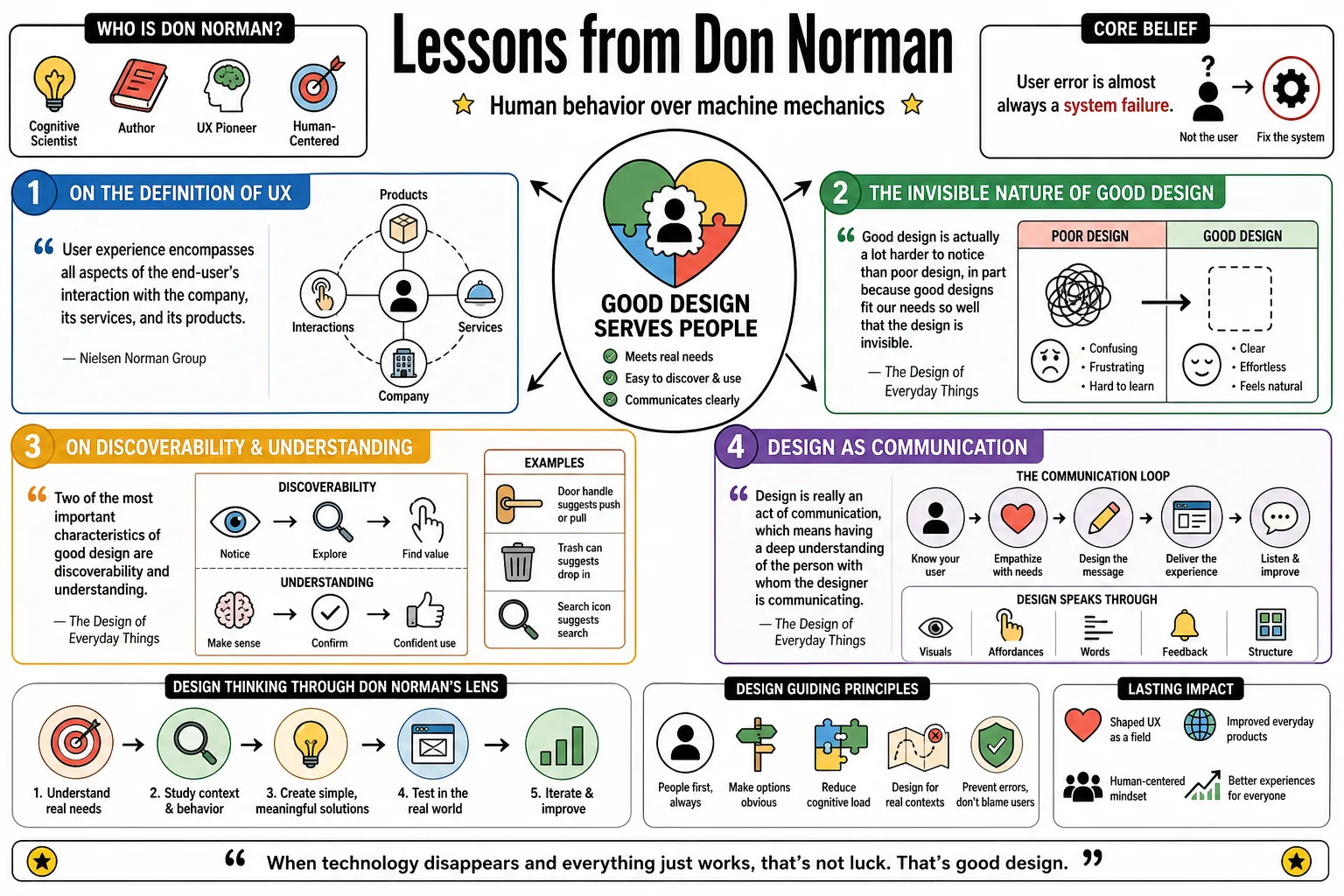
Don Norman coined the term "user experience" and forced the design world to focus on human behavior instead of machine mechanics. He argued that user error is almost always a system failure, a standard that changed how everyday products and digital interfaces are built. This collection organizes his decades of work on usability to show how intentional choices shape the artificial world around us.
Part 1: The Foundations of Usability
- On the definition of UX: "User experience encompasses all aspects of the end-user's interaction with the company, its services, and its products." — Source: Nielsen Norman Group
- On the invisible nature of good design: "Good design is actually a lot harder to notice than poor design, in part because good designs fit our needs so well that the design is invisible." — Source: The Design of Everyday Things
- On discoverability: "Two of the most important characteristics of good design are discoverability and understanding." — Source: The Design of Everyday Things
- On communication: "Design is really an act of communication, which means having a deep understanding of the person with whom the designer is communicating." — Source: The Design of Everyday Things
- On seamless integration: "No product is an island. A product is more than the product. It is a cohesive, integrated set of experiences." — Source: Nielsen Norman Group
- On human behavior: "We have to accept human behavior the way it is, not the way we would wish it to be." — Source: The Design of Everyday Things
- On the duty of machines: "It is the duty of machines and those who design them to understand people. It is not our duty to understand the arbitrary, meaningless dictates of machines." — Source: The Design of Everyday Things
- On eliminating memory burdens: "The most effective way of helping people remember is to make it unnecessary." — Source: The Design of Everyday Things
- On logic versus use: "The problem with the designs of most engineers is that they are too logical." — Source: The Design of Everyday Things
- On holistic scope: "I invented the term [UX] because I thought human-interface and usability were too narrow. I wanted to cover all aspects of the person's experience with the system." — Source: Nielsen Norman Group
Part 2: Human Error vs. System Error
- On systemic failure: "Human error usually is a result of poor design: it should be called system error." — Source: The Design of Everyday Things
- On the nature of mistakes: "Humans err continually; it is an intrinsic part of our nature." — Source: The Design of Everyday Things
- On misplaced blame: "The idea that a person is at fault when something goes wrong is deeply entrenched in society. That's why we blame others and even ourselves." — Source: The Design of Everyday Things
- On fixing root causes: "Blaming the person without fixing the root, underlying cause does not fix the problem." — Source: The Design of Everyday Things
- On edge cases: "It is easy to design devices that work well when everything goes as planned. The hard and necessary part of design is to make things work well even when things do not go as planned." — Source: The Design of Everyday Things
- On bad labels: "Any time you see signs or labels added to a device, it is an indication of bad design: a simple lock should not require instructions." — Source: Living with Complexity
- On failure as data: "Failures? No — Learning Experiences. Scientists and designers should view failures simply as data points that indicate it is time to try something new." — Source: Design for a Better World
- On self-evident operation: Good design is also an act of communication between designer and user, one that must come entirely through the appearance of the device itself. — Source: Nielsen Norman Group
Part 3: Emotion, Aesthetics, and Joy
- On visual appeal: "Attractive things work better." — Source: Emotional Design
- On mood and problem-solving: "Attractive things make people feel good, which in turn makes them think more creatively. How does that make something easier to use? Simple, by making it easier for people to find solutions to the problems they encounter." — Source: Emotional Design
- On the personality of objects: "Everything has a personality: everything sends an emotional signal." — Source: Emotional Design
- On visceral design: "Visceral design is what nature does. This is where appearance matters and first impressions are formed." — Source: Emotional Design
- On behavioral design: "Behavioral design is about use, about experience with a product. But experience itself has many facets: function, performance, and usability." — Source: Emotional Design
- On reflective design: "Reflective design... is about long-term relations, about the feelings of satisfaction produced by owning, displaying, and using a product." — Source: Emotional Design
- On designing for joy: "It is not enough that we build products that function, that are understandable and usable, we also need to build products that bring joy and excitement, pleasure and fun, and, yes, beauty to people's lives." — Source: Emotional Design
- On long-lasting feelings: "True, long-lasting emotional feelings take time to develop: they come from sustained interaction." — Source: Emotional Design
- On human-centered complexity: "The whole point of human-centered design is to tame complexity, to turn what would appear to be a complicated tool into one that fits the task, that is understandable, usable, enjoyable." — Source: Emotional Design
- On smart machines: "Machines will not be smart and sensible until they have both intelligence and emotions." — Source: Emotional Design
Part 4: Complexity and Confusion
- On the nature of complexity: "Modern technology can be complex, but complexity by itself is neither good nor bad: it is confusion that is bad." — Source: Living with Complexity
- On managing complexity: "Complexity is to be managed; it is not to be avoided. It is the confusion that we must avoid." — Source: The Design of Everyday Things
- On mental models: "What makes something simple or complex? It's not the number of dials or controls or how many features it has: It is whether the person using the device has a good conceptual model of how it operates." — Source: Living with Complexity
- On perception: "Simplicity is in the mind, complexity is in the world." — Source: Living with Complexity
- On understanding: "If you understand something, then even things that are complex become simple." — Source: Living with Complexity
- On conservation of complexity: "The total complexity of a system is a constant: as you make the person's interaction simpler, the hidden complexity behind the scenes increases." — Source: Living with Complexity
- On the burden of ease: "Making things easier for the user means making it more difficult for the designer or engineer." — Source: Living with Complexity
- On feature bloat: "Why do we deliberately build things that confuse the people who use them? Answer: because the people want the features." — Source: Living with Complexity
- On superfluous design: "The design of everyday things is in great danger of becoming the design of superfluous, overloaded, unnecessary things." — Source: The Design of Everyday Things
Part 5: Tools and Human Intelligence
- On extending the mind: "The unaided mind is surprisingly limited. It is things that make us smart. Take advantage of them." — Source: Things That Make Us Smart
- On synergy: "The system point of view: The person + artifact is smarter than either alone." — Source: Things That Make Us Smart
- On freeing the brain: "Does the fact that I can no longer remember my own phone number indicate my growing feebleness? No, on the contrary, it unleashes the mind from the petty tyranny of tending to the trivial and allows it to concentrate on the important and the critical." — Source: Things That Make Us Smart
- On machine-centered perspectives: "Today we serve technology. We need to reverse the machine-centered point of view and turn it into a person-centered point of view." — Source: Things That Make Us Smart
- On the non-neutrality of technology: "Technologies are not neutral. They affect the course of society, aiding some actions, impeding others, independent of the morality or reasoning of those actions." — Source: Things That Make Us Smart
- On reflective environments: "Reflection is best done in a quiet environment, devoid of material save that relevant to the task. Rich, dynamic, continually present environments can interfere with reflection." — Source: Things That Make Us Smart
- On cognitive representation: "A good representation captures the essential elements of the event, deliberately leaving out the rest... A representation is never the same as the thing being represented." — Source: Things That Make Us Smart
- On the appropriateness principle: "The representation used by the artifact should provide exactly the information acceptable to the task: neither more nor less." — Source: Things That Make Us Smart
- On natural interaction: "Natural, smooth, efficient interaction should be the goal of all work situations." — Source: Things That Make Us Smart
Part 6: Systems Thinking and The Artificial World
- On the scope of design: "I look around me, and I see that almost everything is artificial. That means everything was designed, but not necessarily by designers." — Source: McKinsey Interview
- On systemic structures: "The notion of a country, of politics, and of the laws that we pass—it's all artificial." — Source: McKinsey Interview
- On mutual influence: "We design the world, and then the world designs us." — Source: Design for a Better World
- On unintended consequences: "The harm was and is not deliberate but rather a direct result of the lack of system thinking." — Source: Design for a Better World
- On pacing: "Technology changed rapidly, but people and culture changes slowly." — Source: The Design of Everyday Things
- On disaster prevention: "People are really good at responding to disaster, but they're not good at preventing it in the first place." — Source: McKinsey Interview
- On temporal constructs: "The clock became the master of human life." — Source: Design for a Better World
- On technological adoption: "People Propose, Science Studies, Technology Conforms." — Source: Things That Make Us Smart
Part 7: Problem Solving and Design Process
- On defining the problem: "A brilliant solution to the wrong problem can be worse than no solution at all: solve the correct problem." — Source: The Design of Everyday Things
- On asking questions: "One of my rules in consulting is simple: never solve the problem I am asked to solve. Good designers never start by trying to solve the problem given to them: they start by trying to understand what the real issues are." — Source: The Design of Everyday Things
- On messy realities: "In the real world, the problems do not come in nice, neat packages. They have to be discovered." — Source: The Design of Everyday Things
- On observation: "Requirements are developed by watching people in their natural environment." — Source: The Design of Everyday Things
- On representation in problem solving: "Solving a problem simply means representing it so as to make the solution transparent." — Source: Things That Make Us Smart
- On iteration: "Fail often, fail fast." — Source: The Design of Everyday Things
- On simplification tactics: "Decreasing the number of buttons and displays is not the solution. The solution is to understand the total system." — Source: Living with Complexity
- On routine mastery: "The behavioral level in human beings is especially valuable for well-learned, routine operations. This is where the skilled performer excels." — Source: Emotional Design
- On Grudin's Law: "When those who benefit are not those who do the work, then the technology is likely to fail or, at least, be subverted." — Source: Things That Make Us Smart
Part 8: Humanity-Centered Design and The Future
- On redefining the discipline: "Humanity-centered design builds on the principles of human-centered design, except it expands them. We must think about all living things and about the environment." — Source: McKinsey Interview
- On the goal of design: "Design is not art. Design is building things to help society, to help other people." — Source: McKinsey Interview
- On technology serving humans: "Technology should serve humanity, not the other way around." — Source: Design for a Better World
- On shifting metrics: "Measure what truly matters to people, not just economic indicators." — Source: Design for a Better World
- On sustainability: "Our artificial way of life is unsustainable." — Source: Design for a Better World
- On the root of the challenge: "Human behavior is the key challenge in addressing global issues." — Source: Design for a Better World
- On circular design: "Embrace a circular economy to eliminate waste and promote sustainability." — Source: Design for a Better World
- On collective action: "A new beginning is not something that can be done by a single person or a single group. It will take a mobilization of many to change our way of being so that we can change the world." — Source: Design for a Better World
- On the ultimate mandate: "Design must change from being unintentionally destructive to being intentionally constructive." — Source: Design for a Better World