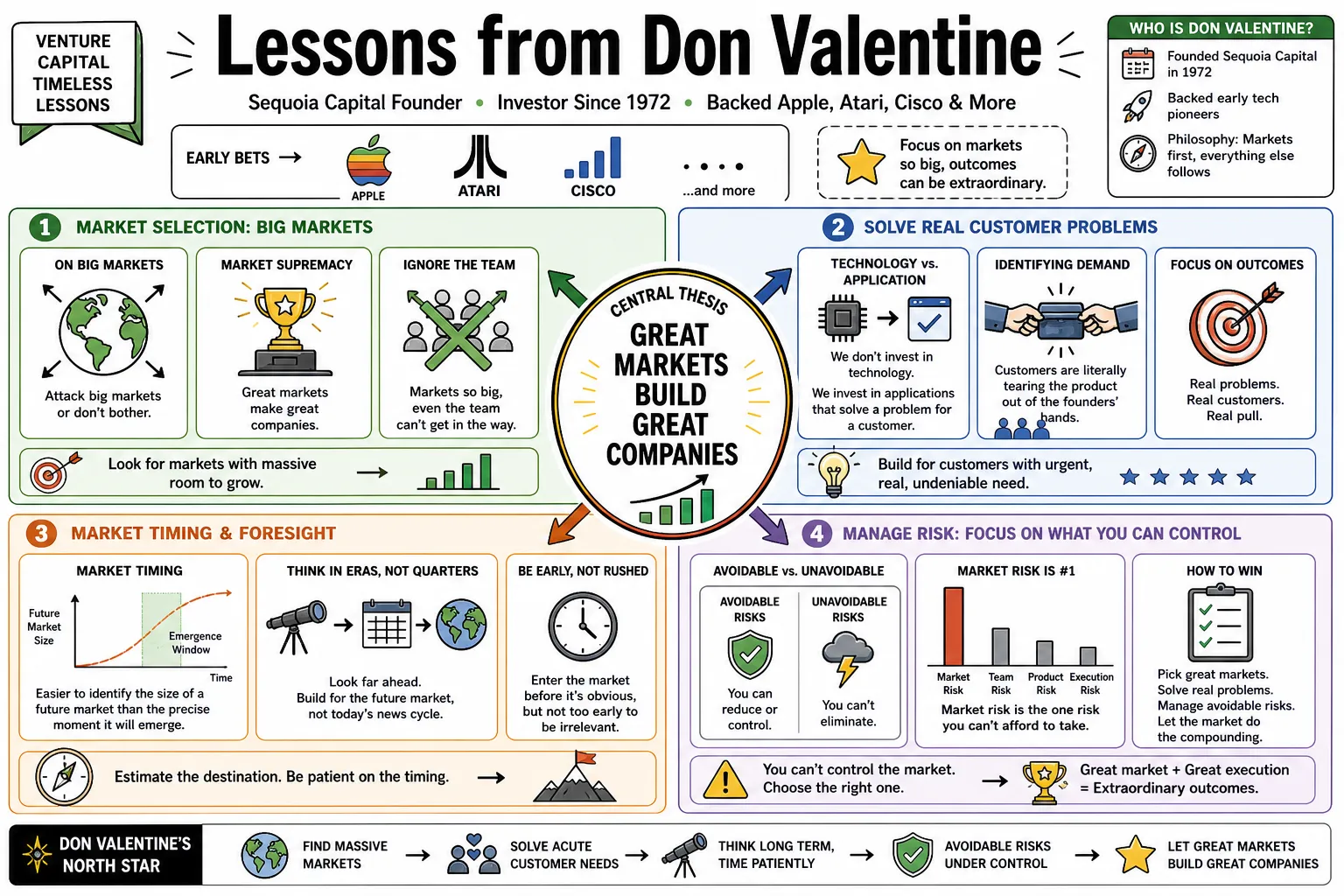
Lessons from Don Valentine
Don Valentine founded Sequoia Capital in 1972 after working in semiconductors and helped back companies including Atari and Apple. He described Sequoia’s early approach as selecting large markets, then finding the products and people needed to build enduring companies. — Sequoia — Our History.
Part 1: Market Selection
- Target Big Markets: Valentine focused on market size, dynamics and competition because Sequoia sought to build large companies; he argued that a company attacking a small market was unlikely to become large. — Stanford GSB — Target Big Markets.
- Markets Before Management Pedigree: Valentine was willing to back an opportunity in a large market even when the initial team lacked polished credentials, because management could be supplemented as the company developed. — Stanford GSB — Target Big Markets.
- Invest in Applications: Valentine looked for applications that solved a consequential customer problem, not a technology demonstration in isolation; Cisco’s router investment followed a concrete networking bottleneck. — Sequoia — Cisco Story.
- Match Product Timing to Demand: Valentine said an investment could fail even when its technology worked if the product arrived before buyers were ready; product availability and market demand needed to coincide. — Stanford GSB — Target Big Markets.
- Recognize Urgent Customer Demand: Valentine described Cisco as having exceptionally strong demand because its routers solved a pressing network problem; he credited John Morgridge, not himself, with the colorful line about customers clamoring for the product. — Computer History Museum — Cisco Oral History.
- Market Demand Cannot Be Engineered Away: Valentine recalled technically successful products for which there were no buyers at the right time; Sequoia sometimes stopped funding those investments rather than try to create the market itself. — Stanford GSB — Target Big Markets.
- Expect Crowding After a New Category Takes Off: Valentine observed that Apple’s early success was followed within a few years by dozens of PC entrants—one reason to study how quickly competitors can crowd an emerging market. — Ethix — Don Valentine Interview.
- Follow Technology into Large Applications: Valentine traced opportunities from microprocessors to PCs, networking and mobile applications, seeking large markets where a practical technology could solve an important problem. — Stanford GSB — Target Big Markets.
Part 2: Product and Problem Solving
- Ask Who Cares: Valentine’s recurring test for a startup was whether it had a thoughtful answer to “Who cares?”—a prompt to identify a real customer and consequential need. — Sequoia — Remembering Don Valentine.
- Solve a Problem Customers Already Have: Valentine favored products aimed at identifiable problems and markets over trying to create demand from scratch. — Stanford GSB — Target Big Markets.
- Make a Material Product Improvement: Valentine contrasted Apple’s improved mobile-music experience with Sony’s Walkman and warned that incumbents can miss a product generation. — Stanford GSB — Target Big Markets.
- Price for Sustainable Margins: Valentine said Sequoia often urged young founders to price products higher; he praised Cisco for maintaining prices and gross margins that produced early cash flow. — Computer History Museum — Cisco Oral History.
- Use Customer Signals to Guide Expansion: In Cisco’s expansion, a customer told the team that acquiring a specialist switching company would make it buy more; Valentine and John Morgridge described how such signals helped shape the broader networking product mosaic. — Computer History Museum — Cisco Oral History.
- Choose Customers Who Can Use the Product: Valentine said Cisco initially favored technically capable customers who could use its routers without extensive hand-holding, reducing the support burden. — Computer History Museum — Cisco Oral History.
- Track Enabling Technology: Valentine used his semiconductor background to recognize applications made possible by microprocessors and to finance companies positioned for that emerging technological shift. — Stanford GSB — Target Big Markets.
- Look for Real Buyers: Valentine used Cisco’s early sales to other university IT departments as evidence that routers solved a concrete networking problem. — Stanford GSB — Target Big Markets.
Part 3: Founder Traits and Psychology
- Learn from Failed Attempts: Valentine said Sequoia liked financing entrepreneurs who had tried and failed because they had learned from the experience and had something to prove. — Berkeley Oral History — Don Valentine.
- Leave Room for Disobedience: Valentine argued that companies need people willing to challenge the existing way of doing things; excessive pressure for obedience can suppress innovation. — Berkeley Oral History — Don Valentine.
- Do Not Confuse Agreeableness with Founder Potential: Roelof Botha recalled Valentine’s framework for assessing founders: the most rewarding investments could involve exceptional people who were not easy to work with. Evaluate exceptional ability separately from agreeableness. — The Tim Ferriss Show — Roelof Botha Interview.
- See Past a Founder’s Appearance: Valentine backed Apple despite Steve Jobs’s unconventional appearance because he saw a large consumer opportunity in affordable personal computing. — Sequoia — Apple Story.
- Judge Work Before Pedigree: Valentine said Sequoia cared less about formal education than what people had done in prior companies, and he warned against rejecting unconventional founders on appearances. — Stanford GSB — Target Big Markets.
- Look for Passion Tied to Reality: Valentine valued founders whose passion was connected to a genuine problem and a viable market, rather than superficial conformity. — Berkeley Oral History — Don Valentine.
- Supplement Founder Gaps: Valentine acknowledged that inexperienced founders often did not know what they lacked; Sequoia used its network and operating experience to supply missing capabilities. — Stanford GSB — Target Big Markets.
- A Vision for a New Market: Valentine called Steve Jobs a visionary because he imagined a personal computer that ordinary people could own when available computers cost far more. — Berkeley Oral History — Don Valentine.
Part 4: Storytelling and Communication
- Stories Help Capital Flow: Valentine said entrepreneurs must learn to tell a coherent story because funding decisions depend partly on how they explain the opportunity. — Stanford GSB — Target Big Markets.
- Explain the Business Clearly: A useful pitch should explain the proposed product, market size, technical risk and who will care without burying the investor in extraneous detail. — Berkeley Oral History — Don Valentine.
- Make the Business Intelligible: Valentine asked a rambling founder to compress a business plan onto a business card so investors could understand the opportunity’s key points. — Berkeley Oral History — Don Valentine.
- Start with the Problem and Market: Valentine pressed founders to say what problem their company would solve, how large the market could be and why their solution would matter. — Berkeley Oral History — Don Valentine.
- Pair Story with Substance: Valentine’s story test was not merely theatrical: he wanted the pitch to make the idea, market size and technical risk intelligible enough to judge an investment. — Berkeley Oral History — Don Valentine.
- Ask Why Now and So What: A later Sequoia partner recalls Valentine asking founders “why now?” and “so what?”—questions that test what has changed and why customers should care. — Sequoia — AI and the Frontier Paradox.
Part 5: The Mechanics of Venture Capital
- Build Major Companies: Valentine said Sequoia’s early aim was to build major companies in large technology markets, rather than merely manage an investment portfolio. — Berkeley Oral History — Don Valentine.
- Invest Hands-On: Valentine kept early investments geographically close because Sequoia expected to work actively with companies and supply capabilities they lacked. — Berkeley Oral History — Don Valentine.
- Question Yesterday’s Assumptions: Valentine argued that investors and companies must recognize when yesterday’s technology or product assumptions no longer fit tomorrow’s market. — Berkeley Oral History — Don Valentine.
- Seek Companies Proactively: Valentine described Sequoia as seeking promising technologists and markets proactively, then using its network to help founders build a company. — Stanford GSB — Target Big Markets.
- Ask Hard Questions: At Atari, Valentine pressed Nolan Bushnell on the numbers before board meetings—an example of his active, analytical involvement after investing. — Sequoia — Nolan Bushnell Interview.
- Stop Funding an Invalid Thesis: Valentine said Sequoia sometimes stopped financing companies when a product lacked timely buyers or the expected return no longer looked realistic. — Stanford GSB — Target Big Markets.
- Distinguish Investment Returns from Company Success: Valentine distinguished a successful venture investment from a successful company: the timing and terms of an exit could make a smaller company as rewarding to investors as a larger one. — Ethix — Don Valentine Interview.
- Beware Investment Frenzies: Valentine warned that when a category becomes the single fashionable answer to what comes next, abundant capital can fund too many similar companies. — Ethix — Don Valentine Interview.
Part 6: Cash and Survival
- Keep Cash Available to Operate: Valentine treated cash flow as a core financial measure and warned that young companies often had little cash or borrowing capacity, especially in downturns. — Stanford GSB — Target Big Markets.
- Manage Cash Deliberately: Valentine prioritized cash flow and described helping young companies with experienced finance support, particularly when cash and borrowing capacity were limited. — Stanford GSB — Target Big Markets.
- Prioritize Cash Flow: Valentine identified cash flow as Sequoia’s key financial metric for early companies, rather than relying on top-line sales alone. — Stanford GSB — Target Big Markets.
- Fund Against Milestones: Valentine said Sequoia did not provide all financing on day one; it reserved money for later rounds and refinanced companies according to their progress against milestones. — Stanford GSB — Target Big Markets.
- Make Spending Discipline Visible: Valentine praised Cisco leader John Morgridge for repeatedly teaching managers to scrutinize spending even as the company grew rapidly and generated cash. — Stanford GSB — Target Big Markets.
- Estimate the Cost of Growth: Valentine evaluated a startup’s projected cash burn against the people, space and equipment it would need, challenging cost forecasts that looked implausibly low or high. — Berkeley Oral History — Don Valentine.
- Use Margins to Generate Growth Cash: Valentine argued that high gross margins can produce cash flow, giving a growing company resources to expand with its market. — Berkeley Oral History — Don Valentine.
- Capital Cannot Replace Scarce Talent: Valentine recalled that Cisco had ample money for adjacent products but too few engineers to build them all, prompting targeted acquisitions of specialist teams. — Computer History Museum — Cisco Oral History.
Part 7: Building the Team and Culture
- Hire for the Go-to-Market Job: Valentine said he looked for a strong salesperson early and wanted sales and marketing experience in place once a product was ready for customers. — Computer History Museum — NetApp Oral History.
- Supply Missing Management Skills: Valentine said Sequoia helped inexperienced founders obtain the management skills and people they lacked, while staying focused on a large market and an actual technical solution. — Stanford GSB — Target Big Markets.
- Pair Engineering with Marketing: Valentine wanted young companies to be strong in technology and engineering while also developing marketing skill to understand market dynamics. — Stanford GSB — Target Big Markets.
- Change Management When Needed: Valentine backed Cisco for its solution to a large problem despite weak management, then helped bring in new executives over time. — Berkeley Oral History — Don Valentine.
Part 8: Silicon Valley and Technological Change
- Watch Incumbent Inertia: Valentine pointed to Xerox and Sony as examples of large companies that missed opportunities despite strong positions and technical resources. — Stanford GSB — Target Big Markets.
- Compare Software and Hardware Economics: Valentine questioned Oracle’s move into hardware because its software business had much higher gross margins than he expected hardware to deliver. — Computer History Museum — NetApp Oral History.
- Learn from the Semiconductor Ecosystem: Valentine credited Fairchild, Intel, SRI and other technology centers with producing the components and experienced people that helped new Silicon Valley companies form. — Stanford GSB — Target Big Markets.
- Use Downturns to Build: Valentine said recessions could be favorable for starting technology companies because valuations, space and talent became more accessible. — Ethix — Don Valentine Interview.
- Share Credit and Mistakes: Valentine said Sequoia’s partners shared credit for successful investments and took collective responsibility for poor investment choices. — Berkeley Oral History — Don Valentine.