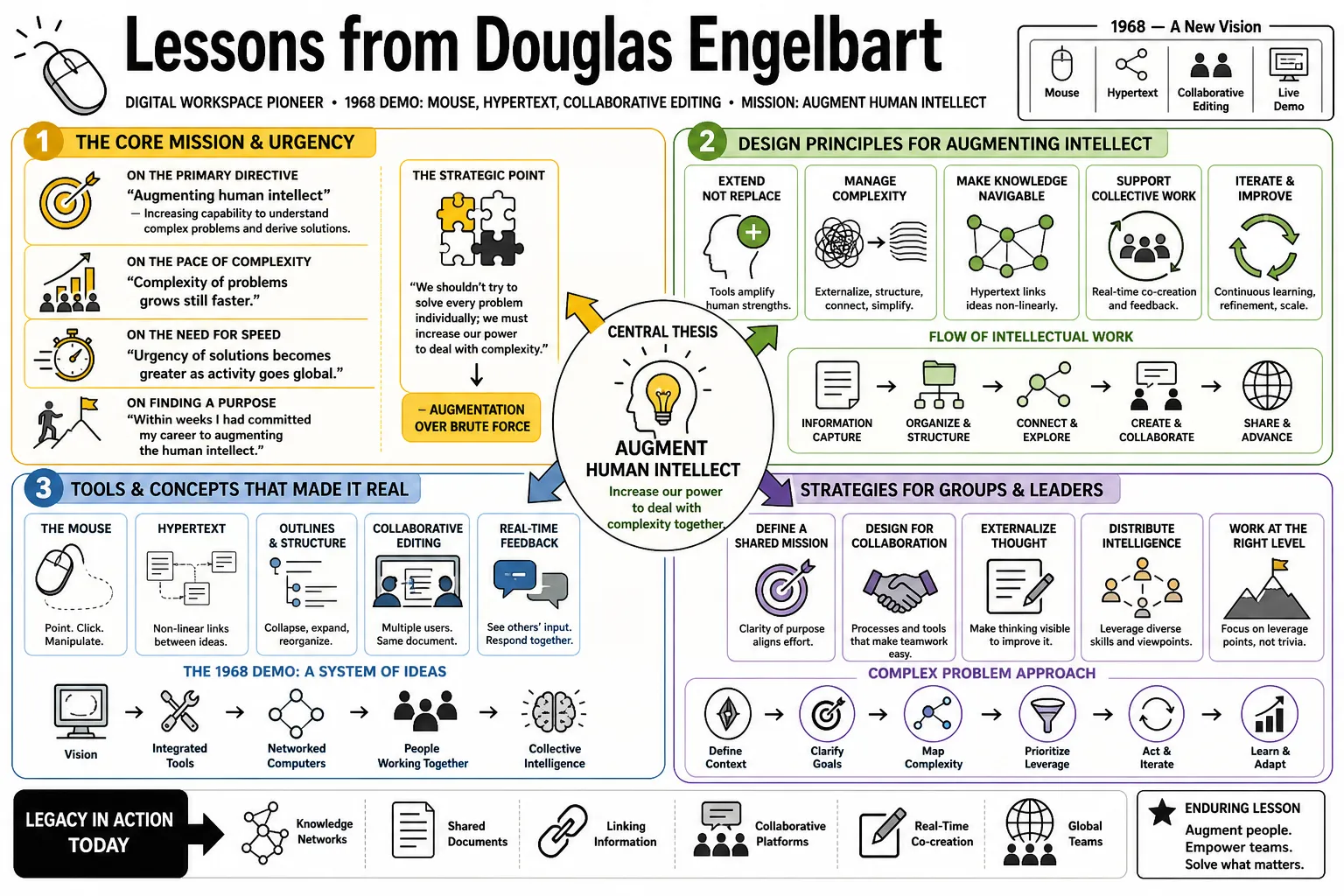
Douglas Engelbart conceptualized the digital workspace, debuting the mouse, hypertext, and collaborative editing in 1968. Beyond these inventions, his underlying focus was finding ways to augment human intellect. This compilation covers his strategies for managing complexity and improving how groups work together.
Part 1: The Core Mission & Urgency
- On the primary directive: "By 'augmenting human intellect' we mean increasing the capability of a man to approach a complex problem situation, to gain comprehension to suit his particular needs, and to derive solutions to problems." — Source: [Augmenting Human Intellect: A Conceptual Framework]
- On the pace of complexity: "Man's population and gross product are increasing at a considerable rate, but the complexity of his problems grows still faster." — Source: [Augmenting Human Intellect: A Conceptual Framework]
- On the need for speed: "The urgency with which solutions must be found becomes steadily greater in response to the increased rate of activity and the increasingly global nature of that activity." — Source: [Augmenting Human Intellect: A Conceptual Framework]
- On finding a career purpose: "Within weeks I had committed my career to 'augmenting the human intellect.'" — Source: [Doug Engelbart Institute]
- On the strategic point: "We shouldn't try to solve every problem individually; we must find the strategic point that, if improved, makes us better at solving all other problems." — Source: [Toward High-Performance Organizations]
- On historical scale: "The digital revolution is far more significant than the invention of writing or even of printing." — Source: [The Unfinished Revolution]
- On intelligence limits: "The intellectual effectiveness exercised today by a given human has little likelihood of being intelligence limited." — Source: [Augmenting Human Intellect: A Conceptual Framework]
- On expectations of progress: "There is no particular reason not to expect gains in personal intellectual effectiveness that compare to those made in personal geographic mobility since horseback and sailboat days." — Source: [Augmenting Human Intellect: A Conceptual Framework]
- On early motivations: "The vision was driven by a realization that the world's problems were scaling exponentially, while human ability to cope was scaling linearly." — Source: [Doug Engelbart Institute]
Part 2: The Meaning of Augmentation
- On defining increased capability: "Increased capability in this respect is taken to mean a mixture of the following: more-rapid comprehension, better comprehension, the possibility of gaining a useful degree of comprehension in a situation that previously was too complex." — Source: [Augmenting Human Intellect: A Conceptual Framework]
- On uncovering the impossible: "Augmentation allows the possibility of finding solutions to problems that before seemed insoluble." — Source: [Augmenting Human Intellect: A Conceptual Framework]
- On automation versus augmentation: "I don't want to build a machine that thinks like a human; I want to build a machine that helps humans think better." — Source: [Smithsonian Interview]
- On the goal of computers: "A computer should act as an interactive vehicle for exploring concepts." — Source: [Doug Engelbart Institute]
- On interactive responsiveness: "If you, in your office, you as an intellectual worker, were supplied with a computer display backed up by a computer that was alive for you all day and is instantly responsive... how much value can you derive from that?" — Source: [1968 Mother of All Demos]
- On being online: "An advantage of being online is that it keeps track of who you are and what you're doing all the time." — Source: [1968 Mother of All Demos]
- On the nature of human thought: "Augmenting intellect means mapping the nonlinear, associative nature of human thought onto an external, manipulable medium." — Source: [Augmenting Human Intellect: A Conceptual Framework]
- On symbol manipulation: "The essence of intellect is the manipulation of symbols; therefore, computers must become interactive symbol-manipulating engines." — Source: [Augmenting Human Intellect: A Conceptual Framework]
- On externalizing memory: "A key function of augmentation is offloading working memory to a visual display, allowing the brain to focus on synthesis rather than retention." — Source: [Augmenting Human Intellect: A Conceptual Framework]
- On the system boundary: "It's the interface between a human and this whole augmentation system, which is so much more than just the technology." — Source: [Smithsonian Interview]
Part 3: The H-LAM/T Framework
- On the whole system: "A human's intellectual effectiveness relies on the H-LAM/T system: Human using Language, Artifacts, Methodology, and Training." — Source: [Augmenting Human Intellect: A Conceptual Framework]
- On artifacts: "Artifacts (technology and tools) are only a fraction of the equation; they are useless without corresponding evolution in the rest of the system." — Source: [Doug Engelbart Institute]
- On language: "Language dictates how we conceptualize the world; to augment intellect, we must develop new languages suited to interacting with computers." — Source: [Augmenting Human Intellect: A Conceptual Framework]
- On methodology: "Methodologies define how we structure our work; changing the tool without changing the method yields only marginal gains." — Source: [Toward High-Performance Organizations]
- On training: "Training is the bridge between human capability and new tools; without rigorous training, the potential of high-performance artifacts is wasted." — Source: [Augmenting Human Intellect: A Conceptual Framework]
- On systemic evolution: "It's all of what I call the human system: the clothes we wear, the facilities we have, the language we employ, the methods, the conventions, the customs." — Source: [Smithsonian Interview]
- On paradigm shifts: "A new tool introduced into an old methodology will simply perform the old methodology slightly faster, failing to fundamentally change the outcome." — Source: [Doug Engelbart Institute]
- On the illusion of quick fixes: "Believing that software alone can solve complex organizational problems ignores the reality of the H-LAM/T interdependencies." — Source: [Toward High-Performance Organizations]
- On conceptual frameworks: "The most significant barriers to augmentation are not technological, but the conceptual frameworks humans use to understand their own work." — Source: [Augmenting Human Intellect: A Conceptual Framework]
Part 4: Bootstrapping & Continuous Improvement
- On the definition of bootstrapping: "Bootstrapping involved the feeding back of positive research results to improve the means by which the researchers themselves can pursue their work." — Source: [Doug Engelbart Institute]
- On the core mechanism: "It wasn't about improving a process. It was about improving the rate of improving a process." — Source: [Doug Engelbart Institute]
- On compounding gains: "The better we get at getting better, the faster we will get better." — Source: [Doug Engelbart Institute]
- On being the test subject: "Researchers must be the first test subjects for their own innovations; if a tool doesn't help the creators work faster, it won't help the world." — Source: [Doug Engelbart Institute]
- On evolutionary strategy: "The best thing we could do would be to find a good evolutionary strategy for the co-evolution that you have to do." — Source: [Stanford Oral History, 1987]
- On the limits of prediction: "There would be no way that we, from our current framework, could guess what was going to be the best way to do it." — Source: [Stanford Oral History, 1987]
- On iterative design: "True innovation requires pushing the frontier by putting prototypes into the hands of high-performance teams." — Source: [Toward High-Performance Organizations]
- On feedback loops: "Bootstrapping creates a positive feedback loop where the outputs of an improvement process immediately become the inputs for the next cycle." — Source: [Bootstrapping Organizations into the 21st Century]
- On Networked Improvement Communities: "A society bootstraps its way to a higher collective intelligence by forming networked communities dedicated to continuous capability improvement." — Source: [Bootstrapping Organizations into the 21st Century]
- On the meta-focus: "The most effective use of a team's time is improving the tools they use to do their daily work." — Source: [Doug Engelbart Institute]
Part 5: The ABC Model of Organizational Work
- On primary work: "A-Activity represents the day-to-day work of an organization, such as writing code, producing goods, or serving customers." — Source: [Toward High-Performance Organizations]
- On first-order improvement: "B-Activity focuses on improving how you do A-Activity, like implementing a new software system or workflow." — Source: [Toward High-Performance Organizations]
- On meta-improvement: "C-Activity is the foundational layer: improving how you improve. It dictates the efficiency of B-Activity." — Source: [Toward High-Performance Organizations]
- On organizational advantage: "Most organizations focus solely on A and occasionally B, but C-Activity provides the greatest long-term advantage." — Source: [Toward High-Performance Organizations]
- On the multiplier effect: "By improving the process of improvement itself, an organization creates a multiplier effect that accelerates everything else." — Source: [Toward High-Performance Organizations]
- On resource allocation: "Organizations chronically underfund C-Activity because its outputs are not immediately visible on a balance sheet." — Source: [Toward High-Performance Organizations]
- On competitive endurance: "In an environment of exponential complexity, the organization with the strongest C-Activity will inevitably outpace its competitors." — Source: [Bootstrapping Organizations into the 21st Century]
- On systemic blindness: "An organization stuck in A-Activity is blind to the structural inefficiencies that will eventually cause its collapse." — Source: [Toward High-Performance Organizations]
- On institutionalizing innovation: "Innovation cannot be left to chance; it must be institutionalized as a core, measurable activity." — Source: [Bootstrapping Organizations into the 21st Century]
Part 6: Collective IQ & Collaboration
- On the definition of Collective IQ: "Collective IQ is a measure of how well people can work together on important challenges, drawing upon their shared perception, memory, and reasoning." — Source: [Doug Engelbart Institute]
- On collaborative necessity: "Almost everything important that has a consequence in the adult world is done by adults working together." — Source: [FastCompany Interview]
- On raising the ceiling: "Wouldn't you want your group to have the highest collective IQ?" — Source: [Elon University Interview]
- On global stakes: "The key thing about all the world's big problems is that they have to be dealt with collectively. If we don't get collectively smarter, we're doomed." — Source: [Doug Engelbart Institute]
- On fixed versus scalable intelligence: "While individual IQ is relatively fixed by biology, a group's Collective IQ can be dramatically boosted through better tools and social processes." — Source: [Bootstrapping Organizations into the 21st Century]
- On the dialogue deficit: "I would really welcome a direct dialogue on what is collective IQ and what is augmentation... It is trudging along, and what I miss is a chance for direct dialogue." — Source: [Dataquest Interview, 2008]
- On societal imperatives: "I believe that it is extremely important for human society to boost its collective IQ and look collectively at the problems and issues we face." — Source: [Dataquest Interview, 2008]
- On shared memory: "A high Collective IQ requires a dynamic, shared memory where the group's knowledge is constantly accessible and updatable by all members." — Source: [Augmenting Human Intellect: A Conceptual Framework]
- On real-time collaboration: "True collaboration involves co-navigating information and co-creating solutions in real time, rather than simply exchanging finished documents." — Source: [1968 Mother of All Demos]
- On digital potential: "It offers the potential for a quantum leap in our collective IQ." — Source: [The Unfinished Revolution]
Part 7: Tool Co-Evolution & The Mother of All Demos
- On public debut: "I hope you go along with this rather unusual setting, the fact that I remain seated when I get introduced and the fact that I am going to come to you mostly through this medium here." — Source: [1968 Mother of All Demos]
- On naming conventions: "I don't know why we call it a mouse. Sometimes I apologize. It started that way and we never did change it." — Source: [1968 Mother of All Demos]
- On relying on the team: "I should tell you that I am backed up by quite a staff of people between here and Menlo Park... If everyone just does their job well, it should go very interesting, I think." — Source: [1968 Mother of All Demos]
- On the dance of co-evolution: "Tools and human practices must evolve together in a continuous dance; one cannot advance significantly without the other." — Source: [Doug Engelbart Institute]
- On system integration: "The power of the oNLine System (NLS) came from integrating the mouse and hypertext into a single, cohesive environment for thought." — Source: [1968 Mother of All Demos]
- On dynamic linking: "Hypertext was originally conceived as a method for object addressing and dynamic thought structuring." — Source: [1968 Mother of All Demos]
- On visual workspaces: "The windowing interface was designed to mimic the way a physical desk allows for multiple contexts to be visible and manipulable simultaneously." — Source: [1968 Mother of All Demos]
- On distance collaboration: "Video conferencing combined with shared digital workspaces demonstrated that geographical distance did not have to limit intellectual collaboration." — Source: [1968 Mother of All Demos]
- On the excitement of the vision: "Just the whole concept of helping people work and think that way just excited me... In that conceptual framework, I thought of the augmentation system." — Source: [Stanford Oral History, 1987]
Part 8: Difficulty, Expertise, and Learning Cliffs
- On the trap of user-friendliness: "Constraining tools to be immediately user-friendly severely limits the ultimate power and throughput those tools can provide." — Source: [Doug Engelbart Institute]
- On the musical instrument analogy: "A computer should be thought of like a musical instrument or a bicycle; it requires practice, but the resulting capability is worth the learning curve." — Source: [Doug Engelbart Institute]
- On high-performance interfaces: "We shouldn't dumb down a violin to make it easier for a beginner, nor should we sacrifice the power of computing interfaces for mere ease of use." — Source: [Doug Engelbart Institute]
- On the learning cliff: "Some of the most powerful capabilities require a learning cliff, demanding significant upfront investment in training to achieve mastery." — Source: [Doug Engelbart Institute]
- On expert-oriented systems: "Designing systems specifically for experts allows for far greater intellectual throughput than designing for the lowest common denominator." — Source: [Augmenting Human Intellect: A Conceptual Framework]
- On the chorded keyboard: "The use of a chorded keyboard alongside a mouse was intended to allow highly trained users to input commands at the speed of thought, bypassing menus." — Source: [1968 Mother of All Demos]
- On limiting human potential: "Insisting that software must be immediately intuitive underestimates human adaptability and our capacity to master complex tools." — Source: [Doug Engelbart Institute]
- On the cost of simplicity: "Simplification often comes at the cost of expression; a constrained vocabulary limits the complexity of the thoughts that can be articulated." — Source: [Augmenting Human Intellect: A Conceptual Framework]
- On the reward of effort: "The friction of learning a difficult system is a temporary barrier to a permanent expansion of cognitive capability." — Source: [Augmenting Human Intellect: A Conceptual Framework]