Douglas Murray is a British journalist and author of The Strange Death of Europe, The Madness of Crowds and The War on the West. His work addresses immigration, identity politics and Western cultural confidence. This profile reviews arguments from his published work and interviews; the claims below remain his views unless independently established. — Bloomsbury — Douglas Murray Author Biography.
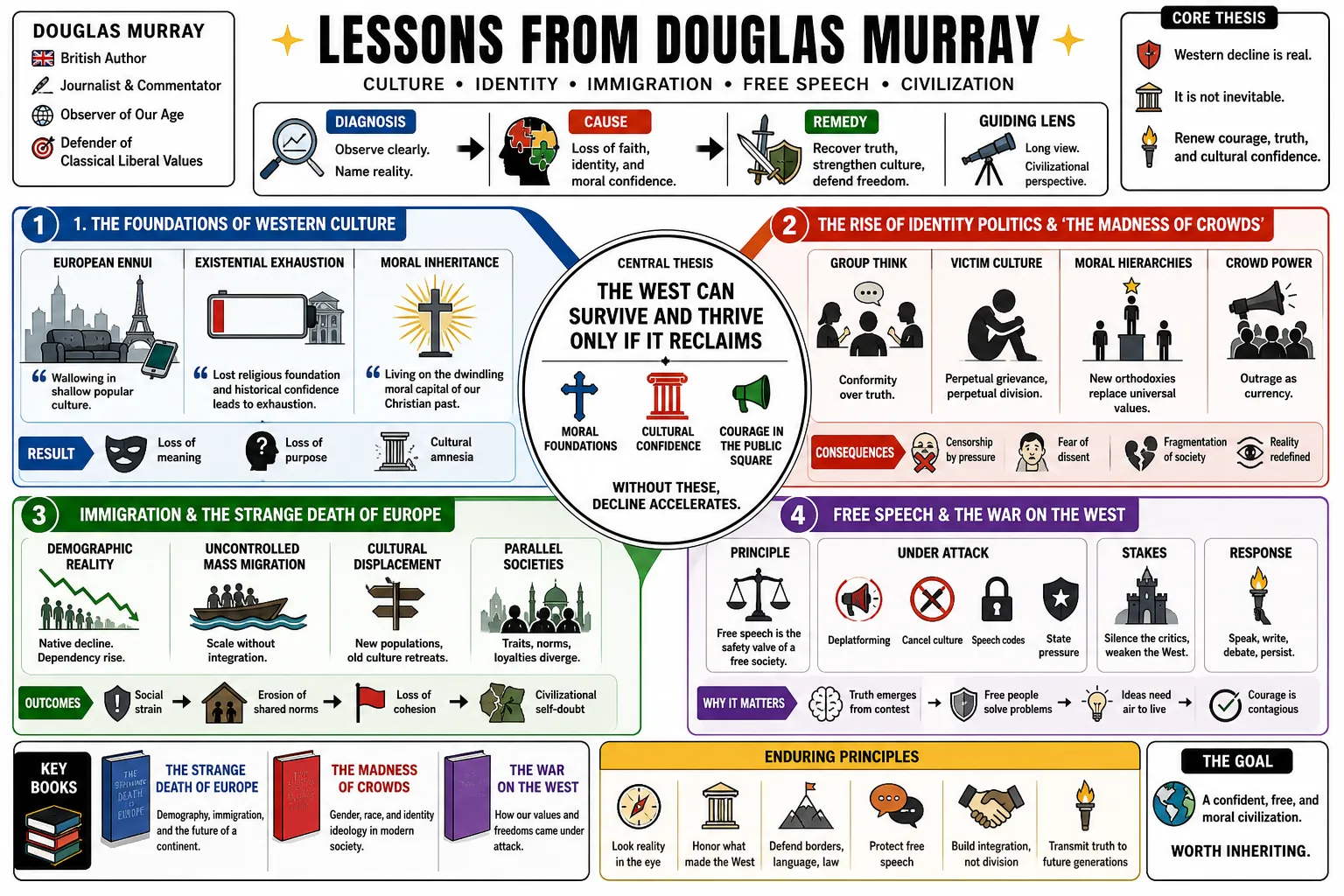
Part 1: The Foundations of Western Culture
- Look Beyond Consumer Identity: Murray argues that people need more than the identity of consumers and that worthwhile lives require a deeper sense of meaning. — John Anderson — Douglas Murray Conversation.
- Civilizational Exhaustion: Murray argues that Europe’s large-scale immigration has coincided with a loss of confidence in its own traditions and legitimacy; this is his interpretation, not a settled demographic law. — Bloomsbury — The Strange Death of Europe Preview.
- Question the Moral Inheritance: Murray asks whether habits such as charity, magnanimity and forgiveness can endure when people no longer accept the religious claims that helped teach them. — John Anderson — Douglas Murray Conversation.
- Retain a Fuller View of Western History: Murray argues that Western history should not be presented solely as a catalogue of oppression and wrongdoing, while acknowledging the need to examine past faults. — The Spectator — Fractured: Can the West Fix Itself?.
- Preserve Fragile Works of Art: Murray uses attacks on paintings and an account of rescuing works from fire to argue that inherited art is fragile and worth protecting. — The Spectator — Are You a Creative or a Destructive?.
- Teach History with More Than One Lens: Murray criticizes accounts of national history framed only through slavery, racism and colonialism, saying they leave out other parts of that history. — The Spectator — Fractured: Can the West Fix Itself?.
- Seek Meaning Beyond Political Identity: Murray argues that political hierarchies of grievance do not answer deeper questions of purpose, and urges people to pursue demanding lives they find meaningful. — John Anderson — Douglas Murray Conversation.
- Value the Tradition of Free Inquiry: Murray describes free thought, expression and room for dissent as an inherited tradition worth defending. — The Spectator — Murray–Scruton Conversation.
Part 2: Immigration and Demographics
- Scale Matters to Integration: Murray treats the scale and speed of immigration as central to the integration debate rather than assuming that experience with an individual newcomer settles the policy question. — Bloomsbury — The Strange Death of Europe Preview.
- Debate Who Enters and in What Numbers: Murray argues that a workable immigration policy needs a candid public discussion of who should be admitted and in what numbers. — The Spectator — To Make Asylum Work, We’ll Have to Talk Frankly.
- A Distinct Argument About Demographic Change: Murray contends that large demographic shifts can change a country’s inherited culture and institutions; his published excerpt presents this as part of his thesis about Europe. — Bloomsbury — The Strange Death of Europe Preview.
- Ask What Holds a Country Together: Murray argues that high immigration has coincided in Britain with a weakening sense of shared national values and social coherence; this is his assessment, not proof that immigrants reject the host culture. — The Spectator — The Cost of Mass Migration.
- Separate Asylum from Economic Migration: Murray argues that conflating genuine asylum claims with broader economic migration can erode public support for people seeking refuge, while acknowledging that a country cannot accept every potential claimant. — The Spectator — To Make Asylum Work, We’ll Have to Talk Frankly.
- Apply Human-Rights Standards Consistently: Murray argues that advocacy for gay rights should also address countries where same-sex conduct is criminalized, even when doing so requires criticizing another society’s laws. — John Anderson — Douglas Murray Conversation.
- Test Tolerance Against Liberal Rights: Murray asks whether a tolerant society can preserve liberal rights when it admits people who hold illiberal views; he presents this as a concern about social change, not a finding about every immigrant. — Evening Standard — Douglas Murray on Immigration, Islam and Identity.
- Consider Unequal Exposure to Change: Murray argues that wealth can allow people to live in more insulated communities while others experience social change more directly. — The Spectator — The Cost of Mass Migration.
- Test Labor-Market Arguments for Migration: Murray questions the claim that large-scale immigration is needed to fill jobs that local workers will not take, and asks policymakers to examine its effects on the domestic workforce. — The Spectator — The Cost of Mass Migration.
Part 3: Identity Politics and Intersectionality
- Question Assumed Coalition Unity: Murray argues that people grouped under LGBT politics can have different views and interests, so a coalition label should not be mistaken for unanimity. — John Anderson — Douglas Murray Conversation.
- Recognize Public-Shaming Tripwires: Murray describes a cultural landscape in which a person can unexpectedly trigger a public backlash by stepping on a contested issue. — Bloomsbury — The Madness of Crowds Preview.
- Treat People as Individuals: Murray objects to reducing people to presumed interest groups defined by sexuality, sex or race, and asks what is lost when individual identity is subordinated to such groupings. — John Anderson — Douglas Murray Conversation.
- Examine Vulnerability Hierarchies: Murray criticizes systems that rank people by intersecting identity and vulnerability claims, arguing that such rankings can become unworkable. — Bloomsbury — The Madness of Crowds Preview.
- Question Self-Sealing Accusations: Murray criticizes arguments in which an objection to an accusation of racism is itself treated as further proof of racism, leaving little room to test the claim. — The Spectator — What a Leaked NHS Memo Tells Us About White Fragility.
- Question Rigid Identity Categories: Murray argues that some political coalitions treat diverse people as if they formed coherent blocs, overlooking differences within those groups. — John Anderson — Douglas Murray Conversation.
- Identity Politics as a Substitute Worldview: Murray describes some social-justice politics as a new metaphysics that seeks to supply meaning after older shared beliefs have weakened. — John Anderson — Douglas Murray Conversation.
- Do Not Reduce Character to Identity: Murray criticizes approaches that treat sex, race or sexuality as a person’s most important attribute and argues for more attention to individuals. — Bloomsbury — The Madness of Crowds Preview.
- Question Promises of Perfect Equality: Murray questions promises of complete equality for everyone, arguing that such a utopian endpoint is unattainable and would not by itself answer questions of meaning. — John Anderson — Douglas Murray Conversation.
Part 4: Historical Guilt and Revisionism
- Examine Historical Guilt Without Erasing Complexity: Murray argues that Western societies can become so focused on historical wrongs that they lose the ability to describe their history in fuller terms. — The Spectator — Fractured: Can the West Fix Itself?.
- Choose Creation Over Destruction: Murray argues that public life should reward people who create and preserve valuable things rather than celebrate symbolic destruction. — The Spectator — Are You a Creative or a Destructive?.
- Reassess Anti-Western Revisionism: Murray calls for a reassessment of what he describes as anti-Western revisionism, arguing that criticism of Western history should also be applied consistently elsewhere. — The War on the West — Publisher Preview.
- Avoid Anachronistic Historical Judgments: Murray criticizes assessing historical figures only by whether they held present-day views, while acknowledging that people in earlier periods also made errors. — The Spectator — Fractured: Can the West Fix Itself?.
- Debate Monuments in Historical Context: Murray uses attacks on Churchill’s statue as an example of what he sees as an overly reductive approach to public history. — The Spectator — Fractured: Can the West Fix Itself?.
- Reject Collective Racial Blame: Murray objects to treating all white people as inherently racist and urges readers to examine such blanket claims rather than accept them as a premise. — The Spectator — What a Leaked NHS Memo Tells Us About White Fragility.
- Do Not Reduce Inherited Culture to Its Faults: Murray warns against treating Western cultural inheritance as though it contains nothing worth preserving. — The Spectator — Fractured: Can the West Fix Itself?.
Part 5: Free Speech and Discourse
- Protect Room for Free Expression: Murray describes the ability to express dissenting or heretical ideas as part of a valuable inherited tradition. — The Spectator — Murray–Scruton Conversation.
- Do Not Let Offense Close Inquiry: Murray says politeness matters, but argues that an objection based solely on offense should not automatically take a difficult subject out of public inquiry. — John Anderson — Douglas Murray Conversation.
- Speak What You Believe to Be True: Murray advises saying something one believes true even when it may be unpopular, arguing that sustained self-censorship can become demoralizing. — John Anderson — Douglas Murray Conversation.
- Protect Discussion of Verifiable Facts: Murray argues that fear of reputational or career punishment can stop people from raising verifiable but contentious matters in public debate. — Young IPA — Douglas Murray Full Interview.
- Recognize Pressure to Self-Censor: Murray argues that people can avoid saying what they believe because they fear social repercussions, and that sustaining such silence can be demoralizing. — John Anderson — Douglas Murray Conversation.
- Value Careful Investigative Reporting: Murray praises Andrew Norfolk’s careful, factual reporting on abuse in Rotherham as an example of journalism that should confront difficult evidence even amid criticism. — The Spectator — The Death of Public Discourse.
- Resist Sustained Falsehoods: Murray advises people not to maintain statements they themselves believe false merely to avoid controversy. — John Anderson — Douglas Murray Conversation.
- Leave Room for Disagreement: Murray argues that people should be able to act on differing views without requiring everyone else to share or endorse those views. — John Anderson — Douglas Murray Conversation.
Part 6: The Madness of Crowds and Culture
- Beware Herd-Like Thinking: Murray warns that group identity and online dynamics can encourage people to think and act in a herd-like way. — John Anderson — Douglas Murray Conversation.
- Allow Deliberation During Fast Social Change: Murray argues that rapid changes in public norms deserve careful discussion rather than instant certainty or compulsory agreement. — Bloomsbury — The Madness of Crowds Preview.
- Examine Class-to-Identity Analogies: Murray argues that some contemporary identity politics replaces a Marxist focus on class with group categories organized around minority status. — John Anderson — Douglas Murray Conversation.
- Online Permanence Raises the Stakes: Murray argues that social media can make a youthful mistake persist publicly, increasing the cost of ordinary errors and the need for forgiveness. — John Anderson — Douglas Murray Conversation.
- Make Room for Forgiveness: Murray argues that public shaming and durable online records make forgiveness more important, particularly for younger people who cannot easily leave mistakes behind. — John Anderson — Douglas Murray Conversation.
- Recognize Tensions Between Rights Claims: Murray says that some women’s-rights and transgender-rights claims can conflict and argues for acknowledging those tensions openly. — John Anderson — Douglas Murray Conversation.
- Keep Shared Word Meanings in Debate: Murray says public argument becomes difficult when speakers cannot rely on shared meanings of words or when critics substitute guessed motives for what was said. — Young IPA — Douglas Murray Full Interview.
- Challenge Avoidance of Difficult Subjects: Murray argues that adults should not treat the possibility of offense as a sufficient reason to avoid investigating difficult questions. — John Anderson — Douglas Murray Conversation.
Part 7: Geopolitics and the Language of Evil
- Distinguish Actual Extremists from Inflated Labels: Murray argues that British public debate can overstate the size of organized far-right movements and treat anticipated demonstrations as though they had happened. — The Spectator — Don’t Fear the Bogeyman.
- Distinguish Criticism from Rejection of Jewish Statehood: Murray argues that opposing the existence of a Jewish state, rather than criticizing particular Israeli policies, can express antisemitism. This is his position in the anti-Zionism debate, not a claim that every critic of Israel is antisemitic. — The Hub — Douglas Murray Interview.
- Take Allies’ Security Concerns Seriously: Murray argues that Western governments should not dismiss Israel’s security concerns about Iran and should consider what support for an ally means when it perceives an existential threat. — The Spectator — What Else Could Israel Do?.
- Recognize Asymmetric Conduct in War: Murray argues that Hamas exploits civilian protection norms by operating among civilians while Israel faces obligations under the laws of war; this is his characterization of the conflict, not a general claim about all democracies and all enemies. — Douglas Murray — Hamas and the Laws of War.
- Apply Terrorism Explanations Consistently: Murray criticizes invoking Western foreign policy as a “root cause” of Islamist terrorism while declining comparable scrutiny of other attacks; he urges a consistent standard for explanation and group blame. — The Spectator — Breivik and the Right.
- Name Anti-Jewish Violence Clearly: Murray urges audiences to recognize anti-Jewish violence for what it is and to stand with Jewish communities facing threats. — The Spectator — You Are Not Alone.
- Do Not Romanticize Putin as an Anti-Woke Corrective: Murray warns that frustration with Western cultural politics does not justify treating Putin’s Russia as a model or overlooking its strategic threat. — The Spectator — Fight for the Right.
Part 8: The Fragility of Civilization and Courage
- Pay Attention to Inherited Culture: Murray asks why people travel to admire distant temples while overlooking cultural landmarks, such as European cathedrals, close to home. — The Spectator — Murray–Scruton Conversation.
- Defend What Is Worth Preserving: Murray argues that a society should be able to acknowledge historical faults without losing the ability to defend valued parts of its cultural inheritance. — The Spectator — Fractured: Can the West Fix Itself?.
- Do Not Make Truth-Telling Exceptional: Murray says he would find it troubling if merely stating what one believes true had to be treated as an act of courage. — John Anderson — Douglas Murray Conversation.
- Pursue Workable Sources of Meaning: Murray argues that meaningful lives remain possible through work and commitment, rather than endless ranking of oneself within political hierarchies. — John Anderson — Douglas Murray Conversation.
- Reject the Idea That Meaning Is Impossible: Murray says modern life can still contain deep meaning, although finding it requires effort and commitment. — John Anderson — Douglas Murray Conversation.
- Treat Europe’s Future as Open: Murray presents Europe’s cultural future as uncertain and asks whether its societies will renew their traditions or continue losing confidence in them. — The Suicide of Europe — Douglas Murray Transcript.