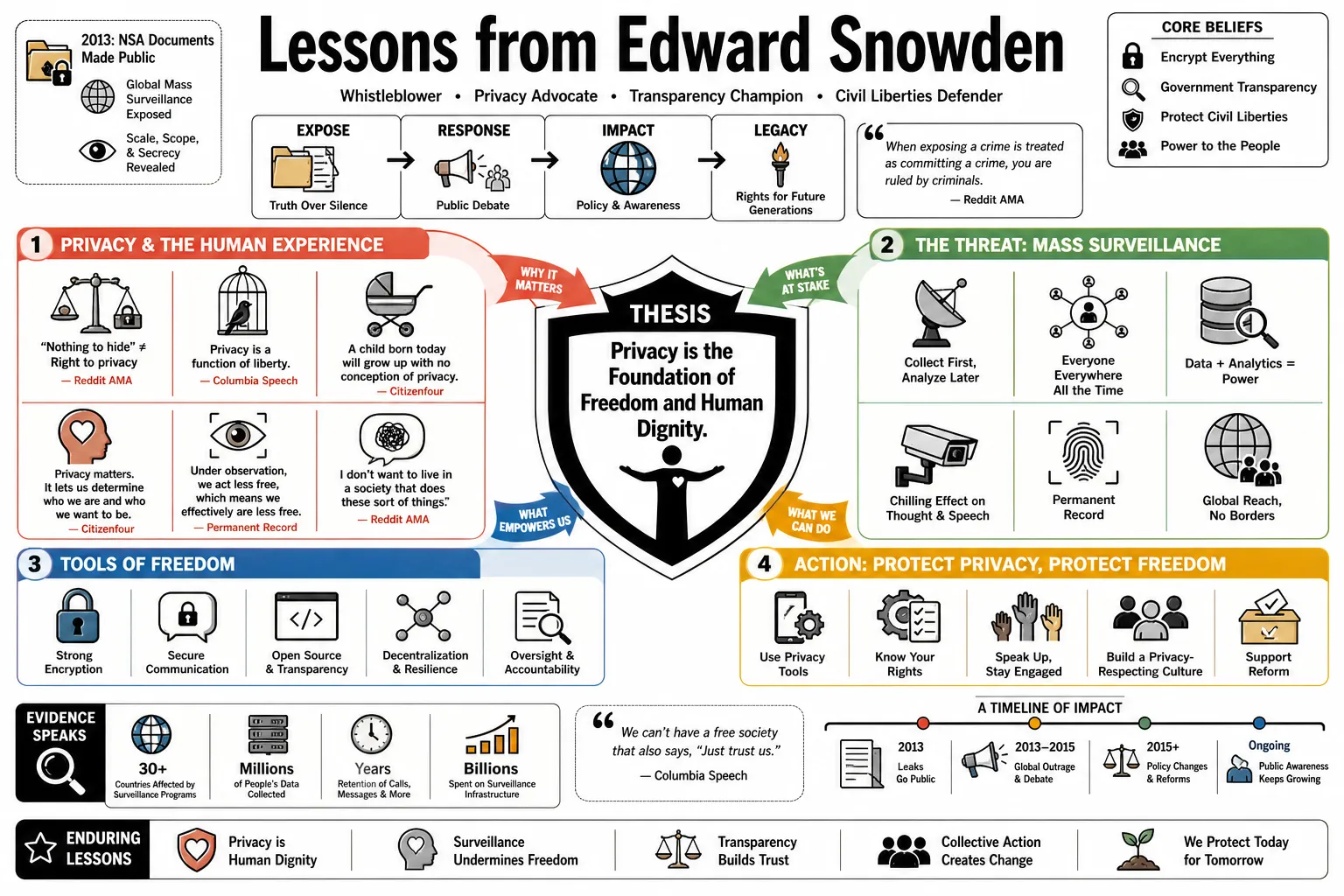
Lessons from Edward Snowden
Edward Snowden is an American whistleblower and former intelligence contractor who leaked classified NSA documents in 2013, exposing the scale of global mass surveillance. He now advocates for encryption, government transparency, and civil liberties.
Part 1: Privacy and the Human Experience
- On the "nothing to hide" argument: "Arguing that you don't care about the right to privacy because you have nothing to hide is no different than saying you don't care about free speech because you have nothing to say." — Source: Reddit AMA
- On the nature of privacy: "Privacy is a function of liberty." — Source: Columbia University Speech
- On future generations: "A child born today will grow up with no conception of privacy at all. They'll never know what it means to have a private moment to themselves—an unrecorded, unanalyzed thought." — Source: Citizenfour
- On self-determination: "Privacy matters, privacy is what allows us to determine who we are and who we want to be." — Source: Citizenfour
- On observation and freedom: "Under observation, we act less free, which means we effectively are less free." — Source: Permanent Record
- On human expression: "I don't want to live in a world where everything that I say, everything I do, everyone I talk to, every expression of creativity or love or friendship is recorded." — Source: The Guardian
- On privacy as a prerequisite: "Privacy is a precondition of free speech, free inquiry, association and dissent." — Source: Columbia University Speech
- On defining liberty: "The freedom of a country can only be measured by its respect for the rights of its citizens, and it's my conviction that these rights are in fact limitations of state power." — Source: Permanent Record
- On the right to be left alone: The domain of personal or individual freedoms that was called "liberty" during the American Revolution is now known as "privacy" during the Internet Revolution. — Source: Permanent Record
- On protecting rights: "Your rights matter because you never know when you're going to need them." — Source: TED 2014
Part 2: Mass Surveillance and State Power
- On turnkey tyranny: "We were constructing a system of turnkey tyranny... you never know whose hand is going to be on that Kleenex and only have to do is turn it." — Source: The Joe Rogan Experience
- On dragnet surveillance: "Some intelligence services operate unaccountable and occasionally criminal dragnet surveillance programs... Such programs are not a threat to privacy, but to free expression and open societies." — Source: ACLU Speech
- On the security state: "The definition of a security state is one that prioritizes security over all other considerations." — Source: SXSW 2014
- On the scope of monitoring: "Every time you pick up the phone, dial a number, write an e-mail... you leave a trace, and the Government has decided that it's a good idea to collect it all, everything, even if you've never been suspected of doing a crime." — Source: The Guardian
- On legal boundaries: "Sometimes the scandal is not what law was broken, but what the law allows." — Source: Permanent Record
- On systemic reach: "There are literally no ingress or egress points anywhere in the continental United States where a communication can enter or exit without being monitored and collected and analyzed." — Source: The Guardian
- On domestic impact: "The NSA doesn't limit itself to foreign intelligence. It collects all communications that transit the United States." — Source: The Guardian
- On the illusion of protection: "The greatest danger to national security has become the companies that claim to protect it." — Source: Continuing Ed Substack
- On shifting power: Power in society is shifting away from civil institutions and the press, and toward governments that grant themselves secret authorities without public consent. — Source: SXSW 2014
- On global consciousness: "We were actually involved in misleading the public and in misleading all the publics... in order to create a certain mindset in the global consciousness." — Source: Citizenfour
Part 3: Technology and Dependency
- On technological ignorance: "To refuse to inform yourself about the basic operation and maintenance of the equipment you depended on was to passively accept that tyranny and agree to its terms." — Source: Permanent Record
- On being possessed by possessions: "When your equipment works, you'll work, but when your equipment breaks down you'll break down, too. Your possessions would possess you." — Source: Permanent Record
- On perfect memory: The agency's ultimate dream is "permanency – to store all of the files it has ever collected or produced for perpetuity, and so create a perfect memory. The permanent record." — Source: Permanent Record
- On future administrations: At any point, a future rogue head of intelligence could flick a switch and instantly track everyone with a device, knowing their past and present. — Source: Permanent Record
- On the early internet: "I remember what the Internet was like before it was being watched, and there's never been anything in the history of man that's like it." — Source: EFF Interview
- On borderless connection: The early internet allowed children and experts from around the world to have equal discussions on any topic, at any time, in a space that was free and unrestrained. — Source: EFF Interview
- On the smartphone era: A globe-spanning apparatus of omnipresent surveillance is now riding in every person's pocket. — Source: Continuing Ed Substack
- On technological protection: "Technology is not the only thing that can protect you. We are the only thing that can protect us." — Source: Web Summit 2019
- On self-censorship: The most pervasive form of censorship is often hidden from the public because it happens at the level of the individual who self-censors out of fear of observation. — Source: Continuing Ed Substack
Part 4: Encryption and Digital Defense
- On the necessity of encryption: "Encryption is defense against the Dark Arts." — Source: SXSW 2014
- On systemic defenses: To prevent the government appropriation of private information, the internet community must fundamentally change how data is stored and relayed. — Source: SXSW 2014
- On trust in communications: "We rely on the ability to trust our communications," which requires robust, unbroken cryptographic protocols. — Source: SXSW 2014
- On backdoor access: Allowing authorities exceptional access to encrypted systems creates a vulnerability that any bad actor can exploit; it is a cliff, not a slippery slope. — Source: Continuing Ed Substack
- On the arms race: Citizens and journalists should not have to be in a constant technological arms race with the most powerful intelligence agencies just to communicate securely. — Source: ACLU Speech
- On collective security: "The only way to protect anyone is to protect everyone," which implies universal adoption of strong encryption. — Source: Web Summit 2019
- On policy vs. technology: While security measures can protect us when necessary, good policy should ensure that extreme technological defenses aren't required for daily life. — Source: ACLU Speech
- On device scanning: If corporations demonstrate the willingness to remotely search devices for specific content, they will inevitably be forced to do so by the worst governments in the world. — Source: Continuing Ed Substack
- On protecting the press: Strong encryption is the only reliable way to guarantee the safety of journalistic sources in an era of digital dragnet surveillance. — Source: Citizenfour
Part 5: Truth, Whistleblowing, and Morality
- On deciding to act: "The reason you're reading this book is that I did a dangerous thing for a man in my position: I decided to tell the truth." — Source: Permanent Record
- On patriotism: "America is a fundamentally good country… But the structures of powers that exist are working to their own ends to extend their capabilities at the expense of the public." — Source: The Guardian
- On defending the Constitution: "I took an oath to support and defend the Constitution, and I saw that the Constitution was violated on a massive scale." — Source: SXSW 2014
- On the nature of heroism: "There are no heroes, right? There's only heroic decisions. You are never further than one decision away from making a difference." — Source: The Joe Rogan Experience
- On telling the truth: "There are times when the only thing you can do is tell the truth and that should not be a crime." — Source: The Joe Rogan Experience
- On hiding: "I have no intention of hiding who I am because I know I have done nothing wrong." — Source: The Guardian
- On anticipated smear campaigns: He expected the government to claim he committed grave crimes and aided enemies, noting that this argument is weaponized against anyone who exposes mass surveillance. — Source: The Guardian
- On lack of consequences: "There is no criminal liability for all the bastards at the head of the FBI, the head of the NSA, who were violating American's rights for decades." — Source: The Joe Rogan Experience
- On having no regrets: "And when it comes to would I do this again, the answer is absolutely yes." — Source: SXSW 2014
Part 6: Democracy and Public Consent
- On systemic accountability: "The key factor is accountability. We can't have officials... who can lie to everyone in the country, who can lie to the Congress, and not even face criticism." — Source: SXSW 2014
- On public participation: "I became haunted by the awareness that we the public – the public not just of one country but of all the world – had never been granted a vote or even a chance to voice our opinion in this process." — Source: Permanent Record
- On closed doors: "The last year has been a reminder that democracy may die behind closed doors, but we as individuals are born behind those same closed doors." — Source: TED 2014
- On unaccountable institutions: "What do you do when the most powerful institutions in society have become the least accountable to society? I think that's the question that our existing generation has to answer." — Source: Web Summit 2019
- On false trade-offs: "We don't have to give up privacy to have good government; we don't have to give up liberty to have security." — Source: TED 2014
- On elite control: "To believe in any conspiracy, whether true or false, is to believe in a system or sector run not by popular consent but by an elite, acting in its own self-interest." — Source: Continuing Ed Substack
- On institutional deceit: Intelligence communities often rely on deceiving the public under the guise of noble intentions to protect national interests overseas. — Source: The Guardian
- On avoiding reality: People frequently embrace elaborate conspiracy theories to avoid acknowledging the daunting, observable reality of institutional conspiracy practices. — Source: Continuing Ed Substack
- On informed citizenry: True democracy requires an informed public; denying citizens the facts about what their government is doing denies them the ability to self-govern. — Source: Citizenfour
Part 7: Corporate Complicity and Data Exploitation
- On corporate-government partnerships: "PRISM is a demonstration of how the U.S. government co-opts U.S. corporate power to its own ends." — Source: The Guardian
- On direct access: Tech giants routinely provide intelligence agencies with direct access to the backends of the systems the global public relies on to communicate. — Source: The Guardian
- On the nature of data: "Data isn't harmless. Data isn't abstract when it's about people... It is not data that is being exploited. It is people that are being exploited." — Source: Web Summit 2019
- On legalizing abuse: "Whether we're talking about Facebook or the NSA, that is the real problem — we have legalized the abuse of the person through the personal." — Source: Web Summit 2019
- On data stockpiling: The emissions of our daily digital lives—network data from smart devices—are relentlessly stockpiled by corporations to map human behavior. — Source: Web Summit 2019
- On commercial surveillance: The modern internet relies on a business model where surveillance is no longer a labor-intensive state activity, but a highly profitable commercial enterprise. — Source: Web Summit 2019
- On the illusion of free services: The cost of free digital services is often paid through the permanent collection and monetization of a user's most intimate communications. — Source: Permanent Record
- On centralized platforms: Consolidating global communication onto a few centralized corporate platforms inherently creates vulnerabilities that states will exploit for surveillance. — Source: TED 2014
- On the convergence of state and corporate power: The line between state surveillance and corporate data mining has blurred to the point where they operate as a single, interdependent apparatus. — Source: Web Summit 2019
Part 8: The Future: AI, Internet Freedom, and Action
- On automated surveillance: Artificial intelligence transforms surveillance by allowing systems to identify individuals through voice, face, and movement patterns without human intervention. — Source: Continuing Ed Substack
- On AI governance: The appointment of former intelligence directors to the boards of leading AI companies represents a "willful, calculated betrayal of the rights of every person on earth." — Source: Twitter
- On the danger of AI training data: The core threat of AI is its reliance on the unprecedented historical accumulation of our intercepted personal data. — Source: Web Summit 2019
- On the scale of individual impact: "It doesn't matter if it's a big difference, doesn't matter if it's a small difference because you don't have to save the world by yourself. And, in fact, you can't." — Source: The Joe Rogan Experience
- On maintaining perspective: His debut on Twitter ("Can you hear me now?") demonstrated that confronting vast state power can still involve humor and defiance. — Source: Twitter
- On the fragility of nations: Reflecting on global events, he warned that the sudden collapse of national stability seen abroad could eventually happen in his own country. — Source: Continuing Ed Substack
- On fighting unwinnable battles: "We're always going to lose more fights than we win. Maybe we win enough to stay free, but we don't want to survive, we want to thrive." — Source: ACLU Speech
- On decentralized futures: Reclaiming the internet requires abandoning centralized services in favor of decentralized networks that are fundamentally immune to dragnet collection. — Source: SXSW 2014
- On resisting normalized tracking: Society must refuse to accept constant tracking as the default state of the digital world; it is a design choice, not a technological inevitability. — Source: Permanent Record
- On a warning for the public: Regarding the integration of surveillance state veterans into the artificial intelligence industry, he offered a stark summary: "You've been warned." — Source: Twitter