Edwin Land co-founded Polaroid, invented instant photography, and developed theoretical models for how the human brain perceives color. He built a business that treated product design as an extension of pure science, directly inspiring the modern technology industry's focus on user-centered hardware. This compilation gathers his perspectives on applied physics, the necessity of failure, and the mechanics of building impossible things.
Part 1: The Intersection of Science and Art
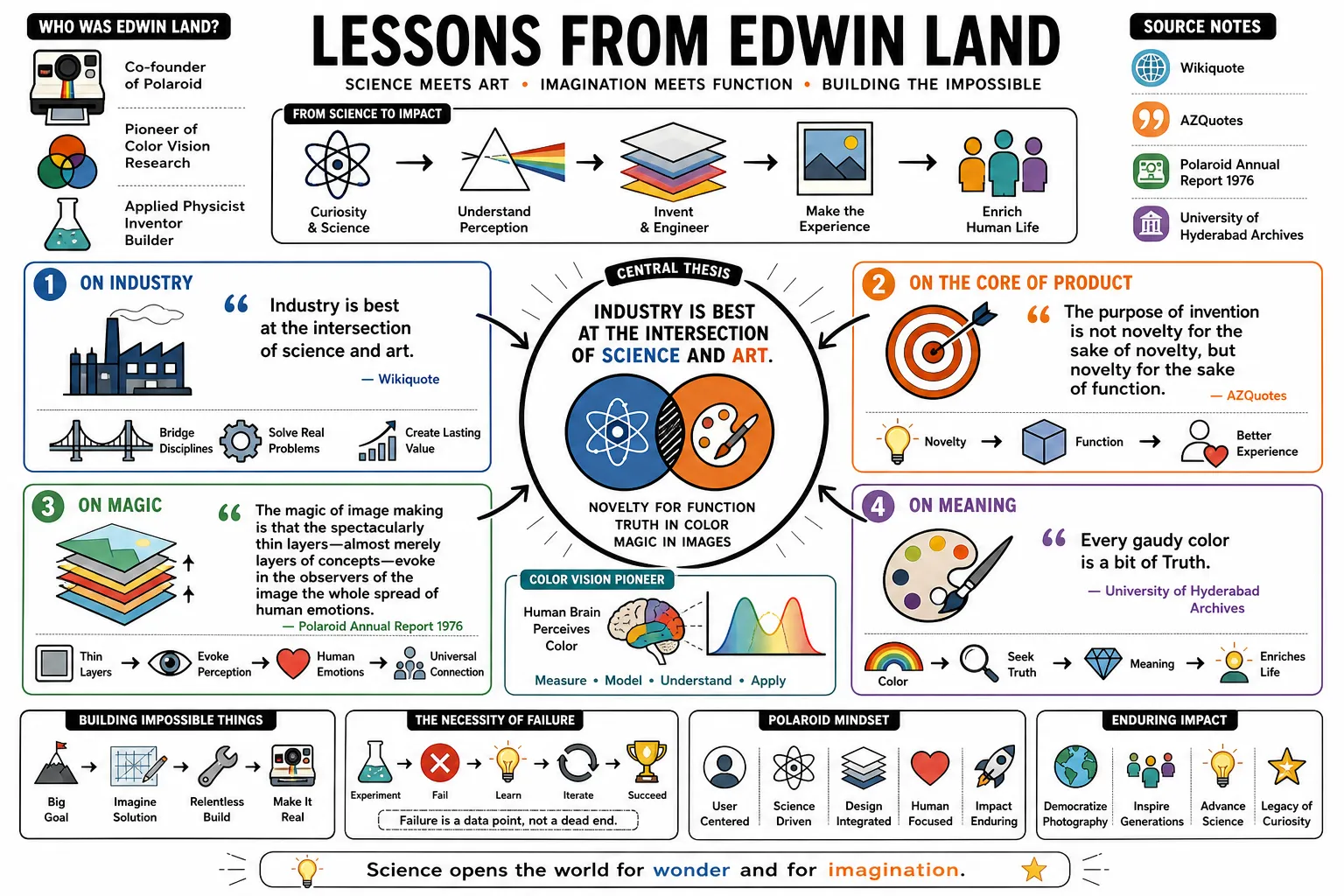
- On Industry: "Industry is best at the intersection of science and art." — Source: Wikiquote
- On the Core of Product: "The purpose of invention is not novelty for the sake of novelty, but novelty for the sake of function." — Source: AZQuotes
- On Magic: "The magic of image making is that the spectacularly thin layers—almost merely layers of concepts—evoke in the observers of the image the whole spread of human emotions." — Source: Polaroid Annual Report 1976
- On Meaning: "Every gaudy color is a bit of Truth." — Source: University of Hyderabad Archives
- On the Beauty of Science: "It has been said that science demystifies the world. It is closer to the truth to say that science, when at its best, opens the world for us, bringing daily realities under a kind of magic spell." — Source: Wikiquote
- On the Unity of Disciplines: Great artists and great engineers share a nearly identical desire for self-expression through the physical creation of their work. — Source: Insisting on the Impossible
- On Fulfilling Needs: Technology should not just be functionally adequate; it must fulfill deep, often unarticulated human needs and provide a sense of delight. — Source: Harvard Business School Collections
- On Aesthetic Perfectionism: Design is never a finish applied at the end of manufacturing, but the core expression of the product's underlying utility. — Source: Deciphr.ai Transcripts
- On Photography: "In short, all that should be necessary to get a good picture is to take a good picture." — Source: Forbes Magazine, 1975
Part 2: The Philosophy of Innovation
- On Predicting the Future: "The business of science is not to forecast the future but to create it." — Source: Bookey Summary
- On the Genesis of Ideas: "Every creative act is a sudden cessation of stupidity." — Source: Life Magazine, 1963
- On Redundancy: "Don't do anything that someone else can do." — Source: Forbes Magazine, 1987
- On Progress: "We live in a world changing so rapidly that what we mean frequently by common sense is doing the thing that would have been right last year." — Source: Wikiquote
- On Continuous Search: "We try everything, but we try the right thing first!" — Source: Insisting on the Impossible
- On Foundational Knowledge: "If you sense a deep human need, then you go back to all the basic science." — Source: American Chemical Society
- On Obsolescence: "Someone is going to make your product obsolete. Make sure it's you." — Source: Forbes Magazine, 1987
- On the Unexpected: Every significant invention must be startling, unexpected, and must come into a world that is inherently unprepared for it. — Source: Deciphr.ai Transcripts
- On the Continuum of Discovery: There is no strict boundary between university-level pure science and industrial application; deep scientific understanding is the only reliable route to solving practical problems. — Source: MIT Archives
Part 3: Solving the Impossible
- On Project Selection: "Don't undertake a project unless it is manifestly important and nearly impossible." — Source: Forbes Magazine, 1987
- On Focus: "If you dream of something worth doing and then simply go to work on it... it is amazing how quickly you get through those five thousand steps." — Source: The Marginalian
- On Persistence: "You must expect failure after failure after failure before you succeed." — Source: AZQuotes
- On Total Engrossment: All true innovation stems from a single mind's total engrossment and intense concentration for hour after hour. — Source: Podscripts Transcripts
- On the Fantasy Technique: "You always start with a fantasy. Part of the fantasy technique is to visualize something as perfect. Then with the experiments you work back from the fantasy to reality, hacking away at the components." — Source: Wikiquote
- On Bridging the Gap: If foundational science is missing to solve a problem, you must personally undertake the basic science required to build a bridge to the applied solution. — Source: American Chemical Society
- On Excessive Effort: "If anything is worth doing, it's worth doing to excess." — Source: Deciphr.ai Transcripts
- On Confidence: "I could not possibly fail in a project that required so many new ideas." — Source: AZQuotes
- On Solutions in Waiting: If a mechanical or chemical problem can be clearly defined, the solution is already waiting in the physical world to be discovered. — Source: Harvard Business School Collections
- On Unleashing Potential: "My whole life has been spent trying to teach people that intense concentration for hour after hour can bring out in people resources they didn't know they had." — Source: Podscripts Transcripts
Part 4: Failure and the Scientific Process
- On the Value of Errors: "A mistake is an event, the full benefit of which has not yet been turned to your advantage." — Source: Forbes Magazine, 1987
- On Fearlessness: "An essential aspect of creativity is not being afraid to fail." — Source: Life Magazine, 1972
- On Learning: "If you cannot fail, you cannot learn." — Source: Bookey Summary
- On the Past: "All you have learned from history is old ways of making mistakes." — Source: QuoteFancy
- On Future Action: "There is nothing that history can tell you about what we must do tomorrow. Only what we must not do." — Source: AZQuotes
- On Consequences: "Nature has neither rewards nor punishments, only consequences. You can use science to make it work for you." — Source: Future Startup
- On Relentless Testing: A manufacturing company should be treated as a research-based organism that prioritizes a culture of continuous physical experimentation. — Source: Optica Publishing Group
- On Empirical Validation: Knowledge must be rigorously verified through action and tangible prototypes rather than abstract boardroom debate. — Source: Deciphr.ai Transcripts
- On Certainty: The scientific method is not merely a laboratory tool, but a foundational survival strategy for any business attempting to build the unprecedented. — Source: Bookey Summary
- On Iteration: Developing a major breakthrough often requires thousands of distinct, exhaustively documented chemical and physical tests to establish basic viability. — Source: Optica Publishing Group
Part 5: Product Design and the User
- On Marketing: "Marketing is what you do when your product is no good." — Source: Forbes Magazine, 1987
- On User-Friendliness: A complex technology must be made entirely invisible to the user, acting as a self-contained, frictionless system. — Source: Harvard Business School Collections
- On Extensions of Self: Products like the instant camera are not meant to be machines, but natural, immediate extensions of the human eye and biological memory. — Source: Life Magazine, 1972
- On End-to-End Control: Complete internal control over product design and distribution is necessary to ensure an original vision isn't diluted by outside intermediaries. — Source: Podscripts Transcripts
- On the Demonstration: A successful product speaks for itself through dramatic, public reveals that prove its functional magic directly to an audience. — Source: Time Magazine Archive
- On Public Resistance: The public's default role is to resist a new invention; the inventor's job is to actively teach the world how to desire it. — Source: Deciphr.ai Transcripts
- On Market Research: Consumers cannot articulate a desire for a product or category that they have never previously encountered in the physical world. — Source: Forbes Magazine, 1987
- On Elegance: Consumer technologies must be engineered as elegant, covetable objects that compress sprawling, complex processes into pocketable, intuitive devices. — Source: Apple History Collections
- On Communication: The true utility of an image-making product lies in giving people a better tool to understand themselves and their immediate surroundings. — Source: Life Magazine, 1972
Part 6: Vision, Optics, and the Mind
- On the Miracle of Vision: "The great miracle of the eye is that it does not need what the physicist needs: it does not need uniform illumination in order to establish a lightness scale." — Source: American Scientist, 1964
- On Color Calculation: "The composition of the light from an area in an image does not specify the color of that area." — Source: Sensors Portal
- On Spatial Relationships: "Human color vision is a spatial calculation involving the whole image." — Source: Sensors Portal
- On the Eye vs. Machine: "The eye is not a photometer." — Source: Sensors Portal
- On the Observer: "There is no tremor in what we call the 'outside world' that is not locked by a thousand chains and gossamers to inner structures that vibrate and move with it and are a part of it." — Source: Wikiquote
- On Meaning: "Of what meaning is the world without mind? The question cannot exist." — Source: Wikiquote
- On the Unknowns of Biology: "How nebulous, how preliminary, our knowledge of the mechanism of vision is!" — Source: Wikiquote
- On Perception vs. Reality: Color is a product of the mind's continuous, relative calculations rather than a simple, absolute measurement of light wavelengths. — Source: Optica Publishing Group
- On the Retinex Concept: The retina and the cerebral cortex operate as a single integrated system to maintain color constancy regardless of fluctuating environmental illumination. — Source: American Scientist, 1964
Part 7: Leadership, Management, and Culture
- On Group Dynamics: "There is no such thing as group originality, group creativity or group perspicacity." — Source: QuoteFancy
- On the Poison of Politeness: "Politeness is the poison of collaboration." — Source: QuoteFancy
- On Inspiring Teams: "The first thing you do is teach the person to feel that the vision is very important and nearly impossible. That draws out the drive in the winner." — Source: QuoteFancy
- On Power: "The most important thing about power is to make sure you don't have to use it." — Source: Notable Quotes
- On Corporate Purpose: The first product of a company is its goods, but the second, greater product is the intellectual and spiritual growth of the people who make them. — Source: Harvard Business School Collections
- On Financial Metrics: "The bottom line is in heaven!" — Source: Podscripts Transcripts
- On Bureaucracy: Good, careful, systematic corporate planning has the lethal capacity to completely suffocate a highly creative company. — Source: Podscripts Transcripts
- On Workplace Ideals: A modern corporation should actively strive to operate as a noble prototype for a better, more fulfilling society. — Source: Founders Map
- On Individual Genius: "Intelligent men in groups are, as a rule, stupid." — Source: Founders Map
- On the Rewarding Working Life: An industrial environment must be structured so that every employee can contribute uniquely and feel truly special in their daily efforts. — Source: Harvard Business School Collections
Part 8: Education and Human Potential
- On Student Ideals: Students arrive at universities full of ideals, harboring the genuine dream of being true academic colleagues to their professors. — Source: MIT Archives
- On Greatness and Democracy: "I submit to you that when in each man the dream of personal greatness dies, democracy loses the real source of its future strength." — Source: Notable Quotes
- On Individuality: "I believe that each young person is different from any other who has ever lived, as different as his fingerprints." — Source: National Academies Press
- On Grading Systems: Traditional grading systems should be discarded in favor of self-checking methods that do not encumber the foundational student-professor relationship. — Source: MIT Archives
- On Unique Contributions: Every individual possesses a specific capacity to bring the world a wonderful and highly specialized way of solving unsolved problems. — Source: National Academies Press
- On Respect in Education: The most fundamental, operational duty of a university faculty is to simply treat young men and women as adults. — Source: MIT Archives
- On Capturing Brilliance: Universities should use modern recording techniques to capture great lecturers at the exact, unscripted moment they are most excited about a new discovery. — Source: MIT Archives
- On Hands-On Experience: Students must be integrated into real, groundbreaking laboratory research from the earliest days of their undergraduate education. — Source: MIT Archives
- On Fostering Potential: Building a capable scientific generation requires finding and nurturing the latent brilliance in individuals rather than building mass-production educational factories. — Source: MIT Archives