Lessons from Eléonore Crespo
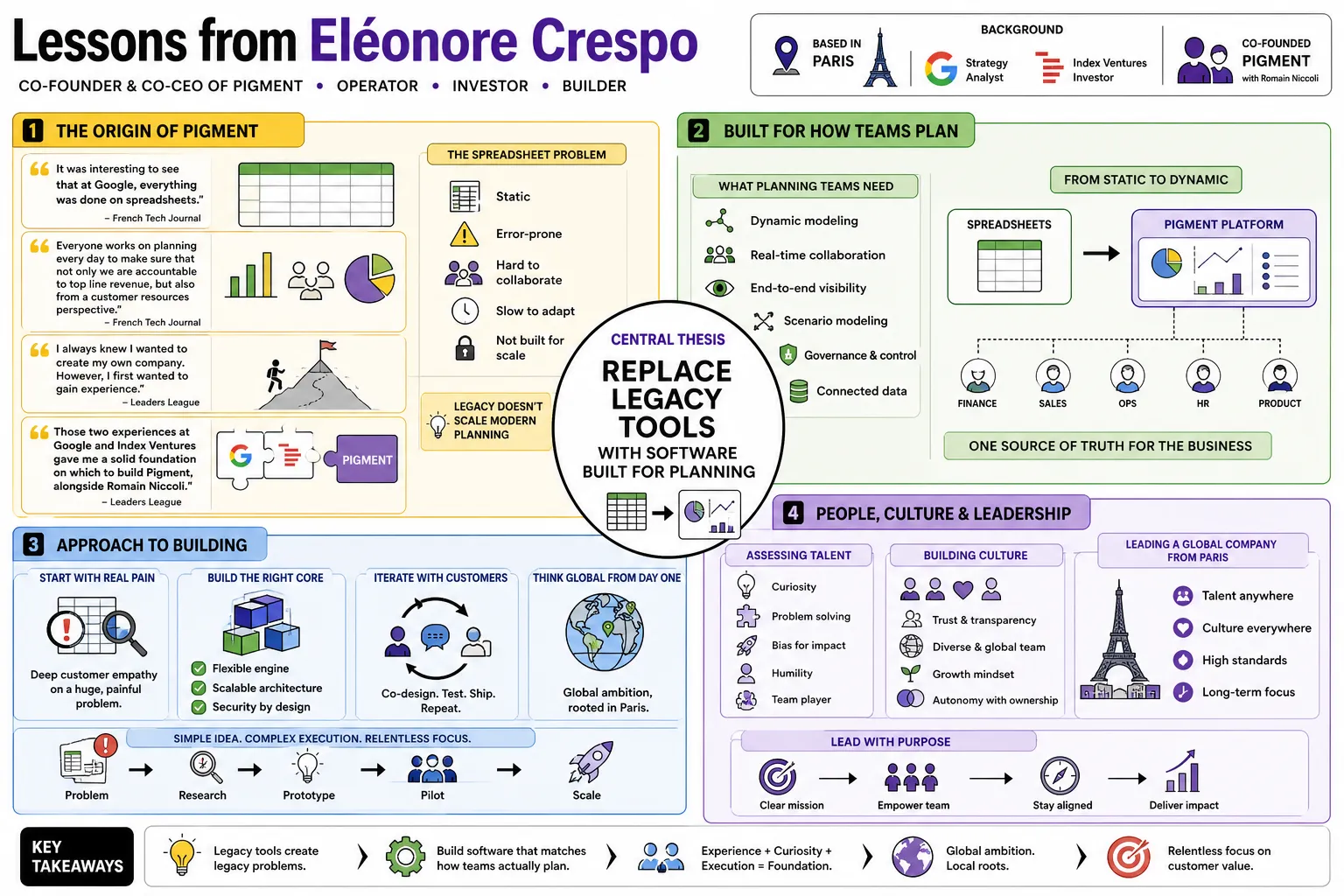
Eléonore Crespo is the co-founder and co-CEO of Pigment, a platform built to replace the static spreadsheets large enterprises rely on for business planning. Before launching the company with Romain Niccoli, she analyzed strategy at Google and evaluated startups as an investor at Index Ventures. This collection gathers her notes on software design, assessing talent, and running a global business out of Paris.
Part 1: The Origin of Pigment
- On the spreadsheet problem: "It was interesting to see that at Google, everything was done on spreadsheets." — Source: French Tech Journal
- On daily planning: "Everyone works on planning every day to make sure that not only we are accountable to what we do from a top line revenue perspective, but also from a customer resources perspective." — Source: French Tech Journal
- On gaining experience first: "I always knew I wanted to create my own company. However, I first wanted to gain experience." — Source: Leaders League
- On building a foundation: "Those two experiences at Google and Index Ventures gave me a solid foundation on which to build Pigment, alongside Romain Niccoli." — Source: Leaders League
- On legacy tools: "Traditional tools like spreadsheets were insufficient for modern business planning, which became the foundational inspiration for the company." — Source: VivaTech
- On early observations: "Even one of the world's most innovative companies relied heavily on spreadsheets for complex strategic planning." — Source: Business Insider
- On the initial idea: "The vision was to empower enterprises to move beyond static, outdated models toward a dynamic, collaborative, and real-time data platform." — Source: Startup Intros
- On the pain points of growth: "Observing high-growth startups firsthand revealed the scaling challenges they faced and the friction caused by legacy planning tools." — Source: Leaders League
- On taking the leap: "The decision to become a founder was a deliberate choice shaped heavily by a background in corporate finance and venture capital." — Source: Leaders League
Part 2: Lessons from Google and Index Ventures
- On working as an analyst: "Reporting directly to the EMEA President and CFO at Google involved advising them on matters of strategy and planning." — Source: Venture Europe
- On observing startups: "Working at Index Ventures provided the opportunity to spearhead investments in successful European companies like Alan, Spendesk, Swile, and Slite." — Source: Venture Europe
- On thinking like an investor: "Founders should think like an investor to understand what makes a company successful, such as generating network effects and building category trust." — Source: The Twenty Minute VC
- On the CEO-CFO dynamic: "As a CEO, the relationship with the CFO is critical." — Source: Pigment
- On strategic orchestration: "The CFO and other financial leaders must act as the orchestrators of company strategy, moving from simple stewards to central decision-makers." — Source: CFO Dive
- On the gap in the market: "Despite the influx of modern software across different sectors, business planning remained stuck in the past, presenting a massive opportunity." — Source: Fast Growth Icons
- On foundational knowledge: "Deep knowledge of enterprise planning and venture-backed growth gained from early roles proved essential to launching a new venture." — Source: World Economic Forum
- On advising executives: "Time spent at Google taught exactly what top-level executives need to see in order to make informed strategic decisions." — Source: PSL
- On understanding scale: "Evaluating high-growth startups at Index gave a clear blueprint for the operational hurdles a company faces as it expands." — Source: The Twenty Minute VC
Part 3: The Co-CEO Dynamic
- On alignment: "We talk 3x a day. That's our superpower." — Source: The Twenty Minute VC
- On shared leadership: "Operating as co-CEOs is a major factor in the ability to scale a business quickly and effectively." — Source: The Twenty Minute VC
- On constant communication: "Maintaining a close, highly communicative relationship with a co-founder allows for rapid decision-making." — Source: The Twenty Minute VC
- On dividing responsibilities: "A functional co-CEO relationship relies on trusting each other's domain expertise while staying completely aligned on the overall vision." — Source: The Twenty Minute VC
- On overcoming challenges: "Sharing the emotional and operational load of a startup makes it easier to navigate periods of extreme stress." — Source: Panelle
- On avoiding silos: "By speaking multiple times a day, co-CEOs ensure that the product engineering side and the go-to-market side of the business never drift apart." — Source: Buzzsprout
- On mutual respect: "The partnership works because it is built on a foundation of mutual respect and a shared ambition to solve a massive enterprise problem." — Source: The Twenty Minute VC
- On setting the tone: "The unified front presented by the co-founders sets a strong cultural standard for collaboration across the entire company." — Source: The Twenty Minute VC
- On making fast choices: "When founders are constantly in sync, they can make critical business decisions in minutes rather than days." — Source: The Twenty Minute VC
Part 4: Hiring and Talent
- On recruiting strategy: "Hiring is everything. I hunt talent like a football scout." — Source: The Twenty Minute VC
- On finding builders: "Hire doers — 'Doers till the IPO' — ask them what is the last thing they have done." — Source: Venture Europe
- On filtering candidates: "Utilize case studies during the interview process to filter out title-chasers or political hires." — Source: Venture Europe
- On getting hands dirty: "Look for senior leaders who are still willing to get into the details and execute directly." — Source: The Twenty Minute VC
- On practical assessments: "Candidates must be able to demonstrate their actual contributions rather than just talking about high-level strategy." — Source: The Twenty Minute VC
- On avoiding politicians: "A startup's culture can be quickly derailed by hiring individuals who care more about their internal status than the product." — Source: Venture Europe
- On the cost of bad hires: "Bringing on the wrong executives early on can create friction that slows down the entire organization." — Source: Buzzsprout
- On scouting continuously: "A CEO must always be looking for exceptional talent, treating recruitment as a permanent priority rather than a seasonal task." — Source: The Twenty Minute VC
- On evaluating track records: "Past performance in building and shipping is the most reliable indicator of a candidate's future impact." — Source: Venture Europe
- On maintaining a doer culture: "As a company scales, it is critical to actively protect the culture of execution against the creep of bureaucracy." — Source: The Twenty Minute VC
Part 5: Leadership and Management
- On resource allocation: "A core tenet of management is focusing on energy management to sustain high performance, rather than just optimizing time." — Source: Venture Europe
- On personal discipline: "I'd rather learn about AI than watch a movie." — Source: Sifted
- On removing friction: "When scaling, ask teams to list the dumbest processes they follow in order to actively cut red tape." — Source: The Twenty Minute VC
- On reframing adversity: "Personal challenges, such as recovering from a severe back injury, can act as gifts that fundamentally shape perspective and resilience." — Source: Sifted
- On building through chaos: "Raising significant capital shortly after giving birth to twins proves that intense personal and professional milestones can coexist." — Source: Panelle
- On leading by example: "A supportive environment requires a strong work ethic to set the tone, while also respecting the need for personal well-being." — Source: The Twenty Minute VC
- On ignoring labels: "Founders should look past external labels or assumptions and focus entirely on building smarter, better, and faster." — Source: Panelle
- On physical and mental health: "Balancing the extreme demands of building a startup requires deliberate attention to sustaining one's physical energy." — Source: Venture Europe
- On fighting bureaucracy: "As headcount grows, leaders must proactively hunt down and eliminate rules that slow down execution." — Source: The Twenty Minute VC
- On continuous learning: "A CEO's job is never static; it demands a relentless commitment to absorbing new information, especially in rapidly evolving fields like AI." — Source: Sifted
Part 6: Product Vision and Customer Trust
- On user advocacy: "Your customers should be your loudest voice in the market. A sales pitch is much easier to trust if it comes directly from the end user of the product." — Source: CFO Connect
- On product excellence: "Think of the product like a boutique coffee shop—focusing on delivering a perfect experience that users genuinely love." — Source: The Twenty Minute VC
- On leveraging AI: "The integration of AI allows users to describe planning models in natural language, making business planning a competitive advantage." — Source: Newswire
- On building credibility: "For a new startup, carefully picking initial customers is paramount to building a foundation of trust." — Source: SaaStr
- On creating champions: "Early adopters should be nurtured to become lifelong advocates who will vouch for the platform's reliability." — Source: SaaStr
- On breaking data silos: "The product must be designed to aggregate data seamlessly across finance, sales, supply chain, and HR departments." — Source: CityAM
- On moving beyond legacy: "The ultimate goal is to replace outdated, rigid enterprise software from legacy giants with an agile, intuitive solution." — Source: CityAM
- On the user interface: "A modern enterprise tool must have the aesthetic and functional appeal of consumer software to drive internal adoption." — Source: The Twenty Minute VC
- On product-led growth: "When the product experience is flawless, customer referrals become the most powerful growth engine." — Source: CFO Connect
- On democratizing data: "By allowing users to interact with complex data models through simple text prompts, the software democratizes financial analysis." — Source: Newswire
Part 7: Navigating Economic Uncertainty
- On asking the hard questions: "Whether you're a tech company or a Fortune 500, everyone is asking themselves the same question right now, which is where are we going, and what if the world gets worse?" — Source: Business Insider
- On the need for confidence: "With so much economic uncertainty, it's more important than ever for companies to be confident about their decision-making." — Source: Enterprise Times
- On accurate forecasting: "During periods of high market volatility, the ability to rapidly model different financial scenarios becomes a company's lifeline." — Source: Business Insider
- On counter-cyclical growth: "Economic downturns are unique opportunities to gain ground rather than just periods to merely survive." — Source: The Twenty Minute VC
- On doubling down: "Invest heavily in the product and market presence while competitors are retreating during tough economic times." — Source: The Twenty Minute VC
- On financial visibility: "Companies cannot afford to wait weeks for financial reports when market conditions are changing by the day." — Source: Enterprise Times
- On strategic agility: "True resilience comes from the ability to pivot resources quickly based on real-time data, not gut feelings." — Source: Business Insider
- On market corrections: "A tightening economy forces startups to build healthier, more sustainable business models from the ground up." — Source: Panelle
- On aggressive expansion: "Economic fear should not deter a well-capitalized company from executing its long-term strategic roadmap." — Source: The Twenty Minute VC
Part 8: Global Ambition and the European Tech Ecosystem
- On geographic neutrality: "In the tech sector, success isn't down to being French or American — you win because you build a product that is truly effective for customers." — Source: Leaders League
- On rejecting protectionism: "Tech sovereignty narratives that frame US-Europe relations as a rivalry rather than an opportunity can be highly counterproductive." — Source: Sifted
- On cross-border growth: "We can't exist only in Europe; European software companies must focus on global competitiveness to survive." — Source: Sifted
- On targeting the US: "Despite being headquartered in Paris, aggressively targeting the US market early on is crucial for reaching global scale." — Source: PSL
- On building a champion: "It is entirely possible to build a massive, globally dominant enterprise software company from European roots." — Source: Sifted
- On diversity in leadership: "Leadership is still often associated with homogeneous profiles, which can create unnecessary barriers for outsiders." — Source: Leaders League
- On systemic change: "True progress in the startup ecosystem requires structural changes rather than just highlighting isolated individual success stories." — Source: Leaders League
- On international collaboration: "Partnering with US companies and investors is a strategic necessity for European founders aiming for top-tier scale." — Source: Sifted
- On the global standard: "A product must be evaluated against the best in the world, not just the best in its local market, to achieve true success." — Source: Leaders League