Eli Dourado researches barriers to technological progress and ways to make abundance more achievable, with work spanning energy, transportation, health, housing and policy execution. — How We Get to an Abundant Future.
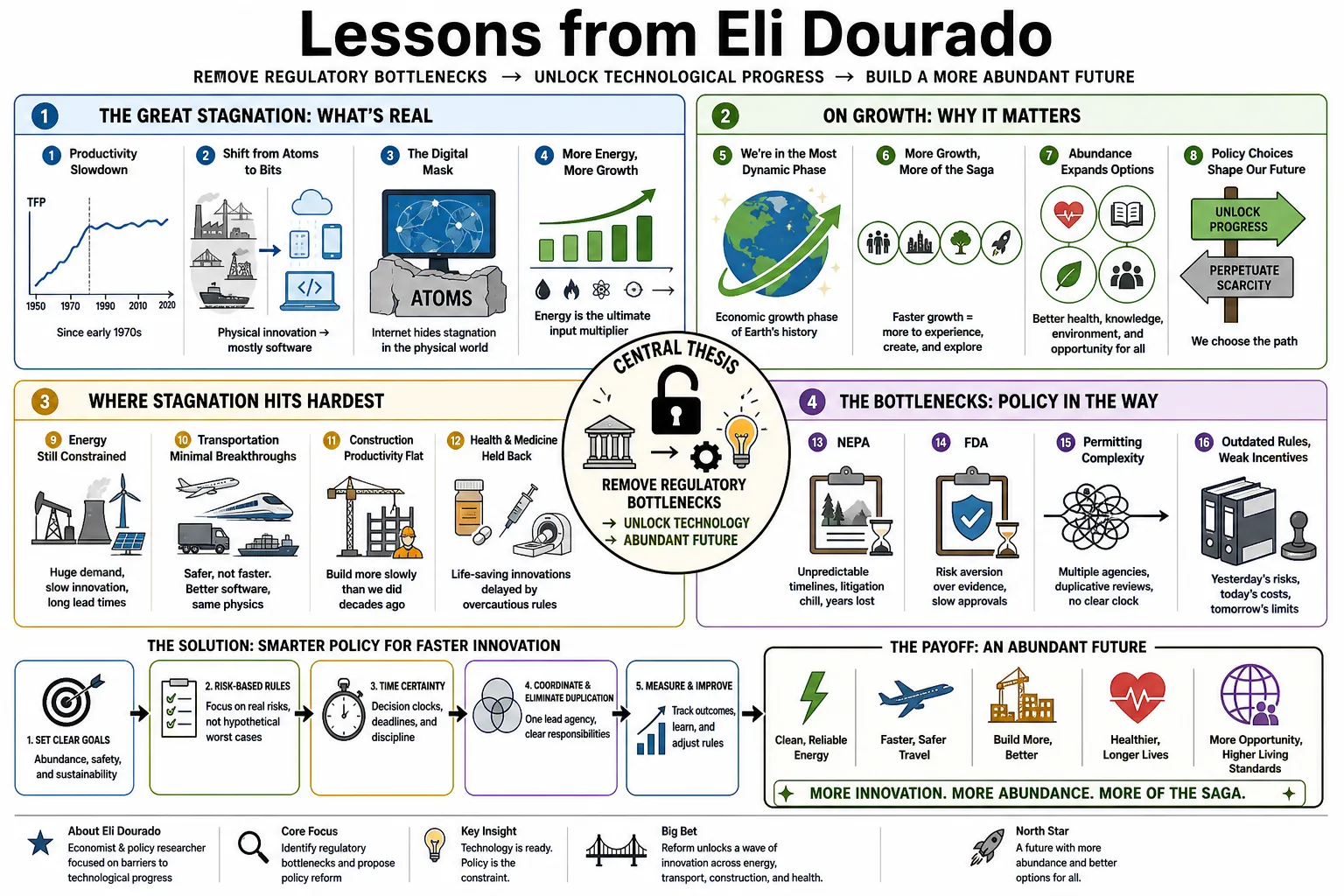
Part 1: The Great Stagnation and Economic Growth
- The productivity slowdown: Dourado highlights the sharp slowdown in U.S. total factor productivity growth after the early 1970s and especially after 2005; new technologies must be adopted at scale to move the measure. — Notes on Technology in the 2020s.
- Growth as a way to see more of the future: He sees economic growth not only as a contributor to material welfare but also as a way for people to experience more of humanity's unfolding story. — Economic Growth Isn't Just Ethical. It's Sublime.
- Digital invention can reach the physical world: Dourado argues that computing's benefits need not stop at screens: more consequential gains may come as digital systems make decisions and act in the physical world. — The Third Industrial Revolution Has Only Just Begun.
- Energy abundance expands options: He argues that cheap, clean energy would expand the set of activities society can afford, rather than treating lower energy use as the sole measure of progress. — Abundant Energy Changes Everything.
- Prioritize consequential bottlenecks: To raise welfare, he prioritizes health, housing, energy and transportation: large sectors with lagging productivity and plausible routes to improvement. — How Do We Move the Needle on Progress?.
- Lagging sectors matter most: Relative price increases in health and housing point him toward sectors where productivity gains could matter more than further efficiency in already-improving industries. — How Do We Move the Needle on Progress?.
- Growth belongs in moral reasoning: Responding to Tyler Cowen, Dourado argues that sustained growth deserves a place in ethical reasoning because of its contribution to human welfare. — Economic Growth Isn't Just Ethical. It's Sublime.
- Find what stalls progress: Dourado describes his work as identifying barriers to technological progress and using concrete investments to help create a more abundant future. — How We Get to an Abundant Future.
- Breakthroughs need deployment: He argues that scientific breakthroughs alone do not lift productivity until entrepreneurs build products, clear regulatory obstacles and scale production. — Notes on Technology in the 2020s.
- Curiosity about what comes next: He says a major attraction of growth is the chance to see what humanity does next, including possibilities in space, technology and longevity. — Economic Growth Isn't Just Ethical. It's Sublime.
Part 2: Advanced Geothermal and Energy Abundance
- The scale of crustal heat: Citing a Stanford resource estimate, Dourado compares heat in Earth's crust with the chemical energy in known fossil fuels and gets a roughly 23,800-to-one ratio. — The State of Next-Generation Geothermal Energy.
- Geothermal's enormous potential: He compares crustal geothermal heat with fissionable resources and says fusion is the only energy resource with greater potential, while stressing that geothermal depends on affordable deep drilling. — Abundant Energy Changes Everything.
- A dated permitting comparison: In 2021 congressional testimony, Dourado contrasted roughly two-week BLM oil-and-gas well approvals with roughly two-year geothermal approvals for similar wells; the figures describe his historical policy comparison, not a universal current timeline. — Joint Economic Committee Testimony.
- Extend appropriate drilling exclusions: He advocated extending oil-and-gas categorical-exclusion treatment to comparable geothermal wells on public lands to shorten early-stage permitting. — The Biggest No-Brainer in All of Energy Policy.
- Coal-plant equipment as a possible retrofit: He describes a possible future in which supercritical geothermal steam could use generator equipment at retiring coal plants, conditional on much deeper and cheaper drilling. — The State of Next-Generation Geothermal Energy.
- Adapt shale-era drilling skills: Enhanced geothermal systems can borrow deeper drilling and fracture-network methods developed by oil and gas engineers, potentially expanding where heat can be accessed. — The State of Next-Generation Geothermal Energy.
- Supercritical heat raises the prize: Higher-temperature supercritical geothermal could yield denser power output, but Dourado stresses that the drilling technology needed to reach such conditions economically remains unproven. — The State of Next-Generation Geothermal Energy.
- Firm power with a small surface footprint: He argues that geothermal can provide around-the-clock clean electricity and that comparable geothermal and oil-and-gas wells can have similar limited surface disturbance; broader cost and land-use advantages remain contingent. — The Biggest No-Brainer in All of Energy Policy.
- Promising, not yet proven at scale: Dourado sees next-generation geothermal as promising because of resource size, technological readiness and relatively tractable policy barriers, while detailing unresolved engineering challenges. — The State of Next-Generation Geothermal Energy.
Part 3: Supersonic Aviation and the Need for Speed
- A speed restriction rather than a noise rule: Dourado criticizes the U.S. overland civil-supersonic restriction as a speed-based rule that limits the market for faster aircraft, and favors a noise standard instead. — 50 Years of Silence.
- Define a measured boom standard: In 2023 he proposed an interim standard of less than 90 PLdB for daytime cruise booms and 80 PLdB at night, pending a permanent FAA rule. — 50 Years of Silence.
- Flight speed has stagnated: He notes that airline travel became safer and cheaper while commercial passenger speeds stopped advancing, with Concorde's retirement reversing the brief supersonic exception. — Personal Aviation Is About to Get Interesting.
- Faster travel changes what is reachable: Dourado argues that lower travel time can make more work, personal visits and opportunities practical, not merely save minutes on trips already taken. — How Do We Move the Needle on Progress?.
- Quiet-flight designs need a viable market: Dourado and Hammond argued that materials, engines and simulation had improved enough to make lower-boom designs plausible, but the overland ban restricted the market and iteration pathway. — Congress Should Legalize Supersonic Flight.
- eVTOL as a conditional mobility opportunity: Dourado listed urban air mobility among areas that could shorten intra-city travel and later discussed regulatory openings for small eVTOL aircraft; deployment was a prospect, not an accomplished commute revolution. — Personal Aviation Is About to Get Interesting.
- The lost overland entry market: Dourado and Hammond argued that the overland ban constrained smaller business jets as a natural entry point for supersonic learning; they did not calculate that it halved Concorde's market. — Congress Should Legalize Supersonic Flight.
- A shorter Pacific itinerary: In 2019 House testimony, Dourado used a prospective San Francisco–Tokyo flight falling from about 11 hours to 5.5 hours to illustrate how supersonic travel might compress a multi-day business trip into one day. — Looking Forward: Aviation 2050.
Part 4: Regulatory Bottlenecks and NEPA Reform
- An informational law became procedural leverage: Dourado argues that NEPA's environmental-disclosure framework became a more powerful procedural obstacle through review requirements and litigation over the adequacy of documents. — Much More Than You Ever Wanted to Know About NEPA.
- Environmental review can delay clean infrastructure: He argues that lengthy environmental review can slow wind, solar, geothermal and cleaner transportation projects even when those projects would have environmental benefits. — Reforming Environmental Review.
- Years of review create uncertainty: Dourado cites multi-year preparation times for environmental impact statements and argues that such delays raise costs and uncertainty for builders. — Much More Than You Ever Wanted to Know About NEPA.
- Litigation shapes the paperwork: He argues that the possibility of lawsuits over EIS deficiencies gives agencies incentives to prepare longer and more defensive documents. — Much More Than You Ever Wanted to Know About NEPA.
- Use categorical exclusions where warranted: He favors broader, evidence-based categorical exclusions for low-impact activities such as comparable geothermal wells, while noting that a categorical exclusion is still a form of NEPA review. — Much More Than You Ever Wanted to Know About NEPA.
- Federal land matters for geothermal: The most accessible geothermal heat resources often overlap western federal land, so federal permitting can shape how quickly firms learn by drilling there. — The State of Next-Generation Geothermal Energy.
- Page and timeline reforms have limits: Dourado welcomed 2020 reforms that set soft limits on environmental-review pages and timelines and made prior analyses easier to reuse; he did not claim they barred courts from halting projects. — Reforming Environmental Review.
- Defensive documentation slows decisions: He describes how agencies, facing litigation risk, can over-document environmental analysis, making approvals slower without a corresponding substantive environmental standard. — Much More Than You Ever Wanted to Know About NEPA.
- State-level review can add delay: Dourado argues that procedural requirements under both NEPA and California's CEQA can stretch some project approvals from months into years; he does not assert that every apartment project takes a decade. — Big Think — Opportunities for Progress.
Part 5: The Space Economy and Falling Launch Costs
- Reusable launch and new services: Dourado contrasts costly conventional launch procurement with cheaper commercial approaches and argues that lower launch costs can enable new services; older Starship cost figures were forecasts, not observed prices. — The Space Launch System Is Part of a Swamp.
- Payload size changes design choices: In his comparison of SLS and Starship, Dourado argues that a larger and potentially cheaper launch vehicle could change how much cargo future missions carry, conditional on its performance and costs. — The Space Launch System Is Part of a Swamp.
- Microgravity manufacturing is an opportunity: Dourado identifies pharmaceuticals, materials and ZBLAN optical fiber as possible products of orbital microgravity manufacturing, with lower launch costs improving the business case. — Why Go to Space?.
- Asteroid mining remains speculative: In 2020 Dourado saw potential value in asteroid mining but expected serious space mining to remain years away; he did not claim it would end terrestrial mineral scarcity. — Notes on Technology in the 2020s.
- Space solar deserves another look: Dourado says cheaper solar panels and launch have prompted renewed interest in space-based solar power, but he treats its economics as unsettled rather than promising unlimited baseload power at a known cost. — Eli Dourado AMA.
- Environmental review reaches launch decisions: Dourado uses FAA review of a SpaceX launch program to illustrate that federal environmental-review procedures can affect space projects as well as terrestrial infrastructure. — Much More Than You Ever Wanted to Know About NEPA.
- Milestone contracts can widen competition: He holds up NASA's COTS program as an alternative to cost-plus procurement: private cost sharing, milestone-based fixed payments and goal-driven requirements let newer firms compete. — NASA's COTS Program.
- Satellite broadband is an immediate space benefit: Dourado identifies low-Earth-orbit broadband constellations as a practical route to improved connectivity for rural households, while framing adoption as a forecast at the time of writing. — Why Go to Space?.
Part 6: FDA Reform and Medical Innovation
- Re-examine the effectiveness requirement: In a direct interview, Dourado notes the FDA's post-1962 requirement to demonstrate both safety and effectiveness and proposes studying whether a safety-first pathway could increase drug throughput. — Metascience 101 — Episode Eight.
- Clinical-trial cost is a bottleneck: Dourado argues that expensive, slow clinical trials can impede drug development and calls for better patient recruitment and medical-record interoperability rather than asserting that every rare disease is abandoned. — Metascience 101 — Episode Eight.
- Vaccine design moved faster than deployment: Dourado notes Moderna designed its vaccine soon after the viral sequence was published, but explicitly says time was needed to determine dose, safety and efficacy; he questions whether the full delay was necessary. — Notes on Technology in the 2020s.
- Challenge trials were a disputed pandemic option: Dourado criticized the refusal to allow COVID human challenge trials as one factor that may have slowed medical progress; any such design would require rigorous ethics and risk assessment. — Don't Fear Biotech Progress.
- Declining drug R&D productivity matters: Dourado invokes Eroom's Law to argue that approved drugs per inflation-adjusted research dollar have declined, leaving potentially valuable treatments undeveloped. — Don't Fear Biotech Progress.
- Off-label practice motivates a regulatory question: Because physicians can prescribe approved drugs off-label, Dourado asks whether initial effectiveness review should be modified; he presents this as a question to investigate, not proof that safety review alone is sufficient. — Metascience 101 — Episode Eight.
- Delay has unseen patient costs: Dourado argues that increasingly cautious approval can withhold potentially useful treatments from patients; this is a policy tradeoff, not a verified count of deaths caused by a five-year delay. — Don't Fear Biotech Progress.
- Testing approval was another COVID bottleneck: In his retrospective account, Dourado cites restrictions on laboratory testing among FDA pandemic failures; the source does not establish the original lesson's specific rapid-antigen-versus-PCR comparison. — Don't Fear Biotech Progress.
- Informed-consent early access was a pandemic proposal: In March 2020 Dourado proposed a separate, transparent path for consenting patients to access incompletely tested COVID vaccine candidates, while acknowledging meaningful safety risks. — Accelerating Availability of Vaccine Candidates.
- Cautious regulation can block translation: Dourado describes a cautious-regulator problem in which higher barriers can delay movement from biology labs to medical practice; his essay does not quantify individual officials' incentives. — Don't Fear Biotech Progress.
Part 7: State Capacity and Institutional Reform
- Institutional capability controls infrastructure cost: Dourado contrasts expensive U.S. transit construction with lower-cost European and Korean examples to argue that the ability to execute matters more than cheap borrowing. — State Capacity Eats Interest Rates for Lunch.
- Procedural work can crowd out building: Dourado argues that years of environmental assessment and defensive documentation can delay physical projects that the government might otherwise approve. — Much More Than You Ever Wanted to Know About NEPA.
- Procurement rules shape who can build: He argues that conventional federal acquisition can favor established contractors and shows how NASA's milestone-based COTS structure allowed newer firms to participate. — NASA's COTS Program.
- Overlapping reviews consume capacity: Dourado shows how a geothermal project on federal land can face several sequential NEPA reviews, complicating investment even when the project's overall aim is clean energy. — Much More Than You Ever Wanted to Know About NEPA.
- Reduce veto points in permitting: Dourado includes permitting reform and ending vetocracy among his priorities and explains how environmental-review litigation can slow infrastructure. — Eli Dourado AMA.
- Make policy solutions actionable: In his AMA, Dourado endorses a policy-maturity test: researchers should identify concrete decisions and actors before advocates try to implement a proposal. — Eli Dourado AMA.
Part 8: Progress Studies and the Philosophy of Abundance
- Progress requires translating ideas into projects: Dourado's 2025 framework combines technological feasibility, sociopolitical barriers and entrepreneurial execution to turn a vision of abundance into specific funded work. — How We Get to an Abundant Future.
- Complacency can slow progress: Dourado argues that crises reveal an ability to innovate faster and asks institutions to reduce normal-time complacency rather than waiting for emergencies. — Crises Are Times of Non-Complacency.
- Institutions shape technological deployment: Dourado stresses that scientific possibility alone does not determine adoption; incentives, regulation, funding and entrepreneurship influence which technologies reach scale. — How We Get to an Abundant Future.
- Abundance is a sector-by-sector project: His 2019 progress analysis prioritizes improving health, housing, energy and transportation rather than relying on GDP growth in the abstract. — How Do We Move the Needle on Progress?.
- Immigration can expand economic capacity: Dourado argued that allowing more immigration could add workers, entrepreneurs and taxpayers; the original aging-and-shrinking-population claim is not established by this source. — The Economics of the Startup Visa.
- Science funding creates incentives: Dourado argues that funding and publication systems shape which scientific questions get asked and how results are presented; his source does not establish that NIH or NSF peer review systematically excludes high-risk work. — How We Get to an Abundant Future.
- Do not limit immigration to founders: In discussing the proposed Startup Visa, Dourado argued that productive immigrants can contribute within established businesses too and should not have to depend on a startup's survival for residency. — The Economics of the Startup Visa.
- Concrete optimism requires execution: Dourado favors ambitious, specific visions backed by clear analysis of nontechnical obstacles and an entrepreneurial willingness to work through them. — How We Get to an Abundant Future.
- Growth aims at human possibility: For Dourado, economic growth and space exploration matter because they can expand human welfare, knowledge and the range of futures people can experience. — Economic Growth Isn't Just Ethical. It's Sublime.