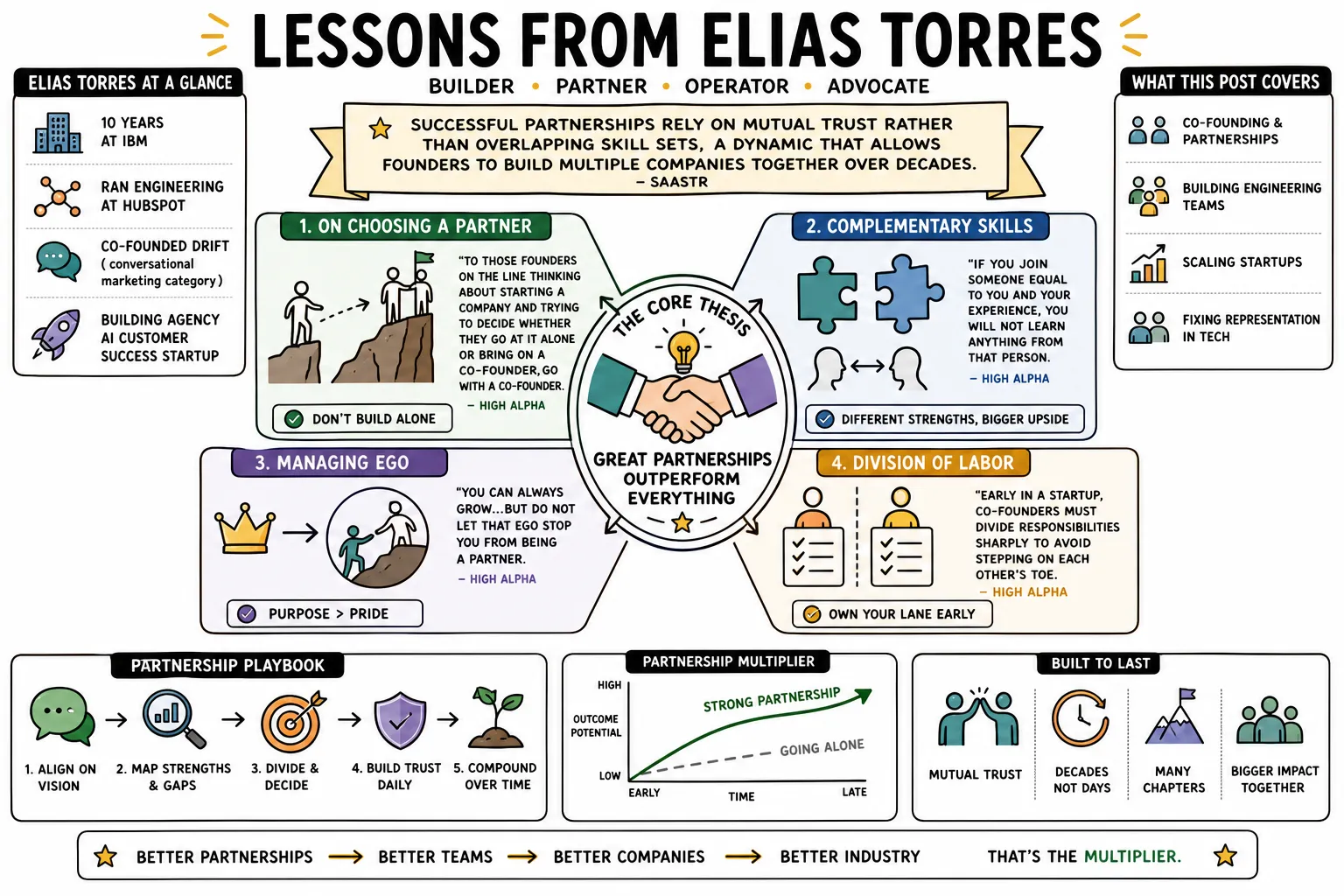
Lessons from Elias Torres
Elias Torres spent a decade at IBM, led engineering at HubSpot, and co-founded Drift and Agency. After Klaviyo acquired Agency in 2026, he became Klaviyo's Chief Product Officer. This profile collects his lessons on co-founding, hiring, engineering, customer engagement, AI, and representation in technology. — Klaviyo Investor Biography.
Part 1: Co-founding and Partnerships
- On Choosing a Partner: Torres recommends that prospective founders seriously consider bringing on a co-founder instead of building alone. — High Alpha Fireside Recap.
- On Complementary Skills: He advises choosing a co-founder whose different experience and skills create opportunities to learn from each other. — High Alpha Fireside Recap.
- On Managing Ego: He cautions founders not to let ego prevent them from accepting a strong partner and growing into the relationship. — High Alpha Fireside Recap.
- On Long-Term Collaboration: Torres and David Cancel had already worked together across several companies before Drift; that familiarity helped him know they could build together. — SaaS Mag Interview.
- On Shared Philosophy: Torres says he and Cancel knew they worked well together and shared a customer-centered, fast-building philosophy. — SaaS Mag Interview.
- On Working Together In Person: For Drift at that stage, Torres and Cancel deliberately chose an in-office team because they believed it suited the speed and culture they wanted; this was their historical choice, not a universal rule. — David Cancel on Remote Work.
Part 2: Engineering Leadership and Team Building
- On Prioritization: Torres puts building the team ahead of polishing the product and urges founders to talk directly with customers. — High Alpha Fireside Recap.
- On Setting Expectations: Torres says the interview should show candidates the company's real culture, values, and working style—and give them room to assess the team as carefully as the team assesses them. — First Impressions Are Everything.
- On a Seven-Day Hiring Process: After learning Paul English's seven-day rule, Torres built a tailored recruiting process intended to move quickly from first contact to an offer; he later acknowledged some roles take longer. — The Art of Recruiting.
- On Small Engineering Teams: At HubSpot, Torres describes tech leads running small teams of roughly three engineers within a larger organization, without claiming that size fits every company. — Engineers Don't Talk.
- On Engineering Updates: Torres aggregated team wins, issues, and direction into a weekly engineering update so people across the company could see what was happening and raise concerns. — Engineers Don't Talk.
- On Understanding Engineers: He used weekly one-to-ones and private feedback channels to hear engineers' concerns and support their development, instead of relying on large meetings alone. — Engineers Don't Talk.
- On Founder Involvement in Hiring: Torres says recruiting remains a founder's job and that the founding team should help attract, assess, and close candidates rather than outsourcing its judgment. — Scaling Up Podcast Transcript.
- On Bias for Action: Torres described Drift's operating principle as a bias for action and daily results, coupled with putting what the team builds in front of customers quickly. — upside.fm Interview Transcript.
- On Hiring for Potential: Torres warns against hiring from résumé keywords alone; he spends time getting to know a candidate's learning ability and fit with the company's stage before committing. — Recruiting Is About Taking Risks.
- On Direct Customer Problem-Solving: Torres argues that adding a nontechnical handoff layer can slow problem resolution; he would rather have engineers spend time with customers and solve technical issues directly. — Elias Torres on Direct Customer Problem-Solving.
Part 3: Diversity, Inclusion, and Representation
- On Nontraditional Backgrounds: Torres says his and Cancel's Latin American backgrounds and different experiences brought distinct perspectives into the company and made some candidates feel represented. — SaaS Mag Interview.
- On Attracting Diverse Talent: He observed a recruiting flywheel: visible leaders from underrepresented backgrounds can attract more people with similarly nontraditional paths. — SaaS Mag Interview.
- On Pay Equity: Torres says Drift used salary reviews and other mechanisms to make equal-pay issues visible rather than relying on a verbal commitment alone. — SaaS Mag Interview.
- On Building a More Inclusive Tech Industry: Torres describes intentional recruiting of underrepresented candidates and work to improve their access to interviews, support, and future leadership opportunities. — upside.fm Interview Transcript.
- On Visibility: Torres says he has a responsibility to speak up for Latino and other underrepresented technologists and to share the opportunities and lessons he received. — Lattice All Hands Transcript.
- On The American Dream Podcast: Through his American Dream podcast, Torres invites entrepreneurs who have felt like the only 'other' in a room to share their stories and lessons for those following them. — The American Dream Podcast.
- On Cultural Differences: Torres argues that leaders with different cultural experiences can bring different perspectives and ideas to company decisions. — SaaS Mag Interview.
- On Representation: Torres credits role models who showed him what was possible and now sees a responsibility to make a path more visible for other underrepresented builders. — Sequoia Training Data Transcript.
- On Bias in Recruiting: Torres describes using unconscious-bias training and deliberate attention to the candidate funnel while trying to hire more underrepresented people at Drift. — upside.fm Interview Transcript.
Part 4: Scaling and Growth
- On Scaling Leadership: Torres calls hiring at scale the most important leadership lesson from his HubSpot period and describes giving talented people a chance while scaling himself as a leader. — Sequoia Training Data Transcript.
- On the Drift Exit: Torres has called Drift's $1.2 billion exit a failure in one important respect: after he lost control, later changes undermined the enduring customer and product impact he had wanted. — GTMnow Podcast Transcript.
- On Post-Acquisition Integration: After Performable joined HubSpot, Torres says the abrupt jump in customer scale forced him to rebuild the team and product and regain customers' trust. — Sequoia Training Data Transcript.
- On Delegation: Torres says founders cannot solve every growth bottleneck by working longer hours; they need to use their time deliberately and delegate work to the right people. — upside.fm Interview Transcript.
- On Capital Efficiency: Looking back at Drift, Torres criticizes the assumption that a company can always hire more people, raise more money, and fix scalability later. — Sequoia Training Data Transcript.
- On Market Timing: Torres and Drift saw messaging and video habits changing and used that shift to pursue a more responsive way for businesses to meet website visitors. — Jungle Ventures Founder Conversation.
- On Enterprise Sales: As Drift moved toward enterprise customers, Torres described changing the value proposition, investing in senior sales talent and training, segmenting teams, and adding product marketing. — Jungle Ventures Founder Conversation.
- On Building Momentum: Torres urges early founders to put work in front of customers, charge for it, and bring marketing and sales into the company rather than waiting for a touchless product to sell itself. — upside.fm Interview Transcript.
- On Adapting Team Communication: As HubSpot's product organization grew, Torres moved from informal visibility to tech leads, structured feedback, and weekly updates so the larger team could stay informed. — Engineers Don't Talk.
Part 5: Conversational Marketing
- On Conversational Marketing: Torres and Cancel saw the static website contact form as a missed opportunity and built Drift around faster, real-time conversations with prospective customers. — Jungle Ventures Founder Conversation.
- On Removing Form Friction: Torres saw conventional contact forms as an awkward delay for buyers already on a company's website; Drift aimed to let them begin a conversation sooner. — Jungle Ventures Founder Conversation.
- On Real-Time Expectations: Drift's early thesis drew on the broader shift toward messaging and video, meeting B2B buyers where they were rather than forcing slower contact routes. — Jungle Ventures Founder Conversation.
- On Scaling Conversations: Torres described using technology to give more website visitors timely attention without adding a proportional number of sales or support staff. — SaaS Mag Interview.
- On the Conversational Cloud: Torres said Drift was expanding from conversational marketing toward a conversational cloud spanning more customer interactions. — SaaS Mag Interview.
- On Responding to Buyer Intent: The Adobe–Drift integration let visitors from target accounts skip a form, book meetings while on the website, and connect to the assigned sales representative. — Adobe–Drift Announcement.
- On Humanizing B2B: Torres framed Drift as a way to improve the quality of interactions with real customers as more business communication moved online. — SaaS Mag Interview.
- On Chatbot Routing: In the Adobe–Drift integration, a chatbot or live conversation could identify a target account and route a qualified visitor to the appropriate sales representative. — Adobe–Drift Announcement.
Part 6: Artificial Intelligence
- On Useful Imperfection: Torres argues that AI can deliver meaningful productivity gains before it is perfect, provided teams understand where imperfect output is tolerable. — Sequoia Training Data Transcript.
- On Autonomous Customer Work: Torres envisaged AI taking over routine customer-success preparation and outreach so human staff could focus on more complex relationships and decisions. — Churn.FM Interview Transcript.
- On AI Beyond Exact Lookups: He contrasts older software's precise database lookups with AI systems that can attempt broader tasks but produce variable answers, requiring users to recalibrate expectations. — Sequoia Training Data Transcript.
- On Choosing AI Review Points: Torres argues that teams should put human review where mistakes matter most instead of requiring a person to approve every low-stakes customer follow-up. — Sequoia Training Data Transcript.
- On Proactive Customer Success: Torres describes Agency's aim of using customer context to surface risks and next actions before the account reaches a late-stage churn conversation; this is an ambition, not a proven universal outcome. — Churn.FM Interview Transcript.
- On AI-Supported Work: Torres argues that AI can let smaller customer teams prepare follow-ups and manage routine tasks at a scale that previously required more people. — Churn.FM Interview Transcript.
- On Agentic Workflows: Torres wants AI systems to do customer work—such as outreach and follow-up—rather than stopping at dashboards, summaries, or a chat box waiting for a person to act. — Sequoia Training Data Transcript.
- On AI Expectations: Torres says current AI remains inconsistent and that asking it to act autonomously for thousands of customers requires greater trust than merely drafting an email. — Sequoia Training Data Transcript.
- On Action-Oriented Software: In his No Priors conversation, Torres criticized software that simply stores customer data and waits for a human to move each workflow forward; he was looking for systems that could act on that context. — No Priors Podcast.
Part 7: Product Development Philosophy
- On Customer Conversations: Torres urges engineering teams to talk directly with customers while searching for product-market fit instead of treating the product as an isolated technical exercise. — High Alpha Fireside Recap.
- On Solving Customer Problems: He says teams should start with customer conversations to learn which problem matters before committing to a product direction. — High Alpha Fireside Recap.
- On Fast Iteration: Torres argues that startups should put work in front of customers, charge early, and learn from the market instead of polishing an idea indefinitely in private. — upside.fm Interview Transcript.
- On Focused Product Scope: Torres says he will not pivot a product merely to win an individual sale; he would rather build for a defined set of early adopters who urgently feel the problem. — Elias Torres on Early Adopters.
- On Customer Value: In Drift's enterprise shift, Torres emphasized selling the value delivered to customers rather than piling up features or treating conversion as the end of the relationship. — Jungle Ventures Founder Conversation.
Part 8: Entrepreneurial Mindset
- On Resourcefulness: Torres traces his route from Nicaragua through IBM and into startups, and describes learning to act quickly with limited resources and uncertainty. — upside.fm Interview Transcript.
- On Rejection: Torres says he cares deeply about product, people, and customers yet keeps building through rejection and setbacks. — Elias Torres on Rejection.
- On Learning Beyond Engineering: Torres says a technology startup needs marketing, brand, and early sales capabilities alongside engineering; a touchless product alone is rarely enough. — upside.fm Interview Transcript.
- On Leaving IBM: After a decade at IBM, Torres chose a much smaller startup because he wanted to move faster and see a more direct impact from his work. — upside.fm Interview Transcript.
- On Authentic Leadership: Torres says his Latino identity became an important part of his leadership, motivating him to speak for underrepresented people and share opportunities. — Lattice All Hands Transcript.
- On Agency's Work Pace: At Agency, Torres publicly described an intense seven-day founder cadence while also saying he takes short breaks; this is a description of that stage, not a universal prescription or a claim that burnout had been solved. — Elias Torres on Agency's Work Pace.
- On Defining Success: Torres says the dollar value of an exit is not the whole measure of success; he wanted Drift to keep serving customers and endure after the transaction. — GTMnow Podcast Transcript.
- On Giving Back: Torres says he invests in people who previously worked for him and wants underrepresented colleagues to gain experience, capital, and a path to found their own companies. — upside.fm Interview Transcript.