Lessons from Emil Eifrem
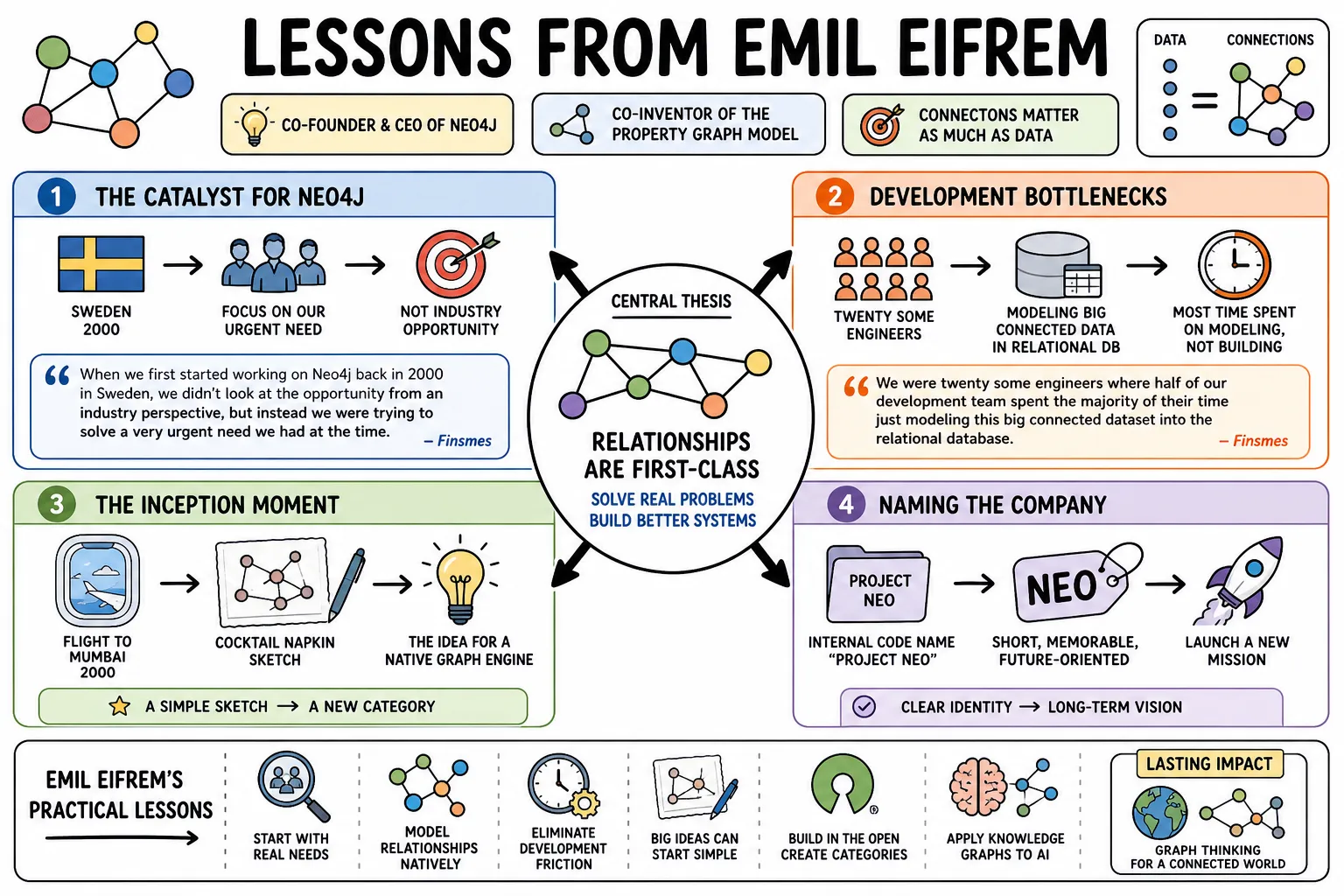
Emil Eifrem co-founded Neo4j and helped develop and popularize the property graph model. His interviews trace the company from a relational-database problem to an open-source business and, later, knowledge-graph applications for AI. — Future of Data and AI Interview.
Part 1: The Origins of the Property Graph
- Solve an Immediate Data Problem First: Eifrem says Neo4j began as an internal response to a Swedish startup's difficulty representing highly connected content and permissions in a relational database, not as a planned database-market opportunity. — Future of Data and AI Interview.
- Notice Where Engineers Fight the Abstraction: At the original startup, Eifrem recalls that roughly half of a 20-person engineering team spent much of its time working around the relational model. That engineering cost signaled a mismatch between the data and the tool. — Future of Data and AI Interview.
- Sketch the Better Model: Eifrem recounts sketching nodes, relationships and properties on a cocktail napkin during a flight to Mumbai. He stresses that the eventual model was a broader team effort, including collaborators at IIT Bombay. — Future of Data and AI Interview.
- Find Language for the New Category: Eifrem says the early product was called Neo and that the team later coined 'graph database' to explain a database centered on connections. The old domain-price and Java-suffix details are omitted because a full direct passage was not accessible in this audit. — Neo4j Interview.
- Test Category Names Until One Resonates: Before 'graph database' stuck, Eifrem says the team tried labels including 'network-oriented database' and 'netbase.' The successful term made the distinct model easier to explain. — Graphistania Podcast.
- Use Humor Without Confusing the Mission: Eifrem describes the 'Larry's yacht' line in his bio as a joke about challenging relational-database dominance, not a literal personal goal. — Future of Data and AI Interview.
- Model Connected Data in Its Natural Shape: Files, folders, shortcuts and permissions created multiple overlapping relationships that were awkward to encode as rows and joins. Eifrem saw a graph as a closer fit for that particular problem. — Future of Data and AI Interview.
- Build for Internal Use Before Selling: The first graph engine solved the team's own content-management problem. Only later, as the broader database landscape changed, did they spin it into a company. — Open Source Underdogs Interview.
- Make Relationships First-Class: Eifrem describes a graph database as storing nodes and the relationships among them, so connected data can be modeled and queried directly rather than reconstructed through tables. — Open Source Underdogs Interview.
Part 2: The Philosophy of Connected Data
- Relationships as First-Class Data: Eifrem describes a graph database as representing entities and their relationships together, making the connections themselves part of the model. — Investment Reports Interview.
- Connected Context for AI: Eifrem argues that graph structures can give AI applications useful context by connecting facts rather than treating records as isolated pieces. — Investment Reports Interview.
- Biological Inspiration: Eifrem says Neo4j drew inspiration from the brain's network of neurons and synapses when designing nodes and relationships; this is an analogy, not a claim that databases work like brains. — Investment Reports Interview.
- Reveal Connected Patterns: Eifrem says connected data can expose relationships that are harder to see when information is split across separate records. — Neo4j Interview with Emil Eifrem.
- Model the Domain Directly: In Eifrem's account, a graph model lets teams represent the entities and links in a domain directly instead of repeatedly translating a connected structure into relational tables. — Graphistania Podcast Interview.
- Impact Beyond the Enterprise: Eifrem points to journalists' work on the Panama Papers as an example of graph analysis helping people investigate connected information outside a conventional enterprise use case. — Neo4j Interview with Emil Eifrem.
- Recognize a Shape Mismatch: The original Neo4j team's files, folders, and permissions were deeply connected; Eifrem says translating those structures into relational tables cost developer time and runtime performance. — Graphistania Podcast Interview.
Part 3: Limitations of the Relational Model
- Tables Were a Useful Default: Eifrem says rows and columns served many simpler data tasks, while more connected modern applications exposed limits of that representation. — Investment Reports Interview.
- Complexity Changes the Fit: His argument is not that tables are obsolete: as users, devices, and relationships multiply, some workloads become less natural to model in rows and columns. — Investment Reports Interview.
- Developer Friction Exposed the Problem: At the original content-management startup, Eifrem says much of his team spent time fighting the relational database because its abstractions did not fit connected content and permissions. — Graphistania Podcast Interview.
- Joins Were Costly in Their Workload: Eifrem recalls that many joins made their particular connected-data workload slow; this is a case-specific observation, not a guarantee that every graph query outperforms a relational query. — Graphistania Podcast Interview.
- Represent Nodes and Relationships: Eifrem describes Neo4j's property graph as storing nodes, relationships, and their properties directly for connected-data use cases. — Future of Data and AI Interview.
- Nested Permissions Were a Stress Test: The team's folders, nested groups, and access rights formed a connected structure that Eifrem says was painful to maintain in tables. — Graphistania Podcast Interview.
- Adopt a Different Model When It Fits: The team's shift to graph modeling came from the shape of its data and workload, not from a claim that all relational modeling should be abandoned. — Graphistania Podcast Interview.
- Changing Connected Structures: Eifrem recalls that their rapidly changing content and security relationships were cumbersome to maintain with their relational stack. — Graphistania Podcast Interview.
- Native Graph Processing: Eifrem distinguishes graph-native storage and traversal from merely storing connected records in tables; his early team's experience motivated that design choice. — Graphistania Podcast Interview.
Part 4: Building an Open-Source Business
- Open Source as Distribution: Eifrem says releasing Neo4j as open source helped developers discover and adopt a new database category without a conventional top-down sales introduction. — Open Source Underdogs Interview.
- Balance Community and Commerce: Eifrem describes a free Community Edition alongside commercial capabilities for larger organizations, balancing broad use with a sustainable business. — Open Source Underdogs Interview.
- Educate a New Category: Because many developers had not heard of graph databases, Eifrem treated community education and open-source access as part of building the category. — Open Source Underdogs Interview.
- Charge for Enterprise Requirements: The commercial edition addressed needs such as stronger security and enterprise administration while keeping a free version available to developers. — Open Source Underdogs Interview.
- Learn from Developer Use: Open-source distribution exposed the product to developers before a sales relationship, giving the team a path to observe real uses and reduce adoption friction. — Open Source Underdogs Interview.
- Lower the First-Use Barrier: Eifrem emphasizes a low-friction developer experience so people can test a graph database before an enterprise purchasing conversation. — Open Source Underdogs Interview.
- An Open-Source Project Is Not a Business Model: Eifrem says free adoption and commercial revenue are separate challenges; a database company needs a deliberate path to paying enterprise customers. — Open Source Underdogs Interview.
- Serve the Enterprise's Different Needs: Eifrem distinguishes developers with more time than money from enterprises with more money than time; the latter pay for capabilities and support suited to production use. — Open Source Underdogs Interview.
Part 5: Startup Survival and Growth
- Survive a Pulled Term Sheet: Eifrem recounts a period when an expected investment fell through, leaving roughly $2,000 in the bank; consulting work and invoice factoring helped the company cover payroll. — Future of Data and AI Interview.
- Align Hiring with Strategy: Eifrem calls out a founder mistake: Neo4j pursued developer-led adoption while staffing too heavily for direct sales and too lightly for product and engineering. — Future of Data and AI Interview.
- Invest in Developer Experience: He says a developer-led company must make it easy for engineers to try, understand, and build with the product before a large sales organization can scale demand. — Future of Data and AI Interview.
- Monetization Needs a Deliberate Path: Eifrem distinguishes open-source popularity from a sustainable database business, which required a commercial offer for enterprise needs. — Open Source Underdogs Interview.
- Build Through Category Immaturity: Neo4j's early years involved teaching developers what a graph database was while maintaining a free community product and a commercial path. — Open Source Underdogs Interview.
- Culture Changes at Scale: Eifrem discusses how values and organizational culture became a different leadership problem as Neo4j expanded beyond its original small team. — Future of Data and AI Interview.
- Category Creation Takes Time: Eifrem describes the transition from explaining a new graph-database category to seeing major vendors offer graph products, which he treats as market validation. — Investment Reports Interview.
- Build Across Regions: Eifrem describes a company rooted in Europe that also had to build teams and reach customers globally; the source does not establish a universal Europe-versus-Silicon-Valley rule. — Open Source Underdogs Interview.
Part 6: Enterprise Sales and Developer Traction
- Enterprise Revenue Requires Enterprise Work: Eifrem says large organizations are an important paying customer group for a database company, requiring capabilities and a sales motion beyond free developer adoption. — Open Source Underdogs Interview.
- Develop Sales Without Losing the Product: The company built a direct enterprise-sales function while preserving the self-service experience that helped developers evaluate Neo4j. — Open Source Underdogs Interview.
- Developers Can Open the Door: Eifrem separates grassroots developer adoption from the eventual enterprise buyer; the first can create interest, but production contracts address different organizational needs. — Open Source Underdogs Interview.
- Prove Use Cases Beyond Social Graphs: Eifrem describes graph databases as useful across fraud, recommendations, customer journeys, and knowledge graphs rather than only social-network data. — Future of Data and AI Interview.
- Security Can Be a Commercial Need: Eifrem identifies stronger security and identity integrations among features that matter to enterprise buyers, even when a free community edition exists. — Open Source Underdogs Interview.
- Let Engineers Test the Value: The low-friction community product lets developers evaluate a graph database in their own work before an enterprise purchasing decision. — Open Source Underdogs Interview.
- Follow the Fraud Connections: Eifrem names fraud detection as a graph use case because related entities and transactions can be examined together; the source does not establish universal real-time superiority. — Future of Data and AI Interview.
- Recommendations Are Another Graph Use Case: Eifrem identifies recommendation systems among applications for connected data, without claiming immediate or measured return on investment for every deployment. — Future of Data and AI Interview.
- Start from Enterprise Data Sources: For knowledge-graph adoption, Eifrem recommends starting with a business problem and the relevant data sources, then building the graph-shaped knowledge layer needed for that use case. — Future of Data and AI Interview.
- Expect a Long Commercial Horizon: Eifrem describes database businesses as sticky and long-lived, while enterprise monetization and adoption need sustained work beyond the first developer download. — Open Source Underdogs Interview.
Part 7: Knowledge Graphs and Artificial Intelligence
- Graphs Can Add Structure to AI: Eifrem sees knowledge graphs as a way to supply structured, connected enterprise context to AI applications; the source does not support treating graphs as an inevitable equivalent of GPUs. — Future of Data and AI Interview.
- Organize Data Before Applying AI: Eifrem argues that fragmented or inconsistent organizational data limits useful AI applications, so consolidation and organization are foundational work. — Investment Reports Interview.
- Ground Answers in Connected Knowledge: Eifrem argues that a knowledge graph can provide context and provenance for AI answers; this may reduce errors but does not guarantee hallucination-free output. — Future of Data and AI Interview.
- AI Needs Context: Eifrem's point is that a graph can connect facts into the context an AI application needs, rather than leaving each record isolated. — Investment Reports Interview.
- Combine Graph and Vector Retrieval: Eifrem favors hybrid retrieval—semantic and keyword search alongside graph traversal—for complex production uses, while acknowledging simpler vector-only retrieval can suffice elsewhere. — Future of Data and AI Interview.
- Make AI Answers Auditable: Eifrem says graph relationships can make part of an AI system's evidence path more transparent and auditable; he explicitly cautions that transparency does not eliminate all risks. — Investment Reports Interview.
- Give Agents Relevant Context: In Eifrem's account, knowledge graphs can organize connected business facts for AI systems and agents; he does not establish that every agent requires a graph as long-term memory. — Future of Data and AI Interview.
- Distinguish Structure from Certainty: Graph structure can make relationships inspectable, but Eifrem's discussion does not claim it makes probabilistic language models deterministic or safe for every mission-critical task. — Investment Reports Interview.
- Connect Models to Private Knowledge: Eifrem describes using a knowledge graph to expose connected organizational information to language-model applications in a more structured way. — Future of Data and AI Interview.
Part 8: The Future of Data and Graph Technology
- Begin with a Business Problem: Eifrem advises teams to select a concrete use case and relevant data sources, then build the knowledge graph incrementally instead of constructing a giant graph before its purpose is clear. — Future of Data and AI Interview.
- The Internet of Connected Things: Eifrem predicted that IoT value would lie in connections among devices, people, organizations, and applications; his trillions-of-connections figure is a forecast, not an observed count. — On Graphs: Emil Eifrem Interview.
- Keep a Precise Graph Query Language: Eifrem describes Cypher as a way to express graph patterns and GQL as a developing standard; AI-assisted querying does not remove the need for precise graph operations. — Graphistania Podcast Interview.
- Category Adoption Is a Signal: Eifrem says major cloud vendors and newer companies entering graph databases demonstrate that the category has spread beyond its early niche. — Investment Reports Interview.
- AI Makes Connected Context More Valuable: Eifrem expects AI systems that must work with complex organizational data to benefit from graph-based context; he does not claim every AI-native startup must use a graph database. — Investment Reports Interview.
- Build a Reusable Knowledge Layer: Eifrem's adoption advice is to build the graph around a real use case, then extend it as the organization learns which connected data is valuable. — Future of Data and AI Interview.
- Place Knowledge Between Data and AI: Eifrem describes a knowledge graph as a structured layer that connects enterprise data to AI applications, rather than a replacement for every underlying data store. — Future of Data and AI Interview.
- Aim Beyond a Single Use Case: Eifrem cites fraud detection, recommendations, and master-data management as graph applications, and describes helping people make sense of connected data as Neo4j's broader mission. — On Graphs: Emil Eifrem Interview.