Emily Kramer is a B2B startup marketing advisor, investor, and creator of the MKT1 Newsletter and Dear Marketers podcast. She previously built and led marketing teams at Asana, Carta, Astro, and Ticketfly. Through MKT1, she writes and teaches about marketing strategy, teams, and AI-enabled workflows. — MKT1.
On Marketing Strategy & Frameworks
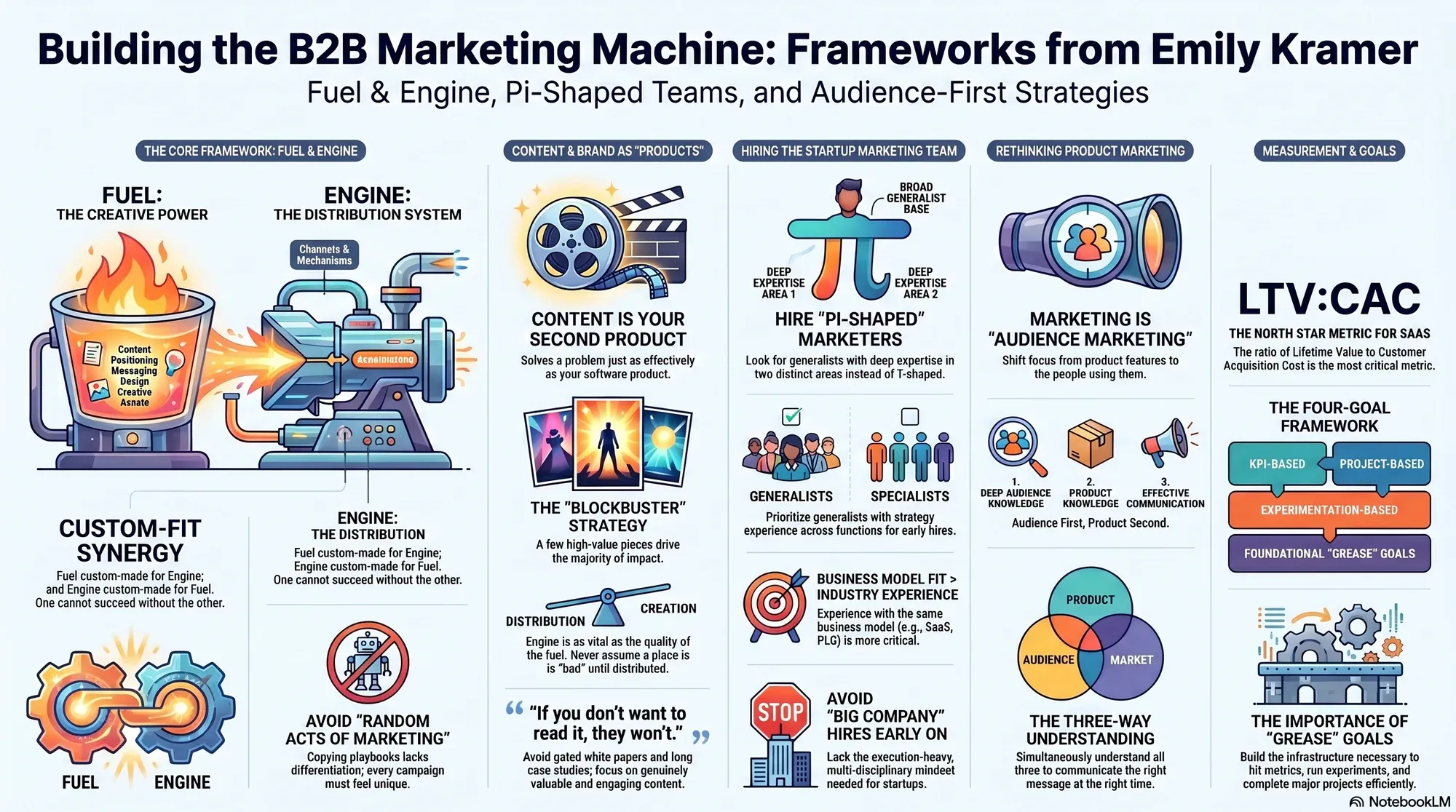
- Fuel and Engine: Strip away marketing sub-function jargon and plan around both the content and messaging you create (fuel) and the channels and systems that distribute it (engine). — MKT1 Fuel and Engine.
- Define the Fuel: Marketing fuel is what a company says and shows its audience, from website copy and design to essays, ads, and videos. — MKT1 Fuel and Engine.
- Define the Engine: The engine comprises the channels, processes, tools, and measurement that put fuel in front of the right audience. — MKT1 Fuel and Engine.
- Fit Fuel to Engine: Kramer argues that content and distribution must be designed for each other rather than developed in separate silos. — MKT1 Fuel and Engine.
- Avoid Random Acts of Marketing: Choose work from a strategy grounded in the company’s audience, go-to-market motion, and advantages instead of copying isolated tactics. — MKT1 Method.
- Build Your Own Playbook: Another company’s marketing playbook may fail because its audience, stage, motion, and strengths differ from yours. — MKT1 Method.
- Organize Marketing Like Product: Marketing resembles a multidisciplinary product team: it needs complementary roles and must balance near-term execution with long-term projects. — MKT1 Marketing Orgs.
- Plan for Short and Long Horizons: Marketing planning should connect immediate growth, longer-term bets, and the foundational work needed to execute efficiently. — MKT1 Method.
- Differentiate the Marketing: A differentiated product still needs marketing tailored to its own audience, market, and advantages; copying a later-stage company is no substitute. — MKT1 Method.
- Identify Built-In Advantages: Look for dynamics such as product virality, network effects, or ecosystem partnerships that can accelerate growth, then build strategy around them. — MKT1 Marketing Advantages.
- Prioritize Four Revenue Levers: Kramer’s four high-level levers are reaching more of the current market, entering new segments, improving conversion or acquisition efficiency, and increasing revenue per customer. — MKT1 Growth Strategy.
- Focus on Big Bets: Kramer favors a small number of strategic bets connected to company goals over indiscriminate requests and scattered activity. — MKT1 Mutiny Takeaways.
- Work With Complements: Kramer urges marketers to consider complementary companies and partners alongside competitors, especially when building a category. — MKT1 Mutiny Takeaways.
- Give AI Full Business Context: A shared marketing AI system needs more than a strategy document: customer, sales, launch, messaging, and brand context must be accessible and kept current. — MKT1 Multiplayer Claude.
- Build Skills That Maintain Skills: Kramer distinguishes skills that perform marketing work from skills that build, test, publish, and maintain those capabilities. — MKT1 Multiplayer Claude.
On Content & Brand
- Treat Content as a Product: Kramer advocates product-like thinking for content: understand the audience, create differentiated value, and build a repeatable content system. — MKT1 Content Strategy.
- Plan Distribution Up Front: Do not judge a piece of content solely by initial results if no appropriate distribution plan was made; choose the audience and channels while planning the content. — MKT1 Content Distribution.
- Manage Content as a Portfolio: Kramer treats content as a portfolio of bets: each should have a chance to add value, while a few may drive outsized returns. — MKT1 Content Strategy.
- Make Content Worth Reading: In a direct Q&A, Kramer says content should add value to its audience and cautions against defaulting to gated white papers or overlong case studies. — Online Geniuses Q&A.
- Design the Company Story: Kramer treats a company’s story as a product that needs a clear purpose, audience, and distinctive point of view. — Dear Marketers: Consistent Story.
- Use Perceptions for Consistency: Kramer and her co-hosts use “perceptions”—ideas they want an audience to associate with a company—to guide a consistent story across channels. — Dear Marketers: Consistent Story.
- Rethink the Company Blog: Kramer’s podcast companion concludes that company blogs are not dead, but derivative SEO posts are less useful; long-form content needs expertise, a distinct point of view, and distribution. — Dear Marketers: Company Blog.
- Choose Clarity Over Cleverness: Kramer endorses plain, audience-specific messaging that quickly explains who a product is for, what it does, and why it is different. — MKT1 Mutiny Takeaways.
- Avoid Bland Universal Appeal: In a direct interview feature, the ice-cream analogy illustrates that trying to please everyone can produce bland content; specificity matters. — Typeform Off Script.
- Let Audience Conversations Shape Content: Kramer uses reader conversations, polls, and feedback to create pointed content rather than generic AI-shaped material. — Typeform Off Script.
On Hiring & Team Building
- Hire π-Shaped Marketers: For early teams, Kramer and her coauthors recommend marketers with depth in two functions and enough breadth to connect the rest. — MKT1 First Marketer.
- Do Not Overvalue Big-Company Experience: A candidate who has worked only at a late-stage or public company may lack the hands-on experience an early startup needs. — MKT1 First Marketer.
- Choose a First Marketer Who Can Both Plan and Execute: The first marketer should set goals and strategy across functions while also being willing to do hands-on work. — MKT1 First Marketer.
- Start With Broad Marketing Range: Early teams benefit from marketers who can work across functions; specialists become easier to layer in as the organization grows. — MKT1 First Marketer.
- Match the Go-to-Market Motion: Experience with the startup’s purchase and business model can matter more than superficial industry similarity when hiring its first marketer. — MKT1 First Marketer.
- Expect Both Strategy and Execution: An early-stage marketer must prioritize, move quickly, and work outside a narrow job description while the team is small. — MKT1 First Marketer.
- Balance Fuel and Engine Roles: As the team grows, Kramer recommends balancing people focused on creative fuel, distribution engine, and roles that combine both. — MKT1 Fuel and Engine.
- Do Not Treat Marketing as Sales Support: Marketing spans full-funnel conversion, customer experience, and long-term brand building, not merely this quarter’s pipeline. — MKT1 Marketing Orgs.
- Develop the Gen Marketer Skillset: Kramer’s Gen Marketer combines AI fluency, audience insight, and cross-channel campaign execution with the ability to learn across functions. — MKT1 Gen Marketer.
- Use Specialists to Scale Proven Work: Kramer describes a small-team model in which in-house generalists test and prove a motion, then specialists help deepen and scale it. — MKT1 Mutiny Takeaways.
- Turn Individual AI Gains Into Team Gains: Kramer argues that shared context and capabilities let improvements made by one AI-fluent teammate benefit the whole team. — MKT1 Multiplayer Claude.
- Rebalance Toward AI-Fluent Generalists: Kramer expects marketing organizations to rely more on generalists who coordinate product marketing, growth, brand, and AI-enabled execution. — MKT1 Gen Marketer.
On Product Marketing
- Think of Product Marketing as Audience Marketing: Kramer argues that product marketing should start with the people a company serves, not only the product it has built. — MKT1 Product Marketing.
- Start With Audience Knowledge: Effective product marketers first understand their audience deeply, then connect that understanding to detailed product knowledge. — MKT1 Product Marketing.
- Connect Product, Market, and Audience: A product marketer’s work links knowledge of the audience and product to clear communication that fits the market. — MKT1 Product Marketing.
- Define Product Marketing Broadly: Kramer defines the function as understanding a company’s audience and product and determining how to communicate effectively with that audience. — MKT1 Product Marketing.
- Clarify an Ambiguous Role: Because product marketing means different things at different companies and stages, founders should define the audience knowledge and communication responsibilities they actually need. — MKT1 Product Marketing.
On Growth, Metrics & Goals
- Use Goals to Prioritize: Marketing goals should help a team choose high-impact work, not stop at short-term lead or revenue targets. — MKT1 Goal Setting.
- Set KPO Goals: Kramer updated her earlier four-type model: she now recommends company-level KPIs, big projects, and operations or foundational work; experiments can still be managed without a separate company-level goal category. — MKT1 Goal Setting.
- Make Foundational Work Visible: Ops goals reserve time for hiring, research, tools, measurement, and processes that enable later projects and growth. — MKT1 Goal Setting.
- Measure Revenue Impact: Kramer argues that marketers should know whether the activities they prioritize contribute to revenue, using suitable full-funnel measurement. — MKT1 Marketing Analytics.
- Fix Analytics Before Over-Engineering: Many early B2B teams lack reliable marketing data either because basic tracking is missing or their systems are too complex for their stage. — MKT1 Marketing Analytics.
- Explain Brand ROI Honestly: Kramer says brand-building returns are difficult to prove with attribution alone and recommends combining brand-health evidence with longer-term business measures when speaking to stakeholders. — Tracksuit Interview.
- Forecast From the Funnel: Use observed funnel stages and conversion rates to build bottom-up forecasts, then compare them with revenue targets and revise the marketing plan accordingly. — MKT1 Marketing Analytics.
- Use Metrics That Fit the Model: In a direct Q&A, Kramer named LTV:CAC as a metric she likes and also cited invites per user for some products; the right measure depends on the business model. — Online Geniuses Q&A.
- Diagnose the Lifecycle, Not Just the Top: Kramer’s analysis of Mutiny stresses tracking sign-ups and conversion through the lifecycle to identify whether traffic, messaging, or another stage is the bottleneck. — MKT1 Mutiny Takeaways.
- Use Trusted Ecosystem Intermediaries: In a signed guest essay, Kramer argues that partners who already have audience trust can extend a startup’s reach more effectively than going directly to every prospect. — Ecosystem Growth Essay.
On Leadership & Career
- Acknowledge the Loneliness of Marketing Leadership: Kramer describes leading startup marketing as difficult and sometimes lonely, a reason she designed a peer-learning course for marketing leaders. — Maven Course.
- Keep Learning From Smart Colleagues: In a direct Q&A, Kramer advises taking time to hire and surrounding yourself with capable people you can learn from. — Online Geniuses Q&A.
- Prioritize Ruthlessly: Kramer says she accepts that she cannot do everything and prioritizes accordingly when work becomes overwhelming. — Online Geniuses Q&A.
- Use Goals to Handle Requests: Kramer recommends sharing clear goals, finding the real problem behind requests, and using an intake process so marketing does not become purely reactive. — Dear Marketers: Requests.
- Avoid Common New-Manager Mistakes: Kramer and her co-hosts identify scattered low-impact work, poor delegation, weak coaching, and neglecting internal communication as recurring marketing-management problems. — Dear Marketers: New Managers.
- Choose Channels for the Company: Kramer argues that once-reliable marketing channels change; teams should select and test channels against their own audience, motion, and advantages rather than assume an old playbook will keep working. — MKT1 Marketing Channels.
- Do Not Force Founder Thought Leadership: A founder’s LinkedIn presence can be worth supporting when the founder wants to participate and the audience is there; forcing it is unlikely to work. — Dear Marketers: Founder LinkedIn.
- Build Relationships With Founders: In a direct Q&A, Kramer suggests reaching founders through useful product feedback or relevant events when seeking early-stage opportunities. — Online Geniuses Q&A.
- Ask Better Questions About Equity: In a direct podcast interview, Kramer discusses the equity gap at early-stage companies and urges candidates to ask informed questions and compare the value of their offers. — Marketing Trends Podcast.
- Leave Room for Fun at Work: Kramer says that having some fun at work has helped her; the remark is personal experience, not a universal productivity prescription. — Online Geniuses Q&A.
- Make Marketing a Startup Strength: Kramer describes marketing as often misunderstood and underused but critical to startups, and says MKT1 aims to help leaders make it a strength. — MKT1.
- Be Candid About Burnout: Asked how she handles overload, Kramer says she does not claim to have solved it; a dog, live music, and prioritization help her personally. — Online Geniuses Q&A.
Learn more:
- How to build a powerful marketing machine | Emily Kramer (Asana, Carta, MKT1) - YouTube
- How to build a powerful marketing machine | Emily Kramer (Asana, Carta, MKT1)
- Definitive Frameworks for BTB (and B2B) Marketing with Emily Kramer | BTB Conf Keynote
- Building an efficient marketing machine: the fuel & the engine - MKT1 Newsletter with Emily Kramer
- How to Avoid Common Marketing Missteps with Emily Kramer, Co-Founder & Marketing Advisor at MKT1 - YouTube
- 93: Emily Kramer - The Death of Marketing Channels - YouTube
- Marketing Planning & Forecasting with Emily Kramer - Part 1 - YouTube
- Finding Go-to-Market and Business Model Fit, Setting the Right Marketing Goals, and Marketers as Investors with Emily Kramer - Omniscient Digital
- A behind the scenes look at my content strategy — MKT1
- Q&A Session: Emily Kramer - Online Geniuses
- “Dear Marketers, How Do You Tell a Consistent Story?” | Dear Marketers - Episode 2
- Dear Marketers: Is the company blog dead? — MKT1
- Dear Marketers: Should your founder be an influencer? — MKT1
- How to hire your first marketer — MKT1
- Building B2B Startup Marketing Orgs from 1 to 25+ — MKT1
- Emily Kramer: Hiring the First Marketer for Your Startup - YouTube
- Building B2B Startup Marketing Orgs from 1 to 25+
- How has the product launch playbook changed? - YouTube
- We've been defining product marketing wrong
- How to measure what marketing activities are actually driving revenue
- Brand ROI demystified: 4 expert tips from MKT1's Emily Kramer - Tracksuit
- Building B2B Marketing by Emily Kramer on Maven
- How do you handle marketing requests? - YouTube
- Bridging the Equity Gap with Emily Kramer, VP of Marketing at Carta - Mission