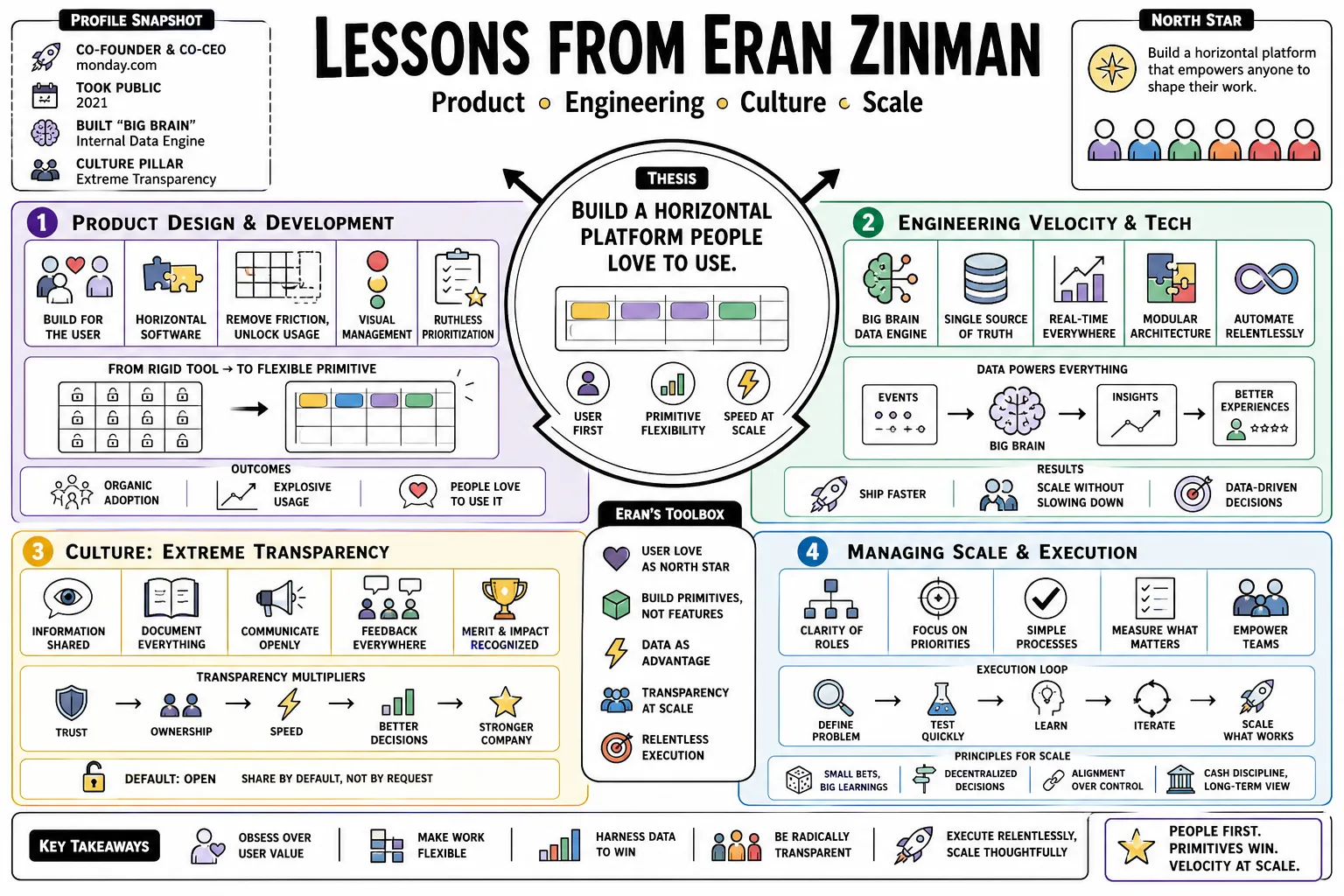
Lessons from Eran Zinman
Eran Zinman co-founded monday.com with Roy Mann and serves as co-CEO. The company went public in 2021. Zinman describes its internal Big Brain analytics platform and a company-wide commitment to transparent operating data. This profile examines his approaches to product, growth, leadership and AI. — 20VC Eran Interview.
Part 1: Product Design and Development
- Build for users: Zinman says product and hiring decisions should favor empathy for users and the experience people actually have, not just revenue optimization. — Startup for Startup Culture Talk.
- Build a horizontal platform: Mann and Zinman chose configurable building blocks rather than prescribing one workflow, after seeing customers adapt spreadsheets to their own businesses. — 20VC Eran Interview.
- Follow the real workflow: The early collaboration product had limited traction; interviews revealed that customers used private spreadsheets to manage work, prompting a pivot to flexible work management. — 20VC Eran Interview.
- Make work visible: The board interface gives teams a shared, real-time view of large and varied workflows; the engineering challenge was to keep that visual surface responsive. — Software Engineering Daily.
- Prioritize demonstrated demand: The CRM product grew from observing tens of thousands of customers build their own CRM workflows on the platform, then packaging that demand into a dedicated product. — 20VC Eran Interview.
- Keep flexibility usable: Zinman described the platform as simple and adaptable enough for a two-person team while supporting much more complex operations across departments. — The Digital Enterprise Interview.
- Offer building blocks: The Work OS idea is to let customers combine boards, columns, automations and integrations into workflows that fit their own processes. — Software Engineering Daily.
- Treat performance as product work: Zinman described virtualized rendering and small, real-time updates as essential to making large boards feel fast. — Software Engineering Daily.
- Learn through iteration: Zinman argues that teams should release and seek real-world feedback quickly, improving toward quality through repeated iterations. — Impact-Driven Leadership.
Part 2: The Co-CEO Model and Leadership
- Make partnership low-ego: Zinman says the co-CEO arrangement works because Roy Mann puts the company ahead of title or personal credit and they spend substantial time thinking together. — 20VC Eran Interview.
- Share the work: The founders initially attended investor meetings together and even switched who discussed business versus technology, before formalizing their co-CEO roles. — 20VC Eran Interview.
- Find common ground early: Zinman says they disagree on priorities at times, but settle important issues before major decisions rather than allowing fundamental splits to linger. — 20VC Eran Interview.
- Lean on partners in hard periods: During difficult public-market periods, Zinman credits Roy, the leadership team and his family as sources of confidence and support. — 20VC Eran Interview.
- Lead for impact: For Zinman, a leader helps a capable team move efficiently toward a clear outcome instead of merely policing tasks or sprint points. — Impact-Driven Leadership.
- Set goals from the desired outcome: Zinman starts planning with what he wants to achieve, then works backward to a plan rather than merely extrapolating from last year's output. — 20VC Eran Interview.
- Keep evolving as founder: Zinman says each stage of leading monday.com has been new to him, requiring continued learning rather than relying on one fixed founder role. — 20VC Eran Interview.
Part 3: Transparency and Data (Big Brain)
- Make operating data visible: Zinman says everyone at monday.com can access Big Brain to see and measure results, extending transparency beyond a management-only dashboard. — 20VC Eran Interview.
- Build the analytics needed to scale: Zinman says monday.com built Big Brain internally to connect campaign and user activity through sign-up, conversion and expansion rather than depending on generic analytics software. — 20VC Eran Interview.
- Let teams use the data: Giving employees direct access to Big Brain lets them examine campaign and product results themselves instead of waiting for management to relay the numbers. — 20VC Eran Interview.
- Measure the full funnel: Big Brain linked acquisition spending and user behavior through conversion and expansion so the team could optimize for cash payback, not only headline SaaS metrics. — 20VC Eran Interview.
- Prefer active value to sign-ups: In the culture talk, Zinman identifies weekly active paying people as a principal KPI, tying product success to actual use by paying customers. — Startup for Startup Culture Talk.
- Judge progress, not activity: Zinman distinguishes a team's impact from merely completing tasks or showing effort; leaders should ask whether work moves the outcome forward. — Impact-Driven Leadership.
- Keep the board close to live metrics: Zinman says Big Brain automatically sent daily company-performance SMS updates to board members, so difficult numbers were visible before meetings. — 20VC Eran Interview.
- Segment retention before interpreting it: Zinman cautions that SMB and enterprise cohorts have different churn patterns, so retention should be analyzed by segment rather than read as one undifferentiated number. — Startup for Startup SaaS Metrics.
Part 4: Scaling and Product-Led Growth (PLG)
- Make value self-service: After the pivot, the founders celebrated customers paying without a sales conversation because it showed the product's value could be understood directly. — 20VC Eran Interview.
- Design for nontechnical teams: Zinman says the product serves many nontechnical industries; flexibility and clear workflows matter beyond a narrow software-engineering audience. — The Digital Enterprise Interview.
- Add enterprise depth without abandoning self-service: The company expanded from self-service SMB adoption into larger accounts by adding onboarding, relationships, security and governance while keeping the smaller-customer product strong. — 20VC Eran Interview.
- Use sales where product alone is insufficient: Zinman says sales became necessary when larger customers needed help with rollout, relationships, security and governance that a self-service product alone could not provide. — 20VC Eran Interview.
- Let pricing follow the work done: Zinman expects AI-driven software pricing to move from seats toward a hybrid and eventually more consumption-based model as products perform more work. — 20VC Eran Interview.
- Lower the initial learning burden: Zinman said dedicated forms and whiteboard tools could make onboarding clearer by giving new users a specific, immediately understandable job to do. — Fast Company Interview.
- Give products focused teams: As monday.com became multi-product, Zinman described dedicated business units with their own product, marketing and sales efforts, operating like small startups inside the company. — 20VC Eran Interview.
- Recognize cross-industry demand: Early marketing brought customers from industries the founders had not targeted; Zinman says that diversity expanded the platform's potential market. — 20VC Eran Interview.
Part 5: Engineering Culture and Execution
- Hire product-minded engineers: Zinman says engineering candidates should care about the people who use the product and the experience those people have, not only technical implementation. — Startup for Startup Culture Talk.
- Release useful increments: Zinman asks teams with long projects what meaningful piece can be shipped in weeks so feedback arrives before the full plan is complete. — Startup for Startup Decision-Making.
- Learn from failures without blame: In his signed essay, Zinman describes weekly retrospectives where teams share lessons from initiatives that did not work, alongside celebrating wins. — How to Lead in This Time of Crisis.
- Use a short deadline to clarify scope: When a proposal is estimated in months, Zinman asks what can be delivered in two weeks—not to compress all the work, but to find a useful first increment. — Impact-Driven Leadership.
Part 6: Marketing and Customer Acquisition
- Measure acquisition payback: Zinman describes tracking campaigns through paid conversion and cash recovery, then using A/B tests to improve the marketing engine. — 20VC Eran Interview.
- Build memorable awareness with measurement: The rebrand to monday.com helped people recall the name after brief ads, while the company tracked YouTube exposure and return rather than treating brand as unmeasurable. — 20VC Eran Interview.
- Recycle acquisition cash deliberately: The company optimized campaigns, onboarding and annual payment flows so marketing spend could return cash quickly and fund further acquisition. — 20VC Eran Interview.
- Focus on execution over competitor anxiety: Zinman says the team studies rival products but does not treat competitors as the determining factor; he puts weight on the company's own execution. — 20VC Eran Interview.
- Add growth engines as scale changes: At roughly $50 million ARR, the founders saw that performance marketing alone would not carry the company to $1 billion, so sales and account expansion became more important. — 20VC Eran Interview.
Part 7: Navigating Failure and Resilience
- Normalize fast learning from failure: After overbuilding his first startup, Zinman made early feedback, experiments and willingness to fail part of monday.com's operating culture. — 20VC Eran Interview.
- Find a path through the early funding gap: The founders spent much of the seed round before the product pivot; existing investors then provided a convertible bridge that let the new self-service momentum develop. — 20VC Eran Interview.
- Separate market sentiment from execution: Zinman distinguishes what the company can change through consistent execution from public-market sentiment it cannot directly control. — 20VC Eran Interview.
- Choose a name people can remember: The dapulse-to-monday.com rebrand made the product easier to remember during short ad exposures; Zinman links the change to acquisition effectiveness. — 20VC Eran Interview.
- Be candid in a downturn: Zinman argues that leaders should regularly share difficult conditions and plans with employees, while giving teams trust and autonomy to act. — How to Lead in This Time of Crisis.
- Acknowledge the founder's strain: Zinman describes the emotional toll of difficult periods and points to team and family support as ways he stays focused on the company. — 20VC Eran Interview.
- Read churn as a value signal: Zinman treats churn as a metric for whether subscribers are receiving real value, not merely as an unpleasant number to hide. — Startup for Startup Churn Episode.
Part 8: Artificial Intelligence and the Future
- Move from recording work to doing it: Zinman argues that AI can shift software from mainly tracking work to performing a much larger share of it; monday.com's products must change accordingly. — 20VC Eran Interview.
- Distinguish prototypes from durable software: Zinman welcomes vibe coding but says generating an interface is not the same as building and maintaining a deep organizational product; he does not expect it alone to replace established software. — 20VC Eran Interview.
- Make AI change the core value: He says monday.com's first AI features were more like decoration; the company is rethinking what its products do rather than just attaching AI features to existing workflows. — 20VC Eran Interview.
- Use AI to change the work mix: Zinman describes AI qualifying inbound leads and helping support and engineering, while noting new bottlenecks and a gradual transition rather than a simple one-for-one headcount formula. — 20VC Eran Interview.
- Transform before the product becomes passive: He accepts that software limited to tracking could become a database beneath agents, and argues that incumbents need to make their products do more of the work. — 20VC Eran Interview.
- Build AI on enterprise controls: Zinman says monday.com's in-platform AI building uses existing data structures and security controls, distinguishing it from a standalone consumer coding tool. — monday.com Q4 2025 Earnings Call.
- Design for people and agents together: Zinman wants the platform to coordinate human and agent work, with agents producing artifacts that people can inspect and use. — 20VC Eran Interview.
- Connect information across tools: Zinman describes integrations that bring information from separate tools into shared workflows, making customer feedback and operational data more visible across teams. — Software Engineering Daily.
- Keep people in the loop: He expects a long period of collaboration between humans and agents because much organizational context is not yet documented for AI to use alone. — 20VC Eran Interview.