Eric Janssen is a faculty member at Ivey Business School who teaches sales and entrepreneurship. A former founder and early-stage startup operator, he also hosts the Sales Reframed podcast, where he explores selling as a practical skill for work and life. — Ivey Faculty Biography.
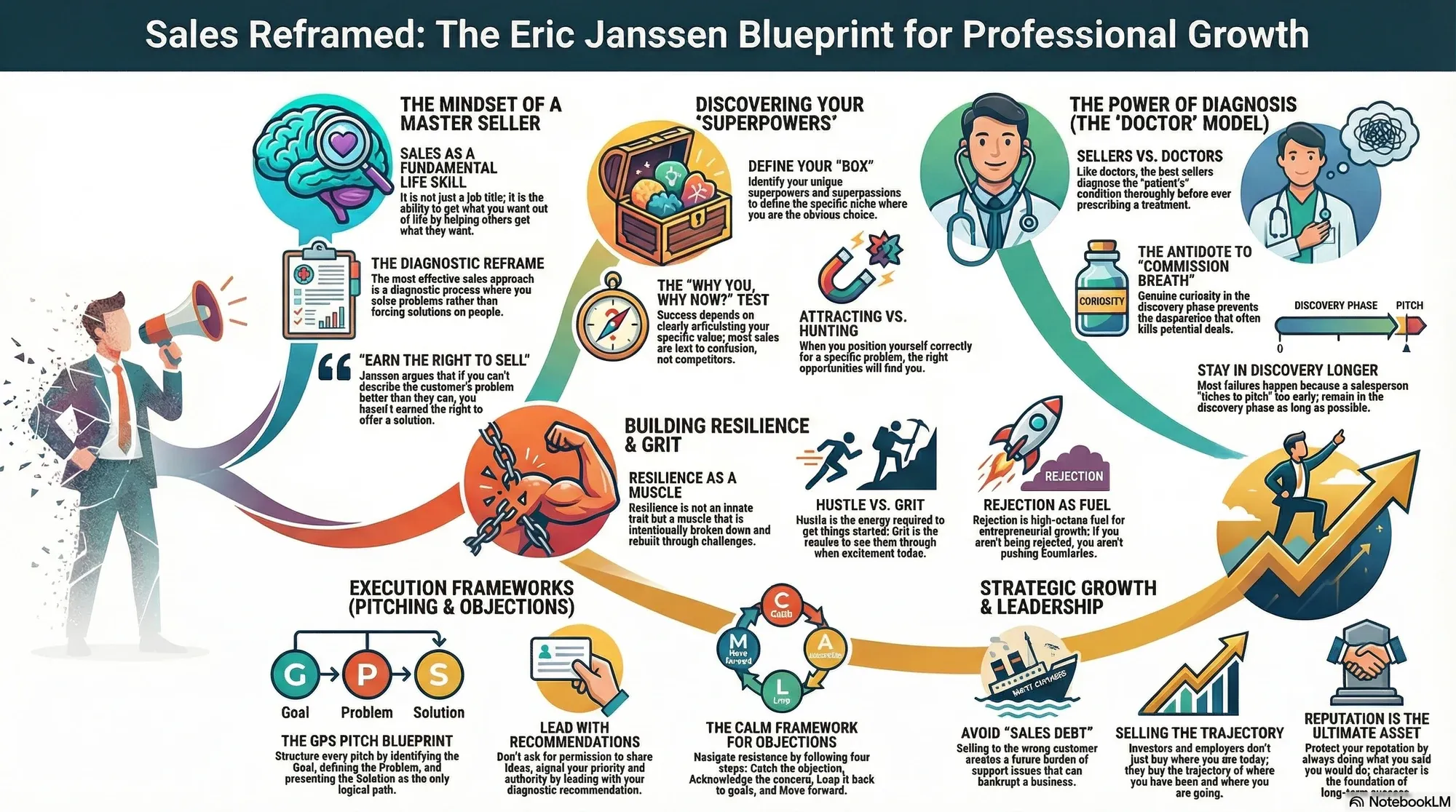
Part 1: The Sales Mindset
- Sales is a life skill: Janssen teaches sales as a transferable skill for people in many roles, not only those with sales titles. — Why Learn Sales?.
- Diagnose before proposing: He frames effective selling as understanding a customer’s problem before recommending a solution. — Sales Reframed: Diagnose First.
- Build and sell: In reflecting on his founder experience, Janssen emphasizes that building a product is insufficient if the team cannot learn to sell it. — The Founder Sales Sprint.
- Everyone sells ideas: He notes that founders and professionals regularly persuade colleagues, employers and customers even outside formal sales jobs. — Why Learn Sales?.
- Learn to sell yourself: Janssen calls selling yourself a major career task: show the other party the value you can provide rather than treating the interaction as a transaction. — Sales Reframed: Superpowers and Superpassions.
- Authenticity over a sales persona: He advises sellers to prepare and show up as themselves instead of imitating an imagined charming extrovert. — Three Common Sales Mistakes.
- Move beyond pushy sales: Janssen rejects the stereotype of sales as pressure to close and recommends screening for mutual fit. — Three Common Sales Mistakes.
- Lead with curiosity: The diagnosis episode urges sellers to ask thoughtful questions before offering answers. — Sales Reframed: Diagnose First.
- Understand the problem first: Janssen’s diagnostic approach asks sellers to learn what a customer is trying to solve before making a recommendation. — Sales Reframed: Diagnose First.
Part 2: Discovering Your Superpowers
- Find your superpowers and superpassions: In his talent-stack exercise, Janssen asks students to identify their strongest skills and interests, including feedback from people who know them. — Sales Reframed: Superpowers and Superpassions.
- Position for the right audience: He argues that a clear value proposition and narrow fit help the right employer or customer see why to choose you. — Sales Reframed: Superpowers and Superpassions.
- Discover your value: Janssen asks students to reflect on demonstrated strengths and gather outside feedback rather than inventing a generic claim of excellence. — Sales Reframed: Superpowers and Superpassions.
- Value propositions evolve: He explicitly describes value propositions as iterative, changing as a person or product develops. — Sales Reframed: Superpowers and Superpassions.
- Answer why you and why now: Janssen says a seller, founder or job candidate should be able to explain why their offering fits this buyer at this moment. — Sales Reframed: Superpowers and Superpassions.
- Make your value legible: He explains that buyers need to understand the specific value and difference an offering provides, not just hear a list of features. — Sales Reframed: Superpowers and Superpassions.
- Use interests to choose opportunities: His superpassions exercise links a person’s interests with skills when evaluating roles and opportunities. — Sales Reframed: Superpowers and Superpassions.
- Pursue opportunities that fit: Janssen’s example of Payton Beckett stresses targeted pursuit and a tailored case for fit; the opportunity did not simply arrive on its own. — Sales Reframed: Superpowers and Superpassions.
Part 3: The Power of Diagnosis
- Diagnose before prescribing: The episode compares good selling with diagnosis: explore the problem before presenting a treatment or product. — Sales Reframed: Diagnose First.
- Resist the premature pitch: Janssen argues that information-heavy early pitches can obscure the problem and reduce clarity. — We’re Obsessed with the Sales Pitch.
- Co-discover the problem: The diagnosis episode recommends a collaborative conversation that lets buyer and seller clarify the real need together. — Sales Reframed: Diagnose First.
- Questions beat information dumps: The direct episode emphasizes questions and listening over impressing the buyer with a polished answer. — Sales Reframed: Diagnose First.
- Diagnosis can reveal poor fit: Janssen says the questions his Intellitix team asked Fyre Festival exposed operational gaps and led them to step back. — Customer Selection Is Your Strategy.
- Understand the buyer’s timing: In explaining a value proposition, Janssen asks sellers to answer why the buyer should act now as well as why this offering fits. — Sales Reframed: Superpowers and Superpassions.
Part 4: Building Resilience and Grit
- Treat resilience as trainable: Janssen teaches will and resilience as capacities people can develop through intentional challenge and support. — Sales Reframed: The Resilience Engine.
- Use challenge to practice courage: He describes offering his students a skydiving challenge as an experiential lesson in doing something difficult despite fear. — Sales Reframed: The Resilience Engine.
- Practice handling rejection: His Rejection Olympics assignment deliberately exposes students to manageable rejection so they can build tolerance for it. — Ivey: Immersive Challenges.
- Will has several supports: Janssen describes will through cause, capacity, capability and community rather than treating grit as sheer stubbornness. — Sales Reframed: The Resilience Engine.
- Founder pressure needs systems: Janssen recounts projecting confidence while feeling overwhelmed by revenue targets, and says he needed accountability and a sales system rather than motivation alone. — The Founder Sales Sprint.
- Rejection is a learning exercise: He uses real-world rejection exercises to help students test and expand their capacity to recover from a no. — Ivey: Immersive Challenges.
Part 5: Mastering the Pitch
- Use the actual G.P.S. blueprint: Janssen’s show defines G.P.S. as Grab attention, explain the Problem and make the Solution a logical next step—not Goal, Problem, Solution. — Sales Reframed: The G.P.S. Blueprint.
- The Doorbot pitch lesson: The G.P.S. episode uses Doorbot’s unsuccessful Shark Tank appearance, followed by Ring’s later success, to illustrate that a valuable product still needs a pitch that lands. — Sales Reframed: The G.P.S. Blueprint.
- A pitch should create clarity: Janssen’s pitching episode stresses guiding the audience to understand the problem and the proposed next step instead of overwhelming it with detail. — Sales Reframed: The G.P.S. Blueprint.
- Make facts memorable through story: Janssen argues that a narrative helps an audience care about and remember the facts in a pitch. — Sales Reframed: Sell With Story.
- Clarity over performance: His signed essay warns that longer, information-heavy pitches can confuse buyers; the objective is a clear conversation, not a performance. — We’re Obsessed with the Sales Pitch.
- Connect problem and solution: In the G.P.S. framework, a clearly articulated customer problem makes the solution easier to see as a relevant next step. — Sales Reframed: The G.P.S. Blueprint.
Part 6: Navigating Objections (CALM Framework)
- Handle objections with CALM: Janssen’s CALM framework treats an objection as an invitation to understand the buyer: Catch, Acknowledge, Loop and Move forward. — Sales Reframed: The CALM Framework.
- Catch the objection: The first CALM step is to notice and receive an objection without trying to swat it away. — Sales Reframed: The CALM Framework.
- Acknowledge the concern: Janssen advises pausing and validating that a buyer’s concern is reasonable before answering it. — Sales Reframed: The CALM Framework.
- Loop back to understand: The Loop step asks follow-up questions, summarizes what was heard and identifies the concern behind the objection. — Sales Reframed: The CALM Framework.
- Move forward together: The last CALM step is to respond to the real concern and collaborate on a next move, not force an immediate close. — Sales Reframed: The CALM Framework.
- An objection carries information: Janssen says objections can indicate engagement or an unmet concern rather than a final rejection. — Sales Reframed: The CALM Framework.
- Stay curious under pressure: The CALM example shows why a defensive reaction to hard questions can hide a real opportunity for dialogue. — Sales Reframed: The CALM Framework.
- Solve objections collaboratively: He recommends treating resistance as a shared problem to understand instead of a contest to win. — Sales Reframed: The CALM Framework.
Part 7: Customer Fit and Strategy
- Choose customers deliberately: Janssen argues that poor customer selection can damage a business even when its team can close deals. — Sales Reframed: Customer Fit and Sales Debt.
- Avoid accumulating sales debt: He uses sales debt to describe how poor-fit customers can create churn, support burdens and distracting product decisions after an apparent short-term win. — Sales Reframed: Customer Fit and Sales Debt.
- Define fit criteria: Janssen advises founders to specify ideal-customer and no-fit criteria with input from operations and customer-success teams. — Customer Selection Is Your Strategy.
- Be willing to decline a prospect: He recounts stepping away from an apparently valuable Intellitix prospect when commitment and fit were inadequate. — I Just Broke Up With My Dream Prospect.
- Focus rather than scatter: Janssen says companies can drown in too many opportunities and should direct limited resources toward customers aligned with their strategy. — Customer Selection Is Your Strategy.
- Build a repeatable selling system: Reflecting on his founder experience, Janssen says disciplined systems and accountability matter more than simply opening more sales channels. — The Founder Sales Sprint.
- Include customer success in selection: His Intellitix fit process involved operations and customer-success teams so that sales commitments matched the conditions for successful delivery. — Customer Selection Is Your Strategy.
- Target specific high-value accounts: Rather than mass outreach, Janssen suggests naming a focused “Dream 20” of specific accounts and tailoring outreach to them. — Three Common Sales Mistakes.
Part 8: Leadership and Personal Trajectory
- Set high expectations in teaching: In his written Poets&Quants interview, Janssen says he sets demanding expectations because he believes students rise to the expectations others hold for them. — Poets&Quants: Eric Janssen Interview.
- Value trajectory over a static résumé: Janssen’s signed post explicitly prioritizes trajectory over experience, alongside curiosity and willingness to take feedback. — Eric Janssen: Trajectory > Experience.
- Keep reinventing your skills: Janssen says continuous self-improvement and learning from peers became a deliberate practice as he grew into a sales-leadership role. — Eric Janssen: What Are You Doing to Get Better?.