Eric Mandelblatt is the founder and chief investment officer of Soroban Capital Partners. His published interviews and Soroban’s Union Pacific campaign discuss commodity capital cycles, decarbonization, railroads and operational leadership. — Soroban’s Union Pacific Presentation.
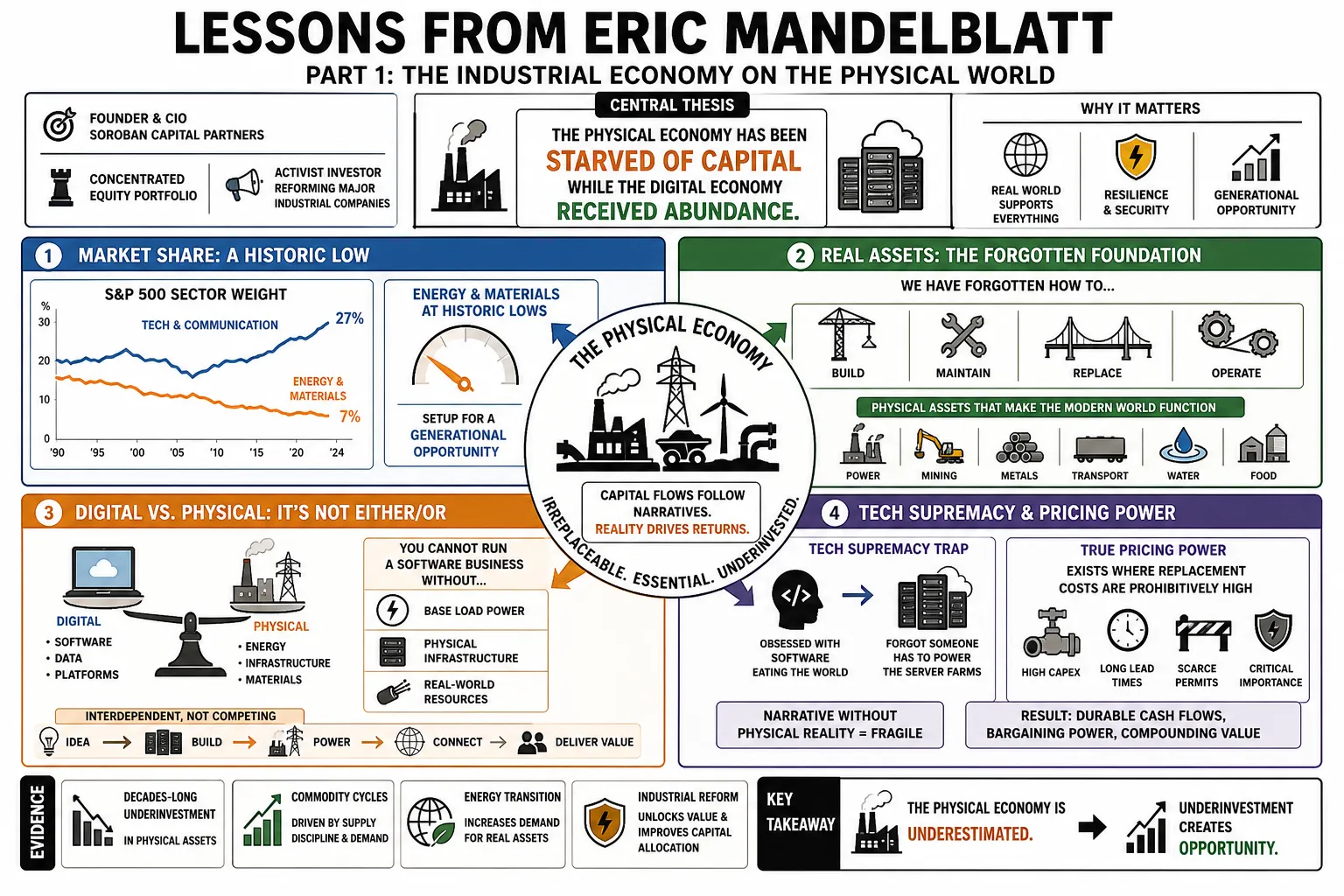
Part 1: The Industrial Economy
- Capital-starved physical supply: In the 2022 interview, Mandelblatt argued that constrained investment in commodity production had made physical supply less responsive to rising demand. — Invest Like the Best, Episode 266.
- A neglected market segment: He contrasted Soroban’s substantial 2022 industrial exposure with the much smaller energy-and-materials allocations he found at peer hedge funds. — Invest Like the Best, Episode 266.
- Rail pricing power: He described the limited number of North American Class I rail networks as an important source of rail pricing power. — Invest Like the Best, Episode 266.
- Hard-to-replicate infrastructure: Mandelblatt viewed established freight-rail networks as unusually durable assets because building comparable new networks would be difficult. — Invest Like the Best, Episode 266.
- Long supply lead times: He argued that years of weak investment and long project lead times prevent commodity supply from responding quickly to higher prices. — Invest Like the Best, Episode 266.
- Industrial reshoring and rail: He expected more US industrial construction and reshoring to increase demand for freight transport; this was his 2022 thesis, not a guaranteed outcome. — Invest Like the Best, Episode 266.
Part 2: Commodity Cycles and Capital Cycles
- Capital cycles shape commodities: He linked commodity supply constraints to prior capital spending and the long time needed to develop new production. — Invest Like the Best, Episode 266.
- Do not model supply as software: Mandelblatt cautioned that commodity supply cannot be expanded as quickly as digital capacity; copper projects, for example, can take more than a decade. — Invest Like the Best, Episode 266.
- Low prices deter future projects: His account of the prior commodity downturn emphasized how weak returns and volatile prices discouraged investment in long-lead-time projects. — Invest Like the Best, Episode 266.
- Investor pressure and energy supply: He said shareholder and social pressure on fossil-fuel producers was one reason higher prices were not eliciting the usual supply response in 2022. — Invest Like the Best, Episode 266.
- Copper mine lead times: Soroban estimated that a new large copper mine could require roughly 10–15 years from investment decision to production. — Invest Like the Best, Episode 266.
- Cash flow and balance sheets: In the 2022 interview he said commodity producers were using windfall cash flow to repair balance sheets and return capital, rather than only expanding output. — Invest Like the Best, Episode 266.
- Commodity exposure and inflation: He described Soroban’s commodity exposure as an inflation hedge, while acknowledging that valuation multiples could still fall. — Invest Like the Best, Episode 266.
- Supply constraints may persist: Mandelblatt argued in 2022 that some commodity supply challenges could last for years because new capacity has long lead times. — Invest Like the Best, Episode 266.
Part 3: The Energy Transition and Decarbonization
- The material intensity of decarbonization: He argued that electrification and renewable power require significant amounts of industrial metals and new physical capacity. — Invest Like the Best, Episode 266.
- Copper and electrification: He identified copper as a central input to electrification and discussed the additional copper demand from electric vehicles and grid expansion. — Invest Like the Best, Episode 266.
- ESG pressure can constrain supply: He said investor and policy pressure against fossil-fuel investment was limiting new supply even as the energy transition still required fossil fuels. — Invest Like the Best, Episode 266.
- The transition takes time: In 2022 he argued that the large existing fossil-fuel share of global energy use meant a rapid switch to renewables was unrealistic. — Invest Like the Best, Episode 266.
- Carbon-pricing uncertainty: He said uncertainty about future carbon taxes and quotas made producers hesitant to commit to new carbon-intensive capacity. — Invest Like the Best, Episode 266.
- The grid also needs investment: His electrification discussion included grid rewiring and charging infrastructure alongside new electric vehicles and generation. — Invest Like the Best, Episode 266.
- A capital-intensive transition: He cited multi-trillion-dollar annual estimates for decarbonization investment and stressed that the transition would be both capital- and time-intensive. — Invest Like the Best, Episode 266.
- Unclear rules complicate long investments: He said uncertainty over future carbon rules affected investment decisions for long-lived steel, aluminum and fertilizer assets. — Invest Like the Best, Episode 266.
- Do not outrun replacement supply: His 2022 concern was that reducing fossil-fuel investment before alternative capacity was ready could aggravate energy scarcity; this is his dated assessment. — Invest Like the Best, Episode 266.
Part 4: Railroads and Infrastructure
- A durable rail franchise: Soroban called Union Pacific a premier, hard-to-replicate North American rail franchise while criticizing its then-current operating performance. — Soroban’s Union Pacific Letter.
- Franchise strength is not execution: The letter argued that Union Pacific’s strong network did not excuse poor safety, service and growth metrics under its then-management. — Soroban’s Union Pacific Letter.
- Operational discipline matters: Soroban argued that experienced railroad operators could improve safety, service and productivity, citing Jim Vena’s earlier tenure at Union Pacific. — Soroban’s Union Pacific Letter.
- Reliable service supports volume: Soroban’s campaign argued that better service could win additional freight volume and use capacity already present on the network. — Soroban’s Union Pacific Presentation.
- Oligopoly does not excuse bad service: In the interview, Mandelblatt said rail operators had lost customer goodwill when limited competition reduced the pressure to provide reliable service. — Invest Like the Best, Episode 266.
- Competing with trucks: Soroban argued in 2023 that better rail service could shift freight from trucks while reducing emissions per ton-mile. — Soroban’s Union Pacific Letter.
- Capital return at railroads: In the 2022 interview he contrasted rail dividends and buybacks with stock issuance elsewhere, while also emphasizing rail service and volume growth. — Invest Like the Best, Episode 266.
Part 5: Capital Allocation and Corporate Governance
- Partner capital alongside clients: Soroban’s 2023 presentation stated that internal partner and employee capital collectively made up its largest single investor. — Soroban’s Union Pacific Presentation.
- Boards must hold leaders accountable: In his signed Union Pacific letter, Mandelblatt listed choosing management, setting targets and holding leaders accountable as core board duties. — Soroban’s Union Pacific Letter.
- Metrics should inform oversight: The 2023 letter criticized Union Pacific’s then-operating metrics and noted that its CEO had missed annual incentive targets; it did not make a universal compensation claim. — Soroban’s Union Pacific Letter.
Part 6: Activist Investing and Driving Change
- A shareholder can press for change: Soroban’s 2023 Union Pacific campaign illustrates its willingness to advocate management change where it believed long-running operating problems remained unresolved. — Soroban’s Union Pacific Letter.
- Match a strong asset with strong leadership: Mandelblatt argued that Union Pacific’s network needed a leader with demonstrated railroad operating expertise. — Soroban’s Union Pacific Letter.
- Escalate after private engagement: The letter said Soroban went public only after years of privately raising its concerns with Union Pacific’s board. — Soroban’s Union Pacific Letter.
- Execution before a new slogan: Soroban’s specific Union Pacific ask was operational leadership capable of improving safety, service and execution on an existing network. — Soroban’s Union Pacific Letter.
- Unlocking a franchise through operations: Soroban argued that improved leadership and operations could allow Union Pacific to better realize the value of its existing network; its 2023 valuation was a forecast. — Soroban’s Union Pacific Letter.
- Long engagement: The letter described Soroban as a patient Union Pacific shareholder since 2016 and said it intended to continue its ownership. — Soroban’s Union Pacific Letter.
Part 7: Investment Philosophy and Concentration
- Concentrated positions: In the 2022 interview Mandelblatt described a portfolio with most risk in a few sectors and several large holdings, without endorsing the original one-third formula. — Invest Like the Best, Episode 266.
- Research-intensive approach: Soroban described its approach as fundamental, research-driven and focused on durable businesses in its original 2023 presentation. — Soroban’s Union Pacific Presentation.
- Internal capital at risk: Soroban’s original 2023 presentation said its partners and employees collectively represented its largest single investor. — Soroban’s Union Pacific Presentation.
- A multi-year investment horizon: Soroban’s 2023 presentation said its long-dated capital base allowed it to underwrite investments over multiple years. — Soroban’s Union Pacific Presentation.
Part 8: The Psychology of Markets
- Peer funds favored growth: In 2022 Mandelblatt said the peer hedge funds he screened had crowded into growth-oriented sectors while Soroban held more industrial exposure. — Invest Like the Best, Episode 266.
- Volatility and leverage: He distinguished commodity price volatility from permanent loss, arguing that repaired producer balance sheets reduced the risk of being forced out during a downturn. — Invest Like the Best, Episode 266.
- Beware false precision: When valuing commodity producers, he warned against precise long-range commodity-price forecasts and favored directional scenarios with a larger margin of safety. — Invest Like the Best, Episode 266.