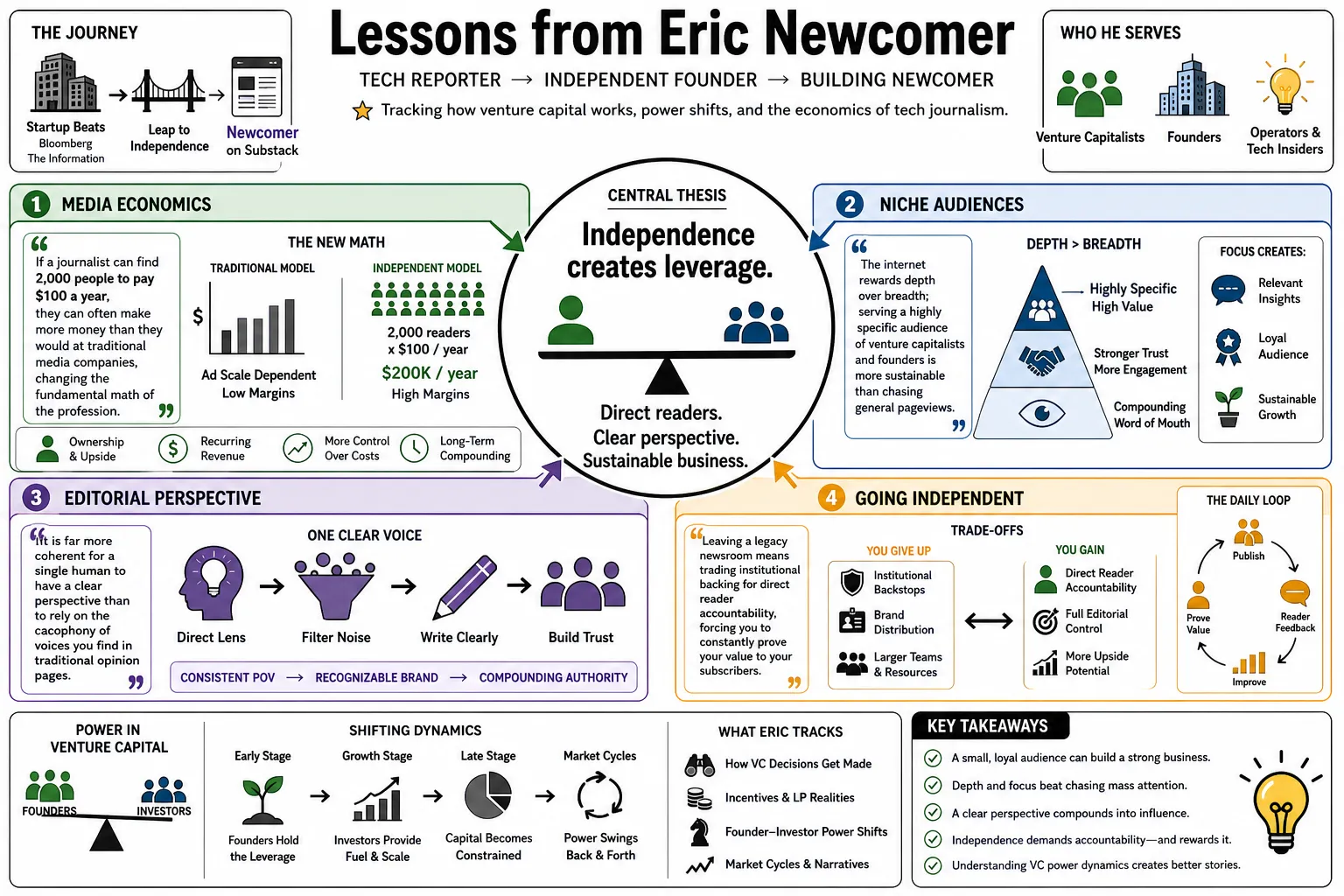
Lessons from Eric Newcomer
Tech reporter Eric Newcomer left his startup beats at Bloomberg and The Information to build an independent Silicon Valley media business through his Substack, Newcomer. This profile collects his observations on how venture capital actually works, tracking the shifting power between founders and investors and the economics of tech journalism.
Part 1: The Business of Independent Journalism
- On Media Economics: "If a journalist can find 2,000 people to pay $100 a year, they can often make more money than they would at traditional media companies, changing the fundamental math of the profession." — Source: [Newcomer Newsletter]
- On Niche Audiences: "The internet rewards depth over breadth; serving a highly specific audience of venture capitalists and founders is more sustainable than chasing general pageviews." — Source: [Newcomer Podcast]
- On Editorial Perspective: "It is far more coherent for a single human to have a clear perspective than to rely on the cacophony of voices you find in traditional opinion pages." — Source: [Substack]
- On Going Independent: "Leaving a legacy newsroom means trading institutional backing for direct reader accountability, forcing you to constantly prove your value to your subscribers." — Source: [Newcomer Newsletter]
- On Subscription Models: "When readers pay you directly, your incentives align with producing high-signal analysis rather than clickbait designed to satisfy advertisers." — Source: [Newcomer Podcast]
- On Competing with Legacy Media: "A solo operator cannot cover every single press release, but they can beat major outlets by being deeply embedded in the social fabric of a specific industry." — Source: [Newcomer Newsletter]
- On the Creator Economy for Writers: "Journalists are realizing that their byline is the actual product, and platforms that let them monetize that byline directly are disrupting the old publishing models." — Source: [Substack]
- On Building Trust: "Readers are willing to pay for content when they feel a parasocial connection to the reporter and trust that the reporter is genuinely curious about the industry." — Source: [Newcomer Podcast]
- On the Value of Scoops: "Breaking news is the fastest way to build an audience, but deep analysis of what that news actually means is how you retain them." — Source: [Newcomer Newsletter]
- On Media Cynicism: "We shouldn't let cynicism about big business or a smug hostility to regulations blind us to recognizing real leadership when it stares us in the face." — Source: [Substack]
Part 2: Venture Capital Dynamics and Power Shifts
- On VC Succession: "The hardest thing for a venture firm to do is pass the torch from its legendary founders to the next generation without losing its position on the cap tables of top startups." — Source: [Newcomer Newsletter]
- On Sequoia's Structure: "Sequoia has maintained its dominance by ruthlessly managing its internal partnership and transitioning leadership before it becomes a crisis." — Source: [Newcomer Podcast]
- On Andreessen Horowitz: "a16z realized early that venture capital is a media business as much as a financial one, using content to build a massive funnel for deal flow." — Source: [Newcomer Newsletter]
- On Benchmark's Model: "Benchmark’s refusal to scale their fund size or add junior partners is a deliberate strategy to guarantee that every partner is actively working on deals, not just managing a firm." — Source: [Newcomer Podcast]
- On Tiger Global: "Tiger Global treated venture capital like a public market asset class, deploying capital at a speed that traditional VCs simply couldn't comprehend or match during the boom." — Source: [Newcomer Newsletter]
- On Information Asymmetry: "Venture capital relies heavily on information asymmetry; the firms that generate the highest returns are the ones that see the shifts in technology before the rest of the market." — Source: [Newcomer Podcast]
- On Limited Partners (LPs): "LPs are the hidden layer of Silicon Valley; when they start demanding liquidity, the pressure cascades down to every late-stage startup." — Source: [Newcomer Newsletter]
- On Multi-Stage Funds: "The rise of funds that can invest from seed to pre-IPO changed the competitive dynamics entirely, forcing smaller firms to specialize or get squeezed out." — Source: [Newcomer Podcast]
- On VC Firm Brand: "A venture firm's brand is its most protective moat. It dictates whether a top founder takes their money or takes an identical check from a competitor." — Source: [Newcomer Newsletter]
- On Politics and VC: "It is depressing that so many VCs are willing to risk core democratic institutions just to loosen up the M&A markets and protect their exits." — Source: [Substack]
Part 3: The AI Boom and Cerebral Valley
- On OpenAI's Governance: "The boardroom drama at OpenAI exposed the inherent tension between non-profit safety mandates and the hyper-capitalist reality of training massive foundation models." — Source: [Newcomer Newsletter]
- On the AI Talent War: "The competition for top AI researchers has completely decoupled from standard engineering salaries, creating a separate economic reality for AI talent." — Source: [Newcomer Podcast]
- On Compute Costs: "In the AI era, access to compute is the ultimate bottleneck, making cloud providers the most powerful kingmakers in the startup ecosystem." — Source: [Newcomer Newsletter]
- On Incumbents vs Startups: "Unlike previous tech waves, the incumbents in AI moved incredibly fast, making it much harder for startups to disrupt them without massive capital." — Source: [Newcomer Podcast]
- On Open Source AI: "Open-source models act as a natural gravity on the margins of closed AI companies, forcing them to constantly justify their premium pricing." — Source: [Newcomer Newsletter]
- On Foundation Models: "Investing in foundation models requires a stomach for massive capital burn with uncertain near-term commercialization, a game only a few firms can play." — Source: [Newcomer Podcast]
- On the AI Hype Cycle: "While the long-term impact of AI is likely underhyped, the short-term valuations of wrapper startups were entirely divorced from their durable moats." — Source: [Newcomer Newsletter]
- On Silicon Valley's Rebirth: "The AI boom effectively ended the narrative of Silicon Valley's demise, pulling talent and capital right back to San Francisco." — Source: [Newcomer Podcast]
- On Regulatory Threats: "The biggest existential risk to the AI boom isn't technological failure, but premature regulation that locks in the advantages of current incumbents." — Source: [Newcomer Newsletter]
- On AI Valuations: "We are seeing seed rounds for AI companies priced like Series B rounds from three years ago, driven entirely by FOMO rather than traction." — Source: [Newcomer Podcast]
Part 4: Startup Valuations and Market Corrections
- On the End of ZIRP: "The end of the zero-interest-rate environment forced startups to pivot from a growth-at-all-costs mindset to one of survival and actual unit economics." — Source: [Newcomer Newsletter]
- On Down Rounds: "Founders treat down rounds like a permanent scar, but in a corrected market, taking the down round is often the healthiest way to reset the company's baseline." — Source: [Newcomer Podcast]
- On Paper Wealth: "A generation of tech workers had to learn the hard way that paper wealth in an illiquid, overvalued startup is very different from actual cash." — Source: [Newcomer Newsletter]
- On Tech Layoffs: "The wave of tech layoffs was as much about resetting corporate culture and correcting pandemic over-hiring as it was about financial necessity." — Source: [Newcomer Podcast]
- On the IPO Window: "When the IPO window shuts, it creates a massive backlog of late-stage companies that are too big to acquire and too expensive to keep funding." — Source: [Newcomer Newsletter]
- On Late-Stage Valuations: "Late-stage valuations during the peak were driven by a momentum game rather than fundamental business metrics, and the hangover has lasted for years." — Source: [Newcomer Podcast]
- On Secondary Markets: "Secondary markets have become the pressure release valve for Silicon Valley, allowing early employees to get liquidity without forcing the company public." — Source: [Newcomer Newsletter]
- On M&A Activity: "Antitrust scrutiny has frozen traditional big tech acquisitions, forcing startups to find paths to profitability rather than building to be bought." — Source: [Newcomer Podcast]
- On Burn Rates: "The most critical metric shifted overnight from top-line revenue growth to months of runway; companies with high burn rates suddenly found themselves un-fundable." — Source: [Newcomer Newsletter]
- On the SoftBank Effect: "The influx of massive, price-insensitive capital distorted the venture market, encouraging founders to take on unsustainable amounts of cash." — Source: [Newcomer Podcast]
Part 5: Founder Cults and Corporate Governance
- On Founder-Friendly Eras: "The pendulum of power swung so far toward founders that investors willingly gave up standard governance controls just to win access to deals." — Source: [Newcomer Newsletter]
- On Dual-Class Shares: "Super-voting shares protect visionary founders from short-term market pressures, but they also remove the only mechanism for accountability when things go wrong." — Source: [Newcomer Podcast]
- On Board Accountability: "A startup board’s primary job is to fire the CEO if necessary, but during the bull market, boards acted more like cheerleaders than fiduciaries." — Source: [Newcomer Newsletter]
- On the Uber Saga: "The ousting of Travis Kalanick was a watershed moment that reminded Silicon Valley that even the most successful founders are ultimately accountable to their investors." — Source: [Bloomberg]
- On WeWork's Fallout: "The collapse of WeWork exposed the dangers of letting charismatic storytelling entirely decouple from underlying business realities." — Source: [Newcomer Podcast]
- On Cult of Personality: "When investors bet entirely on a founder's personality rather than the product, the company's culture inevitably warps around the founder's flaws." — Source: [Newcomer Newsletter]
- On CEO Transitions: "Replacing a founder-CEO with a professional operator is the most delicate surgery in business, and it frequently results in the loss of the company's original DNA." — Source: [Newcomer Podcast]
- On Vision vs Execution: "Silicon Valley systematically overvalues grand visions and undervalues the grueling, unglamorous execution required to make those visions real." — Source: [Newcomer Newsletter]
- On Founder Resignations: "When a founder resigns in the middle of a crisis, it is rarely a sudden decision; it is usually the result of weeks of invisible back-channeling by the board." — Source: [Newcomer Podcast]
- On Investor-Founder Conflicts: "The alignment between investors and founders is temporary; eventually, the investor's need for liquidity will clash with the founder's desire for control." — Source: [Newcomer Newsletter]
Part 6: Media Relations and Tech PR
- On Tech's Hostility to Media: "The tech industry's growing hostility toward traditional media stems from a desire to control the narrative without facing adversarial questioning." — Source: [Newcomer Podcast]
- On Going Direct: "When executives say they want to go direct to the audience, they usually mean they want to broadcast PR talking points without the friction of a journalist." — Source: [Newcomer Newsletter]
- On the Leak Economy: "Leaks in Silicon Valley are rarely accidents; they are almost always strategic weapons used by investors, disgruntled executives, or competitors to shape outcomes." — Source: [Newcomer Podcast]
- On Off-the-Record Conversations: "The real business of tech journalism happens off the record, building the context necessary to understand what the on-the-record statements actually mean." — Source: [Newcomer Newsletter]
- On Tech PR Strategies: "The most effective tech PR isn't about getting good press; it's about managing expectations so that reality always slightly outperforms the narrative." — Source: [Newcomer Podcast]
- On Elon Musk's Playbook: "Musk proved that if your product is culturally relevant enough, you can entirely bypass the traditional PR apparatus and use social media as your primary communications channel." — Source: [Newcomer Newsletter]
- On Financial Disclosures: "Private companies use selectively leaked metrics to paint a picture of hyper-growth, deliberately hiding the unit economics that would tell the full story." — Source: [Newcomer Podcast]
- On Tech Twitter: "Tech Twitter is a distorted mirror of Silicon Valley—it amplifies the loudest controversies but often misses the quiet, structural shifts actually changing the industry." — Source: [Newcomer Newsletter]
- On the Role of Scoops: "A major scoop forces everyone in the ecosystem to react simultaneously, creating a rare moment of transparency in an otherwise opaque industry." — Source: [Newcomer Podcast]
Part 7: The Future of Silicon Valley
- On Geographic Dispersal: "The pandemic proved that tech work could happen anywhere, but it also proved that the serendipity of early-stage dealmaking is still hyper-local." — Source: [Newcomer Newsletter]
- On San Francisco's Resilience: "Despite the doom loops and the genuine civic issues, San Francisco remains the undisputed center of gravity for anyone building frontier technology." — Source: [Newcomer Podcast]
- On Miami and Austin: "The migration to Miami and Austin was driven more by tax optimization and cultural politics than by a genuine superiority in engineering talent." — Source: [Newcomer Newsletter]
- On Remote Work's Limits: "Fully remote teams can execute incredibly well, but they struggle to generate the chaotic, unstructured ideation that leads to major pivots." — Source: [Newcomer Podcast]
- On Immigration and Talent: "Silicon Valley's core competitive advantage has always been its ability to attract the smartest people in the world; any friction in immigration directly damages that moat." — Source: [Newcomer Newsletter]
- On the Tech Backlash: "The public backlash against tech was inevitable once software ate the world; you cannot become the infrastructure of daily life without attracting political scrutiny." — Source: [Newcomer Podcast]
- On Crypto's Decline: "The crypto boom diverted a massive amount of engineering talent away from hard technical problems toward financial engineering, and the ecosystem is still recovering." — Source: [Newcomer Newsletter]
- On Defense Tech: "The resurgence of defense tech investing represents a cultural shift in Silicon Valley, moving from a reluctance to work with the military to viewing it as a patriotic necessity." — Source: [Newcomer Podcast]
Part 8: Early Stage Investing and Dealmaking
- On Seed Stage Valuations: "Seed valuations have remained surprisingly resilient because the earliest stage of investing is driven by optimism and narrative, immune to immediate revenue metrics." — Source: [Newcomer Newsletter]
- On Y Combinator's Influence: "Y Combinator has effectively industrialized the seed stage, creating a standardized template for how startups are formed, priced, and pitched to the rest of the market." — Source: [Newcomer Podcast]
- On Angel Investors: "The best angel investors don't just provide capital; they provide the initial social proof that makes it safe for institutional firms to write the big checks." — Source: [Newcomer Newsletter]
- On Party Rounds: "Party rounds look great for founders because they dilute investor control, but when times get tough, having thirty small investors means nobody feels responsible for saving the company." — Source: [Newcomer Podcast]
- On Pre-empting Deals: "Top venture firms hate competitive processes; their entire strategy revolves around building relationships early enough to pre-empt a round before other term sheets materialize." — Source: [Newcomer Newsletter]
- On the Pitch Process: "A successful pitch is less about the financial projections, which everyone knows are made up, and more about the founder's ability to command a room and articulate a massive total addressable market." — Source: [Newcomer Podcast]
- On Solo Capitalists: "Solo capitalists disrupted traditional VC by offering founders faster decisions and less board oversight, forcing established firms to accelerate their own diligence processes." — Source: [Newcomer Newsletter]
- On the Value of Networks: "In early-stage investing, your network is your diligence. You are constantly triangulating a founder's capability through shared connections and off-channel references." — Source: [Newcomer Podcast]