Eric Nowoslawski founded Growth Engine X, an outbound agency that combines prospect data, campaign testing and automated email infrastructure. His public interviews and writing explain how he selects audiences, develops offers, uses AI for relevant personalization and monitors deliverability. — SellBetter Speaker Profile.
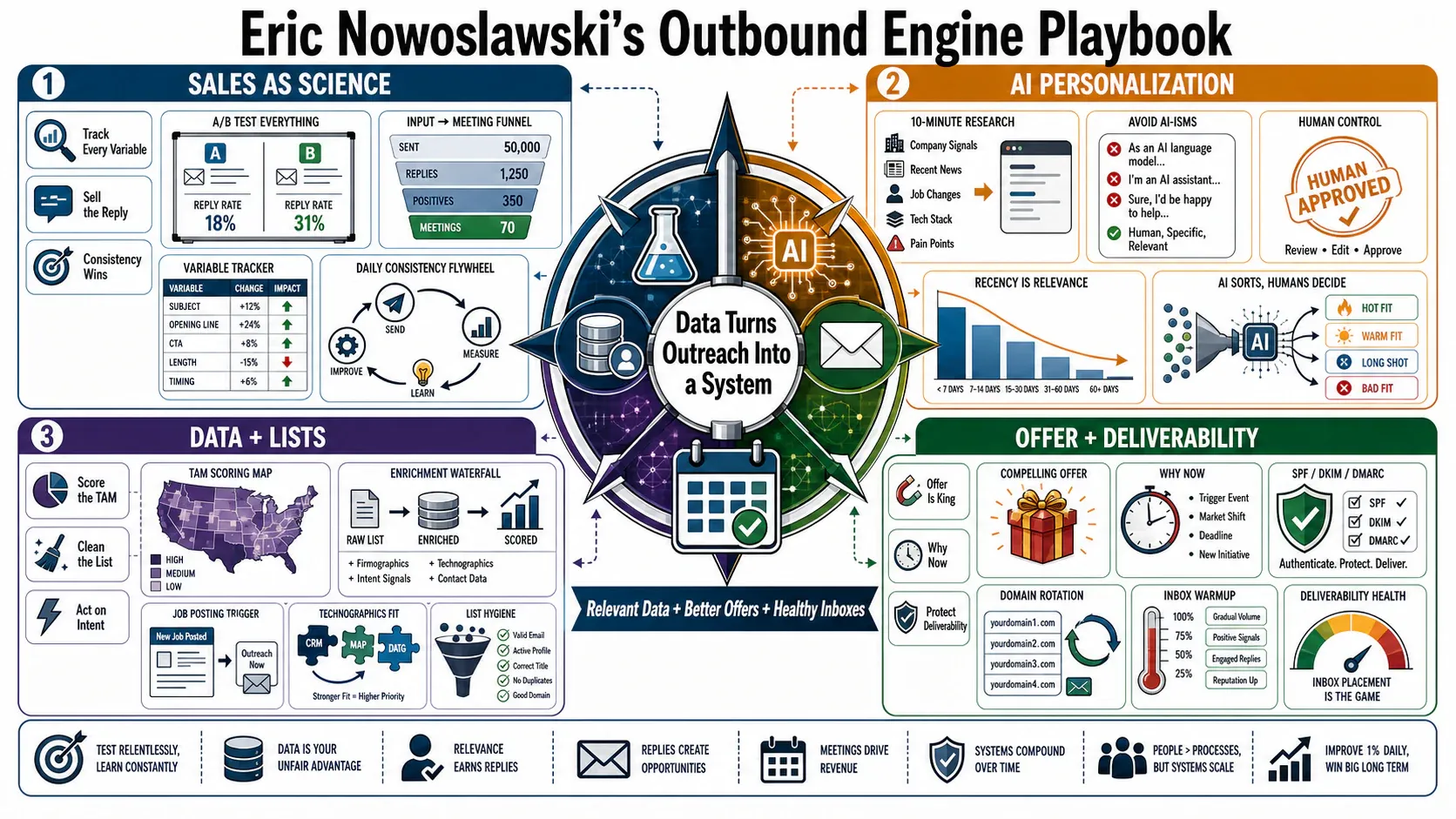
Part 1: The Philosophy of Modern Outbound
- Test outbound components rapidly: Growth Engine X front-loads tests of offers, problem statements, case studies and triggers, then iterates based on the response rather than waiting weeks. — Smartlead Case Study.
- Build a repeatable outbound system: Nowoslawski describes cold email as one way to build a more predictable sales pipeline when the audience, message and infrastructure are deliberately matched. — SellBetter Speaker Profile.
- Treat email like a testable channel: He compares cold email with an ad channel: separate campaigns can test audiences, offers, subject lines and calls to action instead of relying on one template. — The Signal Interview.
- Measure the path to deals: At Growth Engine X, he prioritizes the email-to-deal ratio over raw send volume when judging whether outbound actually creates business. — Smartlead Case Study.
- AI cannot rescue a weak offer: In his signed advice, AI personalization is a multiplier: if the offer is unappealing or the problem is not a priority, the generated first line will not save the campaign. — Eric’s Seven Cold-Email Tips.
- Operational capability is an edge: His 2026 interview describes using coding tools, Clay and data infrastructure to run more precise segmentation and campaign variants than a simple template workflow permits. — The Signal Interview.
- Use public indicators to prioritize accounts: He recommends scoring a market with signals such as open jobs, employee growth, traffic and technology investment, rather than emailing every company identically. — SellBetter Speaker Profile.
- Combine firmographic and persona data: His speaker bio describes combining more than 20 data sources to build targeted outbound playbooks around customer pain and fit. — SellBetter Speaker Profile.
Part 2: Personalization & The AI Revolution
- Generate only the useful variable text: Growth Engine X has used AI-generated first lines alongside tested value propositions, instead of asking the model to invent an entire sales strategy. — Smartlead Case Study.
- Automate manual research logic: He advises recreating, with Clay, the company research a salesperson would otherwise do manually for each prospect and using that evidence to alter the message. — Eric’s Agency Basics.
- Personalize for problem relevance: His signed Clay article ranks recent, product-relevant evidence above generic facts about a prospect’s city, school or company description. — AI Email Personalization Examples.
- Use recent leadership changes as a trigger: His Clay workflow monitors target companies for leaders who started a role in the previous three months, then finds contact details for timely outreach. — Eric’s Leadership-Hire Trigger.
- Use data and guardrails for AI messages: His bylined Clay guide combines prospect data with prompt rules and output constraints so an AI-written snippet remains relevant and less prone to invention. — AI Email Personalization Examples.
- Replace trivia with a relevant signal: He distinguishes personal facts that merely attract attention from a recent job, news or technology signal connected to the problem being sold. — AI Email Personalization Examples.
- Let data change the message: In a direct interview, he describes using AI to inspect prospect data, infer a useful distinction, and write a targeted snippet instead of a generic whole email. — Predictable Revenue Interview.
- Tie the role to a plausible problem: His Clay guide shows how a job title or description can inform a short, role-specific line, while the actual pitch still needs a relevant offer. — AI Email Personalization Examples.
- Match case proof to the prospect: His campaign discussions emphasize using a relevant example or creative idea tied to the prospect’s business rather than a generic case-study attachment. — The GTM Engineer Interview.
Part 3: Mastering Data & List Building
- Score the total addressable market: He teaches teams to rank accounts by observable fit and pain instead of treating every company on a large list as equally likely to buy. — SellBetter Speaker Profile.
- Use an email-finding waterfall: In a signed agency post, he describes trying Leadmagic first and then Prospeo, Get Prospect, IcyPeas and TryKitt to find and validate contacts. — Eric’s Agency Basics.
- Look for observable business changes: He names job openings, employee growth, web traffic and product launches among the public indicators that can help prioritize outreach. — SellBetter Speaker Profile.
- Use technographics when relevant: His first-party prospecting guidance treats a company’s technology stack as a potential product-relevant signal, not a universal substitute for understanding buyer need. — AI Email Personalization Examples.
- Recycle a large market deliberately: For high-volume campaigns, he described tracking how much of a customer’s TAM remains and aiming to reach each contact about once every three months. — Eric’s Continuous-TAM Workflow.
- Segment even at scale: His team uses enriched data to create distinct audiences and messages, so high send volume need not mean one undifferentiated campaign. — Smartlead Case Study.
Part 4: The Art of the Irresistible Offer
- Start with the offer: In an original interview, he puts the strength of the prospect-facing offer ahead of superficial personalization when explaining cold-email conversion. — The GTM Engineer Interview.
- Remove risk from the first step: He asks what value can be offered before the sale; his agency’s free test campaign is one example of making a first conversation easier to accept. — The GTM Engineer Interview.
- Give prospects a useful sample: He used a free, recurring list of newly hired leaders as a cold-email offer, then invited interested recipients to opt in to a newsletter. — Eric’s Cold-Email-to-Newsletter Playbook.
- Use proof that matches the audience: His case-study and offer discussions stress showing a relevant outcome or concrete application for the prospect, rather than generic social proof. — The GTM Engineer Interview.
- Test a different offer, not just words: He describes testing offers and hidden objections; weak response may require changing what the prospect receives, not merely polishing the same copy. — The GTM Engineer Interview.
- Give a reason to care now: His first-email sequence begins with a clear why-you, why-now reason tied to the offer before asking for a meeting. — Eric’s Three-Email Sequence.
Part 5: Technical Infrastructure & Deliverability
- Set the technical foundation first: He lists SPF, DKIM, DMARC and custom tracking domains as basic setup, while stressing that a relevant offer and list matter more than minor technical tricks. — Eric’s Email-Deliverability Tips.
- Monitor and rotate weak domains: He described reviewing domain-level reply rates, cancelling underperformers and bringing warmed reserves into use as needed. — Eric’s Deliverability Workflow.
- Keep sending capacity in reserve: In a direct interview, he described maintaining warmed backup inboxes so campaigns can continue when active sending infrastructure deteriorates. — The GTM Engineer Interview.
- Adjust per-inbox volume by campaign: In one client case with higher spam complaints, his team reduced sends from roughly 50 to 25 per inbox per day while spreading volume across more inboxes. — Eric’s Client Open-Rate Case.
- Age backup domains for harder inboxes: His agency changed to batches of Google and Outlook inboxes so unused domains could mature before a difficult deliverability period. — Eric’s Domain-Management Process.
- Use open tracking only diagnostically: In his restart playbook, he suggests open tracking when unsure about deliverability, while later agency tests led him to rely mainly on reply rates; neither is a universal rule. — Eric’s Cold-Email Restart Playbook.
Part 6: Messaging, Copywriting & Storytelling
- Keep copy short, but test locally: His retrospective of 2025 agency campaigns found 70–90 words performed best in that internal sample; he cautioned that client mix may skew the result. — Eric’s 2025 Campaign Review.
- Open with a specific reason: His three-email sequence begins by explaining why this recipient is being contacted now, then states the offer briefly. — Eric’s Three-Email Sequence.
- Lower friction later in the sequence: He typically uses a direct meeting ask in email one, then offers a lower-commitment audit, lead magnet or video in email three if there is no reply. — Eric’s Three-Email Sequence.
- Pair an offer with proof: In his first-email framework, a clear offer is followed by social proof that others achieved a relevant result. — Eric’s Three-Email Sequence.
- Make each follow-up do a job: His sequence adds supporting context in email two and a distinct, lower-friction offer in email three instead of repeating the first message. — Eric’s Three-Email Sequence.
Part 7: Rapid Experimentation & Iterative Growth
- Front-load campaign testing: The Smartlead case study describes rapid tests of triggers, messages, value propositions and case stories rather than weeks of planning one campaign. — Smartlead Case Study.
- Track outcomes beyond sends: He treats the email-to-deal ratio as a more important measure than raw volume or a high reply count detached from revenue. — Smartlead Case Study.
- Change an underperforming angle: His restart playbook says to revisit template and list filters quickly when a campaign fails, often after roughly 1,000 contacts; that is his heuristic, not a universal cutoff. — Eric’s Cold-Email Restart Playbook.
- Test data quality in production: His small catch-all experiment found large differences in bounce rates across validation labels, showing why provider claims should be checked against actual sends. — Eric’s Catch-All Email Test.
- Remove inboxes with high bounce rates: In one client workflow, he automated removal of inboxes whose bounce rate exceeded 3%; this is an observed agency threshold, not a rule for every domain. — Eric’s Bounce-Monitoring Case.
Part 8: Agency Operations & Scaling the Engine
- Reuse a proven creative-ideas format: His agency’s creative-ideas campaign uses AI to suggest specific uses of a client’s product within predefined value propositions and has been among its stronger approaches. — The GTM Engineer Interview.
- Match outbound economics to the client: He looks for sufficiently large markets and customer value; the Smartlead case described roughly $10,000 annual lifetime value and sales cycles under six months as preferred client traits. — Smartlead Case Study.
- Nurture some cold leads before a call: He described using a free lead list to invite prospects into a weekly newsletter, letting them learn from his content before a sales conversation. — Eric’s Cold-Email-to-Newsletter Playbook.
- Check TAM and unit economics first: In an original interview, he recommended a roughly 100,000-contact TAM and about $10,000 customer lifetime value for agency-scale cold outbound; smaller markets may need a different motion. — The GTM Engineer Interview.
- Some offers fit search better than email: His 2023 cybersecurity-services campaign underperformed his event-interview offer; he hypothesized search would suit that service better because demand was not top of mind. — Eric’s Campaign Comparison.
- Let a test demonstrate the offer: Growth Engine X uses free test campaigns to reduce a prospective client’s risk and demonstrate results before payment. — The GTM Engineer Interview.
- Combine GTM judgment with technical tools: His 2026 interview describes using coding agents for market and email-finding work while retaining Clay for enrichment and delivery; the technology augments, rather than replaces, offer judgment. — The Signal Interview.
Learn more:
- Smartlead: How Eric Nowoslawski Sends 1.5 Million Cold Emails Monthly
- SellBetter: Eric Nowoslawski, Founder of Growth Engine X
- The Signal: Inside Eric Nowoslawski’s AI-Powered Cold Outbound Machine
- Felipe Fuhr: Eric Nowoslawski on Cold Email Engineering and AI Workflows
- The GTM Engineer: The Winning Cold Outbound Formula with Eric Nowoslawski
- Eric Nowoslawski: Seven Cold-Email Tips
- Eric Nowoslawski: Monitoring New Leadership Hires with Clay
- Eric Nowoslawski: Agency Outbound Fundamentals
- Eric Nowoslawski: Catch-All Email Validation Experiment
- Eric Nowoslawski: Email-Deliverability Tips
- Eric Nowoslawski: Client Open-Rate Case Study
- Eric Nowoslawski: Cold Email to Newsletter Playbook