Eric Ryan co-founded Method, OLLY, Welly and Cast. He describes a brand-building approach that begins with studying overlooked consumer categories, then combines product design, a cultural insight and a team of creative and operational specialists. — Brownestone — Pivot Perfect.
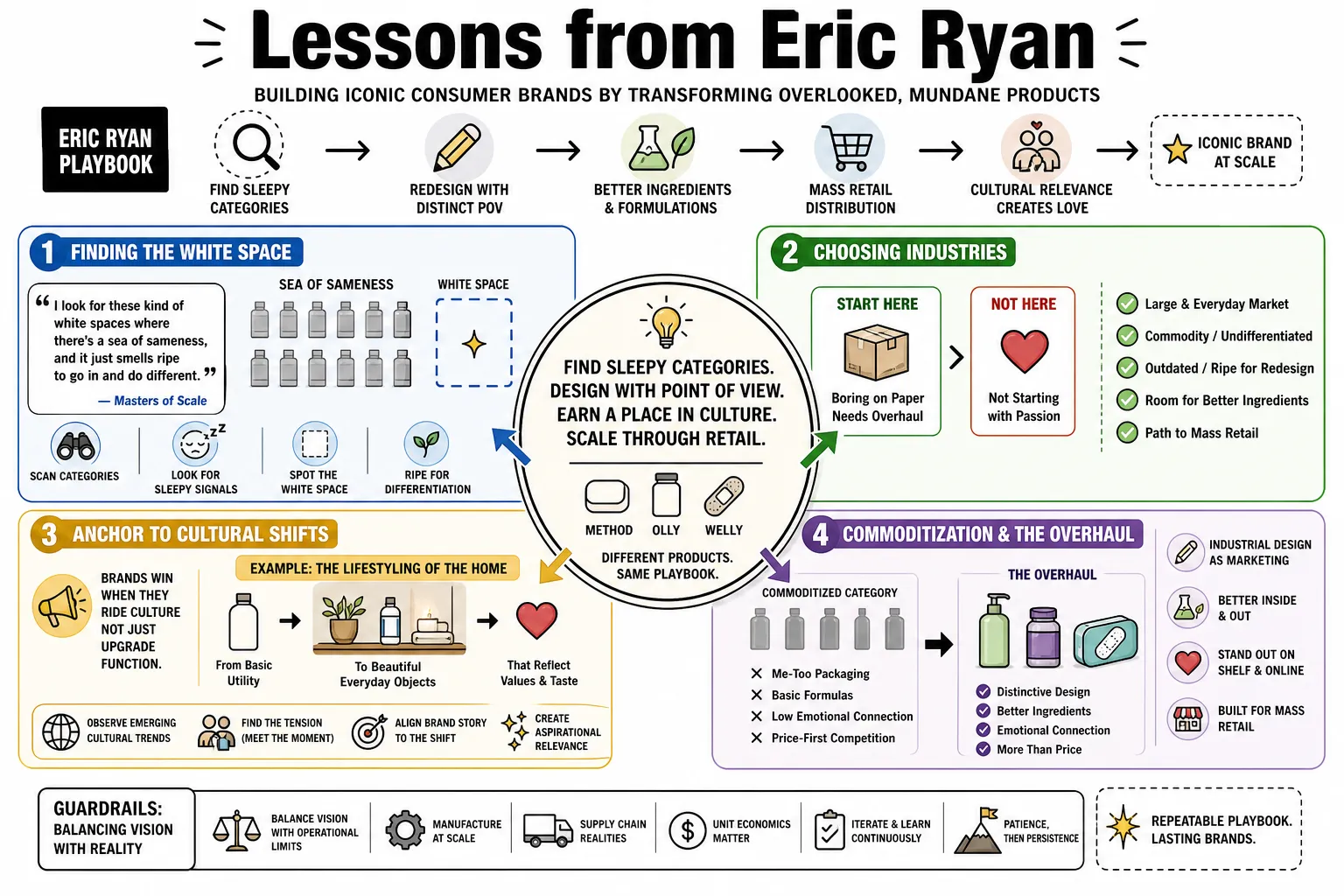
Part 1: Category Selection and the "Sea of Sameness"
- On Finding White Space: Ryan looked for large consumer aisles with little differentiation. The cleaning aisle's sameness led him to investigate whether Method could turn everyday cleaners into objects people wanted to display. — Masters of Scale — The Art of the Steal.
- On Choosing Categories: Ryan said he starts by studying categories rather than with a product idea or personal passion, then looks for a consumer problem and a cultural shift the category has missed. — Rotman — Eric Ryan Interview.
- On Cultural Shifts: Ryan connected Method's launch to growing interest in expressing personal style through the home, and later connected OLLY to a more lifestyle-oriented approach to wellness. — CNBC — Eric Ryan Interview.
- On the Vitamin Aisle: Ryan noticed shoppers struggling to navigate the vitamin aisle and used that confusion as a clue to investigate a simpler, more lifestyle-oriented supplement brand. — Rotman — Eric Ryan Interview.
- On First Aid as an Accessory: For Welly, Ryan reframed bandages and first-aid supplies as colorful accessories for active lives rather than purely clinical items hidden at home. — CNBC — Eric Ryan Interview.
- On Testing Before Scale: Ryan described developing a concept, testing prototypes with friends and family, and selling through local stores before seeking national distribution. — Masters of Scale — The Art of the Steal.
- On Mass-Market Design: Ryan sought to bring design and sustainability into a mass retail context: Method entered Target, and Welly used Target as its initial major retail channel. — CNBC — Eric Ryan Interview.
- On Entering Jewelry: Ryan studied jewelry because buying it often felt cold and transactional to him despite its potential for joy; Cast aimed to make the retail experience playful and social. — Brownestone — Pivot Perfect.
Part 2: Design as a Differentiator
- On Product as Marketing: Ryan said his advertising career taught him to see a better product and its design as part of marketing; at Method, he wanted bottles people would willingly display. — Brownestone — Pivot Perfect.
- On the Countertop Test: Ryan observed that people see dish soap beside the sink more often than they use it, so Method designed its bottle to fit the home's look and express personal style. — Rotman — Eric Ryan Interview.
- On Creating a Category: Ryan thought a small brand would struggle if a conglomerate could simply extend an existing line into the same space; he therefore aimed to create a differentiated category. — Masters of Scale — The Art of the Steal.
- On Borrowing Across Categories: Ryan borrowed Method's countertop form from housewares and its fragrance and color ideas from personal care, then borrowed OLLY design cues from beauty. — Rotman — Eric Ryan Interview.
- On Design and Emotion: Ryan said his advertising background taught him to use creativity and design to create emotional connections with consumers; he applied that lesson across his brands. — CNBC — Eric Ryan Interview.
- On Familiarity and Novelty: Ryan described a repeatable design principle: begin with something familiar and add one novel spin so consumers can understand the product without losing interest. — Rotman — Eric Ryan Interview.
- On the Dispensing Experience: Ryan pointed to Method's one-handed dish-soap pump as a way the product experience could be cleaner and more useful as well as attractive. — SFGate — Method Founders.
- On Meaningful Differentiation: Ryan warned that a product with only surface-level branding and no meaningful point of difference is vulnerable; he looks for a strong insight and a distinct product proposition. — Masters of Scale — The Art of the Steal.
Part 3: The Trojan Horse Strategy
- On Sustainability: Ryan argued that Method had to earn repeat purchases as a desirable, effective cleaning product; its environmental benefit was an additional reason to choose it, not a substitute for performance. — Brownestone — Eric Ryan Interview.
- On Sneaking in Purpose: Ryan described using appealing design and scent to draw shoppers to Method, then letting them discover its environmental mission after the product had won their interest. — Brownestone — Eric Ryan Interview.
- On Mass Retail: For Method, OLLY and Welly, Ryan favored broad brick-and-mortar distribution and worked with Target to bring his brands to mainstream shoppers. — CNBC — Eric Ryan Interview.
- On Shelf Placement: Ryan said Method's initial Target pitch failed, but a redesigned dish-soap bottle by Karim Rashid helped the buyer see a stronger fit for the store. — Masters of Scale — The Art of the Steal.
- On the Movement: Method framed its brand as 'people against dirty,' giving its cleaning products a playful environmental identity beyond their functional use. — Method — People Against Dirty.
- On Mainstream Access: Ryan and Adam Lowry wanted greener cleaners to appeal beyond a narrow environmental niche, using accessible design and pricing to reach ordinary retail shoppers. — Grist — Method Founders Interview.
- On Retail Partnerships: Ryan described Target as a pivotal partner in Method's national expansion, and said retailers helped bring its concentrated-laundry innovation to more shoppers. — Grist — Method Founders Interview.
Part 4: Operational Discipline
- On Scaling Dangers: Ryan's own examples of Method air fresheners and OLLY protein products taught him that too many category extensions can add complexity and dilute margins. — Inc. — Expanding Into New Categories.
- On Process and Creativity: Ryan said he adopted OKRs after Method to allocate time and resources more deliberately. He and Lowry also warned that excessive process can smother a creative culture. — Inc. — Expanding Into New Categories.
- On Artists and Operators: Ryan says consumer brands need both artists who imagine new experiences and operators who make those ideas commercially workable; he prefers teams that respect both roles. — Brownestone — Eric Ryan Interview.
- On Speed: Ryan and Lowry treated speed as a Method operating principle, using their small size to bring ideas to market faster than larger rivals. — Penguin Random House — The Method Method.
- On Execution: Ryan said sharing an idea is less risky than founders assume because developing and executing it is the harder part. — SFGate — Method Founders Interview.
- On Manufacturing Access: Ryan observed that low barriers to manufacturing and distribution make it easier to launch a consumer brand, but also make shallow products easy to copy; a distinctive insight and capable operating team matter more. — Masters of Scale — The Art of the Steal.
Part 5: Innovation and Reinvention
- On Naive Eyes: Ryan values a mix of category insiders and outsiders: newcomers can question assumptions, while experts help the team avoid preventable mistakes. — Brownestone — Eric Ryan Interview.
- On Progress Over Perfection: Ryan gave 'progress not perfection' as his motto. — Lost Answers — Eric Ryan Q&A.
- On Reinvention: Ryan's later brands reused a way of studying neglected categories while changing the product, customer experience and cultural framing for each one. — Brownestone — Eric Ryan Interview.
- On the High Learning Curve: Ryan said Cast appealed to him partly because jewelry forced him onto a new learning curve in retail experience, space and storytelling after three consumer-packaged-goods brands. — Brownestone — Eric Ryan Interview.
- On Forcing New Ideas: Ryan told SFGate that giving away old ideas pushes him to come up with new ones; he linked open sharing to useful feedback and help. — SFGate — Method Founders Interview.
- On Familiarity: Method's highly concentrated laundry product asked too much of shoppers; Ryan said the company moved back to a more familiar 3x concentrate before wider adoption. — Rotman — Eric Ryan Interview.
Part 6: Building Culture and Team
- On Higher Purpose: Ryan wrote that Method's environmental purpose gave employees meaning beyond profit and helped shape the culture he and his cofounder wanted to build. — Fast Company — Building With a Social Mission.
- On Brand Philosophy: Ryan argued that individual product ideas can be copied more easily than a coherent brand philosophy that customers recognize across products. — Mixergy — Eric Ryan Interview.
- On Deliberate Hiring: Ryan described using creative job ads, a homework assignment and multiple interviews to test how a candidate thinks and fits Method's culture. — Inc. — Fine Art of Managing People.
- On Making Mission Tangible: At Method, Ryan said the team began the week by reading a customer advocate letter to connect its purpose with the people using its products. — Fast Company — Building With a Social Mission.
- On Leading Without Holding Every Lever: Ryan described learning to give operators more autonomy instead of trying to control every part of a growing brand himself. — Brownestone — Eric Ryan Interview.
- On Mission-Aligned Recruiting: Ryan said Method's mission helped attract people who shared its values and could sustain motivation through demanding startup work. — Fast Company — Building With a Social Mission.
- On Mission and Business Results: Ryan argued that Method's environmental mission supported its commercial aims by giving the team a shared purpose beyond profit. — Fast Company — Building With a Social Mission.
Part 7: Navigating Entrepreneurial Fear
- On Sharing Ideas: Ryan said he shares ideas freely because feedback helps improve them and can bring in people willing to help execute. — SFGate — Method Founders Interview.
- On Idea Theft: Ryan argued that having an idea is easier than executing it, so fear of someone copying a concept should not prevent a founder from discussing it. — SFGate — Method Founders Interview.
- On Improving Rather Than Proving: Before entering a boardroom, Ryan reminds himself to focus on improving rather than proving himself. — Courageous Podcast — Eric Ryan.
- On the Sophomore Slump: After Method's sale, Ryan feared a second brand might expose his first success as luck. He described the uncertainty as part of beginning OLLY, not as a permanent diagnosis of imposter syndrome. — Rotman — Eric Ryan Interview.
- On Learning From Failure: Ryan described a failed pharmacy venture that taught him how far a new retail concept could depart from shoppers' familiar habits. — Rotman — Eric Ryan Interview.
- On the Post-Exit Slump: Ryan said selling Method left him financially secure but rudderless because building a company had become part of his identity; starting OLLY restored that sense of purpose. — Rotman — Eric Ryan Interview.
- On Seeking Critical Feedback: Ryan described deliberately inviting negative feedback on a new idea before committing, using criticism to test whether it was worth pursuing. — Courageous Podcast — Eric Ryan.
- On Work That Gives Energy Back: Ryan said a project that returns energy to him can be a signal that the idea fits, while acknowledging he sometimes has to work through a difficult period before it starts to flow. — My First Million — Eric Ryan.
Part 8: The Serial Entrepreneur Mindset
- On the Best Job: Ryan said his favorite job is usually the next company he starts. — Lost Answers — Eric Ryan Q&A.
- On the Worst Job: Ryan said he had no single worst job: even difficult work had taught him something, including early jobs outside entrepreneurship. — Lost Answers — Eric Ryan Q&A.
- On the Repeatable Playbook: Across Method, OLLY, Welly and Cast, Ryan reused category study, a distinct product experience and a balance of creative and operating talent, while adapting the approach to each market. — Brownestone — Eric Ryan Interview.
- On the Founder's Role: Ryan described moving toward an incubator model: he helps shape the concept and early team, then relies on operating leaders rather than insisting on running each brand day to day. — Masters of Scale — The Art of the Steal.
- On Improving a Category: Ryan described looking for familiar consumer categories that could be made more intuitive and joyful, rather than building novelty for its own sake. — Brownestone — Eric Ryan Interview.
- On Changing the Laundry Aisle: Ryan and Lowry said Method's concentrated detergent helped establish a design and sustainability direction that larger retailers and manufacturers later adopted across laundry products. — Grist — Method Founders Interview.