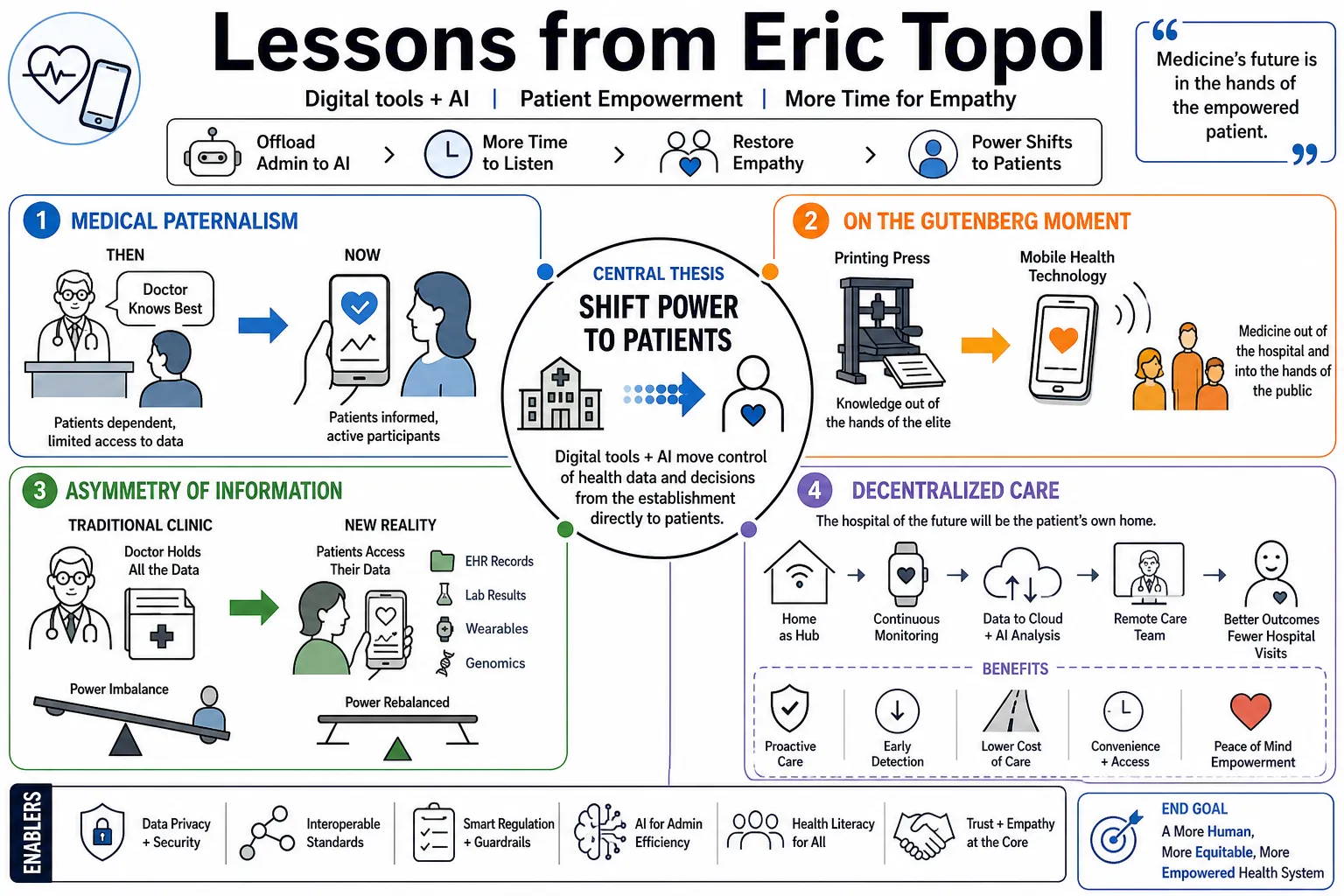
Lessons from Eric Topol
Cardiologist Eric Topol argues that patient access to medical data and validated digital tools can make care more participatory. He also insists that diagnostic information needs careful interpretation and that treatment should remain guided by clinicians. His work explores how technology might give doctors more time to listen and care. — AHRQ Interview with Eric Topol.
Part 1: Democratizing Healthcare
- Challenge Medical Paternalism: Topol describes medicine as historically paternalistic and argues that people who want access to their own data should have it, while recognizing that not every patient wants the same degree of autonomy. — AHRQ Interview with Eric Topol.
- A Gutenberg Moment for Medicine: Topol compares the movement of personal medical information from institutions to patients with the printing press's disruption of information control. — OneMedPlace Interview with Eric Topol.
- Reduce Information Asymmetry: He argues that patients' ability to collect and view their own health data changes a longstanding imbalance in which clinicians and institutions held most medical information. — OneMedPlace Interview with Eric Topol.
- Care for Suitable Patients at Home: Topol sees a growing role for hospital-at-home care for selected patients who do not need emergency or intensive-care treatment. Continuous multimodal AI monitoring remains a proposed capability requiring validation. — Ground Truths — The Hospital-at-Home Movement.
- Extend Imaging Access Carefully: Topol describes handheld ultrasound as a promising way to bring imaging to underserved settings, while emphasizing device cost, operator skill and algorithm validation as current barriers. — Ground Truths — Medical Selfies.
- Let Patients See Their Own Results: Topol argues that people should own and access their laboratory, scan and genomic information so they can review it and discuss it with their physicians. — OneMedPlace Interview with Eric Topol.
- Share Data With Privacy Protection: Topol advocates voluntary sharing of patient-generated information to improve care and research, provided privacy, de-identification and protection from misuse are addressed. — AHRQ Interview with Eric Topol.
- Expect Institutional Resistance: Topol says some clinicians resist patient-generated data and new care models, and notes that reimbursement structures can reinforce existing workflows. — OneMedPlace Interview with Eric Topol.
- Use Data to Guide Encounters: Topol envisions clinicians reviewing patient-collected measurements during visits and using filtered signals to decide when follow-up is needed; he says the analytics needed for this were not yet mature. — AHRQ Interview with Eric Topol.
- Validate Consumer Medical Tools: Topol argues that mobile devices and sensors can capture medically useful information, but their accuracy, interpretation and clinical oversight must be validated before broad use. — AHRQ Interview with Eric Topol.
Part 2: Restoring the Human Touch
- From Shallow to Deep Medicine: Topol describes rushed visits and electronic-record chores as part of an erosion of the patient–doctor relationship; he argues that AI could free time for more attentive care. — Topol — The Future of AI-Facilitated Medicine.
- Use AI to Return Time to Care: Topol identifies a central opportunity for medical AI in reducing clerical work so clinicians can spend more time with patients, rather than treating automation as an end in itself. — Topol — The Future of AI-Facilitated Medicine.
- Liberate Clinicians from the Keyboard: Topol argues that electronic-record documentation can pull clinicians' attention away from patients; carefully implemented ambient notes could restore eye contact and presence. — Topol — The Future of AI-Facilitated Medicine.
- Give Empathy Time to Work: Topol says trust and compassionate communication need clinicians to be present; reducing screen time helps only if saved time is returned to the encounter rather than used to schedule more visits. — Topol — The Future of AI-Facilitated Medicine.
- Let Patients Tell Their Story: Topol says quick, frequent interruptions can obscure details important to diagnosis and care. The often-repeated 18-second average is not asserted here and is omitted. — Voices in AI — Eric Topol Interview.
- Relieve Clerical Burnout: Topol links data-clerk work and short encounters to clinician burnout; he cites early evidence that AI documentation systems can save time and reduce burnout, while implementation choices remain decisive. — Topol — The Future of AI-Facilitated Medicine.
- Deep Empathy Is the Goal: Topol's deep-medicine model pairs richer individual data and machine learning with a third component: more empathetic human care made possible when clinicians are freed from automatable tasks. — Scripps Research — Deep Medicine.
Part 3: AI and Augmented Medicine
- Human Choices Shape Medical AI: Topol warns that medical AI reflects the data and choices used to build it; privacy, oversight, and fairness must be addressed before broad clinical use. — Topol — The Future of AI-Facilitated Medicine.
- Augment Clinicians, Preserve Oversight: Topol presents AI as a way to support clinicians with better information and less clerical work, while warning that patient-facing systems need careful evaluation and clinician oversight. — Topol — The Future of AI-Facilitated Medicine.
- Use Complementary Strengths: AI can help interpret complex images and synthesize patient data, but Topol still envisages physicians supervising reports and applying judgment in care. — Topol — The Future of AI-Facilitated Medicine.
- Reduce Diagnostic Errors with Evidence: Topol cites the heavy toll of diagnostic error and trials in which AI-supported mammography and colonoscopy improved detection; those results do not establish that algorithms can resolve every complex history. — Topol — The Future of AI-Facilitated Medicine.
- Synthesize Patient Records: Topol says specially adapted language models have demonstrated the ability to synthesize extensive patient data from multiple sources, potentially easing chart review; he does not establish the inherited seconds-versus-hours comparison. — Topol — The Future of AI-Facilitated Medicine.
- Bridge Research and Practice: Topol contrasts encouraging clinical evidence for selected medical AI uses with a persistent gap between research and routine practice, citing regulation, reimbursement, trust, and validation as barriers. — Topol — The Future of AI-Facilitated Medicine.
- Read Medical Images with AI Support: Topol identifies medical imaging as AI's most validated current contribution, including mammography and colonoscopy trials, while stressing that broader scan interpretation needs validation before routine adoption. — Topol — The Future of AI-Facilitated Medicine.
- Evaluate Models Continuously: Topol calls for ongoing monitoring of the benefits and harms of patient-facing AI and for further validation before research systems enter routine care; improvement must be demonstrated, not assumed from every outcome. — Topol — The Future of AI-Facilitated Medicine.
- Interrogate Algorithmic Bias: Topol warns that models can propagate existing cultural and clinical biases and may worsen inequities unless fairness is deliberately prioritized and tested. — Topol — The Future of AI-Facilitated Medicine.
- Pursue Preventive Prediction Carefully: Topol proposes combining records, biomarkers, imaging, genomics, and sensor data to identify disease risk earlier; he treats broader prevention and full-stack models as future clinical opportunities requiring validation. — Topol — The Future of AI-Facilitated Medicine.
Part 4: Patient Empowerment
- Respect Patient Participation: Topol argues that medicine has underestimated what patients can contribute and that people who want their own information should be able to participate more actively in care. — AHRQ PSNet — Eric Topol Interview.
- Make Smartphones Useful for Monitoring: Topol describes smartphones linked to sensors for blood pressure, glucose, oxygen, heart rhythm and other measures, while treating reliable interpretation and clinical integration as unfinished work. — Topol — Smartphone Health Care.
- Use Longitudinal Self-Tracking in Care: Topol says patients can track chronic conditions such as blood pressure and diabetes and bring those trends into a clinical visit, making the discussion richer than an isolated measurement. — AHRQ PSNet — Eric Topol Interview.
- Look Beyond One Clinic Reading: Topol sees patient-generated streams as a more granular picture of an individual's health, but says filtering signal from noise and integrating multiple sensors still need work. — AHRQ PSNet — Eric Topol Interview.
- Let People Control Their Records: Topol argues that individuals should own their medical information and decide how it is shared with doctors and hospitals; he presents this as a needed change, not the present legal default. — AHRQ PSNet — Eric Topol Interview.
- Build a Data-Informed Partnership: Topol expects patients bringing their own processed information to ask clinicians for interpretation and guidance, shifting the encounter toward a partnership rather than eliminating professional expertise. — AHRQ PSNet — Eric Topol Interview.
- Treat Personal ECGs as Diagnostic Inputs: Topol describes smartphone ECGs as a way to capture useful rhythm information, but he does not say that a consumer reading alone can safely decide between emergency and routine care. — AHRQ PSNet — Eric Topol Interview.
- Pair Measurement With Good Analytics: Topol says collecting personal health data is only a first step: useful empowerment also requires filtering, interpretation, visualization, and sharing actionable signals with patients and clinicians. — AHRQ PSNet — Eric Topol Interview.
Part 5: The Digital Health Revolution
- Capture Physiological Data Outside the Clinic: Topol describes wearables and other sensors that can collect blood pressure, rhythm and other measures beyond a single clinic visit; combining multiple continuous streams into reliable care remains a technical challenge. — AHRQ PSNet — Eric Topol Interview.
- Use Wearable Rhythm Alerts as Signals: Topol points to smartwatch alerts that prompt an ECG recording when heart rhythm appears abnormal, while leaving interpretation and treatment decisions within clinical care. — Guardian — Eric Topol Interview.
- Move Beyond Video-Only Telemedicine: Topol envisions telemedicine evolving from a video call into an active exchange of patient-generated data with a clinician; he says this richer model is still developing. — Topol — The Hospital-at-Home Movement.
- Make the Smartphone a Health-Data Platform: Topol describes smartphones as platforms for capturing blood pressure, glucose, oxygen, heart rhythm and other measures; useful clinical synthesis requires more than simply connecting sensors. — Topol — Smartphone Health Care.
- Bring Ultrasound to the Point of Care: Topol says he has used handheld or smartphone ultrasound in his cardiology practice in place of a stethoscope, but wider use depends on skill, cost, workflow and validation. — Topol — Medical Selfies.
- Explore Digital Signals for Mental Health: Topol discusses speech patterns, breathing, activity and facial signals as possible ways to track mood and mental-health risk, while emphasizing privacy, consent and the need for careful use. — Guardian — Eric Topol Interview.
- Develop Select Point-of-Care Tests: Topol cites accessible testing for some common problems, such as a pharmacy UTI test, and anticipates more mobile diagnostics; he does not say routine blood work will broadly move home or eliminate phlebotomy. — Guardian — Eric Topol Interview.
- Solve Health-Data Integration: Topol says sensors can generate far more data than current health systems can readily ingest, filter and use; integration and reimbursement are major adoption barriers alongside device performance. — AHRQ PSNet — Eric Topol Interview.
- Keep the Human Exam While Adding Digital Tools: Topol argues that digital imaging and AI can support parts of assessment, but a real physical examination cannot simply be simulated away; clinician oversight remains important. — Guardian — Eric Topol Interview.
Part 6: Precision Medicine and Genomics
- Define the Individual More Deeply: Topol argues that a useful picture of one person's health can draw on genomic, metabolic, microbiome and physiological data, while integrating these layers remains a research and clinical challenge. — Topol — Towards an Optimal Diet.
- Go Beyond Population Averages: Topol criticizes one-size-fits-all decisions when individual biology and clinical risk differ; precision care combines personal information with, rather than discards, population evidence. — Angioplasty.org — Eric Topol Interview.
- Use Polygenic Scores as Probabilistic Clues: Topol sees validated polygenic risk scores as an additional way to identify higher risk for some conditions, alongside family history and clinical factors; ancestry coverage, actionability and timing remain limits. — Topol — Polygenic Risk Scores.
- Account for Gene–Drug Interactions: Topol uses clopidogrel metabolism as an example where CYP2C19 status can inform antiplatelet choices, but says genotype must be considered alongside platelet testing, bleeding risk and the patient's circumstances. — Angioplasty.org — Eric Topol Interview.
- Include the Microbiome Without Overclaiming: Topol treats the gut microbiome as one layer of individual variation that may inform future precision nutrition, but says individualized AI diet recommendations still need outcome validation. — Topol — Towards an Optimal Diet.
- Match Some Cancer Therapy to Tumor Biology: Topol highlights cases where tumor or inherited genomic features can help match advanced-cancer patients to targeted or immune therapies, while screening and benefit vary by cancer subtype. — Topol — A Turning Point in Cancer.
- Separate Sequencing Cost from Routine Use: Topol notes dramatic declines in whole-genome sequencing cost and time, including rapid diagnosis in selected critically ill infants, but does not say routine sequencing is already comparable to a standard blood count. — Topol — Clinical Whole Genome Sequencing.
- Treat Epigenetic Clocks as Research Signals: Topol reviews studies linking DNA-methylation clocks with immune function, inflammation and lifestyle measures, while emphasizing that associations do not establish simple causal control of aging. — Topol — The Drivers of Age-Related Diseases.
- Interpret Genomes in Context: Topol says cheaper, faster sequencing is only part of clinical genomics: variant interpretation, relevant literature and patient context are essential before a molecular result can guide care. — Topol — Clinical Whole Genome Sequencing.
Part 7: Data, Information, and Open Science
- Break Down Patient-Data Silos: Topol says fragmented institutional records limit patients' access and make it harder to learn across people with similar conditions; sharing must preserve individual control and privacy. — AHRQ PSNet — Eric Topol Interview.
- Integrate Longitudinal Health Data: Topol argues that longer follow-up and linked genomic, sensor and clinical data can make large cohorts more informative about disease risk; he does not claim that ICU telemetry is routinely discarded or has already trained deterioration models. — EMJ — Eric Topol Interview.
- Collaborate Across Research Silos: Topol favors collaborative, interactive and open-source research across institutions to combine expertise and accelerate individualized medicine. — Clinical and Translational Science — Topol Interview.
- Protect Privacy While Sharing Data: Topol supports consent-based, privacy-protected health-data sharing and points to federated approaches as one possible way to learn across records without ignoring security risks. — EMJ — Eric Topol Interview.
- Use AI to Extend Diagnostic Attention: Topol notes that clinicians cannot keep up with the literature on thousands of diseases and sees carefully evaluated AI second opinions as a potential aid to diagnostic reasoning. — Topol — Diagnostic Errors.
- Imagine a Privacy-Protected Data Commons: Topol proposes a large, secure resource linking outcomes, genomes and health records so comparable patients can inform treatment and prevention; he says no such comprehensive digital-twin resource exists yet. — EMJ — Eric Topol Interview.
- Learn from Outcomes Beyond Trials: Topol proposes using large, linked patient histories and outcomes to complement clinical trials when assessing which treatments helped similar people, while acknowledging that this nearest-neighbour system has not yet been built. — EMJ — Eric Topol Interview.
- Make Records Interoperable and Patient-Accessible: Topol criticizes EHR systems designed around billing rather than care and calls for uniform, interoperable records that patients can obtain and clinicians can use reliably. — Fixing Healthcare — Eric Topol Transcript.
- Use Historical Data for Risk, Not Certainty: Topol describes combining past records, biomarkers and imaging to estimate future disease risk and guide prevention research, while emphasizing validation and privacy before clinical use. — Topol — The Future of AI-Facilitated Medicine.
Part 8: The Future of Medical Practice
- Train Clinicians for Digital Practice: Topol wants medical trainees to learn telemedical encounters, handheld ultrasound and patient-facing digital tools alongside good clinical communication; he says those skills were not standard in the curriculum he observed. — AHRQ PSNet — Eric Topol Interview.
- Guide Patients Through Their Own Data: Topol expects more patients to bring processed personal health data to appointments and ask clinicians for interpretation and treatment guidance, strengthening a partnership rather than replacing the physician. — AHRQ PSNet — Eric Topol Interview.
- Test Prevention to Extend Healthspan: Topol believes better risk markers and multimodal AI could help prevent major age-related disease and extend years lived in good health, but says that strategy still needs clinical proof. — EMJ — Eric Topol Interview.
- Study Exceptional Healthy Aging: Topol's Wellderly research studied people over 80 without chronic disease to look for protective genomic factors; he presents such work as a way to investigate resilience, not a universal genetic blueprint for longevity. — Clinical and Translational Science — Topol Interview.
- Design for Patient Convenience: Topol criticizes the difficulty of obtaining results and making appointments and sees telemedicine and digital access as ways to reduce avoidable friction; he does not claim waiting rooms will disappear. — Fixing Healthcare — Eric Topol Transcript.
- Align Incentives with Better Care: Topol warns that AI time savings could be used to increase patient volume rather than deepen encounters; reimbursement and organizational incentives must support the latter choice. — Topol — The Future of AI-Facilitated Medicine.
- Demand Evidence Before Claiming Savings: Topol sees potential cost and comfort benefits in selected hospital-at-home programs, but calls for larger randomized studies and better evidence before claiming broad savings from remote or AI-enabled care. — Topol — The Hospital-at-Home Movement.
- Connect Biological and Clinical Layers: Topol argues that genomics, physiology, clinical records and other health data should be interpreted together to understand individuals; he describes integration as an opportunity, not an inevitable collapse of specialties. — Clinical and Translational Science — Topol Interview.
- Expect Mixed Professional Responses: Topol says physicians' response to patient-generated data has been mixed: some resist new care models, while others see the possibility of pairing technology with stronger human relationships. — AHRQ PSNet — Eric Topol Interview.
- Keep Humane Care as the End: Topol's deep-medicine vision combines richer patient information and machine assistance with more time for clinician presence, empathy and trust; technology is a means to that human goal. — Scripps Research — Deep Medicine.