Eric Yuan founded Zoom after years of hearing WebEx customers describe poor video quality and a frustrating mobile experience. He built Zoom around easier communication and a culture he calls “Deliver happiness.” His account connects customer feedback, perseverance, security and trust, and the changing demands of leading a larger company. — Stanford GSB Interview.
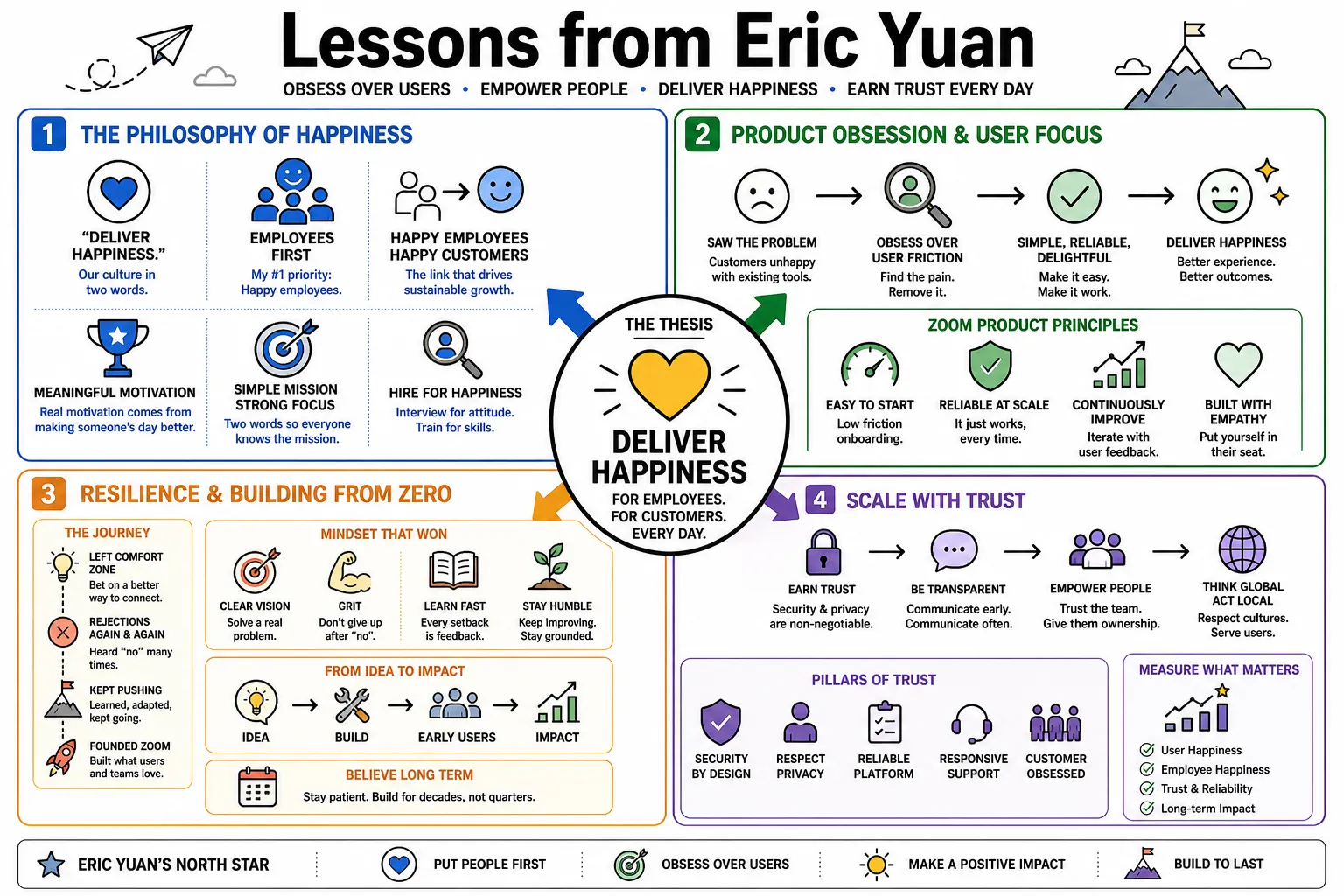
Part 1: The Philosophy of Happiness
- Deliver happiness: Yuan defined Zoom’s culture in two words: “Deliver happiness.” — Stanford GSB Interview.
- Employee happiness first: Yuan said his first priority as CEO is to ensure Zoom employees are happy. — Stanford GSB Interview.
- Happy employees, happy customers: Yuan believes employees who are happy at work are better positioned to make customers happy. — Stanford GSB Interview.
- Sustainable happiness: Yuan contrasts short-term rewards with the longer-lasting happiness of helping other people. — Stanford GSB Interview.
- Hire for the mission: Yuan advises recruiting people who share the company’s mission and can stay focused on long-term goals. — Stanford GSB Interview.
- Retain mission-aligned people: Yuan says employees who share Zoom’s mission are better suited to stay with the company through a long journey. — Stanford GSB Interview.
- Find fulfilling work: Yuan connects sustained work with doing something one is passionate about, good at, and able to contribute through. — Stanford GSB Interview.
Part 2: Lessons from Cisco and WebEx
- Know when legacy software needs replacing: Yuan concluded that tweaking WebEx’s legacy software could not solve customers’ modern usability problems, so he proposed a new solution. — Bessemer Interview.
- Ask the unhappy users: Repeated conversations with WebEx customers told Yuan they disliked the quality and mobile experience, despite the product’s established position. — Stanford GSB Interview.
- Beware cannibalization pressure: Yuan says colleagues resisted his proposal to rebuild the experience partly because it could cannibalize WebEx. — Stanford GSB Interview.
- Leave when customers remain unhappy: After failing to persuade colleagues to fix the WebEx experience, Yuan left his VP role to build a service he believed would better serve those users. — Stanford GSB Interview.
- Rebuild for mobile use: Yuan argued that the poor WebEx mobile experience required a new architecture; he says he could not persuade Cisco to pursue it. — Stratechery Interview.
- A crowded market can still disappoint users: Despite many video-conferencing competitors, Yuan found customers dissatisfied and saw room for a better product. — SaaStr 2017 Interview.
- Compete on customer pain: Yuan emphasizes finding and addressing customer pain points rather than beginning with a rival’s feature list. — Stanford GSB Interview.
Part 3: Overcoming Rejection
- Persist through visa denials: Yuan says his U.S. visa was rejected eight times before he succeeded on the ninth application; he later saw the experience as practice in perseverance. — Stanford GSB Interview.
- Keep the opportunity in view: Recalling his arrival in Silicon Valley, Yuan says he believed hard work could help him pursue his American dream. — Stanford GSB Interview.
- Test skepticism against customers: Friends told Yuan a new video-conferencing company could not survive in a crowded market; his own customer conversations convinced him there was unmet demand. — SaaStr 2017 Interview.
- Trust direct user evidence: When colleagues doubted the rebuild, Yuan trusted the dissatisfaction he had heard from users and chose to start Zoom. — Bessemer Interview.
- Expect hard days: Yuan says leaders trying to make a meaningful change should prepare mentally for challenges and use them to improve themselves and their teams. — Stanford GSB Interview.
Part 4: Early Stage Focus
- Build the first product before scale: Zoom took approximately two years from its founding to its first generally available product, a timeline Yuan confirmed in conversation with SaaStr. — SaaStr 2019 Interview.
- Choose investors who back the founder: Yuan sought investors who believed in his ability to adapt, not only in the first version of the business plan. — SaaStr 2017 Interview.
- Spend with a path to cash flow: Yuan describes reviewing whether each increment of investment could move Zoom toward cash-flow positivity or profitability rather than burning capital indiscriminately. — SaaStr 2017 Interview.
- Test quality before marketing: Yuan says the early team deliberately relied on product adoption, rather than paying for lead-generation marketing, to test whether customers were happy with Zoom. — SaaStr 2017 Interview.
- A retrospective origin connection: As a student, Yuan daydreamed about seeing his distant girlfriend through a device; he later said this was a connection he made in hindsight, not the immediate reason he started Zoom. — Stratechery Interview.
- Track users rather than rivals: Yuan says competitors are outside his control, while talking with users and fixing their pain points is within it. — Stanford GSB Interview.
- Balance potential with experience: Yuan says he initially favored leaders with growth potential, but later concluded Zoom needed a better mix of high-potential and experienced leaders. — Forum Ventures Interview.
Part 5: Solving Customer Pain
- Solve the observed pain: Yuan says innovation begins by spending time with customers, understanding their pain points, and building a response quickly. — Stanford GSB Interview.
- Call customers who cancel: In Zoom’s early days, Yuan personally spoke with customers who canceled subscriptions to understand why and improve the product. — Bessemer Interview.
- Remove joining friction: Yuan says complicated installation, too many clicks, and unreliable audio or video can lose a new user; ease of use was therefore central to Zoom. — Bessemer Interview.
- Prioritize existing customers: Yuan says Zoom prioritized feature requests from existing customers over requests from prospective customers. — SaaStr 2019 Interview.
- Learn from lost accounts: Yuan says some customers who had canceled returned after Zoom used their feedback to improve the service. — Bessemer Interview.
- Treat reliability as trust: Yuan connects reliable audio and video with retaining users who might otherwise abandon a difficult conferencing service. — Bessemer Interview.
Part 6: Trust, Empathy, and Culture
- Build trust deliberately: Yuan says winning users’ trust is central when they depend on Zoom for important communication. — Stanford GSB Interview.
- Earn trust through action: After security mistakes, Yuan says Zoom had to explain the problems, fix them quickly, and communicate openly; the old “favoring trust” wording is a flawed transcript fragment. — Stanford GSB Interview.
- Make care concrete: Yuan describes Zoom’s value of “care” as covering community, customers, the company, teammates, and oneself. — Stanford GSB Interview.
- Admit mistakes publicly: Yuan says he publicly apologized for Zoom’s security failures and shared a plan to address them rather than hiding the issues. — Stanford GSB Interview.
- Notice remote-work strain: Yuan warns that prolonged working from home can bring anxiety, loneliness, and mental-resilience problems, even when productivity holds up. — Forum Ventures Interview.
- Take responsibility for consequential errors: In his 2023 layoff message, Yuan accepted responsibility for overhiring and reduced his own salary. — Zoom: A Message from Eric Yuan.
Part 7: Managing Crisis and Scale
- Respond to a 30-fold demand surge: Yuan’s team faced roughly 30 times as many daily meeting participants during early COVID and had to keep the service running while adapting to new users. — Bessemer Interview.
- Freeze features for security: Zoom paused non-security feature development for 90 days and redirected engineering resources to privacy, safety, and security after the 2020 problems. — Zoom: 90-Day CEO Report.
- Design for unexpected users: Yuan says Zoom’s enterprise-centered assumptions failed when schools, families, and other first-time users arrived without IT support. — Stanford GSB Interview.
- Correct unsustainable hiring: In 2023, Yuan said Zoom had expanded headcount too quickly during the pandemic and announced a roughly 15% workforce reduction to reset priorities. — Zoom: A Message from Eric Yuan.
- Make security work visible: Yuan held weekly public webinars during Zoom’s 2020 security response to update users and answer questions. — Zoom: A Message to Our Users.
- Treat meeting fatigue as a product problem: After a day with 19 Zoom meetings, Yuan said fatigue was real and imagined product cues that could prompt people to take breaks. — Forum Ventures Interview.
- Triage security feedback daily: Zoom’s post-crisis process gathered vulnerability reports into a central repository and reviewed them in daily meetings. — Zoom: 90-Day CEO Report.
- Institutionalize the security lessons: Yuan’s 90-day report says Zoom embedded security requirements, code checks, testing, and monitoring into product-development stages after the immediate crisis. — Zoom: 90-Day CEO Report.
Part 8: Work, Life, and the Future
- Integrate work and life: Yuan rejects a simple daily work-life balance formula: meaningful work can be part of life, while family comes first when there is a conflict. — Stanford GSB Interview.
- Let passion and contribution guide work: Yuan says work feels part of life when people care about it, are good at it, and contribute value. — Stanford GSB Interview.
- Put family first in a conflict: Yuan says Zoom’s rule is to put family first when work and family clash, and describes attending his son’s game before a company Christmas party. — Stanford GSB Interview.
- Digital twins as a future possibility: Yuan envisions personal AI models that could one day send authenticated digital twins to participate in meetings, while acknowledging that current systems cannot yet do this reliably. — Decoder Interview.
- Preserve human conversation: Yuan argues that human-to-human conversations remain essential even as AI agents automate follow-up system work. — CNBC Interview.
- Keep reading beyond your specialty: Yuan recommends books to startup founders and describes what he is reading himself, including books on leadership and social change. — Forum Ventures Interview.
- Leave a service-oriented legacy: Yuan says he wants Zoom remembered for helping people stay connected during COVID and for serving others beyond a software product. — Bessemer Interview.