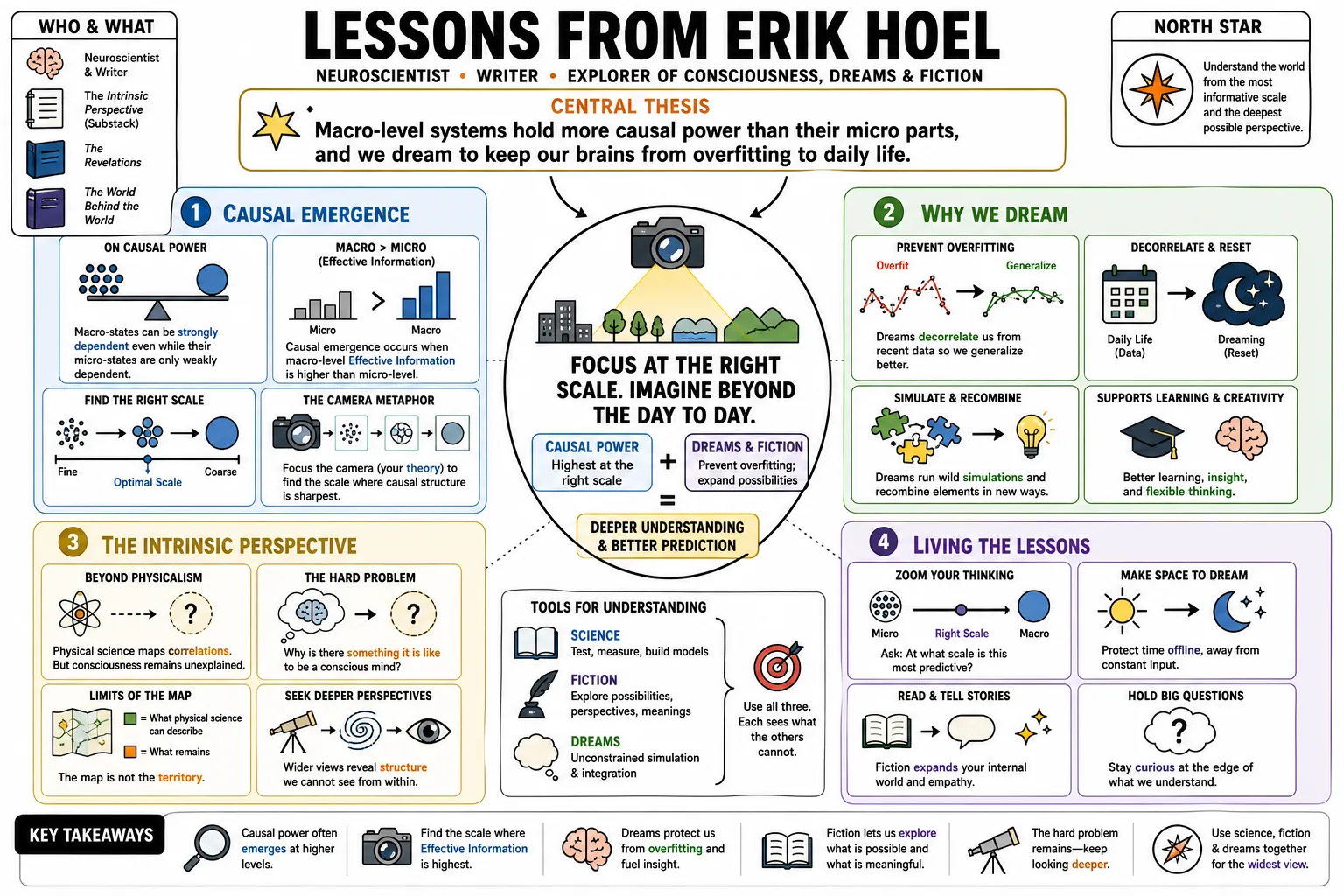
Lessons from Erik Hoel
Erik Hoel is a neuroscientist, novelist and essayist whose work includes mathematical models of causal emergence and the Overfitted Brain Hypothesis of dreaming. In The Revelations, The World Behind the World and The Intrinsic Perspective, he explores consciousness, science and literature. — The Intrinsic Perspective — About.
Part 1: Causal Emergence
- Causal Power: Hoel's causal-emergence framework allows some macrostates to exhibit stronger causal dependencies than their underlying microstates. — A Primer on Causal Emergence.
- Macro Versus Micro: Coarse-graining groups lower-level states into a higher-level description that, for some systems, can expose stronger causal relations. — A Primer on Causal Emergence.
- Effective Information: In the original version of causal emergence, Hoel compared effective information under interventions at different scales; some model systems have higher EI at a macroscale. — A Primer on Causal Emergence.
- The Camera Metaphor: Hoel likens comparing scales to focusing a camera: a system's causal structure can become clearer at a higher scale. — A Primer on Causal Emergence.
- Optimal Scale: In his earlier framework, the causally informative scale need not be the lowest physical scale. — A Primer on Causal Emergence.
- Human Behavior: To illustrate the appeal of higher-level descriptions, Hoel contrasts difficult atomic-state forecasts with the simpler prediction that a person will be asleep 12 hours later. — Quanta — Causal Emergence.
- Widespread Occurrence: Comolatti and Hoel report cases of causal emergence under more than a dozen independently developed causal measures, reducing the concern that the result depends on a single measure. — Causal Emergence Across Measures.
- Complex Systems: For complex systems, Hoel's newer work seeks formal tools to identify the scales that contribute to a system's causal workings. — Causal Emergence 2.0.
- Biological Mechanisms: Klein and Hoel found informative higher scales in tested biological and other real-world networks by grouping network nodes into macronodes. — Informative Higher Scales in Networks.
- Multiscale Nature: Hoel's CE 2.0 model apportions causal contributions across multiple scales instead of choosing only the single EI-maximizing scale used in the earlier version. — Causal Emergence 2.0.
Part 2: Reductionism and the Limits of Science
- Scientific Tension: Hoel identifies a tension between scientists' use of causal explanations at higher levels and their reductionist interpretation of those levels. — My New Theory of Emergence.
- The Ladder Of Science: Hoel describes science as a ladder of descriptions, from microphysics upward, and argues that macroscales are central to ordinary causal explanations. — My New Theory of Emergence.
- Defending Macroscales: In Hoel's account, explanations using concepts such as genes or temperature can convey causal information rather than serving only as dispensable shorthand for particles. — My New Theory of Emergence.
- Gödel Sentences: Hoel proposes, speculatively, that a theory of consciousness might be analogous to a Gödel sentence within science—an argument he says lacks direct evidence. — Consciousness as a Gödel sentence in the language of science.
- Physicalism: Hoel's causal-emergence work challenges the assumption that a microscale explanation is always the most causally informative; he says this approach remains compatible with physicalism. — A Primer on Causal Emergence.
- Measurement Limits: Hoel asks whether studying consciousness creates a self-reference problem, because the experiencing system is also the system trying to explain experience. — EconTalk — Consciousness and Free Will.
- Objective Measurement: Hoel argues that neuroscience has made progress on neurons while still lacking a satisfactory account of how subjective experience relates to neural activity. — EconTalk — Consciousness and Free Will.
Part 3: Dreams and the Overfitted Brain
- The Purpose Of Dreams: Hoel's Overfitted Brain Hypothesis treats the sparse, hallucinatory and narrative qualities of dreams as potentially functional rather than incidental. — The Overfitted Brain.
- Overfitting: Hoel hypothesizes that repetitive daily experiences can make a learning brain overly specific to its environment, analogous to overfitting in machine learning. — The Overfitted Brain.
- Noise Injection: In the hypothesis, dream experiences supply sparse and corrupted inputs, akin to noise or dropout used to improve generalization in machine learning. — The Overfitted Brain.
- Taking Dreams Seriously: Hoel said he wanted a theory of dreams that takes the experience of dreaming itself seriously; his Overfitted Brain Hypothesis remains a hypothesis about their possible function. — Cell Press — Dream Hypothesis.
- Plasticity: Hoel argues that continual waking learning could leave the brain too adapted to recurring experiences; this is the problem his dream hypothesis aims to address. — The Overfitted Brain.
- Subconscious Creativity: Hoel connects the dream-generalization hypothesis to research on sleep and creative abstraction, while noting it as a possible implication rather than a demonstrated dream-specific effect. — The Overfitted Brain.
- Machine Learning Parallels: The hypothesis predicts that dream loss would impair generalization more than rote memorization, a distinction Hoel proposes for future tests. — The Overfitted Brain.
- The Supersensorium: Hoel worries that formulaic entertainment can become too self-similar to provide the surprise that, in his speculative account, art and fiction might offer. — Exit the Supersensorium.
Part 4: The Role of Literature and Fiction
- Literature And Science: Hoel says he entered consciousness research partly because he saw consciousness as a subject on which literature and science could meet on equal footing. — Tufts Now Interview.
- Fiction As Cognitive Tool: Hoel speculates that fiction can act like a waking, crafted dream, broadening experience beyond the familiar patterns of daily life. — Exit the Supersensorium.
- Human Experience: In Hoel's historical account, literature helped build a richer vocabulary for describing minds and inner states. — EconTalk — Consciousness and Free Will.
- Ancient Versus Modern Writing: Hoel contrasts sparse descriptions of inner reactions in an ancient Egyptian tale with the richer psychological narration of later literature, including the modern novel. — EconTalk — Consciousness and Free Will.
- Intrinsic Media: Hoel calls novels a means of examining subjective experience—the ‘intrinsic’ perspective—alongside science's study of the objective world. — Introducing The World Behind the World.
- Finding A Purpose: Hoel says Kierk in The Revelations was deliberately influenced by Søren Kierkegaard's romantic focus on an idea one could live and die for. — Tufts Now Interview.
- Writing Method: Hoel compares his own path into science, originally undertaken partly to research a novel, to a method actor who stayed in the role; his scientific experience then informed The Revelations. — Deborah Kalb Interview.
Part 5: The Intrinsic vs. Extrinsic Perspectives
- The Two Frameworks: Hoel frames the history in The World Behind the World around two developing perspectives: extrinsic accounts of the physical world and intrinsic descriptions of conscious experience. — Introducing The World Behind the World.
- The Extrinsic View: In Hoel's terminology, the extrinsic perspective describes the world through physical mechanisms and the scientific view from outside experience. — Introducing The World Behind the World.
- The Intrinsic View: The intrinsic perspective, in Hoel's terminology, concerns what conscious life is like from within: feelings, thoughts and other experiences. — Introducing The World Behind the World.
- The Mansion Of Minds: Hoel says the intrinsic perspective lets people describe their mental lives and tell stories about themselves, a conceptual achievement alongside the physical sciences. — EconTalk — Consciousness and Free Will.
- Civilization's Development: Hoel argues that civilization developed richer ways to describe both external mechanisms and internal life, with science and literature as major vehicles. — Introducing The World Behind the World.
- Historical Progress: Hoel sees literature's account of inner life and science's account of the external world as two intellectual traditions that sometimes developed in parallel. — EconTalk — Consciousness and Free Will.
- The Ultimate Challenge: Hoel presents the attempt to relate subjective experience to physical brain activity as a central difficulty for contemporary neuroscience. — Introducing The World Behind the World.
- Pristine Unity: Hoel calls his newsletter an attempt at ‘consilience’: finding convergence among science, history, literature and cultural commentary. — The Intrinsic Perspective — About.
Part 6: Artificial Intelligence and the Consciousness Winter
- Intelligence Versus Consciousness: Hoel distinguishes functional AI intelligence, which can be tested on tasks, from consciousness, on which he says there is no scientific consensus. — EconTalk — AI and Humanity.
- The True Danger Of AI: Hoel warns of a conditional risk in which increasingly capable yet nonconscious AIs displace conscious life without needing malicious intent. — EconTalk — AI and Humanity.
- Extinguishing Light: Hoel's ‘extinguish the light of consciousness’ image describes what he fears if a future Earth were left to AI systems without subjective experience. — EconTalk — AI and Humanity.
- Scientific Asymmetry: Hoel calls the gap between rapid AI engineering and limited understanding of consciousness a scientific asymmetry. — AI and Consciousness.
- The Consciousness Winter: Hoel worries about another ‘consciousness winter,’ recalling his account of a period when explicit study of consciousness was marginalized in psychology and neuroscience. — The Risk of Another Consciousness Winter.
- Fragile Fields: Hoel argues that public infighting among consciousness researchers could damage a fragile field and encourage renewed dismissal of its questions. — Ambitious Theories of Consciousness.
- Outsourcing Civilization: Hoel argues that widespread AI adoption could transfer more civilizational processes away from conscious human supervision. — Don’t Dethrone Consciousness.
- An Uninterpretable World: Hoel worries that removing conscious supervision from important systems could make their operation harder for people to interpret. — Don’t Dethrone Consciousness.
- AI Apocalypse Hype: Hoel argues that existential-risk messaging can be commercially useful for AI companies, while apparent AI consciousness can attract talent and customers; neither incentive alone settles the truth of the claims. — Anthropic and Consciousness Research.
- Mirroring The Mind: Hoel doubts current LLM consciousness but says any firm answer about artificial consciousness requires better theories and methods for consciousness research. — EconTalk — AI and Humanity.
Part 7: Subjectivity, Free Will, and The Mind
- Making Sense Of The Brain: Hoel argues that consciousness should be an organizing problem for neuroscience, while acknowledging practical and neuron-level progress in the field. — Neuroscience Is Pre-Paradigmatic.
- Defining Consciousness: For Hoel, consciousness means subjective experience—what it is like to be someone, including sensations, emotions and thoughts. — Consciousness Is a Great Mystery.
- The Loss Of Self: Hoel uses anesthesia and dreamless sleep as familiar examples of consciousness being absent and waking as its return. — Consciousness Is a Great Mystery.
- The Science Of Free Will: Hoel proposes that a relatively top-heavy distribution of causal contributions could be a necessary condition for a scientific definition of free will. — My New Theory of Emergence.
- Agency: In Hoel's proposed framework, psychological macrostates would count strongly in an agent's causal hierarchy only if their measured contribution is relatively top-heavy. — My New Theory of Emergence.
- Integrated Information: Hoel's work with Integrated Information Theory illustrates an effort to formalize consciousness, while he argues that no scientific theory has yet settled what consciousness is. — Hoel on Independent Scholarship.
- Dark Origins: Hoel suggests that intense conscious experience need not depend on human-style rational thought; his example is the possible richness of animal feelings. — Are Animals More Conscious?.
- The Necessity Of Subjectivity: Hoel treats felt emotions and other subjective experiences as central to what consciousness is, rather than reducing consciousness to abstract cognition. — Consciousness Is a Great Mystery.
Part 8: The Culture of Science and Academia
- Intellectual Style: Hoel left his Tufts professorship partly to pursue interdisciplinary hypotheses, essays and books that he felt academic incentives undervalued. — Hoel on Independent Scholarship.
- Independent Thinking: Hoel presents audience-supported independent scholarship as a way to devote more attention to essays and research across disciplinary boundaries. — Hoel on Independent Scholarship.
- The Gallery Aesthetic: Hoel likens the redesigned newsletter to a gallery or museum tour, with visual presentation intended to shape a reader's experience of the essays. — Redesigning The Intrinsic Perspective.
- The Internet's Brevity: Hoel wants a sustained, audience-supported essay practice and described an ambition to write more than a thousand essays over two decades. — Hoel on Independent Scholarship.
- Literary Exorcism: Hoel calls writing a novel a ‘literary exorcism’: a way of putting a former version of himself and a character's inner life onto the page. — Literary Exorcisms.
- Paradigm Shifts: Hoel calls neuroscience pre-paradigmatic because, in his view, it has no accepted theory of consciousness, despite meaningful practical and neuron-level advances. — Neuroscience Is Pre-Paradigmatic.
- Maintaining Civility: Hoel asks readers of his interdisciplinary newsletter to discuss difficult topics civilly, as they would at an intellectually diverse dinner party. — The Intrinsic Perspective — About.