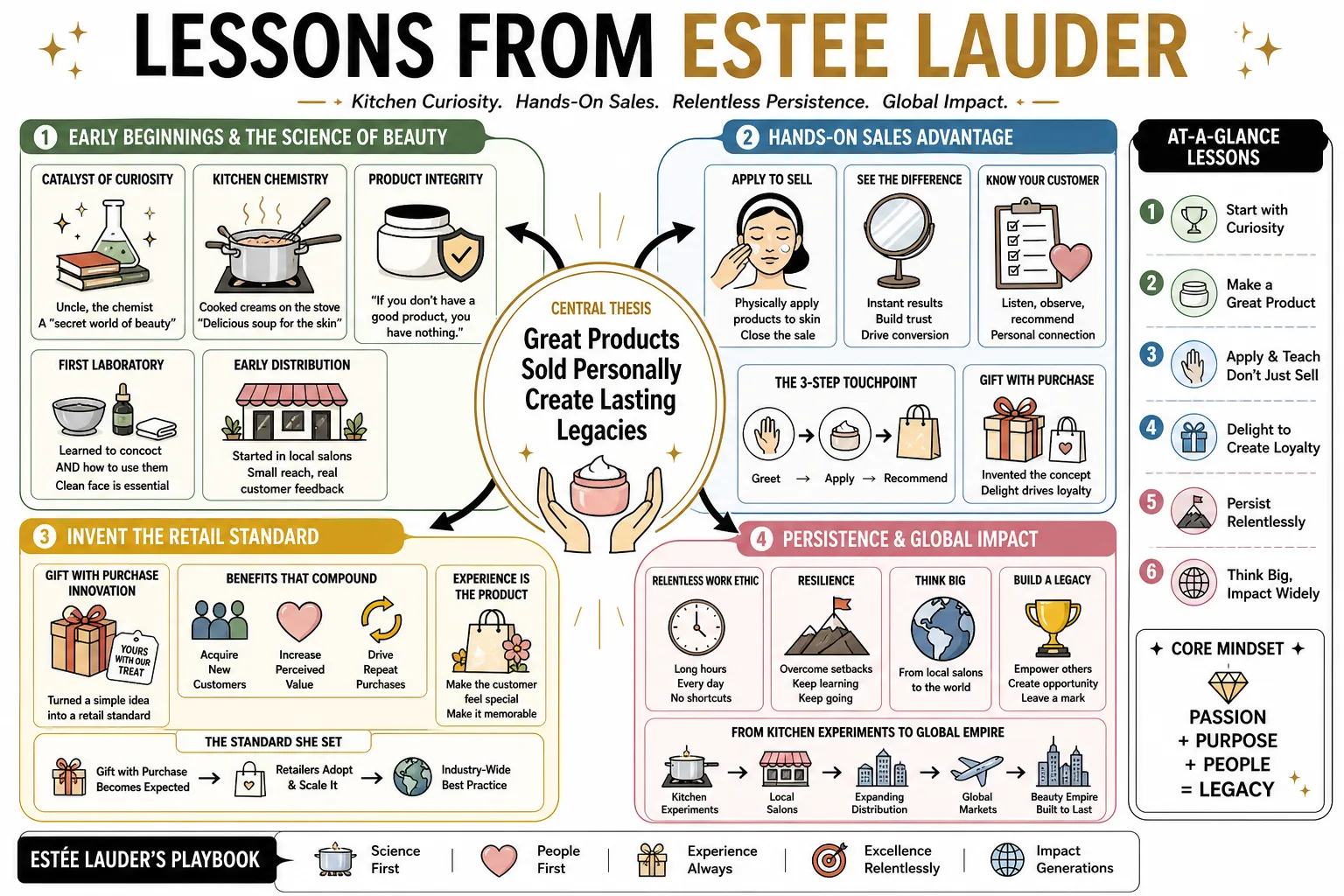
Lessons from Estee Lauder
Estée Lauder began by learning cream-making from her uncle and demonstrating products in New York salons. She and Joseph founded their company in 1946, won an early Saks Fifth Avenue order, and built a prestige beauty business through personal selling, samples, word of mouth and product development. She helped popularize gift-with-purchase rather than demonstrably inventing it. — Estée Lauder Companies — Our Founder.
Part 1: Early Beginnings & The Science of Beauty
- On an early influence: Lauder credited her uncle John Schotz’s home cream-making with sparking her interest in beauty and product formulation. — Estée: A Success Story.
- On learning by making: She watched her uncle mix creams at home and later developed and sold products herself before the company had a formal factory. — Estée: A Success Story.
- On product quality: Lauder said the company tested each new batch against reference samples and discarded products that failed its quality standard. — Estée: A Success Story.
- On the first laboratory: Her uncle taught her how to formulate and apply creams; the family later made a small laboratory in a stable behind the house. — Estée Lauder Companies — Our Founder.
- On beauty salons: Lauder began by demonstrating and selling creams in salons, including to women waiting under hair dryers. — Estée: A Success Story.
- On experiencing fragrance: She had sales teams experience new scents directly during launches rather than relying solely on descriptions. — The New Yorker — As Gorgeous as It Gets.
- On customer research: Lauder personally met consumers and listened at beauty counters, acting as the company’s early one-woman research department. — Estée Lauder Companies — Our Founder.
Part 2: The Art of Salesmanship
- On showing the product: Lauder believed a beauty adviser should explain a product and demonstrate it on the customer’s skin, not rely on a verbal pitch alone. — Estée Lauder Companies — Our Founder.
- On selling what you make: At a sales meeting, Lauder warned that even a fine product has little value if the team does not actively sell it. — The New Yorker — As Gorgeous as It Gets.
- On live demonstrations: She insisted on demonstrating products at Florence Morris’s salon before leaving them with the owner, then used demonstrations with salon customers. — Estée: A Success Story.
- On daily customer contact: Lauder recalled touching fifty faces a day during her early sales work; she did not claim every contact became a sale. — Estée: A Success Story.
- On customer aspiration: Lauder urged her team not to underestimate a woman’s desire for beauty, a principle she connected to serving customers across income levels. — Estée: A Success Story.
- On a simple routine: Lauder promoted a quick everyday makeup routine to answer customers who saw application as too time-consuming. — Estée: A Success Story.
- On listening at the counter: She stayed close to shoppers and asked about their needs, using those conversations to shape selling and product presentation. — Estée Lauder Companies — Our Founder.
Part 3: Marketing Innovation & The Gift with Purchase
- On the Saks breakthrough: In 1947, Lauder won an $800 Saks Fifth Avenue order, her first major department-store account. — Estée Lauder Companies — Our Founder.
- On product sampling: In her early salon business, Lauder gave customers small samples of products they had not bought so they could try them at home. — Estée: A Success Story.
- On word of mouth: Lauder deliberately encouraged customers to tell friends about products they liked, captured in her “Telephone, Telegraph, Tell a Woman” motto. — Estée Lauder Companies — Our Founder.
- On gifts before a sale: Lauder said she sometimes gave a sample even when the customer bought nothing, treating trial as a path to a future relationship. — Estée: A Success Story.
- On choosing the gift: She learned that a color cosmetic such as lipstick drew more interest to gift promotions than cream alone; fragrance later became another useful giveaway. — Estée: A Success Story.
- On enlisting the whole store: At new counter openings, Lauder gave other departments’ saleswomen samples and encouraged them to send shoppers to her counter. — Estée: A Success Story.
- On counter location: After watching shoppers enter Saks, Lauder argued for placing her counter where their attention naturally turned, on the right side near the entrance. — Estée: A Success Story.
- On product presentation: Lauder treated display, packaging and counter ambience as part of how a customer judged a prestige beauty product. — Estée: A Success Story.
Part 4: Work Ethic, Persistence & Luck
- On working for success: Lauder described her success as the result of work rather than merely dreaming about it. — WWD — The Quotable Estée.
- On anger in writing: Her second business rule warned against putting an angry response in a permanent letter; she favored a direct conversation when a relationship mattered. — Estée: A Success Story.
- On preserving relationships: Lauder’s “bees with honey” rule favored courtesy over open hostility when handling business disputes. — Estée: A Success Story.
- On maintaining a prestige image: She warned that short-term sales through discount outlets could damage the carefully built image of a prestige brand. — Estée: A Success Story.
- On studying competition: Lauder advised studying competitors’ products while seeking an original, better approach rather than copying them. — Estée: A Success Story.
- On sustained commitment: Lauder described building a business as a continuing personal commitment, not something to try casually. — Estée: A Success Story.
- On doing the work herself: In a direct interview, Lauder said she had packed, shipped and made products herself and understood the company’s jobs firsthand. — WWD — The Quotable Estée.
Part 5: Brand Identity & The Estée Aesthetic
- On delegating authority: Her “divide and rule” principle meant giving trusted staff real authority and responsibility while she retained overall accountability. — Estée: A Success Story.
- On saying no: Lauder described refusing products or opportunities that did not meet her standard, including a failed line she chose to discontinue. — Estée: A Success Story.
- On informed instinct: She treated instinct as judgment shaped by accumulated observation, not a substitute for knowing customers and products. — Estée: A Success Story.
- On toughness without cruelty: Her “act tough” rule emphasized persistence and firmness without treating employees or customers cruelly. — Estée: A Success Story.
- On correcting mistakes: Lauder advised acknowledging a mistake and cutting losses; she gave discontinued lashes and a teen line as examples. — Estée: A Success Story.
- On package color: She chose a pale blue-green package after considering how it would look in many customers’ bathrooms. — Estée: A Success Story.
- On putting her name on the jar: When she began selling from a salon concession, Lauder chose to put her own name on the jars rather than use her uncle’s label. — Estée: A Success Story.
- On selective distribution: Lauder sought prestigious department-store placement and resisted channels she believed would weaken the brand’s image. — Estée: A Success Story.
- On a coherent visual identity: She coordinated packaging, advertising and displays around a consistent image of the Estée Lauder customer. — Estée: A Success Story.
Part 6: Strategy & Global Growth
- On writing ideas down: Lauder’s eleventh rule was to record ideas because even a strong memory can lose useful details. — Estée: A Success Story.
- On hiring capable deputies: She advised hiring people able to make fast, responsible judgments when the founder could not be present. — Estée: A Success Story.
- On breaking interpersonal barriers: Lauder’s rule about breaking barriers meant using personal hospitality and informal conversation to strengthen business relationships. — Estée: A Success Story.
- On showing appreciation: She recommended personal notes and small gestures of thanks to recognize employees’ work and earn their loyalty. — Estée: A Success Story.
- On training advisers: Lauder insisted that beauty advisers learn the company’s products and sales methods, and she used focused conferences to train them. — Estée: A Success Story.
- On the Youth-Dew spill: In her memoir, Lauder described Youth-Dew spilling while she demonstrated it at Galeries Lafayette; shoppers noticed the scent, but she left open whether the spill was deliberate. — Estée: A Success Story.
- On the Youth-Dew format: Lauder introduced Youth-Dew in 1953 as a bath oil that doubled as a skin perfume, making self-purchase more natural for American women. — Estée Lauder Companies — Our Founder.
- On persistence with Harrods: After an initial rejection, Lauder spent a month courting British beauty editors and returned the following year before Harrods accepted a small order. — Estée: A Success Story.
- On taking a calculated first risk: She described renting a salon concession as a meaningful early risk that let her turn free demonstrations into a business. — Estée: A Success Story.
- On entering overseas markets personally: Her Harrods account involved personal buyer meetings, product demonstrations and beauty-editor outreach rather than merely shipping inventory abroad. — Estée: A Success Story.
Part 7: Leadership & Management
- On leading sales training in person: Lauder personally addressed advisers at sales meetings and demonstrated the selling behaviors she expected at the counter. — The New Yorker — As Gorgeous as It Gets.
- On her relationship with advisers: Lauder referred to saleswomen as “my girls” when discussing her memoir and spoke to advisers directly at company meetings. — WWD — The Quotable Estée.
- On complementary family roles: Estée led products, creativity and sales while Joseph managed finance and operations in the early company. — Estée Lauder Companies — Our Heritage.
Part 8: Legacy & The Philosophy of Empowerment
- On selling hope: In her memoir, Lauder described the company as selling “jars of hope,” linking the product to a customer’s desire to care for her appearance. — Estée: A Success Story.
- On beauty as an attitude: Lauder connected beauty with self-presentation and a sense of possibility, not only with a jar of cream. — Estée: A Success Story.
- On confidence: Lauder argued that feeling attractive could contribute to a woman’s self-respect and confidence; that is her belief, not a demonstrated clinical effect. — Estée: A Success Story.
- On aging and self-care: In her beauty advice, Lauder encouraged customers to care for their appearance as they aged; she presented this as cosmetic guidance, not a medical reversal of aging. — Estée: A Success Story.
- On the satisfaction of achievement: In the memoir’s epilogue, Lauder contrasted comfortable serenity with the fulfillment she found in pursuing ambitious work. — Estée: A Success Story.
- On staying focused: Lauder wrote that pursuing a dream required keeping attention on the chosen goal through sustained work and distraction. — Estée: A Success Story.