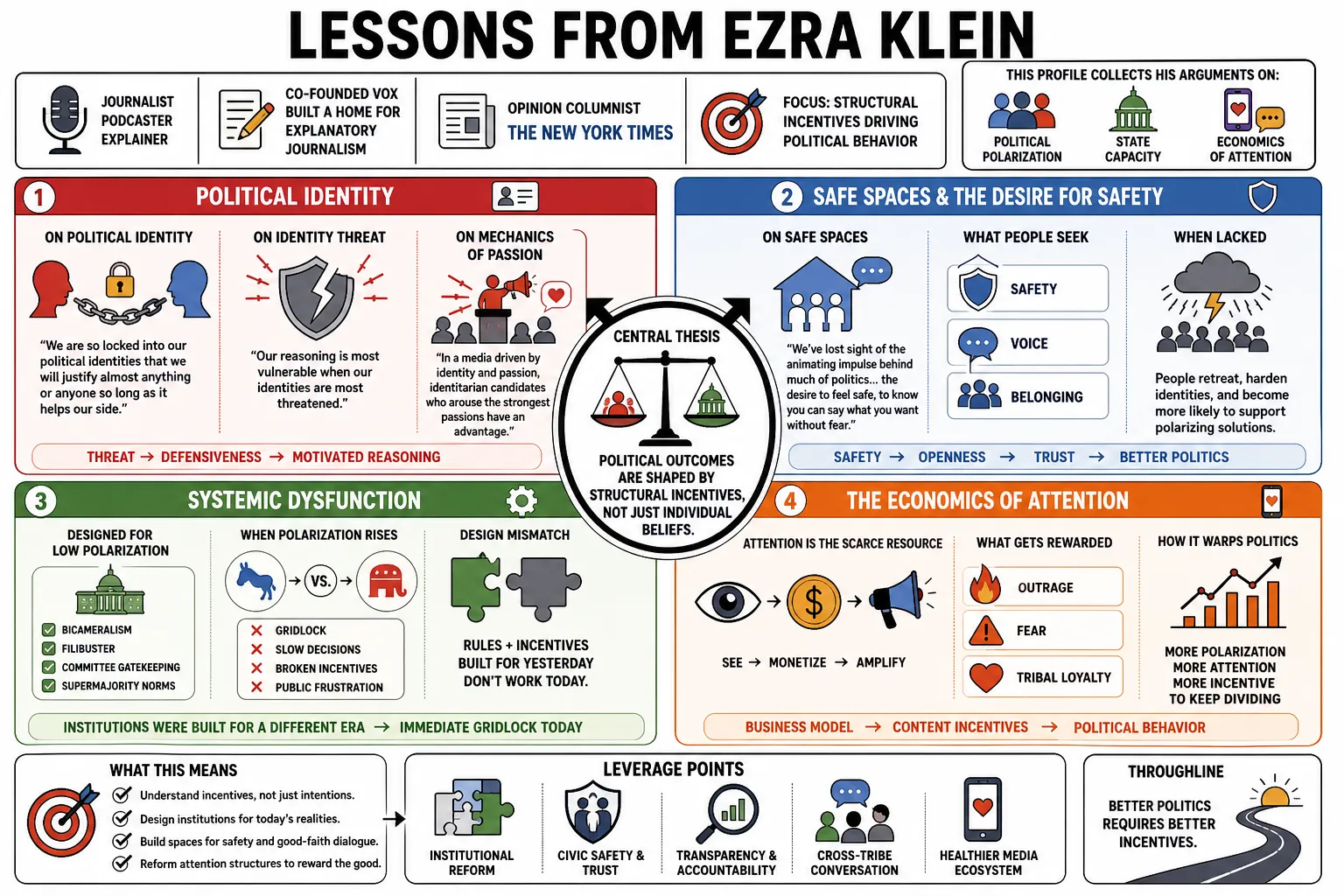
Lessons from Ezra Klein
Journalist and podcaster Ezra Klein focuses on the structural incentives driving political behavior. He co-founded Vox to build a home for explanatory journalism and now writes as an opinion columnist for The New York Times. This profile collects his arguments on political polarization, state capacity, and the economics of attention.
Part 1: Polarization and Identity
- On Political Identity: "We are so locked into our political identities that we will justify almost anything or anyone so long as it helps our side." — Source: [Goodreads]
- On Identity Threat: "Our reasoning is most vulnerable when our identities are most threatened. And for many, this is an era of profound threat." — Source: [Goodreads]
- On the Mechanics of Passion: "In a media driven by identity and passion, identitarian candidates who arouse the strongest passions have an advantage." — Source: [Goodreads]
- On Safe Spaces: "We’ve lost sight of the animating impulse behind much of politics... the desire to feel safe, to know you can say what you want without fear." — Source: [Goodreads]
- On Systemic Dysfunction: The American political system was designed for a period of low polarization, leading to immediate gridlock when parties become deeply divided. — Source: [SuperSummary]
- On Mega-Identities: Political affiliation has evolved into a mega-identity that absorbs and reinforces other social, racial, and religious identities. — Source: [Conversations with Tyler]
- On Motivated Reasoning: Human brains are wired to seek information that confirms pre-existing beliefs and reject dissenting viewpoints. — Source: [Bookey]
- On the Limits of Conclusion: "Authors write whole books about devilishly complex social problems and then pretend they can be solved in a few bullet points." — Source: [Morgan County USA]
- On the Nature of Politics: "Politics uses us for its own ends." — Source: [Medium]
- On Demographic Sorting: Polarization is driven heavily by how thoroughly our demographics and geography sort us into opposing political camps. — Source: [Goodreads]
Part 2: Media and Journalism
- On the Mission of Vox: Journalism should explain the news by providing the background context necessary for readers to understand complex systems. — Source: [Quillette]
- On the Explainer Format: The internet offers limitless space, allowing reporters to provide expansive backstories for complicated trending topics. — Source: [Quillette]
- On Resisting the News Cycle: "The more you're tied to the news cycle, the harder it is to actually step away from that." — Source: [The Washington Post]
- On the Dilemma of Coverage: "The fundamental thing the media does all day, every day, is decide what to cover... to decide what to cover is to become the shaper of the news rather than a mirror held up to the news." — Source: [Goodreads]
- On Journalists as Actors: By choosing what is newsworthy, journalists inevitably become actors rather than objective observers. — Source: [Goodreads]
- On Neglected Topics: Media infrastructure is path-dependent, often focusing on long-standing issues like tax policy while neglecting emerging threats like advanced artificial intelligence. — Source: [YouTube]
- On Identity and Information: "As a way of avoiding dissonance and estrangement from valued groups, individuals subconsciously resist factual information that threatens their defining values." — Source: [Law & Liberty]
- On Challenging the Narrative: The most important events in the world are rarely the ones trending on cable news. — Source: [The Washington Post]
- On Attention Economies in Media: Outlets compete primarily for engagement rather than simply distributing information to the public. — Source: [Wikipedia]
- On Explanatory Journalism: The highest goal of modern digital journalism is deep analysis rather than surface-level speed. — Source: [YouTube]
Part 3: Institutions and Governance
- On Veto Points: The American political system has become a vetocracy because it contains too many structural opportunities to stop government action. — Source: [The New York Times]
- On Procedure Fetish: Agencies have become so fixated on complex processes meant to prevent harm that they frequently sacrifice actual outcomes. — Source: [Medium]
- On Institutional Paralysis: Mechanisms designed for checks and balances have been pushed to an extreme, making it nearly impossible to build basic infrastructure. — Source: [Talk Easy Podcast]
- On the Scarcity Mindset: Liberals must move past a mindset that protects the status quo and instead embrace a politics that actively builds new capacity. — Source: [Crooked Media]
- On Liberal Blindspots: Refusing to admit when government fails creates a political opening for opponents to attack the existence of the state itself. — Source: [The Ezra Klein Show]
- On the Two-Party Trap: "I do not want American politics trapped between a party that will not make government work and a party that wants to make government fail." — Source: [The Ezra Klein Show]
- On State Capacity: Empowering officials and consolidating state capacity is often more effective for progress than reducing the size of government. — Source: [The New York Times]
- On Distinguishing Checks from Obstruction: Lawmakers must learn to separate necessary checks on power from excessive obstruction that harms the public interest. — Source: [Substack]
- On Democratic Frustration: When the government cannot deliver on its promises due to structural vetos, voters understandably lose faith in democratic institutions. — Source: [The New York Times]
- On the Cost of Inaction: The legal processes designed to ensure environmental review frequently end up blocking the exact clean energy projects needed to fight climate change. — Source: [The New York Times]
Part 4: Economics and Policy
- On Supply-Side Progressivism: The left must focus on dramatically increasing the supply of housing and healthcare, rather than just subsidizing demand. — Source: [The New York Times]
- On the Cost Disease: American institutions struggle to explain why essential services like transit and education cost significantly more in the United States than in peer nations. — Source: [The New York Times]
- On the Abundance Agenda: A successful political project must promise abundance of housing and energy rather than just better distribution of scarcity. — Source: [The New York Times]
- On Housing Scarcity: The housing crisis is primarily a crisis of failing to build enough homes where people actually want to live. — Source: [The New York Times]
- On Permitting Reform: To transition to a green economy, the government must reform permitting laws that make it agonizingly slow to lay transmission lines. — Source: [The New York Times]
- On Welfare States: A strong welfare state requires a highly functional administrative state capable of deploying resources efficiently. — Source: [The New York Times]
- On Economic Nostalgia: Nostalgia for mid-century economies frequently ignores the massive exclusionary practices that kept minorities and women out of the workforce. — Source: [The New York Times]
- On Subsidizing Demand: Giving people money to buy things in a supply-constrained market only drives up prices. — Source: [The New York Times]
- On Building as Politics: The ability to execute large-scale physical projects is a core test of a political system's legitimacy. — Source: [The New York Times]
Part 5: Technology and Artificial Intelligence
- On the Era of AI: "There’s a good chance that, when we look back on this era in human history, A.I. will have been the thing that matters." — Source: [Substack]
- On the Pace of Change: "I’ve come to believe that we’re in a potentially brief interregnum before the pace of change accelerates to a rate that is far faster than is safe for society." — Source: [The Ezra Klein Show]
- On Human Potential and AI: Humanity will likely need artificial intelligence to reach the stars, as biological bodies cannot handle the journey. — Source: [Reddit]
- On the AGI Timeline: Policymakers and researchers feel increasing urgency regarding the rapid arrival of artificial general intelligence. — Source: [The Ezra Klein Show]
- On Proactive Regulation: The public sector should heavily invest in safety research rather than leaving the technology's trajectory entirely to private companies. — Source: [80,000 Hours]
- On the Jevons Paradox: AI might increase the demand for labor in certain contexts by lowering the cost of tasks, contrary to predictions of mass job loss. — Source: [MindStudio]
- On AI as Co-Creator: Users should view language models less as traditional tools and more as entities for co-creation in professional workflows. — Source: [The Ezra Klein Show]
- On Institutional Readiness: Governments are currently unprepared to manage the cascading effects that highly capable models will have on the information ecosystem. — Source: [The New York Times]
- On the Risk of Novelty: We should not quash a technology with huge potential simply because it is novel, but we must manage the transition with extreme care. — Source: [Reddit]
Part 6: Animals and Food Ethics
- On the Moral Failing of Our Age: "How we treat farm animals today will be seen, I believe, as a defining moral failing of our age." — Source: [Reddit]
- On Utilitarian Impact: Large-scale change in the food system is vastly more impactful than insisting on narrow ideological purity among a few consumers. — Source: [Reddit]
- On Reducing Meat Consumption: "If we can get everyone to cut meat consumption by half, that is so much better than quadrupling the number of vegetarians." — Source: [Vegan Strategist]
- On Diet as a Moral Choice: The food we choose to consume is a profound moral choice with global consequences. — Source: [Vegan Strategist]
- On Technological Solutions: Supporting meat alternatives like plant-based and lab-grown meat is crucial to reducing human reliance on industrial agriculture. — Source: [Medium]
- On Avoiding Absolutism: A non-judgmental approach to dietary habits is generally more effective at fostering political change than demanding immediate dietary perfection. — Source: [Apollo Grace]
- On Vegan Dropoff Rates: Insisting on strict veganism often leads to high dropoff rates, making sustainable reduction a better societal goal. — Source: [Vegan Strategist]
- On Factory Farming Cruelty: The conditions of modern industrial agriculture are a systemic horror that requires both policy intervention and consumer shifts. — Source: [The Humane League]
- On the Politics of Meat: Reforming the agricultural system will require serious political will and legislation, not just individualized consumer choices. — Source: [Cato Unbound]
Part 7: Attention and Productivity
- On the Value of Attention: "I'm convinced that attention is the most important human faculty. Your life, after all, is just the sum total of the things you've paid attention to." — Source: [The Ezra Klein Show]
- On the Demand Side of Attention: The modern economy is explicitly designed by highly paid engineers to capture and monetize our attention against our will. — Source: [The Ezra Klein Show]
- On the Supply Side of Attention: Our capacity to focus is heavily determined by physical conditions like sleep and financial stability. — Source: [The Ezra Klein Show]
- On Digital Minimalism: Telling someone to be a digital minimalist in the modern workplace is like telling someone who lives in a candy store to diet. — Source: [The Ezra Klein Show]
- On Protecting Morning Focus: Avoiding scheduling meetings before noon is a practical way to preserve cognitive energy for deep writing and thinking. — Source: [Medium]
- On Physical Boundaries with Phones: Creating physical distance from devices during social outings is a necessary step to reclaim personal presence. — Source: [Medium]
- On the Attention Economy: We currently lack high-quality systemic frameworks to help regular people build and replenish their capacity for focus. — Source: [Simplecast]
- On Distracted Workplaces: Productivity advice fails when it places the burden entirely on the individual while ignoring the interruptive design of workplace software. — Source: [Reddit]
- On Attention as Currency: The digital attention economy treats human focus as a commodity, shifting the incentives of journalism and political campaigning. — Source: [The Ezra Klein Show]
Part 8: Reading and Literature
- On Deep Reading: The true value of a book lies in the time spent immersed in its world, not just the quick extraction of its main argument. — Source: [Driverless Crocodile]
- On Interaction with Text: Deep reading allows readers to connect the text with their own existing ideas, generating insights the author never explicitly wrote. — Source: [Driverless Crocodile]
- On Scanning vs. Reading: The scanning habits encouraged by smartphones are addictive and frequently promote shallow confirmation bias. — Source: [Reddit]
- On Grappling with Complexity: Certain ideas require the expansive space of a long book to breathe and cannot be fully understood through social media posts. — Source: [The Ezra Klein Show]
- On the Bookends Routine: Starting and ending the day with physical books rather than screens helps center the mind and ease the transition into sleep. — Source: [Austin Kleon]
- On the World of Imagination: Reading fiction at night allows the brain to detach from the anxieties of the news cycle and step into an imaginative space. — Source: [Austin Kleon]
- On Reading as a Practice: Carving out at least forty-five minutes a day for uninterrupted reading is a vital defense against the fractured modern attention span. — Source: [Medium]
- On Books Shaping Worldviews: Long-form literature provides the fundamental frameworks necessary for understanding modern political dysfunction. — Source: [Radical Reads]
- On the Lost Art of Reading: Reclaiming the ability to read deeply requires deliberate practice and active resistance against the frictionless design of modern technology. — Source: [The Ezra Klein Show]