Lessons from Fareed Zakaria
Journalist and television host Fareed Zakaria analyzes international relations and the shifting balance of global power. He popularized the phrase "the rise of the rest" to describe a world where the West no longer holds a monopoly on economic and political influence. This profile collects his core arguments on diplomacy, democracy, and how societies adapt to technological and historical change.
Part 1: Geopolitics and Global Power Shifts
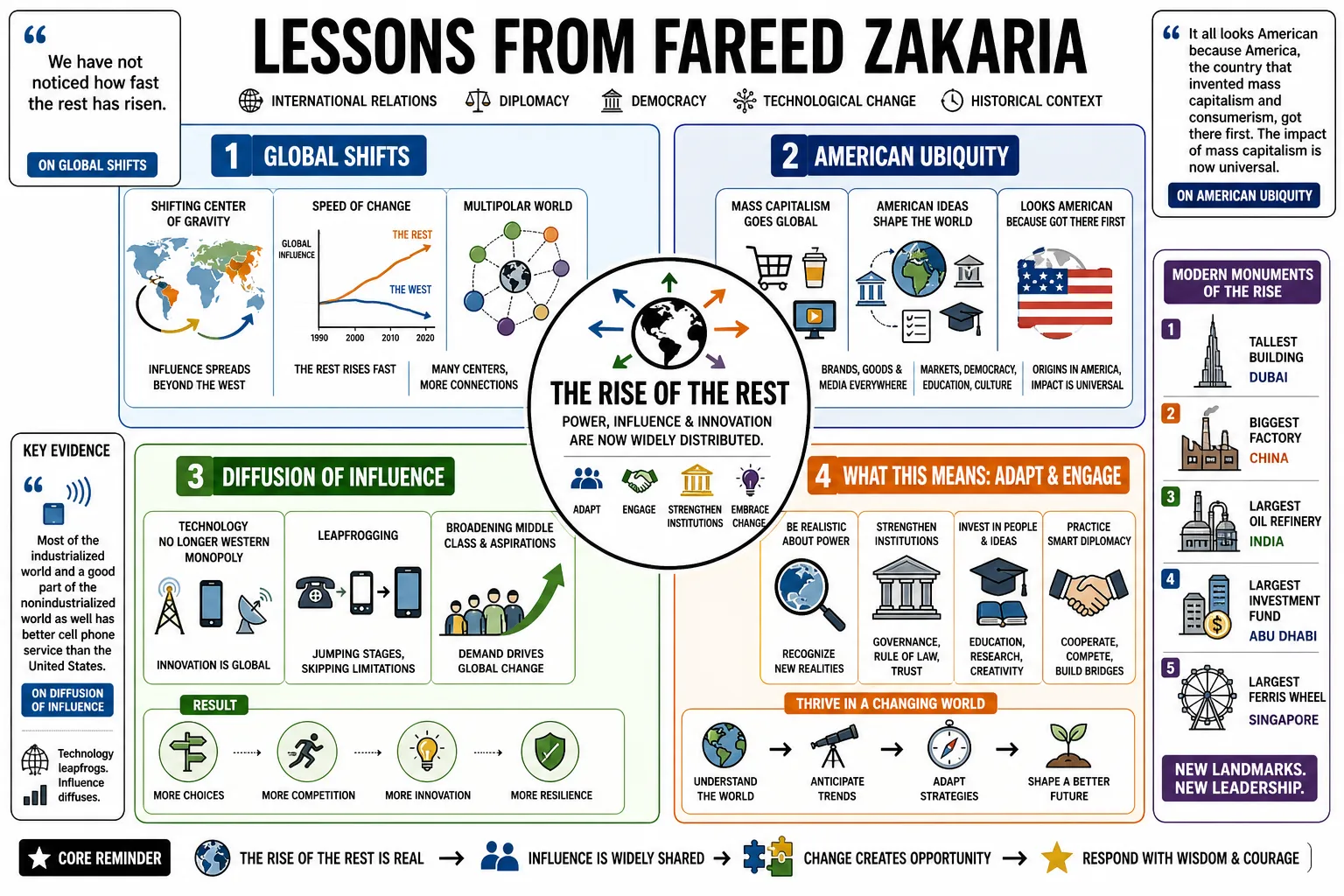
- On Global Shifts: "We have not noticed how fast the rest has risen." — Source: [The Post-American World]
- On the Diffusion of Influence: "Most of the industrialized world and a good part of the nonindustrialized world as well has better cell phone service than the United States." — Source: [The Post-American World]
- On American Ubiquity: "It all looks American because America, the country that invented mass capitalism and consumerism, got there first. The impact of mass capitalism is now universal." — Source: [The Post-American World]
- On Modern Monuments: "The tallest building in the world is now in Dubai, the biggest factory in the world is in China, the largest oil refinery is in India, the largest investment fund in the world is in Abu Dhabi, the largest Ferris wheel in the world is in Singapore." — Source: [AZQuotes]
- On the United States' Historic Mission: "The United States succeeded in its great and historic mission: it globalized the world. But along the way, it forgot to globalize itself." — Source: [The Post-American World]
- On Global Perceptions: "There are two sets of conversations, one with Americans in the room and one without." — Source: [The Post-American World]
- On Structural Change: "Growth takes place whenever a challenge evokes a successful response that, in turn, evokes a further and different change." — Source: [The Post-American World]
- On American Exceptionalism: "We rarely look around and notice other options and alternatives, convinced that 'we’re number one'." — Source: [The Post-American World]
- On the Multipolar Reality: "The rivalry between the United States and China remains the defining feature of modern geopolitics, shaping everything from trade to technology." — Source: [Ten Lessons for a Post-Pandemic World]
- On Emerging Markets: "Developing nations have moved beyond participating in the global economy; they are actively shaping its rules and institutions." — Source: [Fareed Zakaria GPS]
Part 2: American Foreign Policy and Strategy
- On Pragmatism: "Foreign policy is a matter of costs and benefits, not theology." — Source: [The Post-American World]
- On Strategic Vision: "Foreign policy commands attention when it's crisis management. The broader challenge is to lay down a longer-term strategy that endures after the crisis of the moment." — Source: [AZQuotes]
- On Military Interventions: "If there is one lesson for U.S. foreign policy from the past 10 years, it is surely that military intervention can seem simple but is in fact a complex affair with the potential for unintended consequences." — Source: [The Washington Post]
- On Cold War Nostalgia: "We all accuse Vladimir Putin of Cold War nostalgia, but Washington's elites miss the old days as well. They wish for the world in which the United States was utterly dominant." — Source: [AZQuotes]
- On a Messy World: "Today's world is messy and complicated, and American foreign policy must adapt to a world where adversaries and allies are not always cleanly divided." — Source: [The Washington Post]
- On Isolationism: "This isolation has left Americans quite unaware of the world beyond their borders. Americans speak few languages, know little about foreign cultures, and remain unconvinced that they need to rectify this." — Source: [The Post-American World]
- On Defining Interests: "A successful foreign policy requires recognizing the limits of American power and prioritizing core national interests over ideological crusades." — Source: [The Washington Post]
- On Diplomacy: "Diplomacy is often the slow, grinding work of finding marginal areas of agreement between countries that otherwise deeply distrust each other." — Source: [Fareed Zakaria GPS]
- On Multilateralism: "The international institutions built after 1945 reflect an older balance of power, and they must be reformed to include the voices of rising powers if they are to survive." — Source: [Fareed Zakaria GPS]
- On Interdependence: "No single nation, no matter how powerful, can solve transnational challenges like climate change, pandemics, or cyber warfare on its own." — Source: [Ten Lessons for a Post-Pandemic World]
Part 3: The Crisis of Democracy and Liberalism
- On the Nature of Democracy: "Democracy is not simply a political system, but a way of life, a culture." — Source: [The Future of Freedom]
- On Illiberal Democracy: "In general, outside Europe, illiberal democracy has not proved to be an effective path to liberal democracy." — Source: [The Future of Freedom]
- On False Remedies: "The common response to problems in democratic systems is often just 'more democracy,' a formula that is frequently wrong." — Source: [The Future of Freedom]
- On Future Generations: "Edmund Burke once described society as a partnership between the dead, the living, and the yet unborn. It is difficult to see in the evolving system who will speak for the yet unborn, for the future." — Source: [The Future of Freedom]
- On the Rules of Liberalism: "Liberal democracy is about rules, not outcomes. We uphold freedom of speech, rather than favoring specific speech." — Source: [Age of Revolutions]
- On Backlash to Progress: "While periods of immense progress improve living conditions, they inevitably trigger a deep backlash because the resulting freedom comes at the expense of established authority." — Source: [Age of Revolutions]
- On the Rule of Law: "Elections alone do not make a true democracy; without the rule of law and the protection of basic liberties, majority rule can easily become a tyranny." — Source: [The Future of Freedom]
- On Populism: "Populist leaders thrive by dividing societies into pure masses and corrupt elites, bypassing institutions that were designed to limit executive power." — Source: [The Washington Post]
- On Liberty and Order: "Historically, liberty has been rooted in the establishment of order and property rights long before the introduction of mass voting." — Source: [The Future of Freedom]
- On Exporting Democracy: "The spread of democracy, American-style, like the corporate franchising process, often plays into the hands of illiberal forces when underlying institutions are weak." — Source: [The Future of Freedom]
Part 4: Economics, Globalization, and Inequality
- On Commodification: "When everything can be bought, every aspect of life becomes unequal." — Source: [Ten Lessons for a Post-Pandemic World]
- On the Role of Markets: "Markets are essential for growth and efficiency, but they cannot function in isolation; government intervention is required to manage crises and address systemic inequalities." — Source: [Ten Lessons for a Post-Pandemic World]
- On Urbanization: "The city is like poetry: it compresses all life, all races and breeds, into a small island and adds music and the accompaniment of internal engines." — Source: [Ten Lessons for a Post-Pandemic World]
- On Globalization's Persistence: "Despite the rise of nationalist sentiments, globalization persists in new forms. We are highly interconnected, even if the politics of the moment deny it." — Source: [Ten Lessons for a Post-Pandemic World]
- On Economic Resentment: "Where politics was once overwhelmingly shaped by economics, politics today is being transformed by identity." — Source: [Age of Revolutions]
- On Protectionism: "Tariffs and trade wars are often politically popular in the short term, but they act as a tax on domestic consumers and stifle innovation over the long run." — Source: [The Washington Post]
- On Global Supply Chains: "The pandemic exposed the fragility of hyper-optimized global supply chains, pushing companies to prioritize resilience and redundancy over pure cost efficiency." — Source: [Ten Lessons for a Post-Pandemic World]
- On the New Economy: "The shift from a manufacturing-based economy to a knowledge-based one has concentrated immense wealth in cities and left rural areas feeling politically alienated." — Source: [Fareed Zakaria GPS]
- On Economic History: "The 17th-century Dutch economic revolution teaches us that a society built on trade and tolerance can outcompete much larger empires reliant on extraction." — Source: [Age of Revolutions]
Part 5: Education, Humanism, and Culture
- On the Essence of Liberal Arts: "The essence of liberal education was 'not to teach that which is particular to any one of the professions; but to lay the foundation for all'." — Source: [In Defense of a Liberal Education]
- On Freedom of Mind: "The 'liberal' in 'liberal arts' refers to 'freedom', specifically the education that prepares individuals to be free citizens capable of thinking for themselves." — Source: [In Defense of a Liberal Education]
- On Education and Tyranny: "The best way of preventing tyranny is to illuminate the minds of the people. The study of history could serve as an especially effective bulwark." — Source: [In Defense of a Liberal Education]
- On Elitism: "Jefferson’s fear was that without a system of public education, the country would end up being ruled by a privileged elite that would recycle itself through a network of private institutions." — Source: [In Defense of a Liberal Education]
- On Student Conformity: "After centuries of bemoaning that the young are too rebellious, the problem today, it appears, is that they are not rebellious and disrespectful enough." — Source: [In Defense of a Liberal Education]
- On Intellectual Curiosity: "They aren’t willing to challenge conventional wisdom, neither the liberal pieties that offended Allan Bloom nor the conservative ones that gall Deresiewicz." — Source: [In Defense of a Liberal Education]
- On Practical Genius: "The essence of Benjamin Franklin's appeal is that he was brilliant but practical, interested in everything, but especially in how things work." — Source: [In Defense of a Liberal Education]
- On Reading and Writing: "A liberal education teaches you how to read critically, write clearly, and think broadly, skills that remain valuable regardless of how the job market shifts." — Source: [In Defense of a Liberal Education]
- On Synthesis: "The world henceforth will be run by synthesizers, people able to put together the right information at the right time, think critically about it, and make important decisions." — Source: [AZQuotes]
Part 6: Technology, Information, and Society
- On Information Overload: "We are drowning in information, while starving for wisdom." — Source: [AZQuotes]
- On Media Consumption: "Good programming, like good books, asks a little more of the viewer. But no executive today will risk having the viewer bored for even a minute." — Source: [The Future of Freedom]
- On Technological Disruption: "These three forces of technology, economics, and identity together almost always generate backlash that produces a new politics." — Source: [Age of Revolutions]
- On the Digital Revolution: "The digital revolution has fundamentally transformed education, labor, and social interaction, pushing society toward a 'world on steroids'." — Source: [Ten Lessons for a Post-Pandemic World]
- On Social Media and Division: "Social media algorithms are designed to engage, which often means they amplify outrage and polarization rather than fostering measured public debate." — Source: [The Washington Post]
- On Artificial Intelligence: "The rise of artificial intelligence will force us to redefine what human labor means, placing a premium on creativity, empathy, and complex problem-solving." — Source: [Fareed Zakaria GPS]
- On Technological Determinism: "Technology is not destiny; how a society chooses to regulate, distribute, and adopt new tools is a political choice that shapes the future." — Source: [The Washington Post]
- On Speed and Instability: "When information travels instantly, the time for leaders to deliberate during a crisis shrinks, increasing the risk of miscalculation." — Source: [Fareed Zakaria GPS]
- On the Industrial Revolution: "The Industrial Revolution teaches us that massive technological upgrades create immense wealth, alongside severe social dislocation that takes generations to stabilize." — Source: [Age of Revolutions]
Part 7: Lessons from the Pandemic
- On the Pace of History: "Lenin is supposed to have once said, 'There are decades when nothing happens, and then there are weeks when decades happen'." — Source: [Ten Lessons for a Post-Pandemic World]
- On Accelerated Trends: "The post-pandemic world is going to be, in many aspects, a sped-up version of the world we knew." — Source: [Ten Lessons for a Post-Pandemic World]
- On Quality of Governance: "The effectiveness of a nation's response to the pandemic was determined more by the quality of its governance than by its size or resources." — Source: [Ten Lessons for a Post-Pandemic World]
- On Trust in Institutions: "Countries with high levels of social trust and faith in public institutions managed the public health crisis far better than those polarized by political division." — Source: [Ten Lessons for a Post-Pandemic World]
- On the limits of Science: "Science can give us data and vaccines, but it cannot make the political choices about how to balance public health, economic survival, and personal liberty." — Source: [The Washington Post]
- On Global Cooperation: "A global crisis requires a global response, yet the initial reaction of most nations was to turn inward, close borders, and hoard supplies." — Source: [Ten Lessons for a Post-Pandemic World]
- On Remote Work: "The shift to remote work demonstrated that the physical office is no longer strictly necessary for many industries, permanently altering the geography of labor." — Source: [Ten Lessons for a Post-Pandemic World]
- On Fiscal Policy: "The massive government spending during the pandemic ended the era of austerity, showing that the state can and will step in when markets freeze." — Source: [The Washington Post]
- On Human Adaptability: "If the pandemic proved anything, it is the remarkable capacity of humans to adapt their behavior, their businesses, and their lives to sudden, extreme constraints." — Source: [Fareed Zakaria GPS]
Part 8: History, Revolutions, and Progress
- On Organic Change: "Change in society must take place organically; when forced too fast, the ensuing disruption, chaos, and backlash can often break civilization itself." — Source: [Age of Revolutions]
- On Imposed Revolutions: "Above all, the French Revolution shows the danger of revolution imposed by political leaders, rather than growing naturally out of broad social, economic, and technological changes." — Source: [Age of Revolutions]
- On Competing Plotlines: "Throughout this story, we will see two competing plotlines: liberalism, meaning progress, growth, and disruption, and illiberalism, standing for regression, restriction, and nostalgia." — Source: [Age of Revolutions]
- On the Cycle of History: "History is defined by a cycle of ceaseless action and reaction, where every major leap forward produces anxieties that demagogues can exploit." — Source: [Age of Revolutions]
- On Adapting the Liberal Order: "The core tenets of classical liberalism, such as the rule of law, individual rights, and open exchange, remain the best path forward if they can be adapted to manage modern anxieties." — Source: [Age of Revolutions]
- On Identity Politics: "We are living in an era where cultural and identity grievances are proving far more potent in mobilizing voters than traditional economic interests." — Source: [The Washington Post]
- On Nostalgia: "Nostalgia is a powerful political force because it promises a return to a simplified, ordered past that never actually existed." — Source: [Fareed Zakaria GPS]
- On Radical Advance: "Revolutions extend beyond violent uprisings; they represent deep, structural shifts in how human beings work, communicate, and organize their societies." — Source: [Age of Revolutions]
- On the Long View: "The study of history reminds us that no order is permanent, and the survival of open societies depends entirely on the constant work of their citizens." — Source: [The Washington Post]