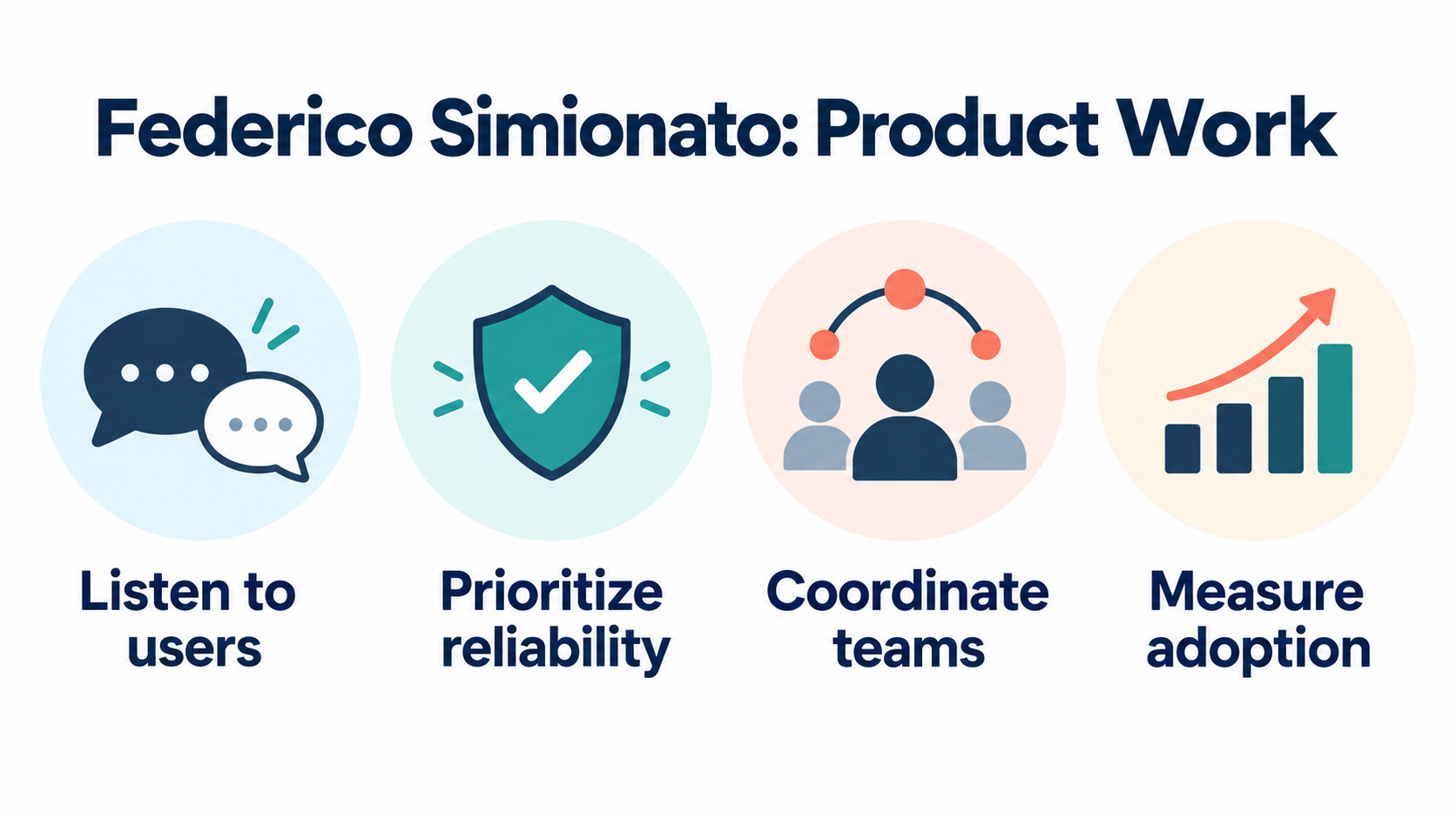
Lessons from Federico Simionato
Federico Simionato, Evernote product lead at Bending Spoons, described 2023 as a year of prioritizing speed, reliability and security while the team modernized the product's underlying technology. His account offers a documented starting point for evaluating Evernote's later feature and AI work. — Evernote 2023 Technology Recap.
Part 1: Product Philosophy & Fundamentals
- Repair the Foundations Before Expanding: Simionato says Evernote allocated much more of its 2023 effort to speed, reliability and security than to new features because a product built on weak foundations would not improve sustainably. — Evernote 2023 Technology Recap.
- Remove Legacy Code That Slows Improvement: In his 2023 engineering recap, Simionato reports removing old experiments, feature flags and unused code, and migrating Evernote data away from its Monolith backend to lower maintenance burden. — Evernote 2023 Technology Recap.
- Prioritize Reliability When It Is the Constraint: Simionato says Evernote made speed, reliability and security its three 2023 goals, accepting a slower pace of product innovation while those fundamentals improved. — Evernote 2023 Technology Recap.
- Measure a Concrete Speed Bottleneck: Simionato describes Evernote Web's slow initial downsync as a specific user-facing bottleneck; in a test account with 17,265 notes, replacing its browser storage brought that process from 285 seconds to 17. — Evernote Web Downsync Improvement.
- Discard Prototypes That Lack a Real Use Case: Simionato says Evernote shows proposed features to relevant users and will revise or drop a prototype when the feedback fails to establish a concrete need. — 20Product Interview.
- Combine Estimates with Qualitative Judgment: When considering Evernote features, Simionato says his team estimates how many people a change may help, but usefulness cannot be known precisely before release; prototypes and customer conversations help fill that gap. — 20Product Interview.
- Balance Invisible Repairs with Visible Improvements: Looking back at Evernote's first modernization months, Simionato says the team should have reserved some capacity for user-visible improvements while it worked on technical foundations; acquisition news and higher prices made an all-invisible effort hard for customers to assess. — 20Product Interview.
- Choose Features for Demonstrable Usefulness: Simionato says Evernote considers potential user reach and whether a feature is a meaningful step forward, then tests prototypes with customers rather than assuming that more features automatically make the product better. — 20Product Interview.
- Warn Users When Sync Is at Risk: Simionato reports that Evernote added in-app warnings for ongoing sync problems and guidance to restart the app, aiming to reduce the chance of users losing unsynced changes. — Evernote 2023 Technology Recap.
- Modernize Through Repeated Releases: Simionato says Evernote moved from releases every four to eight weeks to a regular weekly cadence in 2023 while continuing backend and client modernization into 2024. — Evernote 2023 Technology Recap.
Part 2: The Acquisition & Revitalization
- Modernize Evernote for a Long Product Life: Simionato says the team needed to update Evernote's nearly two-decade-old technology to keep working on the product over the next 10 to 20 years. He does not present the acquisition as a guaranteed return to market leadership. — 20Product Interview.
- Acknowledge the Cost of Simultaneous Change: Simionato says some customers were skeptical or angry when Evernote's acquisition, a price rise and a period of mostly invisible infrastructure work arrived together. — 20Product Interview.
- Price Against Perceived Product Value: Discussing the 2023 Evernote price rise, Simionato says Bending Spoons believed the product still offered enough value for many subscribers; he also acknowledges that the increase produced their largest churn response. — 20Product Interview.
- Retire Dependence on the Old Backend: Simionato reports removing unused code and migrating data away from Evernote's Monolith backend so the team could reduce manual maintenance and continue improving reliability. — Evernote 2023 Technology Recap.
- Do Not Treat Foundations and Features as Strict Phases: Evernote's 2023 program emphasized foundations but also introduced collaborative editing and AI tools. Simionato later said that more visible user improvements should have accompanied the deep technical work from the start. — 20Product Interview.
- Respect Users' Accumulated Work: Simionato notes that customers have built years of notes and working systems in Evernote; for that reason, he regards continued usefulness and subscriber retention as central product concerns. — 20Product Interview.
- Make Product Progress Visible to Users: Simionato says he began monthly product updates after realizing that invisible infrastructure work, acquisition news and higher prices left customers uncertain about Evernote's direction; substantive updates gave them a chance to judge the work and respond. — 20Product Interview.
Part 3: AI Implementation & Utility
- Give AI a Specific User Job: In 2023, Simionato introduced AI Note Cleanup as a way to tidy hurriedly written meeting notes after the meeting, anchoring the feature in a concrete task rather than an abstract promise about AI. — Evernote Pricing and Features Update.
- Ask Questions of Your Notes: Evernote's 2023 AI-Powered Search let users ask natural-language questions and receive answers drawn from relevant notes, with references back to those notes; it was not yet the full Semantic Search later shipped in v11. — Evernote AI-Powered Search.
- Use AI to Tidy Rough Notes: Simionato described AI Note Cleanup as help for formatting and organizing notes taken quickly during a meeting, not as a guarantee that every raw thought becomes an actionable plan. — Evernote Pricing and Features Update.
- Describe the AI Search Privacy Boundary: Evernote's 2023 AI-Powered Search documentation says relevant note subsets are processed by a third-party API for a query, but the note or query content is not used to train AI models. This is more precise than promising that data never leaves the app. — Evernote AI-Powered Search.
- Turn Recordings into Meeting Notes: Evernote v11's AI Meeting Notes can record meetings, transcribe speech with speaker recognition and produce summaries. The 2026 feature is documented by Evernote, not a verified quote that nobody wants a full transcript. — Introducing Evernote v11.
- Remove Friction When Users Reject It: In a direct 2025 interview, Simionato said Evernote initially made AI Search opt-in because the team was cautious about privacy, but users found the setup cumbersome; the later AI Assistant was made more visible, with granular controls. — Engadget Evernote Interview.
- Retrieve Relevant Content Across the Account: In Evernote v11, AI Assistant can search an account's notes from a chat interface and return relevant notes or excerpts. The documented feature does not imply that an assistant understands every part of a user's knowledge base. — Introducing Evernote v11.
- Refine AI Previews with User Feedback: Evernote's 2025 recap says previews of AI Assistant, Semantic Search and AI Meeting Notes were rolled out to paying users and adjusted with early feedback before the full v11 launch. — Evernote 2025 Product Recap.
Part 4: Engineering & Reliability
- Rework the Note Data Structure for Instant Sync: Simionato reports that Evernote's new note-data structure enabled instant content sync across devices and collaborative editing in 2023; he does not describe it as a complete client/server teardown. — Evernote 2023 Technology Recap.
- Lower the Monolith's Maintenance Burden: Simionato says Evernote's Monolith backend had accumulated technical debt; its 2023 data migration aimed to reduce manual maintenance and make the development environment more stable. — Evernote 2023 Technology Recap.
- Reuse Compatible Storage Across Clients: For Evernote Web, Simionato describes moving browser storage from IndexedDB to SQLite/WASM, making its storage approach more compatible with other Evernote clients and sharply improving initial downsync in a test account. — Evernote Web Downsync Improvement.
- Treat Migration Reliability as a User Risk: Evernote's October 2023 incident report says a major data migration overloaded reconnection paths and caused a user-visible outage. The case shows why reliability claims about infrastructure work must account for actual migration risk. — Evernote October 4 Outage Report.
- Modernize Metadata Sync Separately: Evernote's 2024 RENT rollout replaced polling with backend-to-client metadata updates for note titles and lists, reducing dependence on the Monolith and making named sync operations faster. — Evernote RENT Metadata Sync.
- Address the Small Bugs Users Feel: In his 2023 recap, Simionato says many small bugs can frustrate users more than one large defect, and identifies fixing prominent client inefficiencies as a 2024 priority; he does not claim whole bug-only sprints or a measured morale change. — Evernote 2023 Technology Recap.
- Monitor Backend Health to Diagnose Errors: Simionato reports that Evernote added backend health monitoring so the team could diagnose complex failures and fix them sooner. The source does not establish the inherited quote about what kinds of engineers to hire. — Evernote 2023 Technology Recap.
Part 5: User Feedback & Communication
- Match Test Users to the Feature: Simionato says Evernote seeks feedback from experienced users for advanced features and may consult more typical customers for casual use cases; one group cannot stand in for every user's needs. — 20Product Interview.
- Mention Negative Changes in Product Updates: When describing Evernote's monthly product videos, Simionato says they should explain what shipped and how it works while also being upfront about negative developments. — 20Product Interview.
- Acknowledge the Frustration of a Price Rise: In Evernote's 2023 pricing announcement, Simionato acknowledges that higher subscription prices frustrate customers and presents faster infrastructure and product development as the intended use of the increase, not proof that every user will accept it. — Evernote Pricing and Features Update.
- Revise Prototypes After User Conversations: Simionato says Evernote shows Figma prototypes to relevant customers and then changes or discards ideas when the conversations do not establish a useful application; no complaint-to-engineering-ticket speed is documented. — 20Product Interview.
- Show Current Product Work, Not a Wish List: Simionato says Evernote's monthly updates generally describe features already shipped or launching immediately, so customers can judge what they can actually use rather than a speculative future roadmap. — 20Product Interview.
- Read the Feedback Customers Already Send: Simionato's signed 2023 announcement says the new Evernote team studied product reviews and emails and conducted feedback sessions to learn customers' pain points; it does not claim every manager read support tickets. — Evernote Pricing and Features Update.
- Put an Accountable Person Behind Updates: Simionato says monthly Evernote updates helped customers see the people responsible for the product, rather than an unnamed company, during a period of acquisition and pricing change. — 20Product Interview.
- State Rollout Stages Without Overpromising: In 2023, Simionato explained that Evernote's sync overhaul was being phased in and gave customers separate expectations for conflict reduction and faster cross-device sync rather than treating the full upgrade as already complete. — Evernote Pricing and Features Update.
- Treat Blunt Criticism as Product Signal: Simionato says users who see an irrelevant monthly update will say so directly; he treats those comments as a way to tell whether a release addresses a real need, not as proof that the loudest critics care most. — 20Product Interview.
Part 6: Strategy & Monetization
- Connect Higher Pricing to a Stated Investment Plan: Simionato's 2023 pricing announcement says the subscription increase was intended to speed up Evernote infrastructure and product development. That is the company's stated rationale, not proof that the increase was its only viable funding option. — Evernote Pricing and Features Update.
- Let Users Trial a Feature Before Gating It: When introducing AI Note Cleanup in 2023, Simionato said every Evernote user would receive a month of unrestricted access before the feature became subscriber-only; he did not offer a general formula for free-tier generosity. — Evernote Pricing and Features Update.
- Let Subscribers Reassess Value at a Higher Price: Simionato says a subscriber facing a price increase decides whether the product remains useful enough to keep paying; he accepts that the answer will be no for some people. — 20Product Interview.
- Evaluate Reach and Step-Change Usefulness: Simionato says Bending Spoons considers how many users and how much revenue an idea might bring, but also asks whether a prototype makes a qualitative step change; usefulness cannot be precisely scored in advance. — 20Product Interview.
- Pursue Usefulness Even Without Per-Feature Retention Proof: Simionato says Evernote users invest work and content in the app, so the team pursues practical improvements even when it cannot demonstrate that one small feature independently raises retention. — 20Product Interview.
- Frame Evernote Around Personal Productivity: In his 2023 update, Simionato described Bending Spoons' aim as making Evernote more useful for people who rely on it for personal productivity. He did not claim the product should house every piece of a person's life information. — Evernote Pricing and Features Update.
- Protect Trust in the Cancellation Experience: Simionato says Bending Spoons reviews how easy it is to unsubscribe because a reputation for trust matters more in the long run than squeezing a small amount of additional revenue from Evernote. — 20Product Interview.
- Count the Churn Cost of a Price Increase: Looking back in 2025, Simionato says the 2023 Evernote price rise caused more churn than any other intervention the team made, even though they believed most remaining users would still see adequate value. — 20Product Interview.
Part 7: Company Culture at Bending Spoons
- Centralize Reusable Support Functions: Simionato describes Bending Spoons as a horizontal platform with shared recruiting, finance, legal and technical infrastructure, allowing each product team to operate with fewer duplicated functions. — 20Product Interview.
- Keep Multiple Disciplines in the Product Unit: Simionato says the Evernote business unit includes technology, product, design, data science, monetization, growth and management, while other capabilities are provided by Bending Spoons' shared platform. — 20Product Interview.
- Consider What Teams Want to Work On: Simionato says Bending Spoons asks about employees' product interests and, where feasible, tries to match them with work they care about while functional leads still make staffing decisions. — 20Product Interview.
- Build Evidence Before Trusting Product Intuition: Simionato advises testing whether a product idea works instead of letting an unsupported prediction settle the question; he treats evidence as something to build when it is missing. — 20Product Interview.
- Learn from Repeated Product Transitions: Simionato says moving among Bending Spoons products can be uncomfortable because each move requires starting fresh, but it reveals both product-specific lessons and recurring patterns in how companies run. — 20Product Interview.
- Admit When a Confident Launch Failed: Simionato describes Playond, a game subscription product, as a launch Bending Spoons expected to succeed but that ultimately failed. That example supports examining failed assumptions, not a claim about an organization-wide radical-candor rule. — 20Product Interview.
Part 8: Future Vision & Roadmaps
- Let Notes Support Follow-On Actions: Evernote's January 2026 v11 release describes an AI Assistant that can summarize note content, identify action items, generate text and move notes. This is a documented product capability, not a verified Simionato quote about an active canvas. — Introducing Evernote v11.
- Edit a Shared Note Across Devices: In 2023, Simionato described Real-Time Editing as allowing a note opened on a phone and laptop to update across both, while multiple people can work in a shared note. The source does not attribute the change to a remote-work trend. — Evernote Pricing and Features Update.
- Track Shipped Improvements Without Claiming Victory: Evernote's 2025 recap reports more than 160 improvements during that year and previews of three v11 AI features; it does not establish that Evernote had stopped catching up or was defining the market's future. — Evernote 2025 Product Recap.
- Separate Current Task Support from Planned Task Actions: At v11 launch, Evernote said AI Assistant could identify action items and list existing incomplete tasks, while creating and updating tasks through the assistant was still planned rather than already available. — Introducing Evernote v11.
- Address a Long-Requested Search Need: Evernote's v11 announcement says Semantic Search, which can retrieve related content without matching keywords, answered a customer request the company had heard frequently over the prior decade. — Introducing Evernote v11.
- Keep Refining the Core Editor: Evernote's 2025 recap says the team reduced friction in creating, organizing and formatting notes, including specific slash-command and editor changes alongside new AI work. — Evernote 2025 Product Recap.
- Make New Capabilities Available Across Devices: Evernote's v11 release lists Semantic Search and AI Meeting Notes as available on Desktop, Mobile and Web. It does not provide evidence for equal speed across geographic markets. — Introducing Evernote v11.
- Make Audio Capture Easier to Use: Evernote's 2025 recap documents recording improvements such as pause and resume, access from insert and slash-command menus, and continued Desktop navigation while recording; it does not claim to understand every audio, image and text input seamlessly. — Evernote 2025 Product Recap.
- Treat the Second Brain as an Aspiration: Evernote's v11 announcement describes the company's aim to make an intuitive, personalized platform that functions as a second brain; it does not establish an authenticated Simionato quote or that the product has become indispensable. — Introducing Evernote v11.