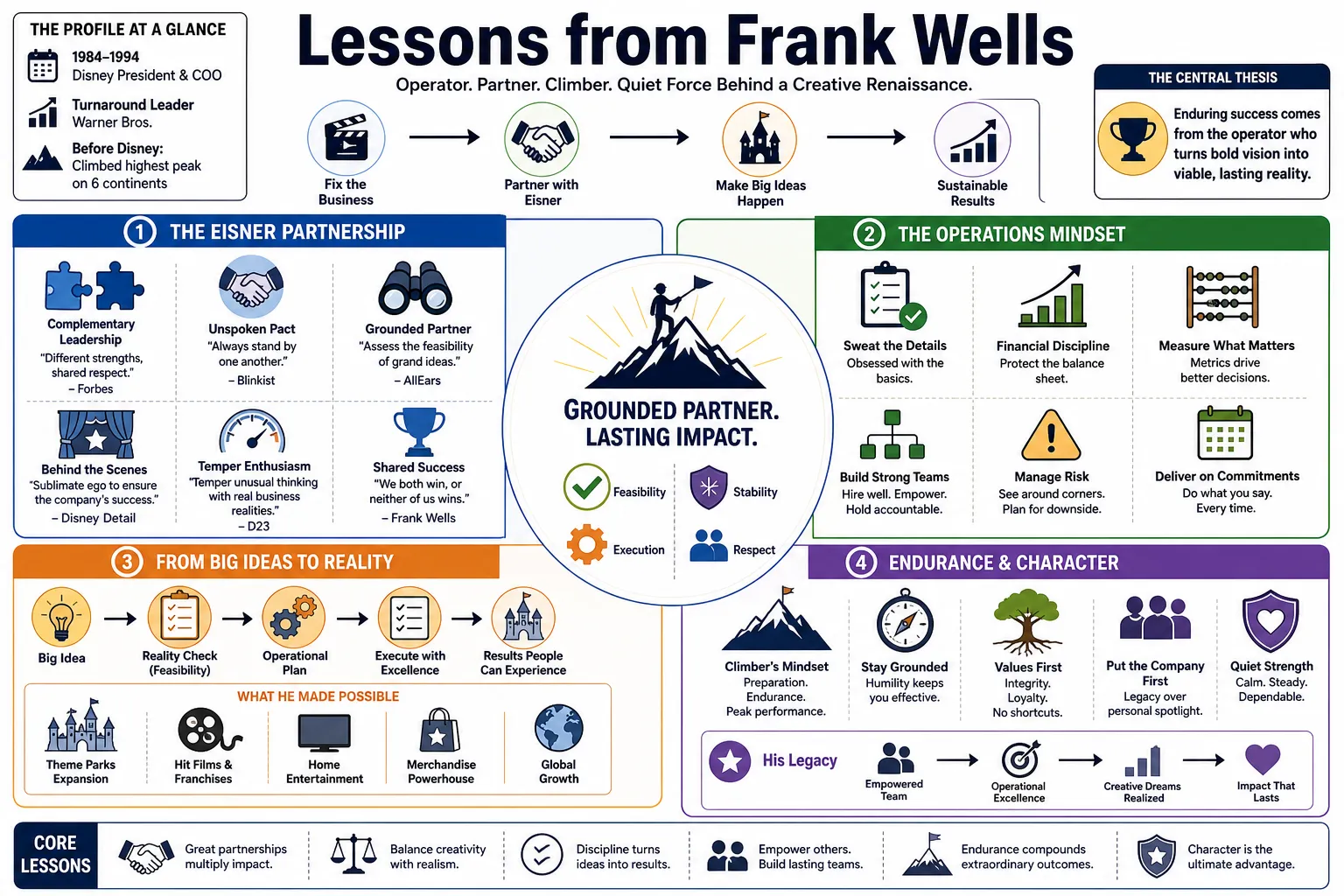
Lessons from Frank Wells
From 1984 to 1994, Frank Wells served as Disney's President and COO, managing the financial reality behind Michael Eisner's creative output. He previously led a financial turnaround at Warner Bros. before taking time off to climb the highest peak on six continents. This profile outlines his approach to operations, partnerships, and endurance.
Part 1: The Eisner Partnership
- On complementary leadership: "The most effective leadership teams are composed of people with different, complementary strengths who respect each other’s roles." — Source: Forbes
- On unspoken agreements: "They shared an unspoken pact to always stand by one another, creating rare stability in a volatile industry." — Source: Blinkist
- On trusting the creative partner: "Wells acted as the grounded, detail-oriented partner who could assess the feasibility of grand ideas." — Source: AllEars
- On behind-the-scenes support: "He was willing to sublimate his ego and work behind the scenes to ensure the success of the company." — Source: Disney Detail
- On reining in enthusiasm: "Frank knew when to temper the CEO's unusual thinking with practical business realities." — Source: D23
- On shared success: "We had a partnership where it didn't matter who got the credit, as long as the work was excellent." — Source: Los Angeles Times
- On managing the tandem: "While one was the public face, the other handled the administrative complexities that allowed the vision to flourish." — Source: Parkeology
- On mutual respect: "Their partnership was strengthened by the fact that they genuinely liked and respected each other." — Source: Blinkist
- On the necessity of a sounding board: "Every grand vision requires a pragmatic operator to test its structural integrity." — Source: Forbes
Part 2: Business Operations at Warner and Disney
- On engineering a turnaround: "During his time at Warner Bros., he was part of a leadership team that helped the studio achieve a major financial turnaround." — Source: Grokipedia
- On operational stability: "He provided the operational stability that allowed artists and creative leaders the freedom to produce their best work." — Source: Forbes
- On managing growth: "They took over a company that was struggling and in danger of being dismantled, presiding over unprecedented financial growth." — Source: D23
- On the discipline of finance: "Creative success is directly tied to financial discipline; the two must operate in tandem." — Source: Forbes
- On expanding the footprint: "He oversaw significant expansion in theme parks, filmed entertainment, and consumer products." — Source: D23
- On corporate strategy: "He understood that expanding a brand meant protecting its core identity while taking calculated financial risks." — Source: Los Angeles Times
- On executing business expansion: "He managed the business expansion that funded a creative resurgence in animation." — Source: Disney Avenue
- On administrative complexity: "Handling the day-to-day operations allowed the studio to focus on making films like The Exorcist." — Source: Grokipedia
- On navigating corporate threats: "His legal and executive background helped steady a company that was vulnerable to hostile takeovers." — Source: Wikipedia
- On long-term value: "Under his operational watch, annual revenues grew from $1.5 billion to $8.5 billion." — Source: D23
Part 3: The Seven Summits and Physical Endurance
- On amateur ambition: "Other than Kilimanjaro, the only mountain I've climbed was Mont Blanc, last year." — Source: Seven Summits Book
- On physical exhaustion: "I was throwing up near the summit just from exhaustion. But I made it." — Source: Seven Summits Book
- On defining his limits: "Definitely not a professional climber. I'm a high-altitude trekker." — Source: Forbes
- On the nature of the challenge: "I got into the Seven Summits because it was a challenge." — Source: Forbes
- On simple perseverance: "All I did was put one foot in front of the other until I got there with a big pack on my back." — Source: Forbes
- On mental endurance: "I would recite poems and get psycho-bio feedback like Pavlov's reflex just to keep moving." — Source: Forbes
- On facing the elements: "Missing the summit of Everest due to weather taught him the ultimate limits of human determination against nature." — Source: Jeff Noel
- On setting massive goals: "He approached both business and life with a spirit of adventure and a relentless pursuit of goals." — Source: Disney Examiner
- On living fully: "For those who want to do it all." — Source: Disney Detail
Part 4: The Eighth Summit and Internal Struggles
- On the inner journey: "That's the figurative inner mountain every person climbs in his own life." — Source: Forbes
- On personal difficulty: "It's a lot tougher than the literal mountains." — Source: Forbes
- On maintaining perspective: "The main theme will be it's not really that important what's happening to us, but it's all-important what our attitude is." — Source: Forbes
- On coping with failure: "Our attitude in coping with difficulties determines the quality of the climb." — Source: Forbes
- On embracing uncertainty: "He was defined by an ability to embrace the uncertainty of a massive undertaking, whether on a mountain or in a boardroom." — Source: American Alpine Club
- On continuous striving: "The Eighth Summit represents the challenges we set for ourselves when the physical mountains run out." — Source: Forbes
- On psychological resilience: "True endurance requires the mental fortitude to keep walking when the peak is out of sight." — Source: Between Disney
- On internal validation: "The figurative mountain requires no audience, only the quiet resolve of the climber." — Source: Forbes
- On the nature of adversity: "Difficulties are the terrain of the inner mountain; how we navigate them is the climb." — Source: Forbes
Part 5: Decisiveness and Clear Communication
- On executive efficiency: "He was known for his decisiveness, often favoring clear, direct communication." — Source: William H. Adams
- On meeting preparation: "He expected others to be prepared and concise in their responses." — Source: William H. Adams
- On active listening: "Despite his high-level executive position, Wells was known for being friendly, kind, and quick to listen." — Source: The Main Street Mouse
- On cutting to the chase: "He had little patience for corporate bureaucracy when a direct answer would suffice." — Source: Los Angeles Times
- On the value of time: "He treated time as a non-renewable resource, expecting meetings to have a clear purpose and outcome." — Source: William H. Adams
- On operational clarity: "A grand vision is useless without a clear, actionable plan to execute it." — Source: Disney Detail
- On straightforward feedback: "He delivered criticism in a way that was direct but never personal, keeping the focus on the work." — Source: William H. Adams
- On making the call: "When a decision lingered, he was the one willing to step in, make the choice, and accept the consequences." — Source: Los Angeles Times
- On accessible leadership: "An open door policy only works if the person sitting behind the desk is actually willing to listen." — Source: The Main Street Mouse
- On removing obstacles: "His primary operational goal was to remove the hurdles that slowed down creative execution." — Source: Disney Detail
Part 6: Navigating the Entertainment Industry
- On legal foundations: "Starting as a partner at an entertainment law firm provided him with the necessary grit to handle Hollywood negotiations." — Source: D23
- On transitioning to leadership: "Moving from representing clients like Clint Eastwood to running a studio required a shift from advising to deciding." — Source: Independent
- On studio turnarounds: "A successful studio requires both creative risks and aggressive cost management." — Source: Grokipedia
- On the role of a consultant: "Sometimes stepping away from the daily grind allows you to see the broader strategic direction of a studio." — Source: Los Angeles Times
- On recognizing talent: "He knew how to identify executives and creatives who could deliver on massive financial expectations." — Source: Wikipedia
- On industry volatility: "The entertainment business is chaotic by nature; management's job is to build a container for that chaos." — Source: Los Angeles Times
- On leaving at the top: "He transitioned to a less active role at Warner Bros. when he realized he needed new challenges outside the studio walls." — Source: Disney Detail
- On managing intellectual property: "He treated the company's library as an active financial asset to be managed, rather than a museum piece." — Source: D23
- On corporate stabilization: "He brought a lawyer's precision to a business built on imagination." — Source: Independent
Part 7: Fostering Creative Resurgence
- On the animation renaissance: "He was instrumental in the animation renaissance of the 1980s and 90s by providing structural support." — Source: Disney Detail
- On protecting the artists: "He created a financial environment where animators didn't have to worry about the studio's bottom line." — Source: Forbes
- On the necessity of structure: "Creativity flourishes best when the boundaries of the budget and the timeline are clearly defined." — Source: Forbes
- On funding the vision: "He figured out the financing so the creatives could figure out the story." — Source: D23
- On the Disney Decade: "The aggressive business expansion he managed laid the groundwork for an era of massive creative output." — Source: Disney Avenue
- On taking calculated risks: "Producing animated features required massive upfront capital; his job was to ensure those bets didn't bankrupt the studio." — Source: Los Angeles Times
- On trusting the process: "He didn't pretend to be an artist, but he understood exactly what the artists needed to succeed." — Source: Disney Detail
- On long-term development: "He understood that quality animation takes time, and he buffered the department from the immediate demands of Wall Street." — Source: Forbes
- On the intersection of art and commerce: "He proved that an executive can drive massive growth without sacrificing the artistic soul of the product." — Source: Disney Detail
Part 8: Humility and Life Philosophy
- On his core virtue: "Humility is the ultimate virtue." — Source: Disney Detail
- On personal reminders: "He famously carried a piece of paper in his wallet with his quote on humility, keeping it close at all times." — Source: Disney Detail
- On servant leadership: "He served as a model for servant leadership, proving you can be effective while remaining grounded." — Source: Los Angeles Times
- On the greater good: "He was focused on the greater good of the organization rather than personal fame." — Source: Disney Detail
- On avoiding the spotlight: "He deliberately stayed out of the press, letting his partners and the projects take the credit." — Source: Forbes
- On ethical management: "He proved that decency and ethics are not impediments to corporate growth." — Source: Los Angeles Times
- On personal balance: "He was remembered as a master of complementary leadership, humility, and balanced living." — Source: Wikipedia
- On defining success: "Success was measured by the health and vitality of the company he served, rather than his own public profile." — Source: Disney Detail
- On leaving a legacy: "His legacy is defined by his ability to operate behind the scenes to make grand visions a reality." — Source: Quarterdeck
- On everyday interactions: "He treated the mailroom clerk with the same respect as the studio chairman, living out the words in his wallet." — Source: Los Angeles Times