Freya India is a British writer and the creator of the newsletter GIRLS, where she investigates how the digital economy affects Generation Z. She is known for arguing that modern internet culture, dating apps, and clinical therapy language encourage young women to act as optimized products rather than individuals. This collection catalogs her observations on modern isolation and the shift toward finding offline meaning in a screen-based world.
Part 1: The Commodification of Girlhood
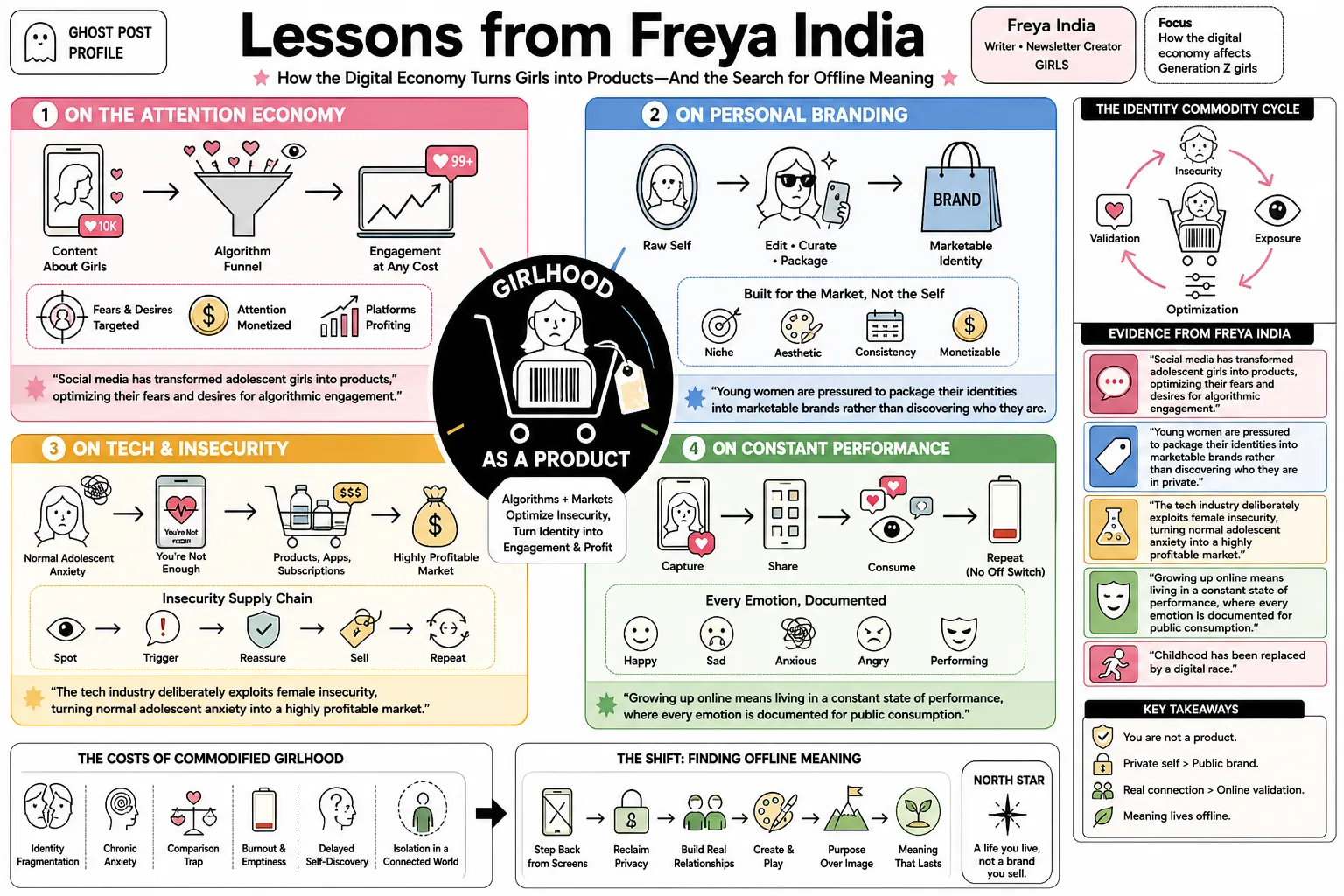
- On the attention economy: "Social media has transformed adolescent girls into products, optimizing their fears and desires for algorithmic engagement." — Source: [GIRLS Substack]
- On personal branding: "Young women are pressured to package their identities into marketable brands rather than discovering who they are in private." — Source: [Quillette Podcast]
- On tech and insecurity: "The tech industry deliberately exploits female insecurity, turning normal adolescent anxiety into a highly profitable market." — Source: [Girls: Generation Z and the Commodification of Everything]
- On constant performance: "Growing up online means living in a constant state of performance, where every emotion is documented for public consumption." — Source: [Modern Wisdom]
- On losing girlhood: "Childhood has been replaced by a digital race to optimize oneself for likes, views, and social capital." — Source: [After Babel]
- On data extraction: "Our most intimate human experiences are being strip-mined for data by platforms that masquerade as communities." — Source: [GIRLS Substack]
- On the consumer mindset: "We are taught to consume culture rather than create it, rendering us passive participants in our own coming-of-age." — Source: [UnHerd]
- On algorithmic identity: "Instead of developing a sense of self through trial and error, Gen Z is handed an identity pre-packaged by the algorithm." — Source: [Girls: Generation Z and the Commodification of Everything]
- On the beauty market: "Beauty is no longer just about appearance; it is an economic imperative demanded by the digital marketplace." — Source: [First Things]
- On privacy: "The tragedy of the modern teenager is the complete loss of the right to be unobserved." — Source: [Socrates in the City]
Part 2: Therapy Culture and Therapy-Speak
- On buzzwords: "Terms like 'gaslighting' and 'toxic' are frequently used to win arguments and shut down honest communication." — Source: [GIRLS Substack]
- On the hoarding of suffering: "Therapy culture has created a perverse incentive where pain is hoarded because it provides social currency and a substitute for a personality." — Source: [Modern Wisdom]
- On clinical language: "When we frame every disagreement in clinical terms, we lose the ability to forgive normal human flaws." — Source: [After Babel]
- On self-obsession: "The constant directive to 'do the work' on oneself often devolves into paralyzing self-absorption rather than actual self-improvement." — Source: [Quillette Cetera]
- On avoiding conflict: "Therapy-speak allows young people to dress up conflict-avoidance and cowardice as setting healthy boundaries." — Source: [GIRLS Substack]
- On Big Therapy: "The mental health industry profits from convincing young people that they are fundamentally broken and in need of endless professional intervention." — Source: [Lean Out with Tara Henley]
- On emotional fragility: "By constantly shielding young people from discomfort, therapy culture has accidentally engineered a generation defined by its fragility." — Source: [UnHerd]
- On the limits of self-care: "True resilience is built through connection with others, not by isolating yourself with a face mask and a list of red flags." — Source: [Girls: Generation Z and the Commodification of Everything]
- On moral outsourcing: "We have outsourced our moral judgments to therapists, preferring a clinical diagnosis over wrestling with right and wrong." — Source: [First Things]
- On the end of empathy: "Weaponized therapy language replaces genuine empathy with a rigid checklist of acceptable behaviors." — Source: [Socrates in the City]
Part 3: The Instagram Face and Manufactured Beauty
- On facial homogenization: "The 'Instagram Face' is the erasure of individuality in favor of an algorithmic composite." — Source: [GIRLS Substack]
- On cosmetic optimization: "Young women are undergoing cosmetic procedures to look perfectly optimized for a screen." — Source: [Modern Wisdom]
- On digital dysmorphia: "Filters have created a generation that is constantly comparing their physical reality to an impossible, digitally rendered avatar." — Source: [Girls: Generation Z and the Commodification of Everything]
- On the loss of character: "When everyone strives for the same surgically enhanced look, faces lose the quirks and imperfections that make them human." — Source: [UnHerd]
- On the beauty arms race: "The standard for female appearance has escalated from looking nice to appearing as a flawless, poreless AI generation." — Source: [GIRLS Substack]
- On visual consumption: "We have trained girls to view themselves through the eyes of a consumer, constantly assessing their own market value." — Source: [Quillette Podcast]
- On the pressure of the grid: "The pressure to maintain a perfect aesthetic on the grid turns the physical body into an ongoing, stressful art project." — Source: [After Babel]
- On aging: "The fear of aging has been accelerated; teenagers are now adopting anti-aging routines before they have even fully grown." — Source: [Girls: Generation Z and the Commodification of Everything]
- On soulless aesthetics: "The tragedy of manufactured beauty is that it is fundamentally soulless, lacking the warmth of genuine human expression." — Source: [Socrates in the City]
Part 4: Dating Apps and the Commodification of Romance
- On the dating marketplace: "Dating apps have trained us to treat potential partners like Amazon products to be scrolled past, evaluated, and discarded." — Source: [GIRLS Substack]
- On the illusion of choice: "The paradox of dating apps is that the illusion of infinite choice paralyzes us and prevents deep commitment." — Source: [Modern Wisdom]
- On the sex recession: "The decline in young people's intimate relationships is directly tied to the risk-averse environment fostered by digital dating." — Source: [UnHerd]
- On algorithmic romance: "We are trusting algorithms to facilitate the most human experience possible, and it is failing terribly." — Source: [Girls: Generation Z and the Commodification of Everything]
- On the fear of vulnerability: "Therapy culture and dating apps combine to make young people terrified of the vulnerability required to actually fall in love." — Source: [Lean Out with Tara Henley]
- On disposable relationships: "The swipe-left culture instills a habit of treating human beings as disposable, lowering the stakes of treating people poorly." — Source: [After Babel]
- On risk aversion: "Gen Z enters relationships with an exit strategy already planned, half-defending against potential hurt." — Source: [GIRLS Substack]
- On the loss of serendipity: "By engineering romance through screens, we have killed the serendipity of meeting someone in the real world." — Source: [Quillette Cetera]
- On romantic cynicism: "The modern dating landscape demands a level of cynicism that is entirely unnatural to the young and hopeful." — Source: [Modern Wisdom]
Part 5: The Loneliness Epidemic
- On the paradox of connection: "Gen Z is the most digitally connected generation in history, yet simultaneously the most profoundly lonely." — Source: [GIRLS Substack]
- On digital substitutes: "Virtual interactions, likes, and streaks are empty calories that can never satiate the human hunger for real presence." — Source: [After Babel]
- On AI companions: "The rise of AI boyfriends and chatbots is a dystopian symptom of a society that has forgotten how to socialize." — Source: [Girls: Generation Z and the Commodification of Everything]
- On the decline of third spaces: "Without physical places to gather free of charge, young people are forced to socialize exclusively in corporate-owned digital spaces." — Source: [UnHerd]
- On the burden of curation: "The loneliness of the modern teen is exacerbated by the exhausting need to constantly curate a fake life for their peers." — Source: [Modern Wisdom]
- On structural isolation: "Loneliness is the natural byproduct of a society built around individual screens rather than communal tables." — Source: [GIRLS Substack]
- On the illusion of intimacy: "We mistake the high-volume exchange of texts and memes for actual intimacy, leaving us fundamentally unknown by our friends." — Source: [Quillette Podcast]
- On the fear of the phone: "The anxiety surrounding phone calls reveals how uncomfortable my generation has become with unscripted human interaction." — Source: [Lean Out with Tara Henley]
- On physical presence: "There is a deep, unmet need for the simple, unglamorous physical presence of other people." — Source: [First Things]
Part 6: Pathologizing Normal Human Emotion
- On rebranding shyness: "We have taken normal personality traits, like introversion and shyness, and rebranded them as social anxiety disorders." — Source: [GIRLS Substack]
- On the medicalization of sadness: "Not every period of sadness is clinical depression; sometimes it is just the appropriate response to a difficult world." — Source: [Modern Wisdom]
- On identity through diagnosis: "A terrifying number of teenagers now introduce themselves using psychiatric labels as their primary identity." — Source: [After Babel]
- On the self-fulfilling prophecy: "Telling a generation they are inherently mentally ill often becomes a self-fulfilling prophecy, stripping them of their agency." — Source: [UnHerd]
- On natural friction: "Friction and discomfort are necessary parts of growing up, yet we now treat them as symptoms requiring immediate intervention." — Source: [Girls: Generation Z and the Commodification of Everything]
- On the ADHD trend: "The explosion of self-diagnosed ADHD on TikTok shows how eager people are for an excuse to explain away normal distractibility." — Source: [GIRLS Substack]
- On overcoming adversity: "When we pathologize every struggle, we rob young people of the triumph of overcoming adversity on their own." — Source: [Socrates in the City]
- On healing from humanity: "We are putting young people under immense pressure to heal from the basic condition of being human." — Source: [Quillette Cetera]
- On emotional hygiene: "The obsession with emotional hygiene has made us intolerant of the messy, unpredictable nature of real relationships." — Source: [Modern Wisdom]
Part 7: Digital Disconnection and the Algorithmic Panopticon
- On the digital gaze: "The modern teenager lives in a panopticon of their own making, constantly adjusting their behavior for an invisible audience." — Source: [Socrates in the City]
- On losing the present: "By constantly documenting our lives for social media, we remove ourselves from the present moment and become spectators of our own experiences." — Source: [GIRLS Substack]
- On algorithmic conformity: "The algorithm does not reward originality; it demands strict conformity to whatever aesthetic or opinion is currently trending." — Source: [Girls: Generation Z and the Commodification of Everything]
- On the loss of the private self: "We have lost the concept of the private self—the part of you that exists only for you, entirely unmonetized and unobserved." — Source: [Modern Wisdom]
- On content creation: "Treating your life as content is a fundamentally dissociative way to live." — Source: [After Babel]
- On the phone-based childhood: "The transition from a play-based childhood to a phone-based childhood is the root cause of the current generational crisis." — Source: [The Gospel Coalition]
- On viral outrage: "Digital platforms run on a fuel of manufactured outrage, training us to be permanently angry and suspicious of one another." — Source: [UnHerd]
- On digital modesty: "The most radical, counter-cultural choice a young person can make today is choosing not to broadcast their life." — Source: [GIRLS Substack]
- On the illusion of community: "A follower count is not a community, and a comment section is not a neighborhood." — Source: [Quillette Podcast]
- On the end of boredom: "By eradicating boredom with constant scrolling, we have also eradicated the quiet spaces where creativity and self-reflection are born." — Source: [Modern Wisdom]
Part 8: The Search for Meaning, Faith, and Real Connection
- On the crisis of meaning: "The anxiety of Gen Z is not just clinical; it is a profound crisis of meaning in a rapidly secularizing world." — Source: [The Gospel Coalition]
- On traditional desires: "We are told that desiring marriage, family, and stability is outdated, leaving many young women feeling deeply unmoored." — Source: [GIRLS Substack]
- On the limits of secularism: "Secular society has dismantled traditional structures of meaning but failed to provide anything fulfilling to replace them." — Source: [First Things]
- On returning to faith: "Many young people are quietly returning to faith because the modern promise of limitless individual freedom has proven isolating and empty." — Source: [Modern Wisdom]
- On embodied reality: "The cure for digital despair is embodied reality: touching grass, speaking face-to-face, and participating in physical community." — Source: [Girls: Generation Z and the Commodification of Everything]
- On the rebellion of the real: "Seeking out analog experiences—reading physical books, joining local clubs—is becoming an act of necessary rebellion." — Source: [After Babel]
- On transcendent purpose: "Without a sense of transcendent purpose, young people are forced to make a religion out of politics, identity, or self-care." — Source: [Socrates in the City]
- On finding community: "True community requires obligation and inconvenience, two things the frictionless digital world has trained us to avoid." — Source: [UnHerd]
- On hope: "Despite the darkness of the digital age, there is an immense, quiet hunger among Gen Z for a life that is beautiful, real, and meaningful." — Source: [GIRLS Substack]