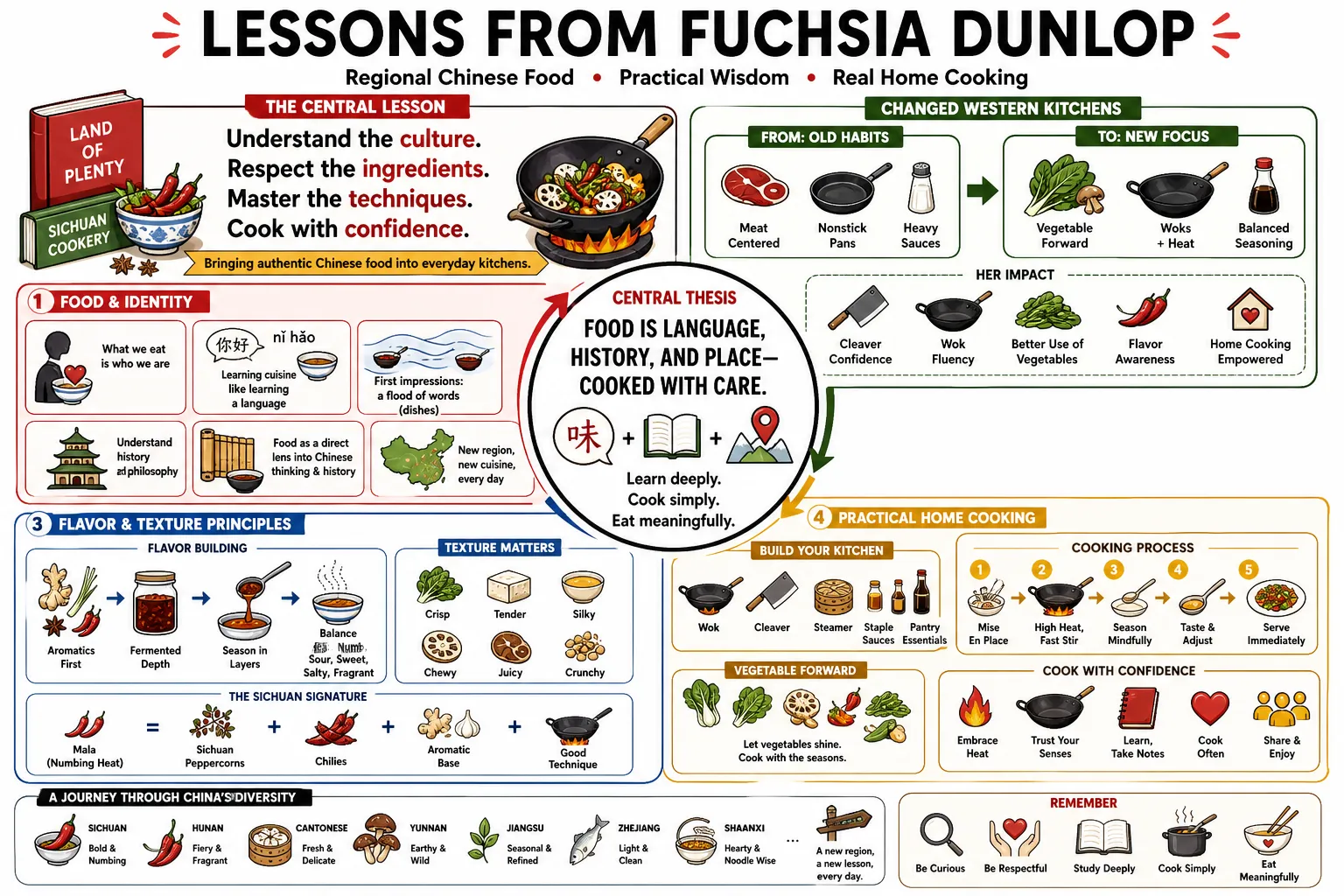
Lessons from Fuchsia Dunlop
Fuchsia Dunlop gave English-speaking cooks a working vocabulary for regional Chinese food, especially Sichuan cuisine. She changed how Western kitchens use woks and cleavers, shifting their focus toward vegetable-heavy meals. The insights below break down her practical approach to flavor, texture, and actual home cooking.
Part 1: Food and Identity
- On defining ourselves: "What we eat is an essential part of who we are and how we define ourselves." — Source: [Goodreads]
- On culinary study as linguistics: "Learning another cuisine is like learning a language. In the beginning, you know nothing about its most basic rules of grammar." — Source: [Goodreads]
- On first impressions: "You experience it as a flood of words, or dishes, without system or structure." — Source: [Goodreads]
- On understanding a culture: "To truly appreciate Chinese food, one must understand the history and philosophy behind it." — Source: [Sixth Tone]
- On food as a historical lens: "Food offers a direct way to gain insights into Chinese thinking and history." — Source: [Then Do Better]
- On regional pride: "When you travel to a new region in China, it feels like learning a whole new cuisine every single day." — Source: [Chicken Scrawlings]
- On the scale of Chinese gastronomy: "I could spend my whole life learning about Chinese cuisine and I would need several life times to ever get to the bottom of it." — Source: [Chicken Scrawlings]
- On terroir: "Chinese gastronomy has long valued where ingredients come from and how they are grown, a concept nearly identical to the Western idea of terroir." — Source: [Sixth Tone]
- On the everyday diet: "The most important thing to remember is that Chinese food is simply what most people in China cook at home every night." — Source: [The Special Sauce Podcast]
Part 2: The Complexity of Chinese Cuisine
- On culinary misconceptions: "People wrongly assume that Chinese cooking is overly complicated and requires a pantry full of strange ingredients." — Source: [The Special Sauce Podcast]
- On home cooking realities: "Cooks in China want to rustle something up that is tasty, healthy, and within their budget for their family." — Source: [The Special Sauce Podcast]
- On Western perceptions: "Historical and political factors led to a narrow perception of Chinese food in the West, often excluding the fresh, vegetable-forward dishes actually eaten in China." — Source: [The Wire China]
- On early immigrant food: "Chinese food was introduced to the West by immigrants facing challenging circumstances, which shaped its early, restricted menu." — Source: [The Wire China]
- On technique: "Chinese cooking is built upon centuries of developed, rigorously applied techniques." — Source: [The Wire China]
- On culinary freedom: "Mastering a range of foundational techniques gives a cook the imagination to transform ingredients in countless ways." — Source: [The Wire China]
- On demystifying the process: "A major focus of my work is making real Chinese cooking accessible to the average home cook." — Source: [The Special Sauce Podcast]
- On technical rigor: "Recipes must be approached with academic and technical rigor to ensure they actually work in a home kitchen." — Source: [The Wire China]
- On balance: "Excellent cooking often relies on restraint, allowing the inherent quality and freshness of ingredients to shine." — Source: [The Guardian]
Part 3: The Philosophy of Vegetables
- On the glory of the cuisine: "But actually, the glory of Chinese cooking is that there are so many vegetables. It's healthy and balanced and refreshing." — Source: [Conversations with Tyler]
- On daily eating: "The Chinese are experts at cooking vegetables, making it natural to eat Chinese food almost every day." — Source: [The Independent]
- On meat as a flavoring: "Meat does not have to dominate the plate; it often acts merely as a flavoring to enhance vegetable-based dishes." — Source: [WordPress]
- On fresh produce: "The true center of a traditional Chinese meal is the abundance of fresh, properly prepared vegetables." — Source: [Conversations with Tyler]
- On healthy eating: "The vegetable-forward nature of the cuisine makes it inherently balanced and good for you." — Source: [Conversations with Tyler]
- On cooking methods: "The techniques applied to vegetables are designed to preserve their texture, color, and nutritional value." — Source: [China Daily]
- On respect for ingredients: "A cook must show respect for the original or essential flavor, known as benwei." — Source: [The Guardian]
- On simplicity: "A beautifully cooked plate of green vegetables is the true test of a Chinese chef's skill." — Source: [The Guardian]
- On seasonal eating: "The traditional Chinese diet is deeply tied to the seasons and the specific vegetables available at any given time." — Source: [The Independent]
- On culinary harmony: "A meal is fundamentally about achieving harmony between the grain, the vegetables, and small amounts of meat." — Source: [Conversations with Tyler]
Part 4: Texture and the Grapple Factor
- On defining texture: "Kougan – literally 'mouthfeel' – is an essential part of the enjoyment of eating, which is an all-embracing sensory experience." — Source: [Goodreads]
- On Western disgust: "Think, for a moment, of the words we use to describe some of the textures most adored by Chinese gourmets: gristly, slithery, slimy, squelchy, crunchy, gloopy." — Source: [Goodreads]
- On expanding the palate: "The Chinese appreciate a far wider range of textures in their food than most Westerners, including bouncy and rubbery sensations." — Source: [Quora]
- On flavorless ingredients: "A Chinese chef can look at an unappealing item like jellyfish and appreciate its brisk, slippery mouthfeel despite its lack of flavor." — Source: [Goodreads]
- On physical engagement: "People talk about food as a great pleasure that includes the physical engagement with your food alongside the flavor." — Source: [The Wire China]
- On the grapple factor: "Chinese people tend to enjoy the process of using teeth and tongue to engage with ingredients such as chicken feet, known as the grapple factor." — Source: [Quora]
- On textural oxymorons: "There is delight in combining textures, creating something that is soft and slippery, yet resistant or crisp at the end." — Source: [The Wire China]
- On culinary translation: "English words for Chinese textures often sound unappetizing, revealing a gap in culinary vocabulary." — Source: [Goodreads]
- On evaluating a dish: "Texture is often equally as important as the actual taste of the dish." — Source: [Quora]
- On the sensory experience: "Eating is meant to be a full-body experience that commands the attention of the mouth, teeth, and tongue." — Source: [The Wire China]
Part 5: The Sichuan Peppercorn and Regional Flavors
- On the original pepper: "Sichuan pepper is the original Chinese pepper, used long before the more familiar black or white pepper stole in over the tortuous land routes of the old Silk Road." — Source: [Goodreads]
- On the sensation of ma: "It is not hot to taste, like the chilli, but makes your lips cool and tingly. In Chinese they call it ma, this sensation; the same word is used for pins-and-needles and anaesthesia." — Source: [Goodreads]
- On modern pairings: "The strange, fizzing effect of Sichuan pepper, paired with the heat of chillies, is one of the hallmarks of modern Sichuanese cookery." — Source: [QuoteFancy]
- On Yangzhou cuisine: "Yangzhou food doesn't jump up and amaze you, like its Sichuanese counterpart. It won't make your lips tingle, or dance jazz on your tongue." — Source: [PopMatters]
- On culinary personalities: "Yangzhou food is a gentler creature that seduces by understatement, unlike the sassy, attention-grabbing nature of Sichuan food." — Source: [PopMatters]
- On regional diversity: "Moving from one province to another in China reveals entirely distinct culinary philosophies and flavor profiles." — Source: [Chicken Scrawlings]
- On the limits of chili: "While Sichuan is famous for heat, its cuisine relies equally on complex, layered flavor profiles that balance the spice." — Source: [QuoteFancy]
- On historical shifts: "The introduction of New World ingredients like the chili fundamentally changed the nature of Chinese cooking." — Source: [Goodreads]
- On the Silk Road: "The exchange of spices and ingredients along ancient trade routes shaped the modern Chinese pantry." — Source: [Goodreads]
- On true Sichuan food: "Authentic Sichuan cuisine is characterized by a hundred dishes, hundred flavors, rather than simply an overwhelming amount of heat." — Source: [PopMatters]
Part 6: Demystifying Ingredients
- On the essential pantry: "Sesame oil, soy sauce and ginger may already be on your shopping list... just add Sichuanese chilli bean paste and fermented black beans and you will open up whole new dimensions of taste." — Source: [Goodreads]
- On MSG hysteria: "The fear surrounding MSG is largely based on bad science, media hype, and a hefty dose of xenophobia." — Source: [FoodFacts]
- On MSG as a tool: "MSG is essentially a tool for umami enhancement, used similarly to how Western cooks use Parmesan or tomatoes." — Source: [Tigers and Strawberries]
- On natural flavors: "While MSG is common in restaurant kitchens, a skilled cook can achieve delicious results using only fresh ingredients and good technique." — Source: [Fuchsia Dunlop]
- On Chinese Restaurant Syndrome: "The idea of a specific syndrome caused by Chinese food is a groundless concept rooted in racial bias." — Source: [FoodFacts]
- On pantry accessibility: "Mainstream supermarkets now carry most of the basic sauces and vinegars needed to cook authentic Chinese food at home." — Source: [Goodreads]
- On magic ingredients: "Stocking a kitchen with a few specific magic ingredients allows home cooks to create complex flavors quickly." — Source: [The Special Sauce Podcast]
- On umami: "Chinese cooks have understood and manipulated savory umami flavors for centuries using fermented soy and bean pastes." — Source: [Tigers and Strawberries]
- On ingredient simplicity: "You do not need expensive or rare ingredients to cook an excellent Chinese meal." — Source: [Fuchsia Dunlop]
Part 7: The Art of the Cleaver
- On versatility: "The cleaver has many uses beyond cutting. Invert it and its blunt spine can be used to pound meat to a paste for meatballs." — Source: [Goodreads]
- On pounding meat: "Pounding meat with a cleaver spine is time-consuming, but produces a perfectly smooth and voluptuous purée." — Source: [Goodreads]
- On crushing spices: "The nub of the handle can stand in for a pestle, to crush a few peppercorns in a pot." — Source: [Goodreads]
- On smashing ginger: "The flat of the blade, slammed down on the board, can be used to smash unpeeled ginger, so that its juices permeate a soup or marinade." — Source: [Goodreads]
- On the aesthetics of cutting: "The art of cutting carries an aesthetic dimension and reflects the care and dedication of the chef." — Source: [Kortina]
- On even cooking: "Precise knife work is a practical necessity in Chinese cuisine to ensure ingredients cook quickly and evenly in a wok." — Source: [Conversations with Tyler]
- On knife mastery: "A single tool, the Chinese cleaver, performs the tasks of an entire block of Western knives." — Source: [FoodAnthro]
- On the chef's foundation: "Proper knife skills are the foundational step for any aspiring Chinese chef before they are ever allowed to cook at a stove." — Source: [Conversations with Tyler]
- On culinary efficiency: "The heavy blade allows gravity to do much of the work when chopping, making it highly efficient." — Source: [Goodreads]
Part 8: Writing from the Outside In
- On her role: "I see my role really as being like a partial interpreter—I'm trying to write from the inside, but as an outsider at the same time." — Source: [Chicken Scrawlings]
- On entering professional kitchens: "Being the first Westerner to train at the Sichuan Higher Institute of Cuisine allowed me to approach recipes with an academic lens." — Source: [The Wire China]
- On cultural translation: "Writing about Chinese food for a Western audience requires explaining both recipes and entire sensory paradigms." — Source: [Chicken Scrawlings]
- On respect for the craft: "My goal has always been to document the culinary traditions of China with the utmost respect and rigorous attention to detail." — Source: [Cooks Without Borders]
- On bridging the gap: "I view my books as instructional guides that weave together history, on-the-ground research, and practical cooking methods." — Source: [Sixth Tone]
- On challenging assumptions: "My work actively seeks to dismantle stereotypes about Chinese food being cheap, greasy, or monolithic." — Source: [Chicken Scrawlings]
- On culinary diplomacy: "By teaching Westerners to cook Chinese food at home, I hope to foster a deeper cultural understanding between the East and West." — Source: [The Wire China]
- On continual learning: "Despite decades of study, I approach every new region in China as an eager student encountering a new cuisine." — Source: [Chicken Scrawlings]
- On a lifetime of study: "One could dedicate an entire lifetime to Chinese food and still only scratch the surface of its depth and variety." — Source: [Chicken Scrawlings]