Gabe Monroy argues for developer-friendly enterprise agent tools governed by the business rules, permissions and approvals of the system of record. His writing connects this approach to open model choice and clear developer interfaces. — Building Agents on Workday’s Guardrails.
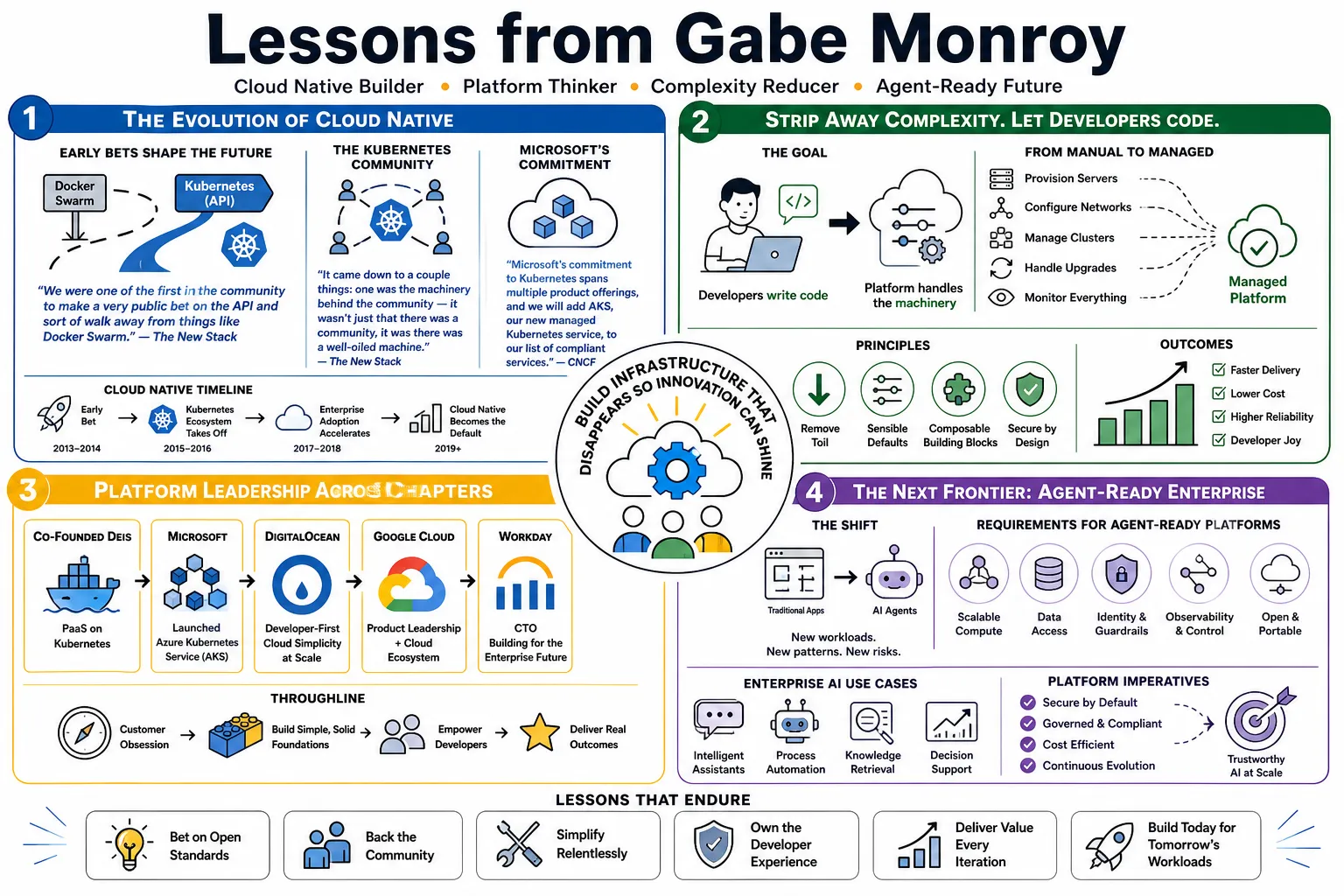
Part 1: The Evolution of Cloud Native
- Bet on the Kubernetes API: Monroy said Deis made an early public bet on the Kubernetes API and moved away from alternatives such as Docker Swarm. — The New Stack Kubernetes Interview.
- Organize the Community: Monroy credited Kubernetes in part to the well-organized machinery behind its open-source community. — The New Stack Kubernetes Interview.
- Make AKS Conformant: Monroy described AKS as part of Microsoft’s broad Kubernetes commitment and said the managed service would conform to the community certification program. — CNCF Kubernetes Certification Announcement.
- Offer Portable Managed Kubernetes: In the same CNCF announcement, Monroy framed AKS as a reliable, scalable and portable environment for container workloads. This was the service aim, not an independently verified outcome. — CNCF Kubernetes Certification Announcement.
- Use Common Service-Mesh APIs: Monroy presented Service Mesh Interface as a set of common APIs that could let Kubernetes applications work across service-mesh implementations. — Service Mesh Interface Announcement.
- Preserve Mesh Portability: SMI specified portable traffic, telemetry and policy interfaces so developers could use more than one compatible service mesh without adopting a single provider-specific API. — Service Mesh Interface Announcement.
- Bridge Kubernetes to Enterprise Systems: Monroy argued that AKS needed to integrate Kubernetes with identity, monitoring, routing and regulatory controls for production users. — InfoQ AKS Q&A.
- Manage the Kubernetes Control Plane: Microsoft’s AKS launch presented a managed control plane and upgrades as ways to reduce operational work while retaining the Kubernetes ecosystem. — Microsoft AKS Launch.
- Keep Developing Open Tools: After Microsoft acquired Deis, Monroy said the team continued to develop Helm and other open-source Kubernetes tools. — InfoQ AKS Q&A.
- Use Orchestration When It Is Needed: Monroy distinguished simple containers from AKS workloads requiring zero-downtime updates, replica management, service discovery or batch workflows. — InfoQ AKS Q&A.
Part 2: Developer Experience and Friction
- Make Hard Work Disappear: Monroy’s stated platform principle is to make difficult implementation work disappear for developers; Workday applied that idea to agent-ready enterprise tooling. — Workday DevCon Announcement.
- Reduce Real Developer Friction: At DigitalOcean, Monroy prioritized faster application builds and deeper integration among platform services rather than making developers assemble those pieces themselves. — Product Hunt AMA.
- Show the Origin of AI Code: Monroy argued that an IDE assistant quoting source material at length should reveal whether it came from Stack Overflow or an open-source license. — SiliconANGLE Duet AI Interview.
- Design Agent-Ready Tool Surfaces: Monroy argued that enterprise tools need self-describing, developer-friendly interfaces so agents can call them through clear, bounded capabilities. — Building Agents on Workday’s Guardrails.
- Keep an Abstraction Escape Hatch: Monroy described using Kubernetes beneath a simpler application platform while letting advanced users work directly with Kubernetes when the abstraction becomes limiting. — Stack Overflow Podcast 395.
- Match Model Latency to the Task: Monroy said a 45-second response is too slow for inline IDE help even if it could be acceptable for generating a larger feature; different tasks call for different latency tradeoffs. — Google Cloud Next Interview.
- Tune for the Coding Moment: Rather than assert a universal ROI ranking for the inner loop, Monroy described tailoring coding assistance to the moment: low-latency suggestions in the editor versus longer-running, broader tasks. — Google Cloud Next Interview.
- Meet Developers in Their Tools: Monroy said coding assistants should fit into the environments developers already use, including existing repositories and workflows. — Google Cloud Next Interview.
- Provide an Opinionated Happy Path: Monroy said customers do not need 17 ways to run a container; he preferred a thoughtfully designed platform with a clear default path for common work. — Product Hunt AMA.
Part 3: Product Strategy and Building
- Solve a Pain Customers Will Pay to Remove: Discussing developer products, Monroy emphasized validating a genuine customer problem before building an elaborate solution. — SaaStr Podcast 633.
- Do Not Overbuild the First Version: Monroy described building an expensive, overengineered OpDemand MVP before enough customer validation; he later favored testing the idea more cheaply. — SaaStr Podcast 633.
- Understand the Customer’s Job: Monroy advised product teams to understand customers’ jobs and pain rather than merely implement each requested feature. — Product Hunt AMA.
- Test Before Expensive Engineering: From the OpDemand experience, Monroy argued for showing prospective customers mockups or other cheap prototypes before committing to a costly MVP. — SaaStr Podcast 633.
- Scale Simplicity as Features Grow: Monroy wanted DigitalOcean to add services without presenting customers a confusing menu of equivalent paths; design should keep common workflows clear. — Product Hunt AMA.
- Distinguish Consumer Candy from Enterprise Pain: In the SaaStr conversation, Monroy treated engaging consumer products differently from enterprise products that must solve an urgent business problem. The candy/vitamin/painkiller quotation belongs to Kevin Fong, not Monroy. — SaaStr Podcast 633.
- Define the Outcome, Not Just Features: Monroy pointed product teams toward the customer’s job, value proposition and actual promise, rather than treating a list of features as proof of fit. — Product Hunt AMA.
Part 4: The Infrastructure of Enterprise AI
- Route LLM Requests for Variable Latency: Monroy said ordinary round-robin load balancing fits LLM applications poorly because request times vary substantially. — Runtime Kubernetes and AI Interview.
- Trust an Agent on Sensitive Records: Monroy distinguished making an agent fast from letting it act on an organization chart or ledger while the enterprise can trust each step. — Workday DevCon Announcement.
- Put Enterprise Rules Under Agent Actions: Monroy argued that platforms should make integrations easier while enforcing approvals, identity and audit rules at the tool and system-of-record layer. — Building Agents on Workday’s Guardrails.
- Expose Agent-Ready Tools: Monroy described MCP tools with clear schemas and business metadata, designed for agents to discover and call through bounded interfaces. — Building Agents on Workday’s Guardrails.
- Keep Guardrails Close to Execution: Monroy argued that controls for enterprise agents belong near inference, tool calls and sensitive business data, not only in a model prompt. — The New Stack Workday Interview.
- Allow Model and Tool Choice: Monroy’s Workday approach lets builders choose models and agent frameworks while Workday retains enforcement of its own business rules. — Building Agents on Workday’s Guardrails.
- Raise the Bar for HR and Finance: Monroy said organizations cannot accept a merely “mostly right” agent when its actions touch people or money; he proposed tighter platform controls rather than promising database-equivalent AI determinism. — The New Stack Workday Interview.
- Place Context Near Enterprise Inference: Monroy connected trustworthy agent behavior to guardrails and business context near the inference and data layers. This is a design direction, not a proved universal cost or sovereignty result. — The New Stack Workday Interview.
Part 5: Trust, Safety, and Guardrails
- Scope Agent Identity and Permissions: Monroy described user-scoped identity and permissions for agent tools accessing sensitive HR and finance data. — Building Agents on Workday’s Guardrails.
- Track Agent Identity and Actions: Workday announced Agent Passport as a planned way to manage agent identity and trace actions; the 2026 release did not establish universal deployment or effectiveness. — Workday DevCon Announcement.
- Make Compliance Part of the Tool Layer: For Workday’s systems of record, Monroy placed business rules, approvals and audit within the platform tools agents use, rather than leaving them to a prompt alone. — Building Agents on Workday’s Guardrails.
- Give Agents Business Context Through Tools: Monroy described exposing context-rich enterprise tools and enforcing business rules where agents act. The source does not claim this eliminates hallucinations. — Building Agents on Workday’s Guardrails.
- Bound Tool Access by the User: Monroy described agents operating through user-scoped tools, so actions are constrained by the permissions and business rules the system of record exposes. — Building Agents on Workday’s Guardrails.
- Keep an Agent Audit Trail: Monroy’s Workday design includes tracking and audit for agent actions; the source does not say every record is immutable or sufficient for all regulation. — Building Agents on Workday’s Guardrails.
- Pair Developer Speed with Trust: Monroy said enabling fast agent development is easier than trusting those agents on sensitive organizational or financial records; his platform strategy tries to address both. — Workday DevCon Announcement.
Part 6: Open Source and Community
- Treat Community Operations as Infrastructure: Monroy credited Kubernetes’ success partly to the organized machinery of its community, beyond the code alone. — The New Stack Kubernetes Interview.
- Continue Upstream Work After Acquisition: Monroy said the former Deis team continued developing Helm and related open-source tools after joining Microsoft; he did not state a universal corporate obligation. — InfoQ AKS Q&A.
- Use Interoperable Interfaces: Monroy’s SMI effort sought common service-mesh APIs to reduce implementation fragmentation for developers. — Service Mesh Interface Announcement.
- Build Standards with Partners: The SMI launch enlisted other Kubernetes vendors to develop a shared interface rather than require one company’s proprietary mesh API. — Service Mesh Interface Announcement.
- Use Community Conformance: The CNCF certification program gave Kubernetes services such as AKS a common conformance target, helping customers compare portable implementations. — CNCF Kubernetes Certification Announcement.
- Use Open Agent Tool Conventions: Monroy described MCP-style agent tools and freedom to choose models and frameworks while keeping Workday’s business-rule enforcement. — Building Agents on Workday’s Guardrails.
Part 7: Democratizing Technology for Small Businesses
- Serve Developers the Hyperscalers Overlook: Monroy positioned DigitalOcean around independent developers and small businesses whose needs differed from those of the largest cloud customers. — DigitalOcean CPO Introduction.
- Offer Managed Building Blocks to Small Teams: Monroy emphasized integrated managed services that let smaller teams build without operating every underlying service themselves. — DigitalOcean CPO Introduction.
- Keep Pricing Understandable: Monroy connected DigitalOcean’s small-business focus with simpler, predictable pricing; the source does not establish that one surprise bill is fatal to a startup. — DigitalOcean CPO Introduction.
- Choose a Clear Cloud Happy Path: Monroy argued that small teams benefit from a thoughtfully designed default route rather than dozens of overlapping options. — Product Hunt AMA.
- Integrate Useful Building Blocks: Monroy wanted managed components that small developers could combine without assembling a hyperscaler-scale platform first. — DigitalOcean CPO Introduction.
- Invest in Developer Education: Monroy said DigitalOcean tutorials helped developers learn and that the company planned to invest further in this community material. — Product Hunt AMA.
- Lower the Cost of Getting Started: Monroy framed DigitalOcean’s mission around making cloud infrastructure accessible to developers and small businesses that could not afford enterprise-scale complexity. — DigitalOcean CPO Introduction.
- Hide Infrastructure Until It Matters: Monroy described a simpler platform over Kubernetes that lets developers focus on applications while retaining a lower-level escape hatch. — Stack Overflow Podcast 395.
Part 8: The Future of Software Engineering
- Treat Reported AI Gains as Contextual: In a 2024 interview, Monroy reported that some Gemini Code Assist customers were seeing 30–50% productivity improvements; he did not disclose adoption scale or establish that range across every software lifecycle. — Economic Times Developer Interview.
- Move Beyond Single-File Assistance: Monroy said larger context windows and knowledge of a full codebase could make coding assistance more useful than isolated file-level autocomplete. — Google Cloud Next Interview.
- Keep Learning to Code: Despite advances in coding assistance, Monroy said he still wanted his sons to learn programming; he did not claim developers would cease writing code. — Times of India Developer Interview.
- Use AI for Code and Test Work: Monroy identified code generation and test automation as areas where coding assistants were already saving time, while developers remained responsible for the work. — Economic Times Developer Interview.
- Describe Agent Tasks in Natural Language: Workday’s Developer Agent announcement used natural-language descriptions to help create business workflows; this is one supported interface, not proof that natural language replaces programming. — Workday DevCon Announcement.
- Use Codebase Context for Maintenance: Monroy described coding assistance moving from single files toward full-codebase awareness, which can help a developer reason about changes across a larger system. — Google Cloud Next Interview.