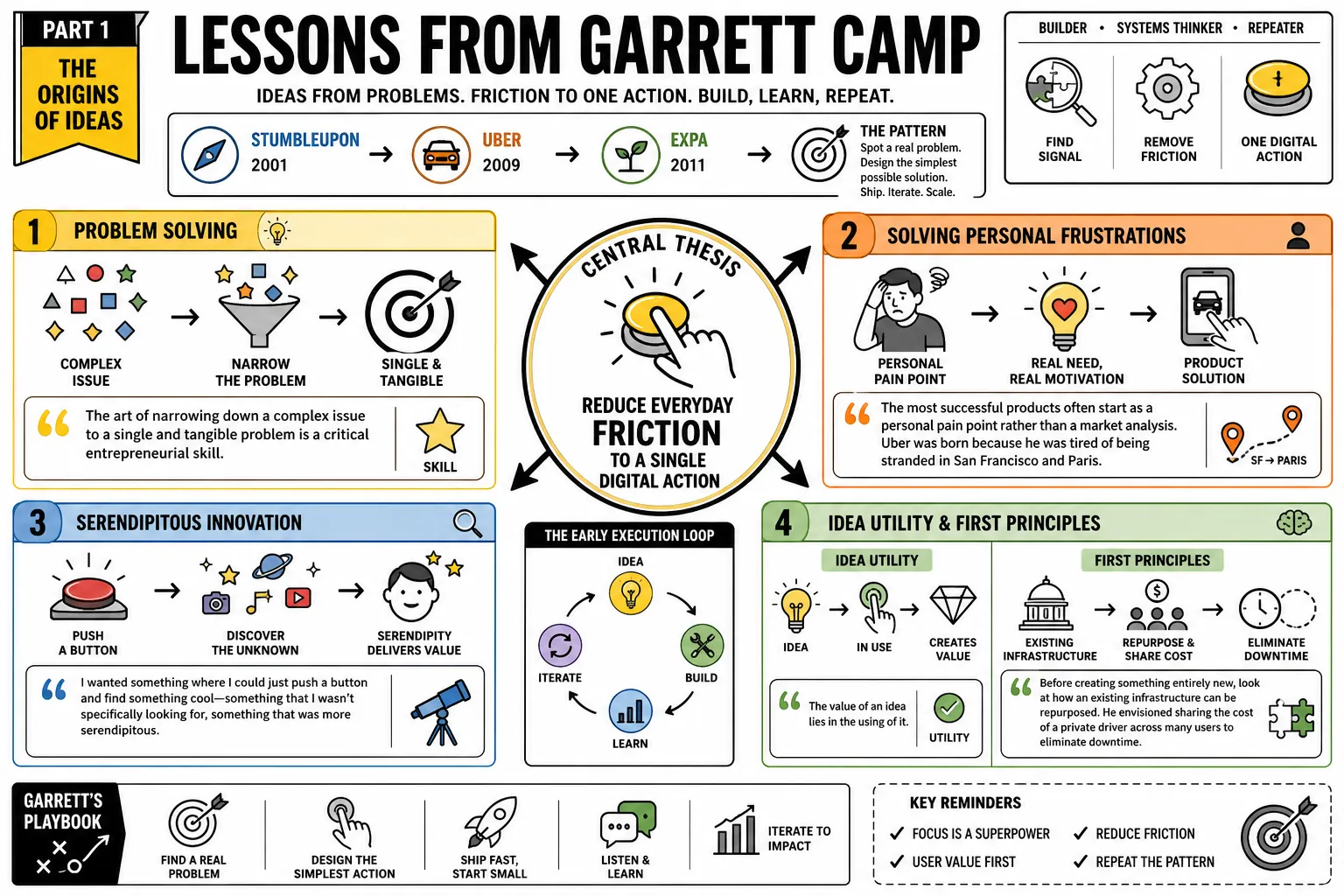
Lessons from Garrett Camp
Garrett Camp co-founded StumbleUpon, Uber, and the startup studio Expa. As a systems designer, he specializes in reducing everyday friction to a single digital action. This profile gathers his frameworks on product simplicity, bootstrapping, and early-stage execution.
Part 1: The Origins of Ideas
- On Problem Solving: "The art of narrowing down a complex issue to a single and tangible problem is a critical entrepreneurial skill." — Source: [QuillBot]
- On Solving Personal Frustrations: "The most successful products often start as a personal pain point rather than a market analysis. Uber was born because he was tired of being stranded in San Francisco and Paris." — Source: [Valiant CEO]
- On Serendipitous Innovation: "I wanted something where I could just push a button and find something cool—something that I wasn't specifically looking for, something that was more serendipitous." — Source: [US Chamber of Commerce]
- On Idea Utility: "The value of an idea lies in the using of it." — Source: [Free.fr]
- On First Principles: "Before creating something entirely new, look at how an existing infrastructure can be repurposed. He envisioned sharing the cost of a private driver across many users to eliminate downtime." — Source: [Y Combinator]
- On Building Painkillers: "Focus on creating painkillers that solve immediate problems, rather than vitamins that are nice to have." — Source: [iPullRank]
- On Simple Utility: "We just wanted to push a button and get a ride... That’s all it was about." — Source: [EdwardBetts]
- On Frictionless Solutions: "Innovation is identifying a universal friction and collapsing it into a single interaction." — Source: [Business Insider]
- On Origin Stories: "The story goes that on one snowy evening in the warm and welcoming city of Paris, Travis Kalanick and Garrett Camp couldn't get a cab. Two men stranded in the hostile city of love, they decided to start Uber." — Source: [Medium]
Part 2: Systems Design & Simplicity
- On Professional Identity: "I'm a system designer at heart, and wanted to be directly involved in the creation of new products." — Source: [Stephen M. Baldwin]
- On Human-Centric Systems: "Technology is only effective if it brings the human into the loop. It is the integration of the human experience that makes an application feel magical." — Source: [QED Investors]
- On Defining Disruption: "I never really thought of [disruption]... if you just make the product simple enough and easy enough to use, and it’s valuable enough, then it will potentially be disruptive." — Source: [How I Invented Uber]
- On the One-Click Goal: "The multi-step process of finding, calling, and paying for a cab was collapsed into a single digital action: One-click hailing." — Source: [Medium]
- On Visual Feedback: "Showing the car moving toward the user on a map in real-time was a core psychological component that built trust and patience into the system." — Source: [Business Insider]
- On Legacy: "In general, people sort of remember me as a good system designer who worked on interesting products that ended up getting good traction. I think that's how people will remember me." — Source: [Stephen M. Baldwin]
- On Functional Purity: "A product should ideally be defined by one primary action that provides immediate utility." — Source: [EdwardBetts]
- On the Danger of Nuance: "Early on, founders should ignore complex marketing. If the basic utility is beloved by users, talent and funding will naturally follow." — Source: [Free.fr]
- On Designing the Back-Office: "Being a system designer includes engineering the operational backend so founders can focus purely on product-market fit." — Source: [Startup Intros]
Part 3: The Philosophy of Discovery
- On Information Overload: "The number of platforms to share or host content has increased significantly, yet we still need better tools to help us filter through the exploding amount of content on the web." — Source: [Search Engine Journal]
- On Intent vs. Discovery: "He aimed to move away from Google's intent-based search toward a passive experience, allowing users to channel surf the Web instead of search." — Source: [US Chamber of Commerce]
- On Social Networks: "I don't think we're really a social network... we're a discovery engine. On Facebook, it's really oriented around your friends' photos... StumbleUpon is much more general." — Source: [AZQuotes]
- On Mobile Constraints: "Searching is more difficult [on mobile]... the one-click [experience] where you just kind of sit there... is actually a little more fun." — Source: [Your Tech Story]
- On Serendipity Systems: "I strongly believe that systems like StumbleUpon play an important role in helping people discover what matters most to them." — Source: [Beyond Motive]
- On Legacy Interfaces: "I still like the StumbleUpon brand, but to me, it sort of represents an old system." — Source: [VentureBeat]
- On Signal vs. Noise: "The goal of discovery platforms is to curate a feed that surfaces hidden gems while explicitly filtering out the content users dislike." — Source: [Search Engine Journal]
- On Pioneering Algorithms: "StumbleUpon pioneered content discovery on the web, before the concepts of the 'like button', 'news feed' or 'social media' were mainstream." — Source: [Fast Company]
- On Transitioning Platforms: "In shifting to Mix, he recognized that a modern discovery engine must incorporate a social element from day one to match contemporary user habits." — Source: [Android Headlines]
- On Letting Go: "After 10 years leading StumbleUpon, it's time for a change... A good traveller has no fixed plans and is not intent on arriving." — Source: [VentureBeat]
Part 4: The Birth of Uber
- On Original Pitch Decks: "Sharing the first pitch deck for UberCab late in 2008 was a way to remind the team of the platform's humble beginnings and original intent." — Source: [Medium]
- On Core Intent: "When we designed the Uber prototype app back in 2009, we were just focused on creating an app that would make it easier to get around." — Source: [Bernoff]
- On Initial Positioning: "The very first concept was envisioned as a NetJets for limos, aiming to offer a premium black-car service." — Source: [EdwardBetts]
- On Solving Dead Time: "A specific driver-side problem the system solved was reducing the dead time when professional chauffeurs were sitting idle without fares." — Source: [Y Combinator]
- On Iterative Building: "He spent hours discussing the logistics and economics of a shared black car service before writing a single line of code." — Source: [Free.fr]
- On Overcoming the Status Quo: "Disruption comes from making a legacy system feel immediately obsolete." — Source: [Business Insider]
- On Early Naming Constraints: "The name UberCab had to be shortened simply because regulatory agencies objected to them using the word cab without being a licensed taxi company." — Source: [Medium]
- On Team Execution: "Thank you to the entire Uber team for turning a simple idea into a platform that has improved so many people's lives." — Source: [Medium]
- On Product vs. Culture: "As Uber grew, he noted the necessity of prioritizing core values and the well-being of drivers just as highly as technical scaling." — Source: [Bernoff]
Part 5: Bootstrapping & Early Execution
- On Maintaining Control: "Stay self-funded as long as possible. While some entrepreneurs aspire to raise investor capital, staying self-funded keeps you in control." — Source: [US Chamber of Commerce]
- On Frugality: "You have to be ready for hard work and frugal spending to get the idea off the ground." — Source: [QuoteFancy]
- On Stack Ranking Tasks: "Trying to do 60 things at once is a mistake. Founders must identify the single most critical task and ignore the rest until it is completed." — Source: [Garrett Camp and Google Zeitgeist]
- On Early Friction: "Accept the early grind. It takes time and unrelenting effort to build a successful startup." — Source: [Your Tech Story]
- On Single-Market Focus: "Optimize service quality by prioritizing a single-city rollout, perfecting the model locally before attempting global expansion." — Source: [Sajith Pai]
- On Corporate Stagnation: "He noted that being owned by eBay made StumbleUpon sleepy, attracting employees looking for stability rather than upside." — Source: [Inc. Magazine]
- On Bureaucratic Hurdles: "The rigid structure of a large acquirer can suffocate a startup's operational agility." — Source: [Business Insider]
- On the Power of Spinouts: "After buying back StumbleUpon, he observed that regaining independence brought back an immediate sense of energy and excitement, essentially resetting them to a start-up." — Source: [Inc. Magazine]
- On Lack of Synergies: "Part ways with a corporate partnership if it limits velocity. He left eBay upon realizing there were few long-term synergies." — Source: [IT Pro]
Part 6: Building the Studio Model
- On Filling the VC Gap: "He created Expa to act as the VC he wished existed when he was struggling through the early days of his first startups." — Source: [Startup Intros]
- On the Builder Ethos: "The studio's fundamental promise is that it is operated by builders for builders, bridging the gap between financial investment and hands-on execution." — Source: [GarrettCamp.com]
- On the Creation Phase: "I’d really like to be involved in the early stage of formation of new ideas and products." — Source: [Business Insider]
- On Validating Ideas: "Before bringing an idea to the public, the studio utilizes its internal resources to stress-test problem-market fit through small iterations." — Source: [Valiant CEO]
- On Shared Infrastructure: "By providing a shared operational backbone, founders can focus entirely on the product thesis without administrative distractions." — Source: [Business Insider]
- On Spinning Out: "A successful studio model relies on knowing when to step back. Companies must eventually spin out as independent entities with their own dedicated leadership." — Source: [Startup Intros]
- On Protecting Vision: "Board structures should be actively designed to protect the product vision rather than strictly optimizing for short-term financial milestones." — Source: [GarrettCamp.com]
- On Over-Analyzing: "He advises studio founders against getting stuck in perpetual planning loops. Once a problem is clear, you must just go for it." — Source: [Sajith Pai]
- On Designing the Seed Stage: "The goal of Expa is to engineer the company-building process so robustly that a massive majority of its seed investments successfully reach a Series A round." — Source: [Business Insider]
- On Experience Apps: "The name Expa is derived from experience apps, reflecting his foundational belief that system design must always prioritize the user interaction." — Source: [Stephen M. Baldwin]
Part 7: Rethinking Money & Philanthropy
- On the Giving Pledge: "I've decided to join the Giving Pledge where I will be leaving half of my assets to charity, and gradually deploy them in the most impactful way I can." — Source: [Giving Pledge]
- On Active Philanthropy: "Philanthropy isn't just about donating money, but also sharing your advice or spending time solving important problems." — Source: [Giving Pledge]
- On Starting Early: "While I'm still passionate about creating useful products, I also realized I shouldn't wait to start giving back." — Source: [Camp.org]
- On Applied Systems Design: "Following a trip to Kenya, he realized that hands-on systems design could create drastically more efficient solutions for those who need it most." — Source: [Medium]
- On Contextual Infrastructure: "Solutions or systems that make sense in the US or Europe might be impractical or ineffective in the developing world where simpler infrastructure to provide food, water, or electricity is higher priority." — Source: [Giving Pledge]
- On Cryptographic Economics: "He launched Eco originally to correct Bitcoin's flaws, specifically wealth concentration and lack of usability, by distributing tokens freely and avoiding an ICO." — Source: [CryptoSlate]
- On Fintech Disruption: "Much like transportation, he views the legacy banking system as an outdated infrastructure ripe for a mobile-first replacement." — Source: [Decrypt]
- On Research and Conservation: "The mission of Camp.org is to bypass standard charity models to fund deep research into sustainable infrastructure and global conservation." — Source: [Camp.org]
- On Collaborative Problem Solving: "My goal is to find a few areas of interest where I can work with others to create systems and products that will make a widespread positive impact." — Source: [Medium]
- On Continuous Learning: "He actively crowd-sources expertise in the non-profit sector, famously asking the public to email his foundation with the best research on effective philanthropy." — Source: [Giving Pledge]
Part 8: Advice for Founders & Operators
- On the Importance of Teams: "It all starts with a great idea and teamwork." — Source: [QuoteFancy]
- On Ignoring Naysayers: "A lot of times naysayers are just people that have not taken the time yet to understand the depth of the problem being solved." — Source: [AZQuotes]
- On the Desperation Metric: "If your product does not solve one of the top three problems a customer faces, they lack the requisite desperation to adopt your unproven solution." — Source: [Sajith Pai]
- On Finding Better Ways: "Innovation is frequently just observing a legacy process and finding a significantly better way to execute it." — Source: [FasterCapital]
- On Grading Performance: "Entrepreneurs should measure their progress strictly by user adoption and product performance, not by their last round of venture capital funding." — Source: [US Chamber of Commerce]
- On Building Before PR: "You don't need a polished communications strategy if the application works seamlessly. Utility drives its own organic growth." — Source: [EdwardBetts]
- On Stepping Back: "Knowing when to shift from CEO to board member is necessary for founders who prefer ideation over late-stage management." — Source: [Business Insider]
- On Long-Term Commitment: "Founders must accept that building something enduring will require years of iterative grinding long after the initial excitement fades." — Source: [Your Tech Story]
- On Remaining Agile: "Founders must remain mentally flexible to pivot their strategy when the market inevitably shifts." — Source: [VentureBeat]