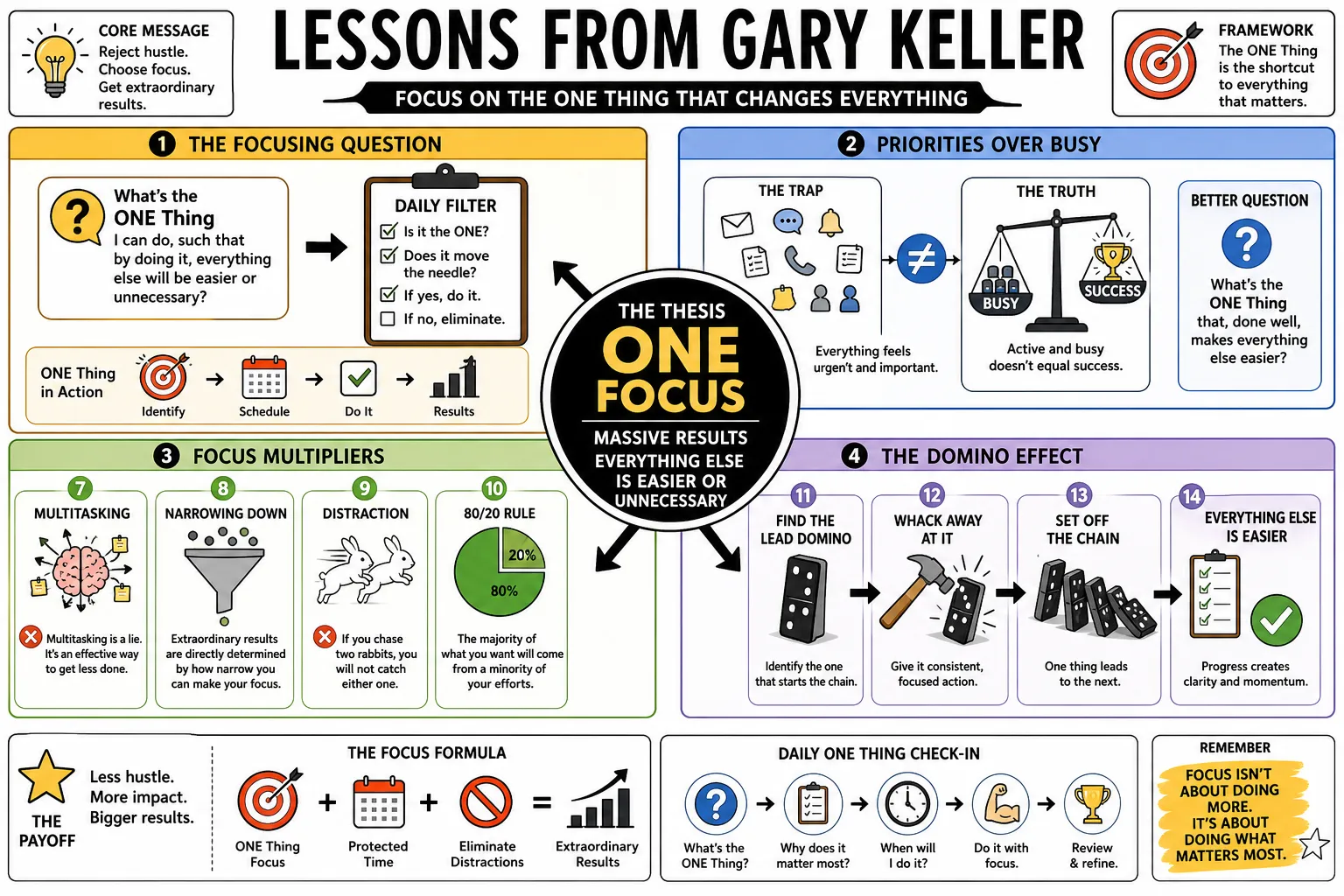
Lessons from Gary Keller
Gary Keller co-founded Keller Williams Realty and, with Jay Papasan, coauthored The ONE Thing. The book’s central method is to identify the most important action and protect time for it. This profile examines his published advice on focus, real estate and purposeful work. — The ONE Thing Book.
Part 1: Focus and Prioritization
- On The Focusing Question: Keller recommends asking which single action would make other work easier or unnecessary, then using the answer to set a priority. — Tim Ferriss Interview Transcript.
- On Priorities: When tasks all feel equally urgent, Keller advises identifying the few with the greatest leverage instead of treating activity as progress. — Tim Ferriss Interview Transcript.
- On Multitasking: Keller argues for giving important tasks undivided attention rather than trying to work on two priorities at the same moment. — Tim Ferriss Interview Transcript.
- On Narrowing Down: Keller narrows a broad goal to the next consequential action; this is a prioritization method, not a guarantee of extraordinary results. — Tim Ferriss Interview Transcript.
- On The Domino Effect: In Keller’s domino analogy, completing an important first action can make later actions easier, so he looks for that first step. — Tim Ferriss Interview Transcript.
- On Distraction: Keller says two important tasks should not be pursued at once; he chooses which one receives the protected work block first. — Tim Ferriss Interview Transcript.
- On The 80/20 Rule: Keller uses the 80/20 idea to look for the small share of actions that matters most to a goal; it is a heuristic, not a fixed outcome ratio. — Tim Ferriss Interview Transcript.
- On Saying No: A protected priority requires declining or deferring some competing requests; Keller also says focus need not consume the whole day. — Tim Ferriss Interview Transcript.
- On Less is More: The ONE Thing proposes doing fewer, higher-leverage things instead of expanding a task list for its own sake. — The ONE Thing Book.
Part 2: Productivity and Time Management
- On Busyness: Keller distinguishes visible busyness from progress on the activity that matters to the goal. — Tim Ferriss Interview Transcript.
- On Time Blocking: Keller plans a two- or three-hour uninterrupted block for his core business activity before other demands fill the calendar. — Tim Ferriss Interview Transcript.
- On Willpower Maintenance: Keller schedules demanding priority work when he personally has more energy; his “full tank” metaphor should not be read as a proven biological account of willpower. — Tim Ferriss Interview Transcript.
- On Daily Timing: Keller prefers to do his most important work early in the day, when he finds it easier to protect his attention. — Tim Ferriss Interview Transcript.
- On False Productivity: Keller measures a productive day by whether its important action was completed, not by the number of tasks crossed off. — Tim Ferriss Interview Transcript.
- On Doing The Right Thing: Keller’s focusing question is meant to identify the right action before optimizing how many actions get done. — Tim Ferriss Interview Transcript.
Part 3: Habits and Discipline
- On Habit Formation: Keller and Papasan advise applying discipline to establish a useful habit, rather than relying on an unrelated aphorism by F. M. Alexander as Keller’s own quote. — The Disciplined Life.
- On The Discipline Sprint: Their habit framework treats discipline as a way to repeat one useful behavior long enough for it to become easier, not as a guaranteed short sprint. — The Disciplined Life.
- On Sequential Success: The ONE Thing organizes progress around one consequential step at a time, with later steps building on earlier ones. — The ONE Thing Book.
- On Sustaining Habits: Keller and Papasan recommend giving one chosen habit sustained practice; how quickly it becomes easier varies by behavior and person. — The Disciplined Life.
- On The Myth of Discipline: The coauthors distinguish a useful habit from being disciplined at everything: practice can concentrate on one behavior that matters. — The Disciplined Life.
- On The Myelin Effect: Keller uses repeated practice as a route to greater fluency. His keynote calls this a “myelin effect,” but the literal neuron-wrapping explanation is not established by the talk. — Gary Keller on The Way.
- On Consistency: Repeating a basic priority habit can make follow-through less dependent on momentary motivation; the method still requires maintenance. — The Disciplined Life.
- On Changing Results: When a method fails, the coauthors advise acknowledging reality and changing the action or system instead of expecting a different result from the same approach. — The Accountability Cycle.
- On Momentum: The coauthors describe progress as an iterative cycle of acting, checking the result and adapting the next step. — The Accountability Cycle.
Part 4: Business Modeling and Real Estate
- On Using Models: Keller and his coauthors recommend studying models built from successful agents’ practices before trying to invent an entire real-estate business approach from scratch. — The Millionaire Real Estate Agent.
- On Success Clues: Keller describes studying earlier achievers and top agents for useful patterns, then testing those models in his own work; “success leaves clues” is quoted from Anthony Robbins in the book. — The Millionaire Real Estate Agent.
- On Systems: Keller treats documented models and systems as a foundation that agents can implement before adapting them; the inherited William Blake line is not Keller’s own saying. — The Millionaire Real Estate Agent.
- On Lead Generation: Keller says real-estate service must be paired with a way to capture, connect with and cultivate leads; he recalls nearly running out of money when he did not capture them. — SHIFT Tactic #5.
- On Goal Frameworks: The 1–3–5 GPS sets one goal, three priorities and five strategies for each priority; the five are not shared across all three. — The 1–3–5 GPS.
- On The Math of Business: Keller’s economic model works backward from a net-income goal through expenses, conversion rates, appointments and leads to the activity required; actual results remain uncertain. — MREA Economic Model.
- On The Ultimate Goal: Keller Williams frames business building around a career worth having, a business worth owning and a life worth living. The similar inherited sentence is Kathy Auerbach’s endorsement, not Keller’s quotation. — Keller Williams Models and Systems.
- On Taking Action: Keller’s business advice begins with taking a concrete step and learning from the result rather than waiting for a perfect plan. — The Millionaire Real Estate Agent.
- On Boldness: Keller pairs ambitious goals with deliberate action; thinking big alone does not build a business. — The Millionaire Real Estate Agent.
- On Planning: In his investor-book preface, Keller favors plans big enough to create room for meaningful results, while stressing patient work rather than guaranteed returns. — The Millionaire Real Estate Investor Excerpt.
Part 5: Navigating Market Shifts
- On Market Shifts: Keller and his SHIFT coauthors ask agents facing a market downturn to acknowledge the changed conditions and choose a practical response. — SHIFT Tactic #1.
- On Keeping Focus: In a shifting market, the coauthors recommend focusing on actions an agent can take—especially expenses and lead generation—rather than waiting for the market to change. — SHIFT Tactic #1.
- On Capability: Keller’s investor-book heading “Anyone Can Do It—Not Everyone Will” frames financial learning and sustained work as choices; it is not a promise that every investor will succeed. — The Millionaire Real Estate Investor Excerpt.
- On Controllables: Keller and his coauthors focus agents on their own expenses, lead-generation work and response to the market, not on controlling the market itself. — SHIFT Tactic #1.
- On Failure: Keller and Papasan’s accountability cycle treats a setback as information: acknowledge it, look for a solution, change course and act again. It does not say that losses are automatically wins. — The Accountability Cycle.
- On Learning From Mistakes: Keller explains that studying earlier achievers and top agents can help an agent learn from others’ experience before repeating avoidable mistakes. — The Millionaire Real Estate Agent.
- On Perseverance: The coauthored purpose framework connects a personally meaningful goal with repeated action, giving effort a reason beyond the immediate task. — The ONE Thing Purpose Workbook.
Part 6: Wealth and The Millionaire Mindset
- On The Rules of Money: Keller Williams’ Quantum Leap course teaches learning the rules and disciplines of money; the inherited threat that money will “punish” anyone who errs is not established. — Quantum Leap Student Manual.
- On Fear And Wealth: Keller writes that worthwhile investment decisions may require acting despite fear, while also treating fear as a prompt to learn and assess risk before acting. — The Millionaire Real Estate Investor Excerpt.
- On Living Your Dreams: Keller and Papasan discuss matching spending and saving choices to longer-term goals—living below one’s means and investing the difference is part of their suggested approach, not a wealth guarantee. — The 10 Rules of Building Wealth.
- On Sustained Focus: Keller’s investor preface favors patient, sustained work and a plan over expectations of quick wealth; it does not claim that every achievement has the same cause. — The Millionaire Real Estate Investor Excerpt.
- On Playing Big: Keller asks readers to consider ambitious goals, while acknowledging that a large goal alone does not ensure the outcome. — The Millionaire Real Estate Agent.
- On Growing Into Goals: Keller presents the pursuit of a larger goal as a reason to develop the skills and systems needed to pursue it, not as an automatic personal transformation. — The Millionaire Real Estate Agent.
- On Business Operations: The Millionaire Real Estate Agent distinguishes working as an agent in a job from building a measured, systematized business. — The Millionaire Real Estate Agent.
Part 7: Leadership and Ownership
- On Ownership: Keller and Papasan’s accountability cycle asks people to recognize their own role in a situation and act on what they can change without claiming control over every outcome. — The Accountability Cycle.
- On The Accountability Cycle: Keller describes accountability as seeking reality, acknowledging it, owning a response, looking for solutions and acting, rather than blaming circumstances. — Gary Keller’s BOLD Keynote.
- On Victimhood: Keller contrasts accountable action with deflecting responsibility or resigning oneself to circumstances; the inherited “author or victim” wording is not verified as his quote. — Gary Keller’s BOLD Keynote.
- On Life As A Question: The coauthored book uses the thought that how people live is their answer to life’s questions; its practical lesson is to ask better questions and act on the answer. — Family Matters and The ONE Thing.
- On Challenging Beliefs: Keller urges people to examine the beliefs they accept as true because those beliefs can shape how they act; this is his mindset teaching, not proof that belief alone determines reality. — Gary Keller’s BOLD Keynote.
- On Leadership Focus: Keller says achievement depends on other people’s help and urges recognizing those relationships; the inherited claim that a leader must always serve others first is not directly established. — Gary Keller’s BOLD Keynote.
- On Action Over Words: Keller links a meaningful priority to a protected daily work block: purpose becomes practical when it determines what receives time. — Tim Ferriss Interview Transcript.
Part 8: Life Balance and Core Values
- On The Juggle Of Life: When Ferriss reads the glass-and-rubber-balls metaphor from The ONE Thing, Keller identifies family and health as fragile priorities he does not want work to displace. The metaphor is not presented as Keller’s invention. — Tim Ferriss Interview Transcript.
- On The Illusion Of Balance: The ONE Thing calls perfect daily balance unrealistic and recommends intentional periods of focus, followed by attention to other important areas of life. — Counterbalancing the 7 Circles.
- On Counter-Balancing: Counterbalancing means temporarily prioritizing one important activity and then returning to relationships, health and other commitments—not indefinitely sacrificing them. — Counterbalancing the 7 Circles.
- On Long-Term Compounding: Keller’s investor preface describes results as the product of patient work over time rather than an overnight windfall; the profile should not promise compounding returns. — The Millionaire Real Estate Investor Excerpt.
- On Meaningful Work: Keller’s business-building framework asks readers to grow into the skills, models and systems needed for a larger goal; that development is part of the work, not a guaranteed identity change. — The Millionaire Real Estate Agent.
- On The Power Of Choice: The SHIFT coauthors focus on how an agent responds to changed market conditions, while recognizing that the conditions themselves are real constraints. — SHIFT Tactic #1.
- On Defending Your Time: Keller uses his calendar to protect a recurring block for the work he has chosen as most important, while still making time for relationships and other priorities. — Tim Ferriss Interview Transcript.
- On True Freedom: Keller and Papasan connect money decisions with personal priorities such as meeting needs, living below one’s means and giving; higher earnings alone do not guarantee freedom or alignment. — The 10 Rules of Building Wealth.
- On Living With Purpose: The ONE Thing describes purpose as a source of direction and motivation; the official workbook reproduces the coauthored book’s “straightest path to power” passage. — The ONE Thing Purpose Workbook.