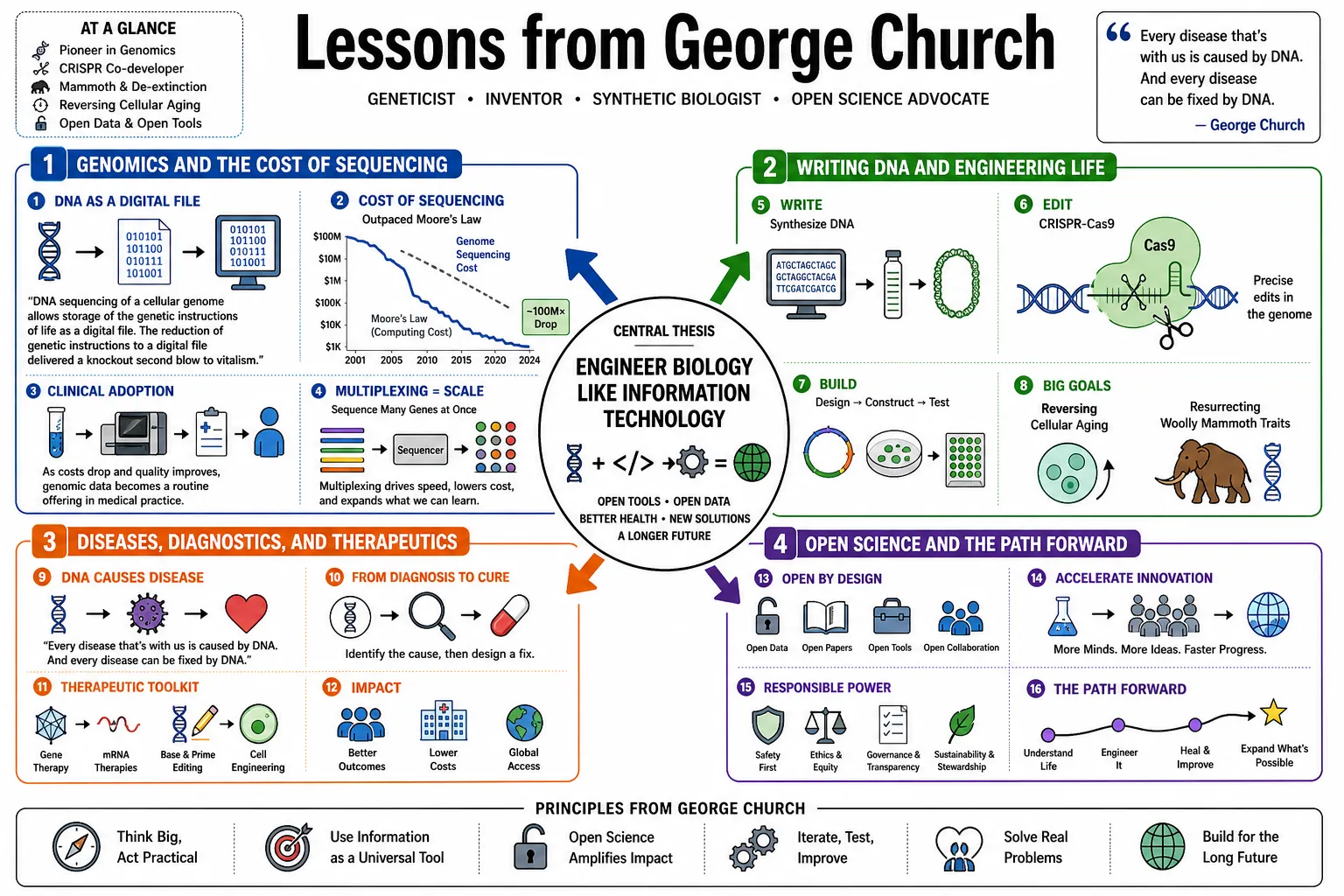
Lessons from George Church
Harvard geneticist George Church helped develop high-throughput genome sequencing and coauthored an early demonstration of CRISPR editing in human cells. His laboratory also pursues synthetic biology, personal genomics, aging research and projects to introduce cold-adapted traits into elephants; many of these applications remain research goals. — Radical Technology Meets Radical Application.
Part 1: Genomics and the Cost of Sequencing
- On DNA as a digital file: DNA sequencing makes biological instructions available as digital sequence data for analysis and comparison; a sequence alone does not determine a person or organism. — The Personal Genome Project.
- On the cost of sequencing: Church helped develop high-throughput sequencing; he describes multiplexing as a route to cheaper, more scalable genome reading, not proof that sequencing alone is routine care. — NHGRI Oral History.
- On clinical adoption: Church says cost, privacy, and perceived utility still limit widespread personal-genome adoption, even as sequencing has become cheaper. — Science Interview on Nebula Genomics.
- On genetic diseases: Church argues that genomes can inform diagnosis and research while emphasizing that DNA is only one part of health and development. — The Personal Genome Project.
- On multiplexing: Church pursued sequencing many DNA molecules in parallel, an approach central to the scaling of next-generation sequencing. — Clinical Chemistry Interview.
- On nanopore sequencing: Nanopore sequencing reads electrical changes as DNA passes through a pore; Church independently proposed the concept, but this is one of several sequencing approaches. — Church Lab Nanopore Sequencing.
- On the limitations of the original Human Genome Project: Church’s Personal Genome Project argued that high-quality sequence data must be linked with diverse health and trait information to improve interpretation. — The Personal Genome Project.
- On reading versus writing: The Genome Project–Write proposed moving from reading DNA toward the much harder engineering and testing of large genomes, with ethics and biosafety built in. — The Genome Project–Write.
- On data storage: Church’s team encoded and recovered a book in DNA, demonstrating dense information storage while noting slow read/write processes and practical limitations. — Writing the Book in DNA.
- On genomic dark matter: Church coauthored early work identifying regulatory motifs in noncoding sequences; noncoding DNA is not uniformly functionless, but its roles require testing. — Noncoding Regulatory Motifs Study.
Part 2: Synthetic Biology and Engineering Life
- On manufacturing with biology: Church has speculated that biology could eventually manufacture a very broad range of materials; he explicitly notes that biological chemistry does not yet cover every element and bond. — FoundMyFitness Interview.
- On biological fuels: In a 2013 interview Church described organisms that use carbon dioxide and light to make engine-compatible fuel; this was an early technical demonstration, not proof of current commercial economics. — Der Spiegel Interview.
- On artificial life: Church said his team had synthesized ribosomes that made a protein, while stressing that they had not made artificial life. — Harvard Synthetic Ribosome Report.
- On standardizing biological parts: Church describes synthetic biology as combining reusable biological parts with engineering, automation and laboratory evolution; biological parts are not yet as predictable as electronic components. — Constructive Biology.
- On multiplex automated genomic engineering: Church’s team developed MAGE to automate repeated targeted edits in E. coli and reported increased lycopene production in a laboratory demonstration. — Multiplex Genome Engineering Paper.
- On recoding genomes: Church’s team recoded E. coli so the tested viruses could not productively use its altered genetic code; this is a laboratory result, not demonstrated immunity to every virus in every organism. — Swapped Genetic Code Study.
- On mirror-image biology: Church now warns that self-replicating mirror bacteria could evade natural biological defenses and argues for biocontainment and monitoring before such organisms are made. — Mirror-Life Risk Interview.
- On biological safety: A Church-coauthored recoding study added dependence on a synthetic amino acid as one containment layer; its effectiveness outside the tested system is not guaranteed. — Swapped Genetic Code Study.
- On synthetic ribosomes: Church’s lab reported synthetic ribosomes capable of making a protein, an enabling result for future protein engineering rather than an artificial cell. — Harvard Synthetic Ribosome Report.
- On viewing biology as engineering: Church frames synthetic biology as an engineering discipline that combines genetic design, automation, testing and selection, with safety considered during development. — Constructive Biology.
Part 3: CRISPR and Gene Editing
- On the significance of CRISPR: Church and colleagues showed in 2013 that RNA-guided Cas9 could edit several sites in human cells; the team contributed to human-cell applications of a broader CRISPR field. — RNA-Guided Human Genome Engineering.
- On off-target effects: Church notes that both off-target and on-target damage matter in gene editing, especially when many edits are attempted at once. — Radical Technology Meets Radical Application.
- On base editing: Church discusses base editors as useful alternatives to double-strand cutting but cautions that they have specificity and editing-range limits; he credits David Liu’s group for major advances. — Radical Technology Meets Radical Application.
- On multiplex editing in animals: Church and colleagues used CRISPR to inactivate porcine endogenous retroviruses and generate edited pigs, addressing one safety hurdle rather than proving transplant readiness. — PERV-Inactivated Pig Study.
- On prime editing: Church regards prime editing as a promising route toward precise DNA changes, while stressing that current editors have not solved the full problem of safe, exact editing. — Radical Technology Meets Radical Application.
- On delivery mechanisms: Church distinguishes the ability to edit DNA in cells from delivering gene-editing components safely and effectively to the right tissues in patients. — The Augmented Human Being.
- On somatic versus germline editing: Church discusses somatic therapy and inherited germline changes as different risk and governance questions; feasibility does not settle social acceptability. — The Augmented Human Being.
- On the speed of CRISPR adoption: Church’s group demonstrated RNA-guided editing in human cells in 2013, an early milestone before later therapeutic development and clinical translation. — RNA-Guided Human Genome Engineering.
- On combinatorial gene therapy: Church’s laboratory work highlights the need to coordinate multiple edits for some applications while managing toxicity and unintended damage. — Radical Technology Meets Radical Application.
- On democratization of editing: Church argues that accessible gene-editing tools should be paired with safety engineering, testing, and oversight before broad deployment. — The Augmented Human Being.
Part 4: De-extinction and Ecological Restoration
- On the rationale for de-extinction: Church proposes that cold-adapted elephants might help Arctic ecosystems and permafrost through grazing and snow compaction; the climate benefit remains a hypothesis. — A Mammoth Solution.
- On hybridizing species: Church describes the project as introducing selected extinct traits into living elephants, not cloning a complete woolly mammoth. — A Mammoth Solution.
- On cold adaptation: The team is investigating traits such as hair and subcutaneous fat so edited elephants might tolerate Arctic conditions; a viable cold-adapted animal has not been demonstrated. — A Mammoth Solution.
- On artificial wombs: Church has explored external gestation to avoid using endangered elephant surrogates, but described growing an animal fully in the lab as a major unresolved challenge. — Guardian Interview with George Church.
- On keystone species: Church hopes that cold-adapted elephants could play an ecological role in Arctic restoration, but the ecosystem outcome cannot be assumed before animals exist and are studied. — A Mammoth Solution.
- On Neanderthal genetics: Church has discussed sequencing and synthesizing Neanderthal DNA to investigate ancient traits, while treating cognitive implications as speculative rather than established. — Der Spiegel Interview.
- On the ethics of recreation: Church frames the edited-elephant proposal as conservation of an endangered living species, not recreation of an extinct animal for spectacle, and calls for public engagement about its impacts. — A Mammoth Solution.
- On ancient DNA degradation: Church explains that ancient mammoth DNA is degraded, so researchers read fragments and use modern elephant cells to test selected reconstructed traits. — Mammoth Interview.
- On the timeline of mammoth revival: Church has offered optimistic early estimates for a cold-adapted elephant, but also acknowledged major gestation and development hurdles; no reliable revival date is established. — Guardian Interview with George Church.
Part 5: Aging, Longevity, and Rejuvenation
- On aging as a disease: Church’s group investigates whether mechanisms associated with aging can be modified or reversed in animals; this is not a demonstrated human cure for aging. — The Augmented Human Being.
- On epigenetic reprogramming: Church describes cellular reprogramming as a possible way to restore youthful cell functions, while acknowledging unresolved mechanisms and limits to repair. — George Church Longevity Interview.
- On treating age-related diseases collectively: A Church-coauthored study found one combination of AAV gene therapies helped mouse models of four age-related diseases; human prevention of all such diseases remains unproven. — Combination Gene Therapy in Mice.
- On canine longevity: A Church-lab spinout moved from mouse gene-therapy work toward a pilot in dogs; it had not shown that the therapy extends canine or human lifespan. — Rejuvenate Bio Dog Pilot.
- On protective variants: Church says comparative studies of unusually long-lived animals have supplied hints about protective genes, but had only modest influence on therapy selection at the time of his interview. — Harvard Bioethics Interview.
- On viral vectors: In mouse models, Church and colleagues used AAV vectors to deliver candidate longevity-related genes; delivery and safety for humans remain separate challenges. — Combination Gene Therapy in Mice.
- On the economics of longevity: Church argues that restoring health in older people could be more useful than merely prolonging frailty; the predicted healthcare savings remain hypothetical. — The Augmented Human Being.
- On age reversal versus life extension: Church distinguishes attempting to restore youthful function from simply adding years to life; he presents human age reversal as a research goal. — The Augmented Human Being.
- On combinatorial therapies for aging: Church’s mouse study tested multi-gene approaches because age-related diseases involve overlapping pathways; it does not establish a human rejuvenation treatment. — Combination Gene Therapy in Mice.
Part 6: Open Science and the Personal Genome
- On data privacy: The Personal Genome Project’s open-consent model does not promise anonymity: participants accept that published genomic and trait data may identify them. — Harvard Personal Genome Project.
- On open-source biology: Church’s Personal Genome Project invites volunteers to contribute public genome, health and trait data for research, with explicit consent rather than a blanket requirement for all patient data to be open. — Harvard Personal Genome Project.
- On informed consent: The Personal Genome Project requires volunteers to demonstrate understanding of the risks before enrollment and spells out the consequences of public data release. — Harvard Personal Genome Project.
- On sharing personal data: Church publicly shared his own genome and health information as part of the Personal Genome Project’s open-participation model. — Clinical Chemistry Interview.
- On the limitation of siloed data: Church argued that integrating genome sequences with phenotype and health information can make research more informative, while public sharing requires informed consent. — The Personal Genome Project.
- On blockchain and genomics: In 2018 Church and Nebula cofounders proposed blockchain-mediated control over access to genomic data; their interview describes a business design, not a verified deployed privacy guarantee. — Science Interview on Nebula Genomics.
- On citizen science: The Personal Genome Project reports that motivated volunteers contribute research-relevant datasets and engage with researchers as active participants. — Harvard Personal Genome Project.
- On commercializing genomes: Church contrasted the uncompensated public-data Personal Genome Project with Nebula’s proposed marketplace in which individuals could choose whether to share and be paid. — Science Interview on Nebula Genomics.
- On public trust: Church’s Genome Project–Write proposal calls for early public discussion, transparent biosafety standards, and equitable distribution of potential benefits. — The Genome Project–Write.
Part 7: Bioethics and Technological Responsibility
- On technological moratoriums: Church has criticized voluntary moratoria alone and favors monitoring DNA synthesis orders, containment, testing and enforceable oversight for risky biological work. — Mirror-Life Risk Interview.
- On pathologically calm debate: Church described himself as “pathologically calm” in a reported interview; the phrase describes his temperament, not a demonstrated prerequisite for sound bioethics. — New York Times Church Profile.
- On proactive regulation: Church argues that transformative biological tools need safety discussions and governance before deployment rather than after an alarming experiment is already complete. — The Augmented Human Being.
- On bioterrorism: Church warns that synthetic biology can be misused and advocates DNA-order screening, surveillance and containment as imperfect but actionable safeguards. — Mirror-Life Risk Interview.
- On cognitive enhancement: Church has discussed possible genomic approaches to cognitive enhancement, but describes them as speculative and distinct from approved therapies. — Harvard Bioethics Interview.
- On equitable access: Church’s Genome Project–Write proposal calls for lowering engineering costs and sharing eventual benefits across regions, rather than making capabilities available only to wealthy groups. — The Genome Project–Write.
- On natural vs. unnatural: Church notes that humans have long modified living things; synthetic biology extends that history while introducing new capabilities and risks. — Constructive Biology.
- On playing God: Church responds to “playing God” concerns by describing synthetic biology as manipulation of existing life rather than creation of life’s basic principles. — Constructive Biology.
- On public engagement: Church and coauthors call for public dialogue about genome-scale engineering before sensitive applications are attempted. — The Genome Project–Write.
Part 8: The Deep Future and Human Evolution
- On space exploration: Church identifies radiation and low gravity as obstacles to long-term human space travel and treats biological adaptation as one possible research route, not an available fix. — Future of Life Podcast with George Church.
- On radiation resistance: Church’s space-genetics program asks whether radiation-resistance mechanisms demonstrated in bacteria could be generalized to human cells; it does not claim astronaut protection has been achieved. — Consortium for Space Genetics.
- On brain mapping: Church coauthored a proposal to record activity across large neural circuits as a way to study brain function and disorders; it did not claim a complete live-human neuron map already exists. — Brain Activity Map Proposal.
- On spatial transcriptomics: Church and colleagues developed in situ RNA sequencing to localize thousands of transcripts within biological samples, an early spatial-gene-expression method. — In Situ RNA Sequencing Study.
- On directed evolution: Church describes synthetic biology as combining designed edits with selection and laboratory evolution, not as replacing natural evolution with total human control. — Constructive Biology.
- On multi-planetary existence: Church discusses biological approaches to difficult space-settlement constraints; he treats multi-planet survival as a long-range possibility requiring many unsolved systems. — Future of Life Podcast with George Church.
- On synthetic human genomes: Church coauthored the Genome Project–Write proposal to reduce the cost of constructing and testing large genomes, including human cell-line genomes; it was a project goal, not a completed synthetic human genome. — The Genome Project–Write.
- On the limits of biology: Church urges separating what physics permits from what is currently practical or desirable; biological possibilities still face engineering, safety and social limits. — Der Spiegel Interview.