Lessons from George Lucas
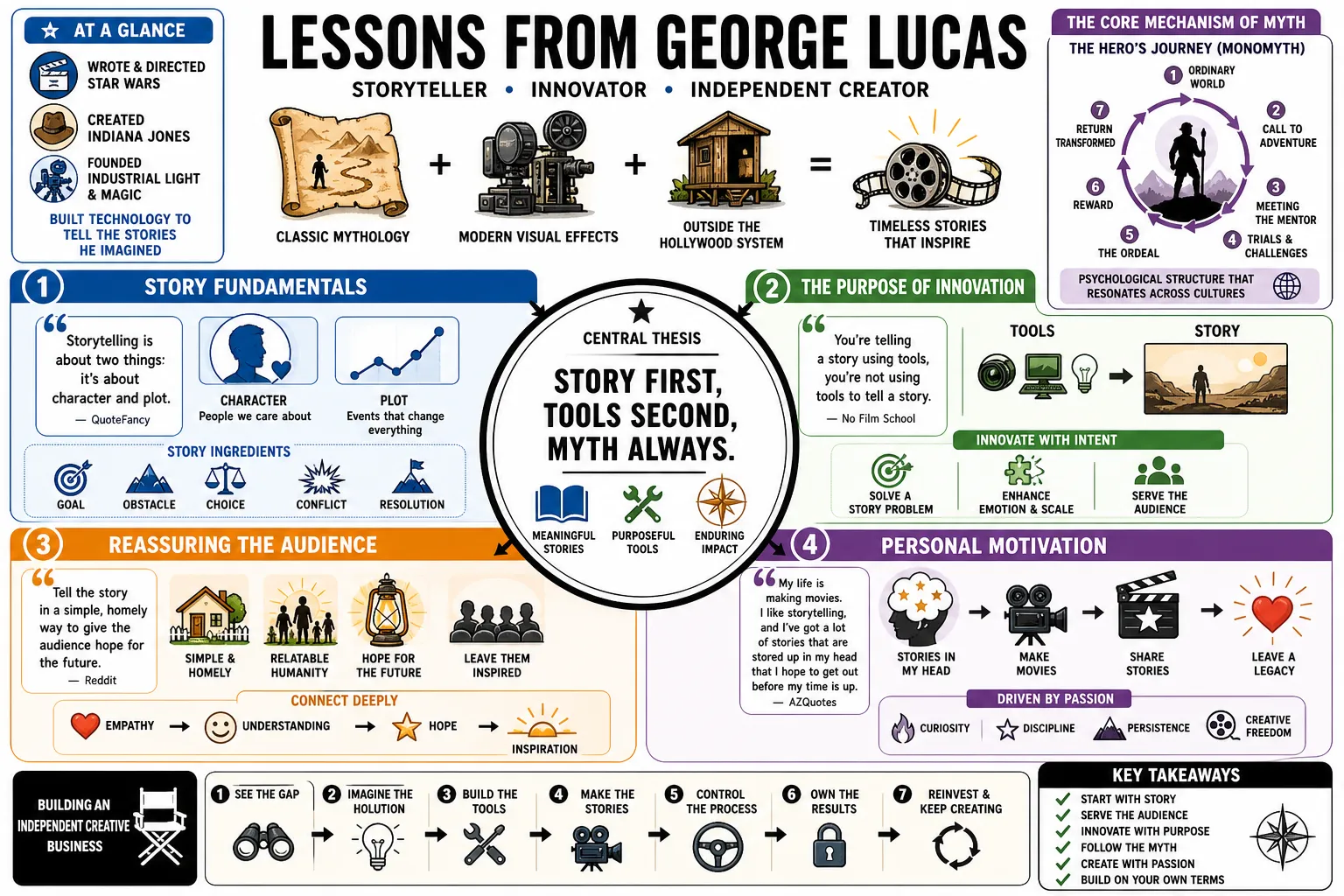
George Lucas wrote and directed Star Wars, created the Indiana Jones franchise, and founded Industrial Light & Magic to invent the technology his films required. Operating strictly outside the traditional Hollywood system, he built his career on a mix of classic mythology and modern visual effects. This profile collects his practical advice on storytelling mechanics and running an independent creative business.
Part 1: Storytelling and Narrative
- On Story Fundamentals: "Storytelling is about two things; it's about character and plot." — Source: QuoteFancy
- On The Purpose of Innovation: "You're telling a story using tools, you're not using tools to tell a story." — Source: No Film School
- On Reassuring the Audience: "Tell the story in a simple, homely way to give the audience hope for the future." — Source: Reddit
- On Personal Motivation: "My life is making movies. I like storytelling, and I've got a lot of stories that are stored up in my head that I hope to get out before my time is up." — Source: AZQuotes
- On The Core Mechanism of Myth: "Myths are built on the monomyth, the hero's journey, which provides a psychological structure that resonates across cultures." — Source: Medium
- On Writing Dialogue: "I'd be the first person to say I can't write dialogue. My dialogue is very utilitarian and is designed to move things forward. I'm not Shakespeare. It's not designed to be poetic." — Source: CBC
- On Jumping Into The Action: "Skip the over descriptive beginning. Start right in the middle of the action, so the audience isn't overwhelmed with exposition right from the start." — Source: Golden Script
- On The Actor's Perspective on His Writing: "George, you can type this shit, but you sure can't say it!" (As told to him by Harrison Ford). — Source: CBC
- On Academic Screenwriting: "Although I write screenplays, I don't think I'm a very good writer. I'm very interested in studying cultures and social issues, but as an academic I don't think I would have been too successful." — Source: QuoteFancy
- On The Subservience of Words to Images: "Film is a visual medium. The words are there to support the images and the movement, not the other way around." — Source: No Film School
Part 2: Filmmaking and The Creative Process
- On The Real Challenge of Directing: "Learning to make films is very easy. Learning what to make films about is very hard." — Source: Reddit
- On Film as Deception: "The secret to film is that it's an illusion." — Source: AZQuotes
- On Sticking to Your Idea: Lucas says criticism always hurts, but compares his job to painting a house the color he intended: the point is not to satisfy every outside preference, but to make the movie he set out to make. — Reference: CBS/60 Minutes interview on criticism and the white-house analogy
- On Making Choices on Set: Lucas frames the filmmaker's job as staying actively involved in choices and making the best possible version of the movie, especially when studios or later releases can change the work. — Reference: Hollywood Reporter interview on director involvement and making the best possible movie
- On The Importance of Editing: "Editing is the only unique aspect of filmmaking that doesn't borrow from other art forms like photography, theater, or writing." — Source: Film Obsessive
- On Creative Revision: "Most artists, most painters, even composers would want to come back and redo their work. They've got a new perspective on it, they've got more resources, they have better technology, and they can fix or finish the things that were never done." — Source: AZQuotes
- On The Director's Prerogative: "Right or wrong, this is my movie, this is my decision, and this is my creative vision, and if people don't like it, they don't have to see it." — Source: Gracious Quotes
- On Controlling the Final Cut: "This is the movie I wanted it to be, and I'm sorry you saw half a completed film and fell in love with it. But I want it to be the way I want it to be." — Source: TV Tropes
- On Artistic Growth: "A director's style is born out of their limitations and how they choose to solve problems on the set." — Source: Golden Script
- On Working with Francis Ford Coppola: "He took me from not being able to write a word in terms of writing screenplays to being the king of wooden dialogue." — Source: CBC
Part 3: Sound Design and Musicality
- On The Mathematical Breakdown of Film: "The sound and music are 50 percent of the entertainment in a movie." — Source: And And And Creative
- On Prioritizing Audio Over Words: "I believe half a movie is the sound. The sound is extremely important, but the dialogue is not. That's not where the issue is." — Source: Birch Tree
- On Mixing as Orchestration: "It's like a big symphony orchestra... and the singing is in there, the choir and everything. It's all one big sound track." — Source: Birch Tree
- On The Audience's Emotional Reaction: "Sound is 50 percent of the moviegoing experience, and I've always believed audiences are moved and excited by what they hear in my movies at least as much as by what they see." — Source: AZQuotes
- On The Value of John Williams: "The music elevates the entire film, translating the visual myth into an immediate emotional language." — Source: Allied Productions
- On Ben Burtt's Soundscapes: "Creating an entirely new universe requires inventing the distinct auditory texture of that universe from scratch." — Source: Quotery
- On Audio Kinetic Energy: "Sound gives the visuals their weight, their speed, and their physical reality within the frame." — Source: Birch Tree
- On The Contrast of Silence: "Sometimes the most powerful sound you can use in a busy sequence is absolute silence." — Source: And And And Creative
- On The Subconscious Impact of Foley: "People don't notice great sound design, but they feel it. It bypasses the intellect and hits the nervous system." — Source: Allied Productions
Part 4: Special Effects and Technology
- On The Limitation of Spectacle: "A special effect without a story is a pretty boring thing." — Source: Goodreads
- On Creating Industrial Light & Magic: "I had a problem: a story I wanted to tell... So I went and found the technology to do it. In the process of making 'Star Wars,' there weren't any visual effects houses, so I had to invent one." — Source: Entrepreneur
- On The Inherent Link Between Art and Tech: "All art is dependent on technology because it's a human endeavour, so even when you're using charcoal on a wall or designed the proscenium arch, that's technology." — Source: AZQuotes
- On Digital Liberation: "In 3-D filmmaking, I can take images and manipulate them infinitely, as opposed to taking still photographs and laying them one after the other. I move things in all directions. It's such a liberating experience." — Source: QuoteFancy
- On The Promise of Digital Media: "Digital technology allows us a much larger scope to tell stories that were pretty much the grounds of the literary media." — Source: AZQuotes
- On Engineering Kinetic Energy: "For 'Star Wars' I had to develop a whole new idea about special effects to give it the kind of kinetic energy I was looking for. I did it with motion-control photography." — Source: QuoteFancy
- On The Transition to CGI Characters: "We tried to do Yoda in CGI in Episode I, but we just couldn't get it done in time... the puppet really wasn't as good as the CGI. So when we did the reissue, we had to put the CGI back in, which was what it was meant to be." — Source: AZQuotes
- On Technology Solving Artistic Problems: Lucas treats technology as a tool in service of art: in discussing digital Yoda and film changes, he says movies are technological art forms and that improvements should help the filmmaker realize the intended version. — Reference: Hollywood Reporter interview on film technology, CGI Yoda, and improving the work
- On Pushing Medium Boundaries: "We are constantly trying to remove the barrier between the imagination of the filmmaker and the physical reality of the screen." — Source: Medium
Part 5: Independence and The Studio System
- On The Decline of Creativity in Hollywood: "What happens now... nobody knows what to do. The stories they're telling are just old movies. 'Let's do a sequel, let's do another version of this movie.' And it's not just in movies, but in almost everything, there's almost no original thinking." — Source: Forbes
- On The Rise of Corporate Studios: "Suddenly all these corporations were coming in. They didn't know anything about the movie business... But then the studios went back to saying, 'We don't trust you people and we think we know how to make movies'." — Source: Business Insider
- On Guarding The Integrity of Art: "If something is not done now to clearly state the moral rights of artists, current and future technologies will alter, mutilate, and destroy for future generations the subtle human truths and highest human feeling that talented individuals within our society have created." — Source: Reddit
- On Building Lucasfilm: "I built an independent empire outside of Hollywood so that I would never have to ask a studio for permission to make the films I wanted to make." — Source: Film Obsessive
- On Original Intentions: "My ambition was ultimately to be Michael Moore. I wanted to make visually interesting films and documentaries." — Source: No Film School
- On Retaining Merchandising Rights: Lucas took less upfront money after American Graffiti because he wanted sequel rights, and later used the Empire deal to regain merchandising rights; his attorney describes the goal as being able to make the movies he wanted to make. — Reference: Deadline interview with Tom Pollock on Lucas retaining sequel and merchandising rights
- On The Danger of Committees: "Films are made by filmmakers, not by committees of executives looking at focus group data." — Source: Better Humans
- On Self-Funding: Lucas says he chose to do The Empire Strikes Back himself by going to the bank for financing; the risk was financial ruin if it failed, while ownership let him make the sequels on his own terms. — Reference: Yahoo/IndieWire report on Lucas self-financing The Empire Strikes Back
- On Defining Independence: "Independence isn't just about budget size; it's about who has the final say on the cut that reaches the theater." — Source: IGN
Part 6: Business, Risk, and Ambition
- On The True Foundation of the Film Business: "The secret to the movie business, or any business, is to get a good education in a subject besides film... All the skill in the world isn't going to help you unless you have something to say." — Source: Succeed Feed
- On Accidental Commercial Success: "I made money in spite of myself, and I think it's because I didn't care whether it was a hit or not a hit." — Source: No Film School
- On Enduring the Grind: "You simply have to put one foot in front of the other and keep going. Put blinders on and plow right ahead." — Source: Entrepreneur
- On Goal Ambiguity: "Part of the issue of achievement is to be able to set realistic goals, but that's one of the hardest things to do because you don't always know exactly where you're going, and you shouldn't." — Source: Medium
- On The Heavy Burden of Success: "Success is a very difficult thing. It's much more difficult than one might think." — Source: QuoteFancy
- On Passion as Risk Mitigation: "You have to find something that you love enough to be able to take risks, jump over the hurdles, and break through the brick walls that are always going to be placed in front of you." — Source: Medium
- On The Importance of Imagination: "Dreams are extremely important. You can't do it unless you imagine it." — Source: Entrepreneur
- On Locating Your Strengths: "Everybody has talent, it's just a matter of moving around until you've discovered what it is." — Source: India Times
- On The Secret to Happiness: "The best way to pursue happiness is to help other people. Nothing else will make you happier." — Source: Gracious Quotes
Part 7: Failure, Growth, and Perseverance
- On The Core Lesson of Failure: "It’s okay to lose; just don’t lose the lesson." — Source: Culture Slate
- On The Necessity of Mentors: "Mentors have a way of seeing more of our faults than we would like. It’s the only way we grow." — Source: Goodreads
- On Reaching the Breaking Point: "The secret is not to give up hope. It's very hard not to. If you're really doing something worthwhile, I think you will be pushed to the brink of hopelessness before you come through to the other side." — Source: CEO Blog Nation
- On Using Rejection as Fuel: Star Wars was a hard sell: United Artists and Universal turned Lucas down, and Fox backed him largely because of American Graffiti rather than because the studio understood the space opera. — Reference: Business Insider on Lucas recalling studios that turned down Star Wars
- On Financial Failures: "A commercial failure only means the market didn't align with your vision at that specific moment; it doesn't invalidate the art." — Source: Deja Reviewer
- On Ignoring the Naysayers: "You have to develop a thick skin. If you believe in the story, you can't let the immediate criticism steer you off your path." — Source: Economic Times
- On The Value of Early Setbacks: "Struggling early in your career teaches you how to solve problems creatively when you don't have the budget to solve them financially." — Source: Quote Catalog
- On Overcoming Production Disasters: "Every movie is a series of compromises and disasters. Directing is just the act of surviving those disasters while keeping the core idea intact." — Source: Medium
- On Adapting to Mistakes: "If an effect fails or a scene doesn't work, you don't abandon the film; you rewrite the scene or invent a new effect." — Source: Culture Slate
- On The Resilience Required for Filmmaking: "You don't survive in this industry without learning how to absorb failure and immediately pivot to the next solution." — Source: AZQuotes
Part 8: Education, Learning, and Mentorship
- On The Primary Human Endeavor: "Education is the single most important job of the human race." — Source: Screen Rant
- On Modernizing Schools: "Our system of education is locked in a time capsule. You want to say to the people in charge, 'You're not using today's tools! Wake up!'" — Source: QuoteFancy
- On The Foundation of Society: "Education is the foundation of our democracy—the stepping-stones for our youth to reach their full potential." — Source: Edutopia
- On Engaging Students: "My own experience in public school was quite frustrating. I was often bored... I wondered, 'Why can't school be engaging all of the time?'" — Source: Edutopia
- On The Impact of Great Teachers: "From kindergarten to college, certain teachers engaged my curiosity and motivated me to learn. While I was not the best student, their efforts left a lasting impact." — Source: AZQuotes
- On Teaching the Grammar of Media: "We learn the grammar of English... but nobody teaches anybody what screen direction is, what perspective is, what color is, what a diagonal line means... you need to teach them the grammar of the language." — Source: TV Tropes
- On Project-Based Learning: "With project-based learning, students learn by designing and constructing actual solutions to real life problems." — Source: Forbes
- On Information Literacy: "In today's world, students need three fundamental skills: they need to know how to find information, how to assess the quality of information, and how to creatively and effectively use information to accomplish a goal." — Source: Forbes
- On Breaking Educational Isolation: "Traditional education can be extremely isolating—the curriculum is often abstract and not relevant to real life, teachers and students don't usually connect with resources and experts outside of the classroom." — Source: Edutopia