Grace Hopper was a mathematician, computer scientist, and Rear Admiral in the U.S. Navy. She is best known for inventing the first compiler and advocating for high-level, English-like programming languages, which laid the technical and philosophical groundwork for COBOL. This profile compiles her insights on systems architecture, challenging institutional stagnation, and the human side of technical leadership.
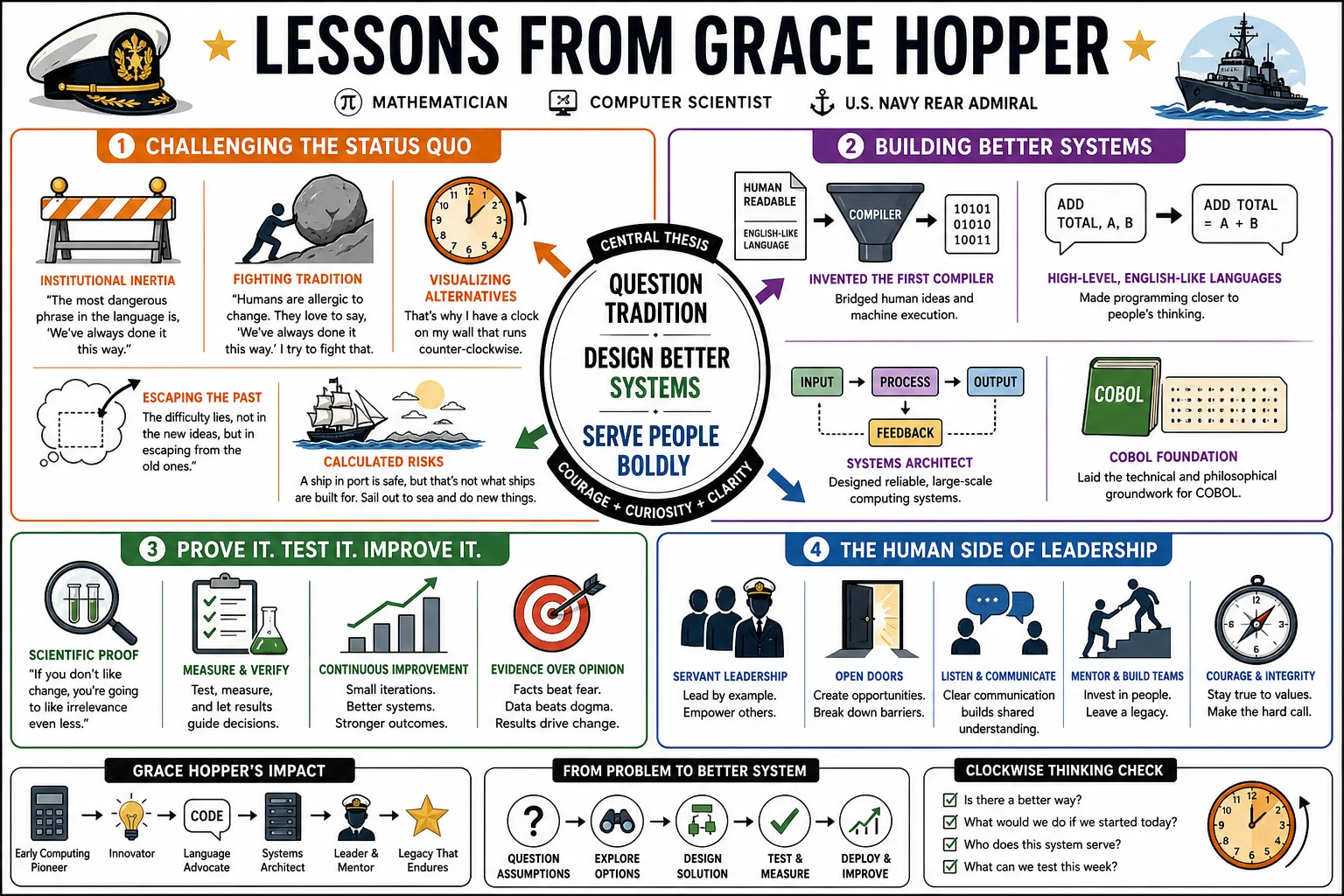
Part 1: Challenging the Status Quo
- On Institutional Inertia: "The most dangerous phrase in the language is, 'We've always done it this way.'" — Source: [In Her Sight]
- On Fighting Tradition: "Humans are allergic to change. They love to say, 'We've always done it this way.' I try to fight that. That's why I have a clock on my wall that runs counter-clockwise." — Source: [Quote Investigator]
- On Escaping the Past: "The difficulty lies, not in the new ideas, but in escaping from the old ones." — Source: [In Her Sight]
- On Visualizing Alternatives: "It tells perfectly good time, but it reminds us that we don't have to do things the way we've always done them." — Source: [Quote Investigator]
- On Calculated Risks: "A ship in port is safe, but that's not what ships are built for. Sail out to sea and do new things." — Source: [Ian Khan]
- On Scientific Proof: "If you do something once, people will call it an accident. If you do it twice, they call it a coincidence. But do it a third time and you've just proven a natural law!" — Source: [AZ Quotes]
- On Breaking the Mold: "I've always objected to doing anything over again if I had already done it once." — Source: [Computer History Museum]
- On Progress Constraints: "They told me computers could only do arithmetic." — Source: [Bookey]
- On Pushing Boundaries: "In matters like this, you don't run against logic — you run against people who can't change their minds." — Source: [Yale University]
Part 2: Managing Things, Leading People
- On Leadership Distinctions: "You manage things; you lead people." — Source: [FairyGodBoss]
- On the Over-Management Problem: "We went overboard on management and forgot about leadership. It might help if we ran the MBAs out of Washington." — Source: [AZ Quotes]
- On Reciprocal Loyalty: "Leadership is a two-way street, loyalty up and loyalty down. Respect for one's superiors; care for one's crew." — Source: [Medium]
- On Purposeful Action: "A goal is a dream with a plan and a deadline." — Source: [Gracious Quotes]
- On Navy Organization: "You can’t derive the organization of the Navy; you have to memorize it." — Source: [YouTube]
- On Boot Camp Wisdom: "If they put you down somewhere with nothing to do, go to sleep—you don't know when you'll get any more." — Source: [Gracious Quotes]
- On the True Function of Computers: "A human must turn information into intelligence or knowledge." — Source: [Yale University]
- On Empirical Evidence: "One accurate measurement is worth a thousand expert opinions." — Source: [FairyGodBoss]
- On Empowerment: True leadership was about solving problems and providing the tools for others to express their own curiosity and potential. — Source: [Bookey]
Part 3: The Architecture of Computing
- On the Mark I's Scale: "It was 51 feet long, eight feet high, eight feet deep. And it had 72 words of storage and could perform three additions a second." — Source: [Yale University]
- On the Machine's Gender: "The Computer was originally 'She' in reference to the Mark I." — Source: [Wikiquote]
- On the Shift to Intelligence: "[The Computer] was the first machine man built that assisted the power of his brain instead of the strength of his arm." — Source: [Wikiquote]
- On Systemic Growth: "Life was simple before World War II. After that, we had systems." — Source: [Yale University]
- On Programming as Foundations: "To me, programming is more than an important practical art. It is also a gigantic undertaking in the foundations of knowledge." — Source: [Bookey]
- On Data over Process: "We must state relationships, not procedures." — Source: [AZ Quotes]
- On First Encounters: "I didn’t [know so much about computers]. It was the first one." — Source: [Fourmilab]
- On the "Model T" Era: "Whether you recognize it or not, the Model T's of the computer industry are here. We've been through the preliminaries of the industry." — Source: [YouTube]
- On Information Overload: "We're flooding people with information. We need to feed it through a processor." — Source: [Motley Bytes]
- On Valuation: She predicted that "Information" would eventually appear on corporate balance sheets as an asset more valuable than the hardware itself. — Source: [Diritto UE]
Part 4: Language, Compilers, and COBOL
- On Machine Independence: She viewed the compiler as the essential bridge that would translate universal code into specific machine code, ensuring programs weren't locked to single architectures. — Source: [Bushido Codes]
- On English Syntax: "Data processors ought to be able to write their programs in English." — Source: [Wikipedia]
- On Bridging Disciplines: She identified two types of thinkers—symbol-oriented mathematicians and word-oriented data processors—and built languages for the latter. — Source: [Yale University]
- On Reusability: "That was building the compiler," she said, referencing her drive to never hand-code an instruction she had already figured out once. — Source: [Computer History Museum]
- On the Establishment: The computing establishment initially told her computers were too "stupid" to write their own programs. — Source: [Planet Mainframe]
- On Memory Constraints: She designed early compilers to function like data processing systems, reading source code from tape in passes because memory was too limited to hold entire programs. — Source: [Computer History Museum]
- On Standardization: "A language isn't very useful if you get different answers on different computers." — Source: [Bushido Codes]
- On Architectural Separation: She pioneered the idea of separating the Data Division from the Procedure Division, allowing data structures to be defined once and reused. — Source: [Medium]
- On Validation: She insisted on strict testing and validation standards for compilers to ensure vendor compliance. — Source: [Immunity Networks]
Part 5: Bureaucracy and Execution
- On Getting Permission: "It is much easier to apologize than it is to get permission." — Source: [Wikiquote]
- On Bureaucratic Navigation: Waiting for every level of a hierarchy to approve a new idea often kills innovation before it can start. — Source: [An Injustice Mag]
- On Decisive Action: "If it's a good idea, go ahead and do it." — Source: [Ceilfors]
- On Military Pride: "I've received many honors and I'm grateful for them; but I've already received the highest award I'll ever receive, and that has been the privilege and honor of serving very proudly in the United States Navy." — Source: [FairyGodBoss]
- On Retirement Cycles: "I seem to do a lot of retiring," referring to her multiple recalls to active duty. — Source: [Medium]
- On Age in the Service: She just barely got into the Navy at age 37, older than most recruits, because she wanted to fight in WWII. — Source: [Reddit]
- On Family Legacy: She felt compelled to join the Navy because her great-grandfather was a rear admiral. — Source: [Fourmilab]
- On Civilian Adjustments: "They should have a course in civilian dressing. Here I’ve been wearing nice round-toed, flat-heel shoes, and all of a sudden they want to put me on spike heels." — Source: [Fourmilab]
- On Unity: "There was a time when everybody in this country all did one thing together," reflecting on the WWII effort. — Source: [YouTube]
- On Opportunity: "The ladder of success is best climbed by stepping on the rungs of opportunity." — Source: [Wikiquote]
Part 6: Systems Thinking and The Model T
- On Parallel Processing: "In the early days of this country, when they moved heavy objects around... they used oxen. And when they got a great, big log on the ground and one ox couldn't move it, they didn't try to grow a bigger ox. They used two oxen." — Source: [Wikiquote]
- On Scaling Hardware: "We shouldn't be trying for bigger computers, but for more systems of computers." — Source: [YouTube]
- On Recognizing Paradigms: She argued that despite the rapid progress of technology, the industry was still only in its "Model T" stage. — Source: [YouTube]
- On Total Flow: She stressed looking at the "total flow of information" within an organization before selecting a computer system. — Source: [Diritto UE]
- On Conservation Measures: "He decided that it was using too much energy," she said, recalling when President Carter eliminated the boat commute from the Pentagon to the Navy Yard. — Source: [YouTube]
- On Industry Growth: "We're now at the beginning of what will be the largest industry in the United States." — Source: [YouTube]
- On Resourcefulness: "You don't have to know everything. You just need to know where to find it." — Source: [Bookey]
- On Uncharted Waters: She believed that both individuals and organizations must be willing to leave the safety of the known. — Source: [Ian Khan]
- On Managing Logistics vs Vision: She advocated for using computers to handle the management of data so humans could focus on intelligence. — Source: [Gracious Quotes]
Part 7: Debugging, Latency, and the Physical World
- On the Need for Speed: "Everybody wants answers—better answers, faster. And you get them out of the computers, so you’ve got to make the computers faster." — Source: [Fourmilab]
- On Visualizing Latency: "I called over to the engineering building and said, 'Please cut off a nanosecond and send it over to me.'" — Source: [YouTube]
- On the Physical Constraint of a Nanosecond: "A nanosecond is 11.8 inches long. The maximum limiting distance that electricity can travel in a billionth of a second." — Source: [Vassar College]
- On Microseconds: "Here’s a microsecond: 984 feet. I sometimes think we ought to hang one over every programmer's desk... so they know what they're throwing away when they throw away microseconds." — Source: [YouTube]
- On Picoseconds: "Of course, they’ve been talking about nanoseconds for several years, but now they’re talking about picoseconds. And a picosecond is a thousandth of a nanosecond." — Source: [Fourmilab]
- On the First Bug: "It was warm in the summer of 1945; the windows were always open and the screens were not very good. One day the Mark II stopped when a relay failed." — Source: [Goodreads]
- On the Moth: "Inside one of the relays, beaten to death by the contacts, was a moth." — Source: [Goodreads]
- On Coining the Action: "From then on, when anything went wrong with a computer, we said it had bugs in it." — Source: [QuoteFancy]
- On Logbook Evidence: "First actual case of bug being found," written next to the taped moth in the Harvard Mark II logbook. — Source: [Massive Sci]
- On Patience in Engineering: "Programming requires patience and the ability to handle detail." — Source: [Economic Times]
Part 8: The Future, Youth, and Education
- On Her True Legacy: "The most important thing I've accomplished, other than building the compiler, is training young people." — Source: [In Her Sight]
- On Fostering Confidence: "They come to me and say, 'Do you think we can do this?' I say, 'Try it.' And I back 'em up. They need that." — Source: [In Her Sight]
- On Forward Thinking: "I've always been more interested in the future than in the past." — Source: [In Her Sight]
- On the Equal Opportunity to Learn: "My father believed his daughters should be given the same opportunities as his son, so my sister and I both went to Vassar." — Source: [Medium]
- On Discovering Pedagogy: Tutoring others in math and physics at Vassar was how she realized her gift for teaching. — Source: [Her STEM Space]
- On Sparking Curiosity: "You don't teach people how to be curious. You give them the tools through which they can express their curiosity." — Source: [Bookey]
- On the Fluidity of Time: She often challenged young people to see beyond the confines of established methods because they are not yet allergic to change. — Source: [HRECOS]
- On Academic Roots: Even while in the military, she bridged her work with her academic roots by ensuring a copy of the massive Mark II calculation was sent to the Vassar library. — Source: [Her STEM Space]
- On Mentorship as Development: She viewed the development of the next generation of engineers as the ultimate goal of a leader. — Source: [FairyGodBoss]