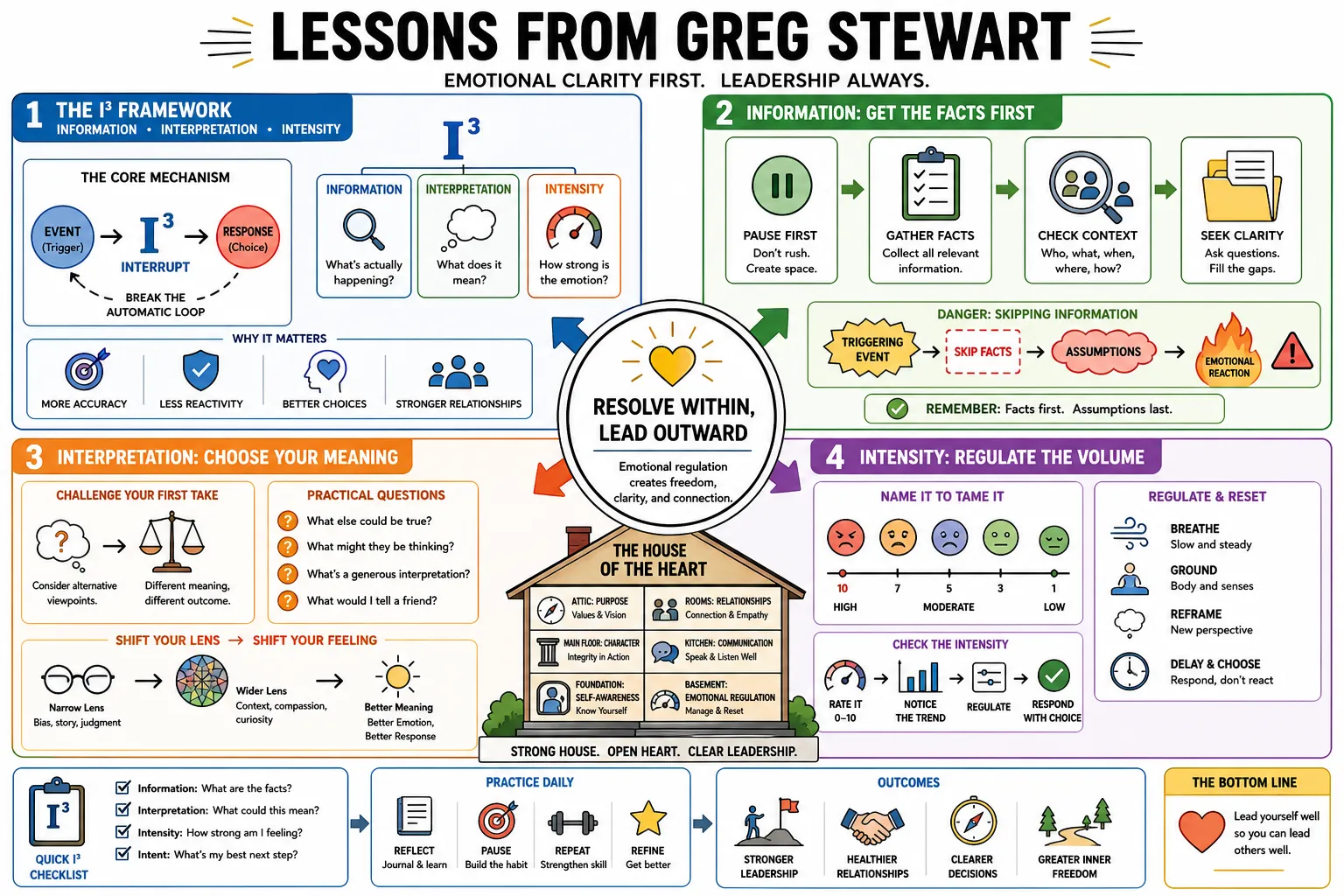
Lessons from Greg Stewart
Clinical counselor and executive coach Greg Stewart developed the I³ framework to help people process negative emotions by breaking them down into information, interpretation, and intensity. His work argues that effective leadership and healthy relationships depend on resolving internal conflicts first. This collection outlines his approach to emotional regulation, including his "House of the Heart" metaphor and the practical mechanics of self-awareness.
Part 1: The I³ Framework: Information, Interpretation, Intensity
- On the core mechanism: "The I³ framework is built on three consecutive pillars: Information, Interpretation, and Intensity, designed to interrupt the automatic loop of emotional reactivity." — Source: [Becoming More Counseling]
- On gathering information: "Before forming an opinion or launching into a reaction, emotional intelligence requires pausing to ensure you have collected all the relevant facts." — Source: [OnlineBookClub]
- On the danger of assumptions: "Jumping straight from a triggering event to an emotional response often means skipping the necessary step of objective information gathering." — Source: [Audible]
- On challenging interpretations: "You must actively consider alternative viewpoints and challenge your default interpretation of an event before allowing it to dictate your feelings." — Source: [OnlineBookClub]
- On the lock system analogy: "Processing emotions is much like navigating a canal lock system; you must move through distinct gates of understanding before the water level (or emotional intensity) can safely shift." — Source: [OnlineBookClub]
- On managing intensity: "The goal of processing an emotion is not to eliminate its intensity, but to choose a response that is measured, constructive, and emotionally intelligent rather than purely reactive." — Source: [Becoming More Counseling]
- On the auto-response: "Our brains are wired for immediate self-protection, meaning our first interpretation of a conflict is rarely the most accurate or helpful one." — Source: [SynerVision Leadership]
- On slowing down: "The space between a stimulus and a reaction is where the I³ process lives; expanding that space is the fundamental practice of emotional regulation." — Source: [Master Leadership]
- On emotional sequencing: "You cannot effectively manage the intensity of your anger or fear until you have first corrected the flawed information or interpretation that fed it." — Source: [Becoming More Counseling]
- On conscious choice: "True emotional intelligence is found in the deliberate choice of how intense feelings are expressed, rather than in their absence." — Source: [OnlineBookClub]
Part 2: The House of the Heart: Architecture of the Self
- On the internal metaphor: "The 'House of the Heart' serves as a framework for understanding how we construct our public personas versus where we hide our deepest insecurities." — Source: [Becoming More Counseling]
- On the front room: "Most professionals spend their entire careers carefully decorating their 'front room', the space where executive presence, strategy, and polished skills are on display for the world." — Source: [Becoming More Counseling]
- On superficial fixes: "Adjusting the furniture in the front room of your life will never solve the structural cracks radiating from the foundation." — Source: [SynerVision Leadership]
- On compartmentalization: "Leaders often attempt to lock the doors to their internal rooms, hoping that unprocessed trauma will not bleed into their public performance." — Source: [Chasing the Insights]
- On emotional floor plans: "Understanding your own emotional architecture is required before you can invite anyone else, a spouse or a colleague, safely into your space." — Source: [Your Partner in Success Radio]
- On neglected spaces: "The rooms we refuse to enter in our own hearts are usually the exact places generating the anxiety and conflict we experience in our daily lives." — Source: [Becoming More Counseling]
- On authentic living: "Authenticity means allowing the condition of your front room to honestly reflect the health of the rest of your house." — Source: [SynerVision Leadership]
- On internal renovations: "Deep coaching and counseling are less about adding new extensions to your skill set and more about doing the hard, messy work of internal renovation." — Source: [Growth Hacking Culture]
- On the cost of hiding: "The energy it takes to keep the doors to your inner rooms deadbolted is energy stolen from your capacity to lead and love." — Source: [Master Leadership]
- On welcoming others: "Vulnerability is the act of opening the front door and allowing someone to see the house as it actually is, dust and all." — Source: [Becoming Bridge Builders]
Part 3: Reframing Negative Emotions
- On the purpose of negativity: "Negative emotions (such as insecurity, fear, worry, and anger) should not be avoided; they are meant to be embraced as catalysts for personal growth." — Source: [SynerVision Leadership]
- On emotion as energy: "Emotion, at its core, is simply energy. The objective is to harness and channel that energy effectively instead of suppressing it." — Source: [AbeBooks]
- On the fear of anger: "Anger is often treated as a toxic force, but when filtered through interpretation, it provides the necessary fuel to overcome difficult obstacles." — Source: [Audible]
- On the illusion of control: "Suppressing a negative emotion does not control it; it merely forces the energy to leak out in passive-aggressive or destructive ways later." — Source: [Master Leadership]
- On emotional avoidance: "We spend vast amounts of time trying to numb or avoid discomfort, completely missing the lessons those exact feelings are trying to deliver." — Source: [Becoming More Counseling]
- On decoding anxiety: "Anxiety is rarely about the future itself; it is usually a signal that we feel unequipped in the present to handle a perceived threat." — Source: [Chasing the Insights]
- On the utility of insecurity: "Insecurity, when acknowledged rather than hidden, points us directly toward the areas where our identity relies too heavily on external validation." — Source: [Growth Hacking Culture]
- On emotional inflation: "Unprocessed negative emotions tend to inflate over time, taking up more space in our psyche until they dictate our behavior entirely." — Source: [Growth Hacking Culture]
- On shifting perspectives: "The shift from seeing negative feelings as enemies to viewing them as instructors is the turning point in emotional maturity." — Source: [Becoming More Counseling]
- On the danger of toxic positivity: "A culture that demands constant positivity forces people to bury the very emotions that are required for deep healing and resilience." — Source: [Your Partner in Success Radio]
Part 4: Internal Mastery for Leaders
- On the origin of influence: "Real influence in any organization begins with internal mastery; you cannot sustainably lead others if you cannot regulate yourself." — Source: [OnlineBookClub]
- On projecting unresolved issues: "Leaders who have not resolved their own internal obstacles will inevitably project those insecurities onto their teams and organizational culture." — Source: [Becoming More Counseling]
- On the illusion of external change: "Changing external circumstances, like switching jobs or restructuring a team, will fail if the leader's internal emotional mechanics remain broken." — Source: [OnlineBookClub]
- On directing anger: "In leadership, the rage of negative emotions can be unleashed against the obstacles preventing growth, rather than directed at the people around you." — Source: [Audible]
- On the executive mask: "The higher you climb in leadership, the heavier the mask becomes, making it increasingly difficult to address the real internal issues driving your decisions." — Source: [Chasing the Insights]
- On emotional blind spots: "A leader's unexamined emotional triggers are the biggest threats to an organization's stability and psychological safety." — Source: [SynerVision Leadership]
- On the burden of leadership: "Leadership requires the emotional fortitude to absorb the anxiety of the system without reflecting it back onto the team." — Source: [Becoming Bridge Builders]
- On authentic authority: "Authority derived from title is brittle; authority derived from emotional groundedness and self-awareness is resilient." — Source: [Master Leadership]
- On inner conflict: "The conflicts a leader refuses to settle within their own mind will eventually manifest as conflicts within their boardroom." — Source: [Becoming More Counseling]
Part 5: Intimacy and Vulnerability in Marriage
- On confronting marital obstacles: "Couples must face their negative emotions together, using the friction of disagreement to build intimacy rather than walls." — Source: [Audible]
- On the root of communication breakdown: "Poor communication in a marriage is rarely a vocabulary problem; it is almost always an interpretation and emotional regulation problem." — Source: [Promote, Profit, Publish]
- On shared emotional spaces: "Intimacy is achieved when both partners feel safe enough to move out of the 'front room' and share the less polished areas of their lives." — Source: [Your Partner in Success Radio]
- On fighting fair: "Using the I³ process during an argument helps couples slow down and ensure they are responding to what was actually said, not what their insecurities assumed was said." — Source: [Becoming More Counseling]
- On mutual vulnerability: "Confronting uncomfortable emotions is a necessary path to authenticity; you cannot have deep connection without risking exposure." — Source: [Your Partner in Success Radio]
- On emotional safety: "A strong marriage functions as a secure container where both individuals can experience high-intensity emotions without the fear of abandonment." — Source: [Promote, Profit, Publish]
- On misdirected anger: "Often, the anger directed at a spouse is actually energy displaced from unresolved personal frustrations that have not been properly interpreted." — Source: [Becoming More Counseling]
- On the habit of assumption: "Assuming you know your partner's intent without gathering the necessary information is the quickest way to manufacture unnecessary conflict." — Source: [Audible]
- On rebuilding trust: "Trust is rebuilt through the consistent, shared practice of accurately interpreting each other's emotional signals over time, rather than through grand gestures." — Source: [Becoming More Counseling]
Part 6: The Smoke Detector Principle
- On the function of alarms: "Negative emotions operate like smoke detectors: they are loud, annoying, and disruptive, but they are signaling that something requires your immediate attention." — Source: [Becoming More Counseling]
- On ignoring the signal: "Taking the batteries out of your internal smoke detector because you dislike the noise does not put out the fire; it just guarantees you will get burned." — Source: [Becoming More Counseling]
- On the nature of the threat: "The smoke detector doesn't tell you how big the fire is, only that there is smoke. It is your job to investigate the source before panicking." — Source: [SynerVision Leadership]
- On false alarms: "Sometimes our emotional alarms are triggered by burnt toast rather than a house fire; applying the I³ framework helps distinguish between a minor irritation and a major emergency." — Source: [Master Leadership]
- On valuable feedback: "Instead of being frustrated by feelings of worry or fear, we should view them as valuable feedback loops providing data about our current environment." — Source: [Becoming More Counseling]
- On immediate investigation: "When the alarm of anxiety sounds, the most ineffective response is to sit still and worry about the noise; the healthiest response is to get up and locate the smoke." — Source: [Chasing the Insights]
- On recalibrating sensitivity: "Therapy and coaching often involve recalibrating your emotional smoke detectors so they stop going off at every minor fluctuation in the room." — Source: [Becoming More Counseling]
- On appreciating the warning: "A properly functioning emotional warning system is a gift that provides the necessary intensity to protect what you value most." — Source: [SynerVision Leadership]
- On systematic responses: "Just as we have evacuation plans for physical fires, we need emotional protocols to follow when our internal alarms are triggered." — Source: [Becoming More Counseling]
Part 7: Exploring the Basement: Identity and Value
- On foundational stability: "True psychological stability requires going down into the 'basement' of your heart to address the core issues of identity, value, and self-worth." — Source: [Becoming More Counseling]
- On hidden drivers: "The behaviors we exhibit in the front room are almost entirely powered by the foundational beliefs quietly operating in the basement." — Source: [Becoming More Counseling]
- On the fear of the dark: "Most people avoid the basement because it is where they store their past traumas, failures, and unexamined shame." — Source: [SynerVision Leadership]
- On defining self-worth: "If your self-worth is tied exclusively to your professional output, your foundation will crack the moment you experience a setback in your career." — Source: [Growth Hacking Culture]
- On structural integrity: "You cannot build a towering career or a lasting marriage on a basement foundation that is rotting from unaddressed insecurity." — Source: [Becoming More Counseling]
- On the source of resilience: "Resilience is not forged in the public victories, but in the quiet, difficult work of cleaning out the basement of your own psyche." — Source: [Master Leadership]
- On reclaiming identity: "Healing requires excavating the false narratives you were handed in the past and replacing them with a sturdy, self-determined sense of value." — Source: [Your Partner in Success Radio]
- On the weight of expectations: "The basement is often cluttered with the heavy, inherited expectations of others; growth requires deciding what to keep and what to throw away." — Source: [Becoming Bridge Builders]
- On foundational peace: "When you know precisely who you are and what you are worth at your core, the chaotic storms happening upstairs lose their power to dismantle you." — Source: [Becoming More Counseling]
Part 8: Proactive Teachability and Continuous Growth
- On the necessity of learning: "Growth stalls the moment you believe you have nothing left to learn about your own emotional mechanics." — Source: [Growth Hacking Culture]
- On proactive teachability: "Proactive teachability means you do not wait for a crisis to expose your flaws; you actively seek out feedback and areas for improvement." — Source: [Growth Hacking Culture]
- On embracing friction: "The most effective leaders invite friction into their lives because they know that being challenged is the only way to refine their interpretations." — Source: [Master Leadership]
- On the ego as an obstacle: "Ego is the enemy of teachability; it convinces you that you already have all the information required, short-circuiting the entire I³ process." — Source: [Chasing the Insights]
- On curiosity over defensiveness: "When confronted with negative feedback, the emotionally intelligent response is to replace defensiveness with genuine, investigative curiosity." — Source: [SynerVision Leadership]
- On the lifelong process: "Emotional regulation and internal mastery are not destinations you arrive at; they are lifelong practices that require daily calibration." — Source: [Becoming More Counseling]
- On the value of coaching: "A good coach or counselor avoids giving you the answers; they simply hand you a flashlight and guide you down the stairs to your own basement." — Source: [Your Partner in Success Radio]
- On the danger of comfort: "Comfort zones are the most dangerous places for personal development; growth requires the willingness to step into the emotionally unknown." — Source: [Promote, Profit, Publish]
- On becoming more: "The ultimate goal of confronting your negative emotions is to systematically remove the barriers preventing you from becoming more." — Source: [Becoming More Counseling]