Guido van Rossum created Python at CWI after finding that C took too long for Amoeba utilities while the Bourne shell lacked the facilities he needed. Python grew from that unofficial project through CWI collaborators and public releases. — History of Python: CWI Years.
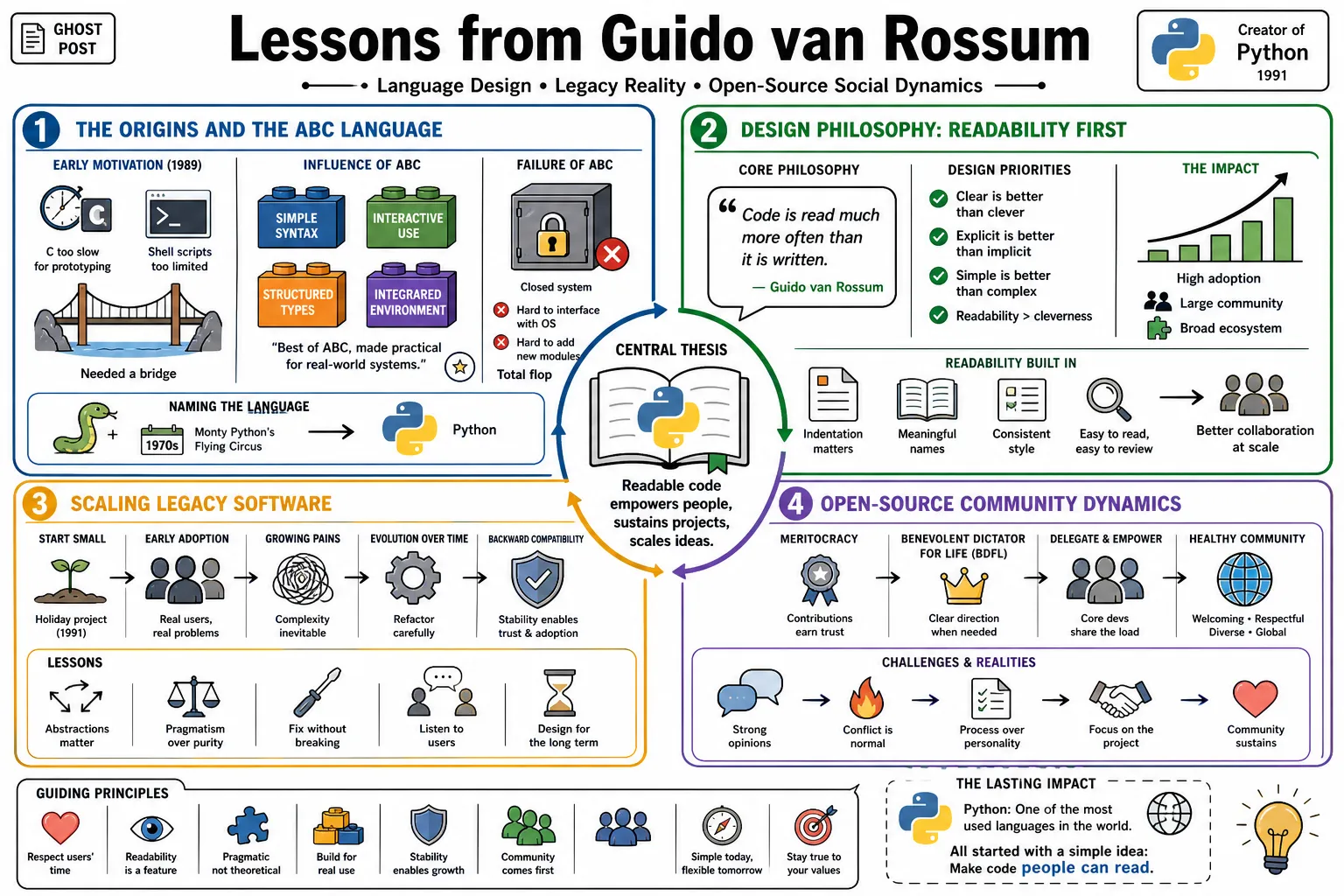
Part 1: The Origins and the ABC Language
- the influence of ABC: Python drew heavily on Guido’s experience implementing ABC, but he deliberately altered ABC’s data types and environment to serve practical systems work. — Early Language Design.
- the failure of ABC: ABC’s integrated, relatively closed environment limited direct access to files, other programs, and user-led extension; Python consciously departed from that model. — Python’s Design Philosophy.
- early motivation: In the Amoeba project, C made administration utilities slow to develop and the Bourne shell could not express its distributed-system operations well, creating a need to bridge the two. — History of Python: CWI Years.
- naming the language: Guido chose the name Python from Monty Python’s Flying Circus, an irreverent choice for what began as a skunkworks project. — History of Python: CWI Years.
- significant whitespace: Python inherited indentation-based block structure from ABC; Guido notes that the idea predates ABC, while ABC’s designers introduced the accompanying colon. — Early Language Design.
- interactive prompts: Guido confirmed that Python’s interactive >>> prompt came from ABC, though he did not know where ABC’s designers got it. — History of Python: CWI Years.
- low expectations: Guido began Python in late December 1989 as an unofficial project to solve a concrete work need, without a dedicated CWI budget. — History of Python: CWI Years.
- pragmatism vs purity: Guido rejected ABC’s push for an isolated, perfected environment and unfamiliar novice terminology, favoring an extensible language that experienced programmers could use with existing systems. — Python’s Design Philosophy.
- the bridging gap: His immediate goal was a higher-level language that bridged the productivity gap between C and the Bourne shell for Amoeba administration utilities. — History of Python: CWI Years.
Part 2: The Core Design Philosophy of Python
- complexity: Guido explicitly favored a useful “good enough” implementation over perfection, while keeping the core portable and allowing multiple levels of extensibility. — Python’s Design Philosophy.
- the purpose of languages: Guido describes programs as instructions for machines that must also be readable to the other people who develop and debug them. — Lex Fridman Podcast #341.
- the one obvious way: Tim Peters’s Zen of Python expresses a preference for one obvious way to do something; Guido reproduced it as an account of the design principles behind Python. — The Zen of Python.
- reducing cognitive load: Readability and simplicity were explicit design concerns for Guido; the Zen articulates one obvious way as a useful ideal, not a guarantee that Python has only one form for each task. — Python’s Design Philosophy.
- error handling: Guido paired recoverable errors with the rule that errors should not pass silently, which led him to use exceptions throughout Python’s implementation. — Python’s Design Philosophy.
- extensibility: Python was designed with multiple levels of extensibility so users could connect it to capabilities beyond the interpreter, including compiled extensions. — Python’s Design Philosophy.
- practicality: Guido’s original design rules permitted pragmatic shortcuts when they yielded a useful implementation that could be improved later. — Python’s Design Philosophy.
- the Zen of Python: Tim Peters wrote the Zen of Python to capture Guido’s largely unstated design principles; Guido explicitly credits Peters rather than claiming authorship. — Python’s Design Philosophy.
- ambiguity: The Zen of Python advises refusing the temptation to guess in the face of ambiguity; it is Tim Peters’s formulation, not a verified verbatim Guido quote. — The Zen of Python.
Part 3: Readability and the "Humanist" Approach
- the primary audience: PEP 8 makes readability central because code is read more often than it is written; this is a Python style-guide principle, not a verified verbatim Guido statement. — PEP 8.
- humanist design: Guido calls software development a social activity and explains why programs must be readable to teammates as well as executable by machines. — Lex Fridman Podcast #341.
- punctuation: Guido wanted punctuation to be used conservatively, broadly in line with written English or familiar algebra rather than ornamental syntax. — Python’s Design Philosophy.
- visual structure: Guido explains that meaningful indentation lets a program’s visual layout reflect its block structure rather than being merely optional formatting. — Lex Fridman Podcast #341.
- language scale: Simplicity and readability were explicit design priorities, but Guido also allowed complexity where real users needed it; “hold the whole language in one’s head” is not an authenticated quotation. — Python’s Design Philosophy.
- the social aspect: Guido describes software as team work, where shared formatting conventions help one programmer understand and improve another’s code. — Lex Fridman Podcast #341.
- naming things: Python’s syntax uses punctuation conservatively; Guido illustrates the rule with familiar algebraic notation and avoiding symbols such as $ for variables. — Python’s Design Philosophy.
- approachability: Python’s relatively low initial bookkeeping makes it easier for beginners to experiment, while retaining the capabilities needed for larger programs. — Lex Fridman Podcast #341.
Part 4: The BDFL and Community Governance
- the BDFL title: Guido describes the BDFL role as his long-standing responsibility for final decisions in Python’s development; the claimed 1995 origin of the title is not established here. — Lex Fridman Podcast #341.
- community driven design: Python grew through early CWI collaborators, public releases, community feedback, and shared maintenance rather than remaining solely Guido’s private project. — History of Python: CWI Years.
- the PEP process: The PEP process documents and discusses substantial Python proposals; PEP 1 credits Barry Warsaw, Jeremy Hylton, David Goodger, and Alyssa Coghlan, so it should not be described as Guido’s sole invention. — PEP 1.
- stepping down: After the contentious PEP 572 debate, Guido resigned as BDFL in 2018, saying he no longer wanted to make final decisions while remaining a core developer and mentor. — Transfer of Power.
- distributed authority: Python adopted an elected steering council after Guido stepped down as BDFL, distributing the final governance responsibility across multiple core developers. — PEP 13.
- the burden of leadership: Guido cited both the strain of divisive PEP decisions and the inevitability that Python would eventually have to govern without him. — Transfer of Power.
- moving forward: On stepping down, Guido told core developers they would be on their own in choosing a governance model and declined to appoint a successor. — Transfer of Power.
- open source politics: The PEP 572 dispute showed Guido how personally charged language decisions could become; he cited others’ hostility toward his decision as a reason to leave the BDFL role. — Transfer of Power.
Part 5: Scaling Python: Types, Performance, and Work
- static typing: Guido says optional type hints are especially useful for organizations maintaining large Python codebases; he does not establish a universal 10,000-line threshold. — Lex Fridman Podcast #341.
- optional typing: PEP 484 explicitly keeps type hints voluntary and Python dynamically typed, allowing projects to adopt static checking without requiring every beginner to annotate code. — PEP 484.
- type checkers: PEP 484 standardizes annotations for offline static analysis, notably mypy, and does not make the Python interpreter enforce the hints at runtime. — PEP 484.
- Dropbox migration: At Dropbox, Guido helped make static typing and mypy practical at large scale; the company’s first-hand account distinguishes this work from its separate Python 2-to-3 migration. — Dropbox Type-Checking History.
- Python 4.0: Guido treats Python 4 as hypothetical: another breaking transition would need a compelling reason and a safer migration process than the long Python 2-to-3 change. — Lex Fridman Podcast #341.
- performance priorities: Guido joined a Microsoft-supported team advancing Faster CPython so that performance work too large for one volunteer could be pursued collaboratively. — Microsoft Faster CPython Interview.
- the GIL: Guido discusses the GIL as a constraint on parallel execution and explores gradual alternatives; a no-GIL transition depends on extension compatibility and cannot be an overnight switch. — Lex Fridman Podcast #341.
- un-retiring: Guido came out of retirement to join Microsoft and work on CPython performance; the source does not establish the claimed travel-plan motivation. — Microsoft Faster CPython Interview.
- corporate backing: Microsoft funded a six-person Faster CPython team, including Guido, to contribute performance improvements to the open-source interpreter. — Microsoft Faster CPython Interview.
- engineering culture: Dropbox’s account of type-checking millions of lines describes an incremental engineering and tooling effort, not a simple switch from “cowboy coding.” — Dropbox Type-Checking History.
Part 6: Software Quality, Bugs, and Ambiguity
- the inevitability of bugs: Guido acknowledges that even good software has bugs and discusses why concurrency increases risk; the cited 10–70-per-1,000 range was supplied by the interviewer and challenged, not asserted by Guido. — Lex Fridman Podcast #341.
- system resilience: Guido observes that large systems often rely on retries and recovery mechanisms because perfect bug-free operation is unrealistic. — Lex Fridman Podcast #6.
- machine ambiguity: Guido distinguishes programming instructions, which need precise interpretation, from natural conversation, where context helps people resolve imprecision. — Lex Fridman Podcast #341.
- the limits of validation: Guido argues that the ideal of proving every large program bug-free has largely given way to practical testing and recovery mechanisms. — Lex Fridman Podcast #6.
- simplicity: Guido placed simplicity among Python’s central design goals and connected understandable behavior with recoverable, visible errors. — Python’s Design Philosophy.
- human error: Guido’s discussion of concurrency stresses that humans struggle to hold multiple interleavings in mind; language and API design must account for that cognitive limit. — Lex Fridman Podcast #341.
Part 7: AI, Software 2.0, and the Future of Programming
- AI coding assistants: Guido says Copilot saves him typing but not much thinking; he cautions against relying on generated code one does not understand. — Lex Fridman Podcast #341.
- Software 2.0: Asked about data-trained “Software 2.0,” Guido distinguishes it from conventional programming and expects different concepts and skills to develop for those systems. — Lex Fridman Podcast #6.
- the glue for machine learning: Guido describes Python as useful around machine-learning systems while performance-sensitive components may run in compiled code. — Lex Fridman Podcast #341.
- code review in the AI era: Guido warns that programmers should not use AI-generated code for tasks they cannot understand; assistance does not remove the need to judge the result. — Lex Fridman Podcast #341.
- the future of the Python language: Guido expects Python to remain useful as layers of software abstraction evolve, though he avoids a categorical prediction about its permanent dominance. — Lex Fridman Podcast #341.
Part 8: Personal Reflections and the Programmer's Life
- human nature: Guido says people have both good and bad potential and that behavior depends greatly on circumstances and context. — Lex Fridman Podcast #6.
- literature's influence: Guido names Willem-Frederik Hermans, whose morally ambiguous WWII fiction he admired as a teenager, while saying literature did not directly influence his technical work much. — Lex Fridman Podcast #6.
- advice for beginners: For beginners, Guido recommends choosing a concrete project they genuinely want to build, because that motivation helps them learn to code. — Lex Fridman Podcast #341.
- career ambition: Python started as a practical tool for Guido’s colleagues at CWI, not as an officially funded effort to create a world-scale language. — History of Python: CWI Years.
- mentorship: After resigning as BDFL, Guido said he would remain available to mentor other core developers; the separate diversity claim is not supported by that message. — Transfer of Power.
- the stress of open source: Guido’s resignation message describes the personal strain of hostile public debate over a language proposal, illustrating a real cost of maintaining a large open-source project. — Transfer of Power.
- legacy: Asked about Python’s long-term future, Guido imagines it becoming a legacy language that quietly underpins later abstractions; the claimed personal quote about lines of code is not verified. — Lex Fridman Podcast #341.