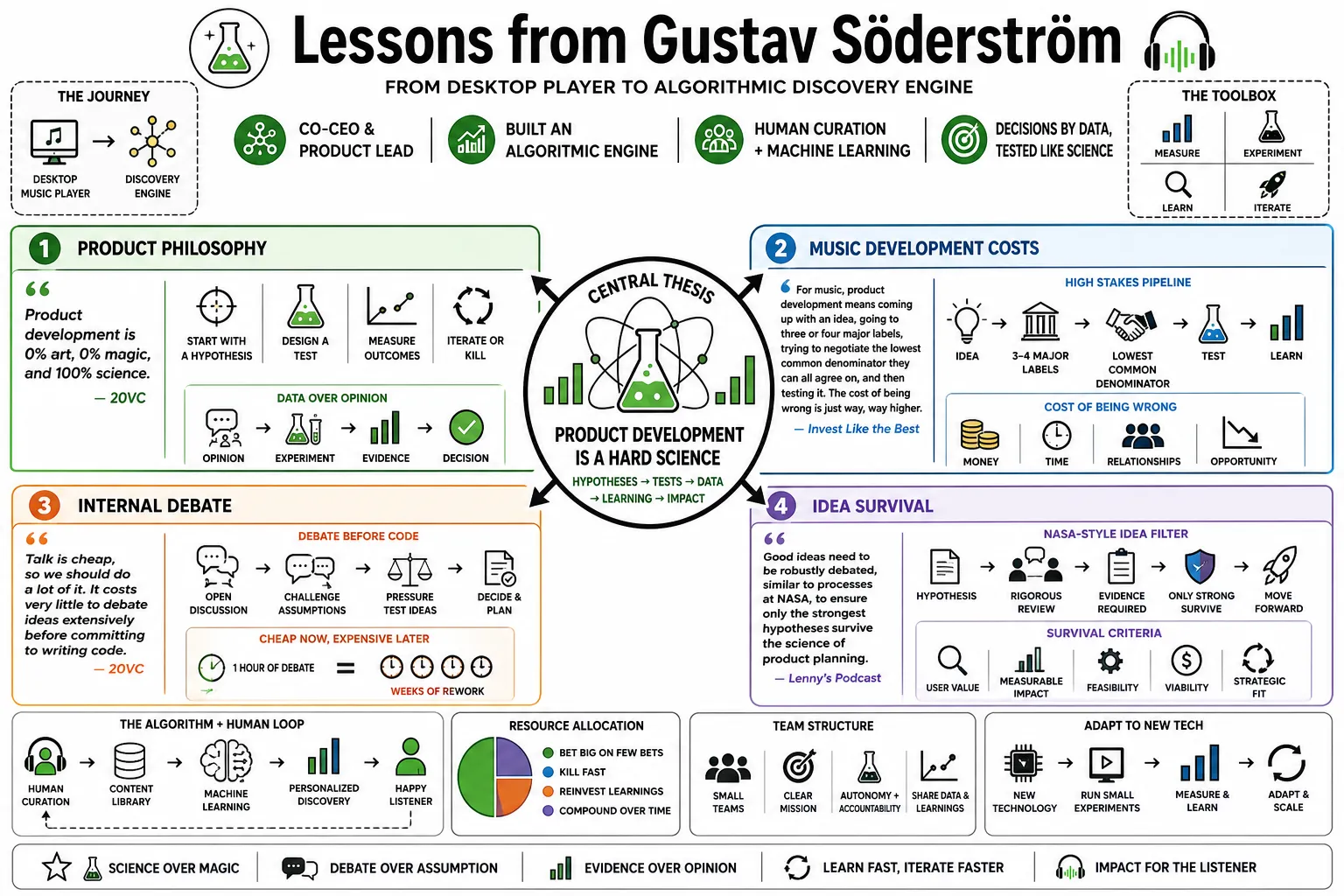
Lessons from Gustav Söderström
As Spotify’s Co-CEO and longtime product lead, Gustav Söderström turned a desktop music player into an algorithmic discovery engine. He approaches product development as a hard science, building an "algotorial" system that mixes human curation with machine learning. This collection details how he allocates resources, structures technical teams, and adapts to new technology.
Part 1: The "Science" of Product
- On Product Philosophy: "Product development is 0% art, 0% magic, and 100% science." — Source: 20VC
- On Music Development Costs: "For music, product development means coming up with an idea, going to three or four major labels, trying to negotiate the lowest common denominator they can all agree on, and then testing it. The cost of being wrong is just way, way higher." — Source: Invest Like the Best
- On Internal Debate: "Talk is cheap, so we should do a lot of it. It costs very little to debate ideas extensively before committing to writing code." — Source: 20VC
- On Idea Survival: Good ideas need to be robustly debated, similar to processes at NASA, to ensure only the strongest hypotheses survive the science of product planning. — Source: Lenny's Podcast
- On Execution Speed: Do not mistake endless debate for progress; once a hypothesis is formed, the priority is to build it, ship it, and tweak it with live data. — Source: Lenny's Podcast
- On Waiting for Data: When data is available, it must guide the decision, but until that point, teams should remain strictly committed to testing their underlying hypothesis. — Source: 20VC
- On User Feedback: Negative feedback is inevitable when scaling, but the scientific approach requires separating loud vocal minorities from actual behavioral data. — Source: Lenny's Podcast
- On Design Magic: What people often label as magic in product design is usually just a mechanism we do not yet fully understand or have the metrics to explain. — Source: 20VC
- On Continuous Learning: The greatest advantage in tech goes to those who accept new information and challenge their existing worldviews quickly instead of clinging to old assumptions. — Source: Spotify: A Product Story
Part 2: Managing Bets and Resource Allocation
- On Prioritization: The bets board stack-ranks all company initiatives so that the entire organization knows exactly what the most important goals are at any given time. — Source: Invest Like the Best
- On Failing Safely: Number one on the priority list should never fail. If failures occur, they should happen from the bottom up, with lower-priority bets failing first. — Source: Spotify: A Product Story
- On Internal Conflict: A transparent stack-ranking system eliminates internal politics because everyone knows exactly what the company is committed to achieving and what trade-offs were made. — Source: 20VC
- On Build vs. Buy: The decision to build versus buy has shifted from an IT cost question to a strategic decision about where to focus internal engineering on customer differentiation. — Source: Spotify: A Product Story
- On The Builder's Trap: Companies frequently waste time trying to build internal tools when they should just buy them, getting distracted from their actual consumer product. — Source: Invest Like the Best
- On Strategy Pitches: Senior leaders must pitch their bets in six-month sprints, defending why their project deserves company resources over another executive's idea. — Source: Lenny's Podcast
- On Focus: A company can only do a few things well simultaneously, meaning you have to aggressively cut good ideas to fund the great ones. — Source: Spotify Investor Day 2026
- On Iterative Funding: We treat new product initiatives like venture investments; we give them a little bit of resources to prove out a hypothesis before scaling up the team. — Source: Lenny's Podcast
- On Sunk Costs: If a bet isn't working after a reasonable testing period, it is systematically shut down and the resources are moved to the next item on the board. — Source: Invest Like the Best
- On Open Source: If an internal tool solves a universal problem but doesn't differentiate your consumer app, you should open-source it to share the maintenance burden. — Source: Spotify: A Product Story
Part 3: Strategy, Competition, and Macro Trends
- On Macro Winds: "Never fight a macro wind." When a massive technological shift occurs, reposition your company so the trend becomes a tailwind rather than a headwind. — Source: 20VC
- On Emulating Competitors: If a startup merely tries to emulate incumbents, they will inevitably just become a lesser version of them. — Source: Invest Like the Best
- On Differentiation: Do the complete opposite of your competition to carve out an entirely new value proposition. — Source: 20VC
- On Ubiquity vs. Walled Gardens: "At the time, every major tech platform was building their own walled garden for audio... We bet the other way. We decided Spotify should work everywhere." — Source: Spotify: A Product Story
- On Hardware Agnosticism: By refusing to lock into a single ecosystem, Spotify Connect turned hardware fragmentation into a distribution advantage. — Source: Decoder
- On Feature Delays: Sometimes you have to delay a fully built feature—like lossless audio—because industry economics shift, making the original strategy unviable. — Source: Decoder
- On Evaluating New Tech: The most important rule in technology leadership is to never let yourself say "I don't need that crap" when a new paradigm emerges. — Source: Invest Like the Best
- On Business Evolution: A tech platform must constantly evolve, acting as an R&D department for the broader industry to turn user behavior into new verticals. — Source: Invest Like the Best
- On Strategic Patience: Sometimes the best strategic move is to wait until a market matures rather than forcing a product into an ecosystem that isn't ready for it. — Source: Lenny's Podcast
Part 4: Artificial Intelligence and Engineering
- On AI in Coding: The most senior engineers have already shifted from writing raw code manually to supervising and steering AI-generated code. — Source: Fast Company
- On Productivity: Generative AI is creating a massive productivity inflection point for internal engineering, completely changing how software is built. — Source: Fast Company
- On Agile Adaptation: We are in the middle of a massive shift; the software tools and architecture you build today might be useless in a month. — Source: Lenny's Podcast
- On Developer Portals: Onboarding engineers used to take 60 days, which forced us to build Backstage to reduce infrastructure chaos and improve autonomy. — Source: Spotify: A Product Story
- On Autonomous Agents: Well-structured internal developer portals provide the necessary component ownership data that allows AI agents to safely perform large-scale codebase changes. — Source: Invest Like the Best
- On LLMs: Instead of just building another large language model, the strategic advantage lies in building a large taste model based on trillions of specific user signals. — Source: Spotify Investor Day 2026
- On Two-Way Interfaces: Generative AI is moving consumer apps from passive consumption feeds to active, two-way conversational interfaces. — Source: Invest Like the Best
- On AI Personas: Features like the AI DJ act as an ambient friend, providing context and personality rather than just a sterile list of algorithmic recommendations. — Source: Decoder
- On The Future of Music Creation: AI will lower the barrier to entry for music creation, shifting the industry focus from technical production skills to pure creative taste. — Source: Lenny's Podcast
- On Infrastructure Maintenance: Tools like Backstage were born from the realization that as companies scale, managing microservices becomes a larger bottleneck than writing product code. — Source: Spotify: A Product Story
Part 5: Music, Podcasts, and Media Evolution
- On The Origins of Streaming: "If you took your files and you stored them in a locker at Google it'd be a streaming service. It's just that in that locker you have all the world's music now for free." — Source: 20VC
- On Podcasting: Moving into podcasts wasn't just about adding a new format; it was a fundamental pivot to transform from a music app into an all-encompassing audio platform. — Source: Spotify: A Product Story
- On Creator Tools: If you want to own the ecosystem, you have to build tools that make it easier for creators to distribute and monetize their work directly on your platform. — Source: Decoder
- On Visual Audio: The introduction of video and TikTok-like feeds wasn't about abandoning audio, but about creating better visual discovery mechanisms for audio content. — Source: Decoder
- On The "Everything App": To remain competitive, single-purpose media apps must inevitably expand into multi-format platforms that bundle various types of content. — Source: Decoder
- On Format Wars: The format itself matters less than the friction it takes to access it; reducing friction is usually the winning product strategy. — Source: Lenny's Podcast
- On Live Audio: Experiments with live audio proved that while synchronous formats generate hype, asynchronous, on-demand consumption is where long-term retention lives. — Source: Invest Like the Best
- On Audiobooks: Adding audiobooks was the logical next step in monetizing attention that was already dedicated to spoken-word content. — Source: Spotify Investor Day 2026
- On The Attention Economy: We are not competing against other music players; we are competing against everything else you could be doing with your eyes and ears. — Source: Decoder
Part 6: Human Curation vs. Algorithms
- On "Algotorial" Curation: The best product experiences combine the intuition of human editors with the personalization scale of machine learning. — Source: Spotify: A Product Story
- On Human Intuition: "Humans are advanced beings. They have much better intuition than machines do... about non-discovered things." — Source: 20VC
- On Machine Scale: While humans can spot a cultural trend before the data exists, machines are required to distribute that trend to millions of users based on individual preferences. — Source: Spotify: A Product Story
- On Editorial Ownership: In a hybrid system, the human editor acts as the product owner who sets the creative hypothesis, while the algorithm executes the delivery. — Source: Invest Like the Best
- On User Agency: "Taste is not fact. It's an option." — Source: Decoder
- On Steering Algorithms: Users must be given tools to actively steer their recommendations, ensuring they don't feel trapped by their past listening history. — Source: Lenny's Podcast
- On Algorithmic Echo Chambers: Purely algorithmic feeds risk narrowing a user's tastes; human curation is necessary to inject serendipity and break the feedback loop. — Source: Spotify: A Product Story
- On Prompted Generation: Using natural language prompts to generate playlists gives users the ultimate editorial control over an AI's output. — Source: Fast Company
- On Metadata: An algorithm is only as good as the metadata feeding it; human classification early on is what trains the system to recognize complex genres. — Source: Invest Like the Best
- On Trusting the Machine: Eventually, you have to let go of manual programming and trust the machine learning models to optimize for long-term user retention. — Source: Lenny's Podcast
Part 7: Engagement, UI, and "Time Well Spent"
- On Empty Calories: "At Spotify, we don't capture people's attention with empty calories. We do it by delivering an experience that people truly value." — Source: Spotify Investor Day 2026
- On Regrettable Time: Many platforms rely on endless scrolling that leaves users feeling empty and regretful, which is an inherently fragile business model. — Source: David Senra Interview
- On Measuring Success: The true measure of product success is not total minutes spent in a single binge session, but how frequently users choose to return day after day. — Source: Spotify Investor Day 2026
- On Earning Loyalty: Users are far more willing to pay for content subscriptions when they perceive the time spent on the app as enriching rather than manipulative. — Source: David Senra Interview
- On Honest Metrics: Companies must be brutally honest with themselves about whether their engagement metrics reflect genuine user value or just dark patterns. — Source: David Senra Interview
- On Interface Design: The interface should get out of the way; if users are focusing on the UI instead of the content, the design has failed. — Source: Decoder
- On Redesign Backlash: Any major UI overhaul will face immediate user backlash; you have to look at the long-term retention data rather than the short-term social media complaints. — Source: Lenny's Podcast
- On Habit Formation: A successful consumer product integrates so seamlessly into a daily routine that using it becomes a subconscious habit rather than a deliberate choice. — Source: Invest Like the Best
- On Visual Density: As platforms add more formats, the challenge becomes managing visual density so the app doesn't feel cluttered or overwhelming to the core user. — Source: Decoder
Part 8: Organization, Autonomy, and Team Dynamics
- On Synchronized Autonomy: To innovate at scale, a company must grant teams the autonomy of a startup while keeping them synchronized toward the same overarching mission. — Source: Lenny's Podcast
- On Squad Structures: While extreme autonomy in small squads works early on, as a company matures, it requires centralized strategy to prevent product fragmentation. — Source: Lenny's Podcast
- On Internal Podcasts: Producing internal podcasts is a highly effective way to transparently communicate strategy from leadership down to individual contributors without corporate jargon. — Source: Lenny's Podcast
- On Co-Leadership: Splitting the CEO role allows one leader to focus entirely on product and technology while the other focuses on business and market expansion. — Source: Fast Company
- On Cross-Functional Teams: Building a cohesive user experience requires deep, synchronized collaboration across product, design, data, and engineering from day one. — Source: Invest Like the Best
- On Talent Retention: Providing engineers with world-class internal tooling is one of the most underrated strategies for employee retention and satisfaction. — Source: Spotify: A Product Story
- On Defining Roles: The product manager's job is not to have the best ideas, but to create a framework where the best ideas can be surfaced and tested. — Source: 20VC
- On Changing Course: A strong leadership team must have the humility to publicly admit when a highly anticipated product bet was wrong and shut it down. — Source: Invest Like the Best
- On Organizational Scaling: The structures that helped you reach 100 employees will actively sabotage you at 10,000; you have to constantly rebuild the company's operating system. — Source: Lenny's Podcast