Guy Kawasaki was the chief evangelist of Apple, where he helped market the original Macintosh computer in 1984. He popularized the concept of technology evangelism, teaching companies how to turn early users into vocal advocates. This profile collects his most useful observations on startups, product design, and communication.
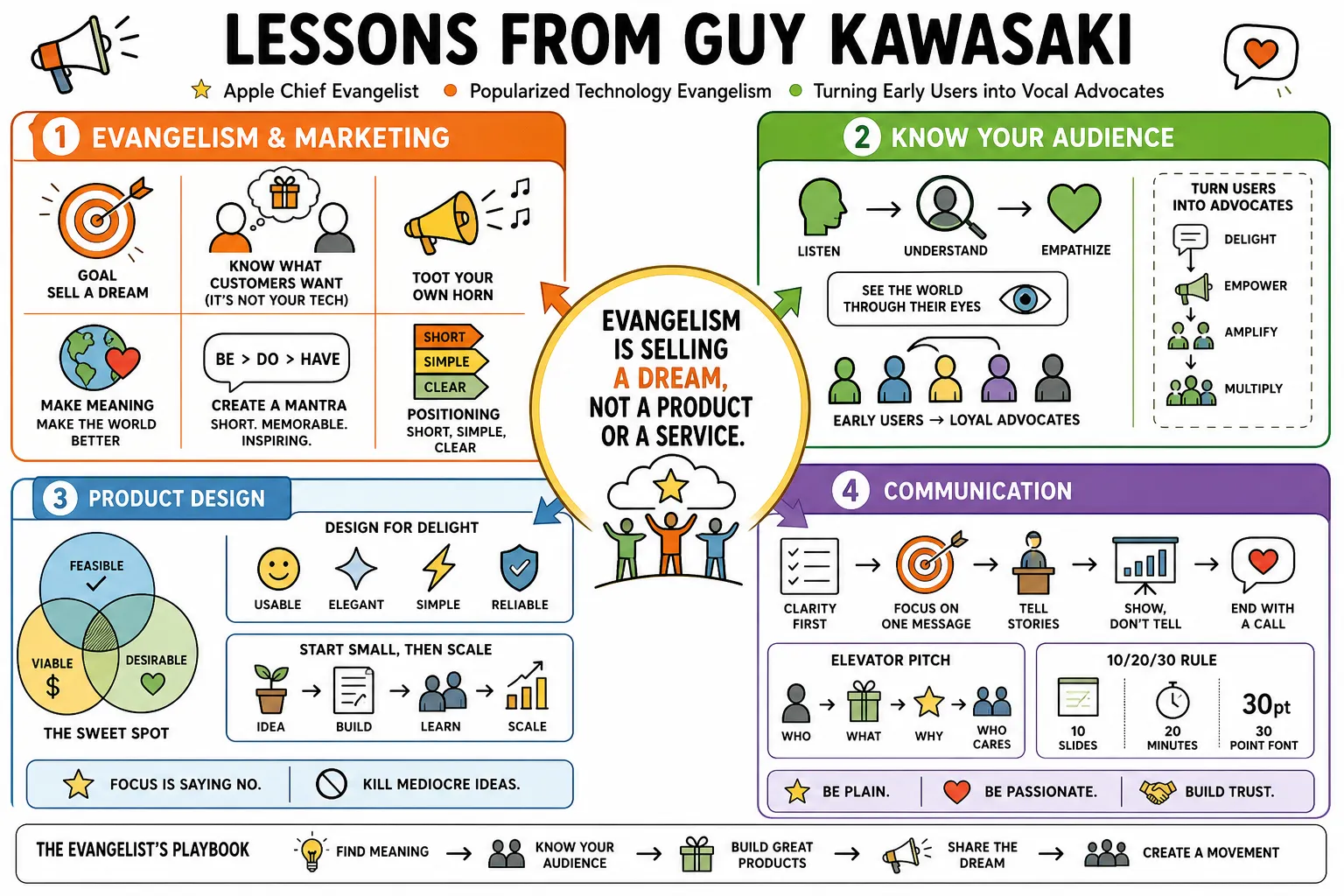
Part 1: Evangelism and Marketing
- On the goal of evangelism: "Evangelism is selling a dream, not a product or a service." — Source: [Selling the Dream]
- On getting the first followers: "To succeed in evangelism, you must understand what your customer wants, and it is usually not your technology." — Source: [Harvard Business Review]
- On self-promotion: "If you don't toot your own horn, don't complain that there's no music." — Source: [Goodreads]
- On making meaning: "The best reason to start an organization is to make meaning; to create a product or service to make the world a better place." — Source: [Forbes]
- On creating a mantra: "Forget mission statements; they are long, boring, and irrelevant. Instead, take your meaning and make a mantra out of it." — Source: [The Art of the Start]
- On positioning: "A good positioning statement is short, simple, and clear." — Source: [Medium]
- On knowing your audience: "Evangelism requires you to understand the other person's best interests." — Source: [Enchantment]
- On storytelling in marketing: "Always tell stories. Use them to illustrate your key points. Stories are ten times more powerful than adjectives." — Source: [Scott D. Clary Podcast]
- On avoiding hype: "Do not use words like revolutionary, innovative, and cool to describe your own product. Let your users decide that." — Source: [Inc. Magazine]
- On customer retention: "It costs five times as much to get a new customer as it does to keep a current one." — Source: [Rules for Revolutionaries]
Part 2: Entrepreneurship and Pitching
- On taking action: "Entrepreneurship is about doing, not learning to do." — Source: [Marina Barayeva]
- On the primary goal: "Entrepreneur is not a job title. It is a state of mind of people who want to alter the future." — Source: [Wise Sayings]
- On first steps: "The hardest thing about getting started, is getting started." — Source: [AZ Quotes]
- On purpose of a pitch: "The purpose of a pitch is to stimulate interest, not to close a deal." — Source: [The Art of the Start]
- On presentations: "Apply the 10/20/30 Rule of PowerPoint: ten slides, twenty minutes, and a thirty-point font." — Source: [Guy Kawasaki Blog]
- On seeking investment: "When you pitch a venture capitalist, you should assume that they are looking for a reason to say no." — Source: [Entrepreneur]
- On business plans: "Write a business plan only because investors expect it, not because it will accurately predict the future." — Source: [Fast Company]
- On prototyping: "A prototype is worth a thousand business plans." — Source: [The Art of the Start 2.0]
- On early sales: "Sales fix everything. If you have sales, investors will forgive all your other mistakes." — Source: [TechCrunch]
- On execution over ideas: "Ideas are easy. Implementation is hard." — Source: [Stanford eCorner]
Part 3: Innovation and Product Design
- On customer feedback limitations: "Your current customers cannot tell you how to innovate. They cannot tell you about the next curve." — Source: [Forbes]
- On jumping curves: "True innovation happens when you jump to the next curve, not when you improve the current one by ten percent." — Source: [Rules for Revolutionaries]
- On early versions: "Don't worry, be crappy. The first version of a revolutionary product is always flawed." — Source: [TEDx]
- On product quality: "Good enough is good enough. There is time for refinement later. It is not how great you start, it is how great you end up." — Source: [Goodreads]
- On focusing the product: "Do not try to be all things to all people. Be something great for a specific group of people." — Source: [LinkedIn Pulse]
- On building what you want: "Often, the best products are built because the founders wanted them for themselves." — Source: [Y Combinator]
- On simplicity: "Design your product so that your mother could use it without calling you for help." — Source: [Macworld]
- On iterating products: "Churn, baby, churn. Innovation is a process of continuous iteration and fixing." — Source: [The Art of the Start]
- On niching down: "Find a niche and dominate it. Then expand." — Source: [Harvard Business Review]
- On breaking conventions: "Revolutionary products often break the rules of the existing industry." — Source: [Rules for Revolutionaries]
Part 4: Enchantment and Influence
- On defining enchantment: "Enchantment is the purest form of sales. It is all about changing people's hearts, minds and actions." — Source: [AZ Quotes]
- On intent: "The difference between enchantment and simple sales is that with enchantment you have the other person's best interests at heart, too." — Source: [Inc. Magazine]
- On first impressions: "If you want to make a good first impression, smile at people. What does it cost to smile? Nothing." — Source: [Enchantment]
- On building trust: "Trust is built over time through competence and character." — Source: [Psychology Today]
- On reciprocity: "Be a baker, not an eater. The universe has a way of rewarding generosity when you do not expect a return." — Source: [Guy Kawasaki Blog]
- On active listening: "Listen to people. It proves that you value them and their opinions." — Source: [Remarkable People]
- On shared passions: "Pursuing your passions makes you more interesting, and interesting people are enchanting." — Source: [Goodreads]
- On conceding mistakes: "Admitting your mistakes quickly and gracefully is a powerful way to enchant people." — Source: [Medium]
- On being visible: "Remember that you are influencing people who are watching you, even when you do not realize it." — Source: [Goodreads]
Part 5: Leadership and Management
- On hiring: "A players hire A players. B players hire C players, and C players hire D players. Always hire people who are better than you." — Source: [Forbes]
- On trusting the team: "Micromanagement is a clear sign that you hired the wrong people." — Source: [The Art of the Start]
- On managing expectations: "Under-promise and over-deliver. It is the easiest way to keep everyone happy." — Source: [Harvard Business Review]
- On leading by example: "Never ask an employee to do something you would not be willing to do yourself." — Source: [Inc. Magazine]
- On making decisions: "Better to fail at doing the right thing than to succeed at doing the wrong thing." — Source: [AZ Quotes]
- On handling layoffs: "If you have to lay people off, do it quickly and with deep respect." — Source: [TechCrunch]
- On fostering culture: "Culture is not what you write down; it is what your employees do when you are not in the room." — Source: [Entrepreneur]
- On performance reviews: "Provide feedback immediately. Waiting for an annual review to correct a problem is a failure of leadership." — Source: [Fast Company]
- On celebrating wins: "Celebrate the small victories. It keeps the team motivated for the long haul." — Source: [Stanford eCorner]
Part 6: Social Media and Communication
- On the purpose of social media: "Social media is not about driving traffic; it is about building relationships." — Source: [Social Media Examiner]
- On professional presence: "Act as if every social media profile is your professional profile." — Source: [Attorney at Work]
- On frequency of posting: "If you aren't annoying someone with your frequency of posting, you aren't posting enough." — Source: [Buffer]
- On sharing value: "Provide value first. If you constantly pitch your product without providing value, people will tune you out." — Source: [Content Marketing Institute]
- On responding to critics: "Ignore the haters. Engaging with trolls only amplifies their message." — Source: [Medium]
- On visual content: "Always include a picture or video with your posts. Text alone is no longer enough to capture attention." — Source: [Canva]
- On email etiquette: "Keep your emails to five sentences or less. Everyone is busy." — Source: [Guy Kawasaki Blog]
- On speaking clearly: "Use plain English. Jargon only confuses people and makes you look insecure." — Source: [Toastmasters]
- On repeating the message: "You have to repeat your message until you are sick of hearing it yourself." — Source: [Rules for Revolutionaries]
Part 7: Career and Personal Growth
- On finding passion: "People don't find passions; they develop them. It is rarely love at first sight." — Source: [Coaching for Leaders]
- On becoming indispensable: "Do the work nobody else wants to do. That is how you make yourself indispensable." — Source: [Think Remarkable]
- On broad skillsets: "Entrepreneurship is a marathon combined with a decathlon, you have to do a lot of things well for a long time." — Source: [Wise Guy]
- On changing paths: "The most powerful sign is that your work no longer enchants you. When this happens, it may be time to look for new challenges." — Source: [QuoteFancy]
- On continuing education: "Read constantly. The more you read, the more connections you can make between disparate ideas." — Source: [Remarkable People]
- On mentors: "Find someone who will tell you the truth, even when it hurts." — Source: [LinkedIn]
- On seeking diversity: "Actively seek out different perspectives because they make you better." — Source: [Apple Podcasts]
- On facing rejection: "Rejection is just data. It tells you what does not work so you can try something else." — Source: [Forbes]
- On avoiding complacency: "Success is a lousy teacher. It makes you think you can do no wrong." — Source: [Harvard Business Review]
Part 8: Life Lessons and Resilience
- On regression to the mean: "Don't get cocky when things are good, or too negative when things are bad. Life regresses to the mean." — Source: [Wise Guy]
- On legacy: "Your legacy is not the money you made, but the lives you touched and the people you helped." — Source: [Real Leaders]
- On family: "Document your family history while you still can. Time is undefeated." — Source: [Psychology Today]
- On starting small: "You do not have to save the world on day one. Start by asking simple questions that scratch an itch." — Source: [Substack]
- On taking a stand: "It is better to have some people hate you and some people love you than for everyone to just tolerate you." — Source: [Medium]
- On controlling your reaction: "You cannot control what happens to you, but you can control how you react to it." — Source: [Kara Goldin Podcast]
- On humility: "Always be nice to people on the way up, because you will meet them on the way down." — Source: [Inc. Magazine]
- On true grit: "Resilience means not getting knocked out when you take a hit." — Source: [Remarkable People]
- On the ultimate goal: "At the end of your life, the only thing that will matter is whether you made a positive difference." — Source: [Wise Guy]