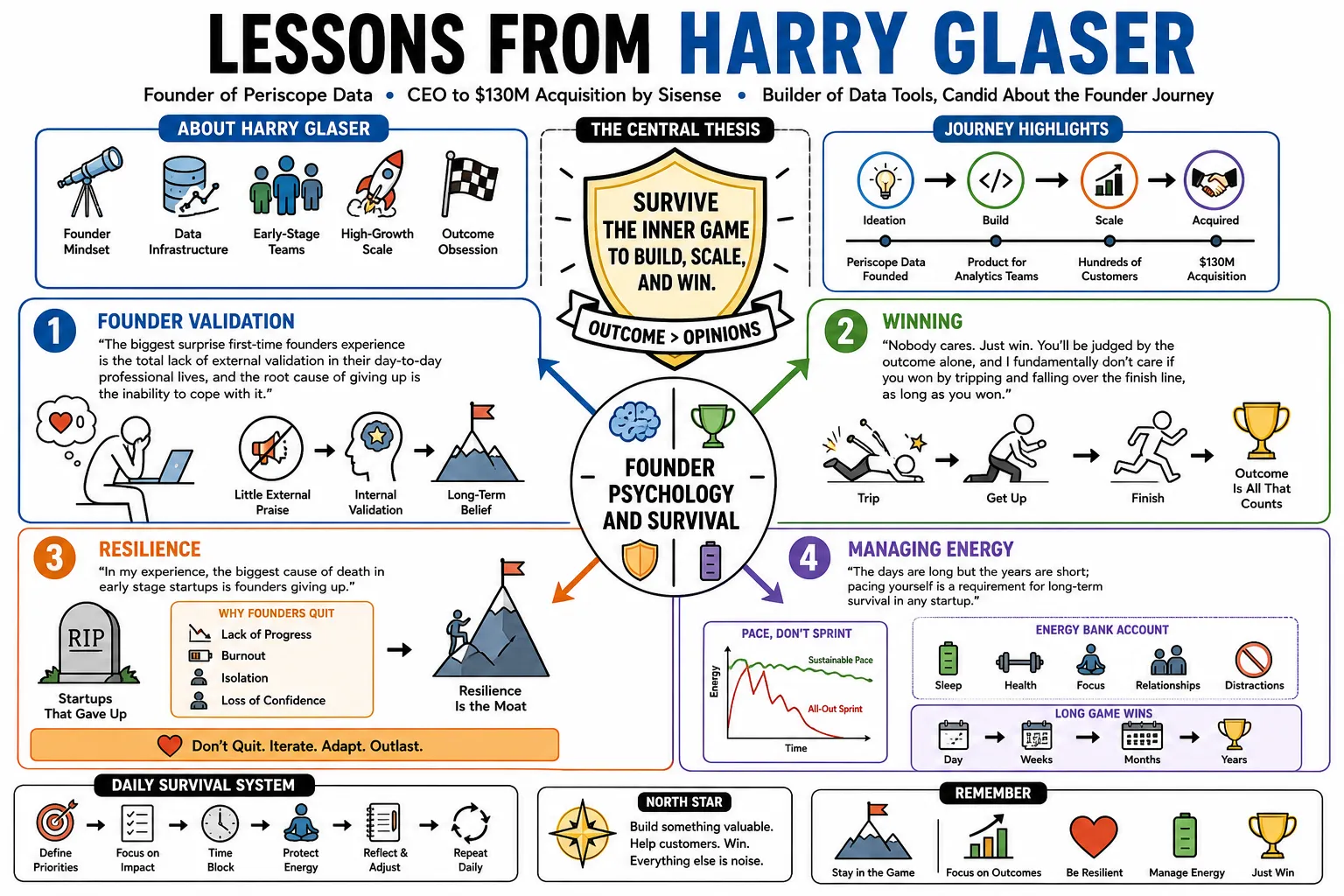
Lessons from Harry Glaser
Harry Glaser is the co-founder and CEO of Kitewing, an AI agent for business data analysis. He previously co-founded and led Periscope Data, an analytics-as-code company acquired by Sisense. His writing and interviews cover the realities of founding, building teams, data infrastructure, acquisitions and technology choices. — Harry Glaser About Page.
Part 1: Founder Psychology and Survival
- On Founder Validation: A first-time founder loses the routine external validation of a job; Glaser says that absence can make persistence harder. — Keep Going.
- On Winning: Glaser argues founders are ultimately judged on results, so they sometimes need to make unpopular decisions they believe are right. — The Days Are Long but the Years Are Short.
- On Resilience: In Glaser's experience, early startups often end because their founders give up before the business has conclusively run out of money. — Keep Going.
- On Managing Energy: To recover from burnout, Glaser recommends finding small daily routines that restore joy in the work rather than relying on a vacation to fix it. — The Days Are Long but the Years Are Short.
- On a Growth Slowdown: When growth slows, Glaser warns that a series of tactical fixes may conceal eroding product–market fit; the company needs to confront the deeper problem. — When the Growth Slows.
- On Founder Involvement: Glaser says founders can collaborate deep in a team when they bring relevant expertise, maintain high standards and engage consistently rather than intervene sporadically. — On Founder Mode.
- On Handling Rejection: Glaser recalls roughly 70 investor pitches for Periscope's first financing and says founders need the grit to endure many noes. — YFS Magazine Interview.
- On Delegating Without Losing Ground Truth: Glaser says founders should delegate routine work as they scale but keep sampling code, sales calls and support to retain an independent view of the product and customer. — Keep Coding.
- On Delegating Decisions: Glaser tries to give leaders the authority, information and relationships to decide for themselves instead of drawing every decision back to the CEO. — AiThority Interview.
- On Self-Worth During Slow Growth: Glaser urges founders to separate personal worth from their company's growth rate and restore healthy habits while fixing the business. — When the Growth Slows.
Part 2: Hiring and Team Building
- On Hiring Executives: Glaser prefers leaders who have stayed through a long run, lived with consequences and handled setbacks, rather than hiring for an impressive résumé alone. — Hire Leaders With a 5+ Year Run.
- On the Early Team: Glaser says the first 10–20 hires can shape a self-reinforcing culture; he learned to build an inclusive environment early rather than relying on demographics alone. — Project Include Q&A.
- On Moving On from a Bad Fit: When a senior leader's departure is decided, Glaser recommends announcing it promptly, establishing interim leadership and taking time over the replacement. — How to Build and Run Your Exec Team.
- On Cofounder Trust: Glaser advises starting with someone you trust deeply enough to disagree, recover from conflict and stay committed through setbacks. — You and Your Co-Founder.
- On Executive Interviews: Glaser uses interviews to test whether he can work with a candidate and whether they can reason through messy decisions, then checks the track record separately. — Hire Leaders With a 5+ Year Run.
- On Running Managers: Glaser's executive team reviews forecasts and roadmap delivery together each week so leaders own company-wide outcomes, not only their departments. — How to Build and Run Your Exec Team.
- On Internal and External Leaders: Glaser favors a mix of internally promoted up-and-comers and externally hired veterans whose experience can balance their energy and judgment. — How to Build and Run Your Exec Team.
- On Reference Checks: Glaser recommends extensive backchannel references and listening for a pattern of only lightly positive comments rather than conducting calls after a hiring decision is effectively made. — Hire Leaders With a 5+ Year Run.
Part 3: Data Analytics and Infrastructure
- On Data Access: Glaser described Periscope as a shared platform where analysts, data scientists and engineers could work together to give stakeholders a fuller picture of the business. — Sramana Mitra Interview.
- On SQL for Analysts: Periscope made complex SQL run fast enough to build business-intelligence dashboards in minutes; Glaser treated direct SQL work as part of the product's strength. — The Most Important Function at the Company.
- On the Modern Data Stack: Glaser describes a workflow that starts with notebook experiments, then moves mature models into Git-backed retraining, testing and deployment. — SuperDataScience Transcript.
- On Actionable Analysis: Glaser's Flexport example shows analysts building a rerouting recommendation in hours for an urgent operational decision, not merely producing a static report. — Sramana Mitra Interview.
- On Knowing the Numbers: Glaser says founders and sales leaders should understand key metrics and their calculations deeply enough to question performance directly. — On Founder Mode.
- On Speed of Analysis: In Glaser's Flexport example, a data team had to analyze new routing options by noon after a morning port-strike alert; timeliness mattered to the decision. — Sramana Mitra Interview.
- On Unifying Data Workflows: Glaser described Periscope as a platform that brought analysts, scientists and engineers into one workflow to give internal stakeholders a fuller business picture. — Sramana Mitra Interview.
- On Curated Self-Service: Glaser described letting business users explore data sets curated by analysts, giving them more control without requiring them to write SQL themselves. — TechTarget Interview.
Part 4: Sales and Go-to-Market Strategy
- On Training Nontechnical Sales Teams: Glaser discussed how Periscope built institutional training for nontechnical staff selling a technical analytics product. — SaaStr Podcast 030.
- On Founder-Led Sales: Glaser says that concentrating only on product is a mistake for technical founders; he learned to sell Periscope himself after technical content brought in leads. — YFS Magazine Interview.
- On Sales-Engineering Talent: At Periscope, Glaser says a technical customer-solutions team became a career path into sales engineering, analytics and product roles. — The Most Important Function at the Company.
- On Choosing a Market Segment: After Periscope's startup segment became saturated, Glaser refocused the team on larger customers who still valued the product and could sustain a different sales approach. — When the Growth Slows.
Part 5: Diversity, Inclusion, and Culture
- On Inclusion First: Glaser says he initially focused too much on demographics and learned that building inclusive values and culture helped attract a more diverse team. — Project Include Q&A.
- On Diversity in the Hiring Funnel: Glaser describes examining top-of-funnel sourcing and asking recruiters for a diverse candidate pool instead of relying only on applicants who volunteered. — Project Include Q&A.
- On the Value of Different Perspectives: Glaser says a diverse team can catch language and product issues that a homogeneous team misses, improving the experience for a wider set of customers. — Project Include Q&A.
- On Reducing Bias in Language: Glaser says Periscope revised hiring and marketing copy after a tool flagged language that could discourage applicants from different backgrounds. — Project Include Q&A.
- On Transparency During a Slowdown: Glaser recommends telling employees plainly when growth has slowed, why it matters and what the company must change to regain footing. — When the Growth Slows.
- On Making Inclusion a Value: Glaser advises CEOs to state publicly that people from different backgrounds should feel welcome and to bring the whole leadership team behind that goal. — Project Include Q&A.
Part 6: Acquisitions and M&A
- On the Emotional Reality of Selling: Glaser describes an acquisition as a difficult transition with both celebrations and losses for employees, and a different kind of stress for founders afterward. — What I Learned Selling My Company.
- On Acquisition Integration Risk: Glaser warns founders to imagine a buyer mishandling the business and alienating employees before deciding an offer is better than staying independent. — What I Learned Selling My Company.
- On Post-Deal Integration: Glaser says even a lucrative acquisition can be followed by failed integration, employee churn or missed targets; those risks belong in the sale decision. — What I Learned Selling My Company.
- On Deal Uncertainty: Glaser cautions that acquisition offers are infrequent and signed letters of intent may not close, so founders must keep running the business through the process. — What I Learned Selling My Company.
- On Life After an Acquisition: Glaser says watching an acquirer take control can create a new kind of stress, and the founder may face years of hard work to secure an outcome for the team. — What I Learned Selling My Company.
- On Communicating a Deal: Glaser advises limiting knowledge of an acquisition process before signing a letter of intent, then recognizing that employees will have different reactions when the deal is announced. — What I Learned Selling My Company.
- On What Outlasts an Exit: Glaser says the relationships with former teammates matter more to him now than the memorabilia he kept from Periscope's acquisition. — The Days Are Long but the Years Are Short.
Part 7: AI, Machine Learning, and Engineering
- On Practical AI Work: Glaser now leads Kitewing, which he describes as an AI agent that performs business data analysis and data-science work for customers. — Harry Glaser About Page.
- On the Conscience of AI: In an AWS session description, Glaser argued that data teams should challenge potentially harmful outcomes from ML classification and prediction. — AWS re:Invent Session Guide.
- On Model Deployment: Glaser identifies the handoff from a data scientist's notebook to production software as a bottleneck and describes automating packaging, version control, tests and serving. — SuperDataScience Transcript.
- On Technical Debt Before Product–Market Fit: Glaser argues that some technical debt follows necessary early speed, while building for scale before customers arrive can prevent learning fast enough. — The Mistakes We Make the Second Time.
- On Reducing MLOps Friction: Glaser describes Modelbit's approach of packaging notebook code, dependencies and environment for production deployment so data scientists need less manual ML-engineering work. — SuperDataScience Transcript.
- On Governed Data Agents: Kitewing's current product is an enterprise data-analysis agent with governed connectors, test prompts, audits and traceable data lineage. — Kitewing Product.
- On Early Engineering Speed: Glaser says moving quickly to find product–market fit can justify technical debt; premature scale architecture can be the bigger risk. — The Mistakes We Make the Second Time.
- On Where to Innovate: Glaser advises founders to concentrate organizational innovation on their core product and business rather than inventing novel structures and processes everywhere. — How to Build and Run Your Exec Team.
- On Monitoring Models: Glaser says production teams should log model inputs and outputs so they can investigate changing inferences and possible drift later. — SuperDataScience Transcript.
Part 8: Philosophy of Technology and Work
- On Escaping Ecosystem Lock-In: Glaser criticizes ecosystems that make people accept inferior bundled tools and describes returning to a personally chosen, interoperable set of devices and applications. — Our Relationship to Technology Is Broken.
- On Avoiding Premature Complexity: Glaser warns against building microservices or distributed databases for a scale a startup has not reached; such over-engineering can slow the search for customers. — The Mistakes We Make the Second Time.
- On Focusing During a Slowdown: When Periscope's growth stalled, Glaser focused the team on the customer segment still working and rebuilt the sales approach around it. — When the Growth Slows.
- On Tools Serving Users: Glaser argues people should choose tools for their own needs and retain the freedom to replace parts of a stack rather than accept a vendor's ecosystem by default. — Our Relationship to Technology Is Broken.