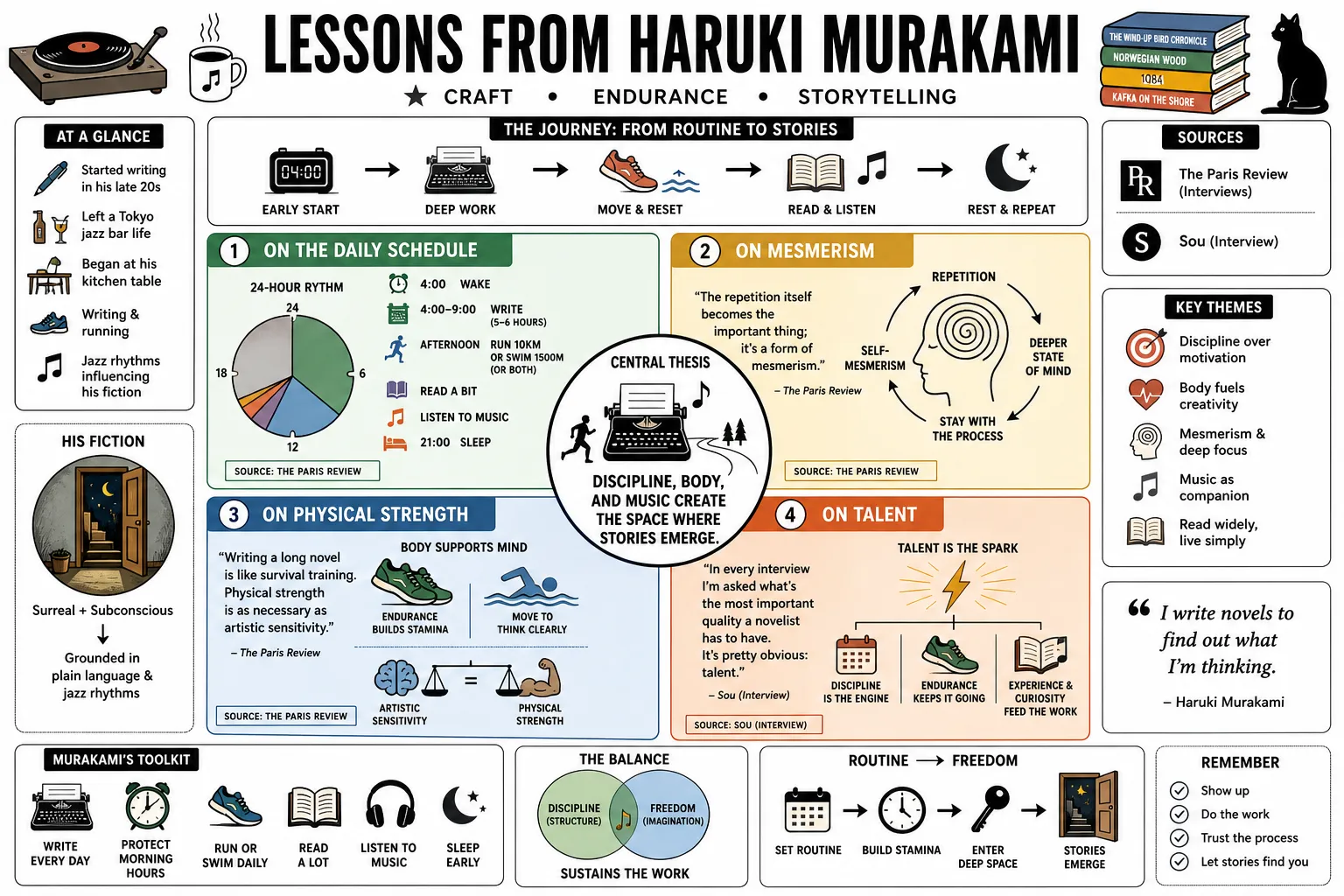
Lessons from Haruki Murakami
Haruki Murakami began writing at his kitchen table in his late twenties, trading a Tokyo jazz bar for a strict routine of writing and marathon running. His fiction grounds the surreal and the subconscious in plain language and jazz rhythms. This profile gathers his thoughts on craft, endurance, and storytelling.
Part 1: Writing Process and Routine
- On the daily schedule: "When I'm in writing mode for a novel, I get up at four a.m. and work for five to six hours. In the afternoon, I run for ten kilometers or swim for fifteen hundred meters (or do both), then I read a bit and listen to some music. I go to bed at nine p.m. I keep to this routine every day without variation." — Source: The Paris Review
- On mesmerism: "The repetition itself becomes the important thing; it's a form of mesmerism. I mesmerize myself to reach a deeper state of mind." — Source: The Paris Review
- On physical strength: "Writing a long novel is like survival training. Physical strength is as necessary as artistic sensitivity." — Source: The Paris Review
- On talent: "In every interview I'm asked what's the most important quality a novelist has to have. It's pretty obvious: talent." — Source: What I Talk About When I Talk About Running
- On focus: "If I'm asked what the next most important quality is for a novelist, that's easy too: focus—the ability to concentrate all your limited talents on whatever's critical at the moment." — Source: What I Talk About When I Talk About Running
- On endurance: "After focus, the next most important thing for a novelist is, hands down, endurance. If you concentrate on writing three or four hours a day and feel tired after a week of this, you're not going to be able to write a long work." — Source: What I Talk About When I Talk About Running
- On the chisel metaphor: "I have to pound away at a rock with a chisel and dig out a deep hole before I can locate the source of my creativity." — Source: The Paris Review
- On pulling the story out: "A story, a monogatari, is not something you create. It is something that you pull out of yourself. The story is already there, inside you." — Source: The New Yorker
- On drafting: "The first draft is messy; I have to revise and revise. Four or five drafts." — Source: The Paris Review
- On having nothing to say: "I have a strong desire to write but nothing to say. By stripping away what I do not want to write, the actual story begins to emerge." — Source: Novelist as a Vocation
Part 2: Endurance and Running
- On the essence of running: "Exerting yourself to the fullest within your individual limits: that’s the essence of running, and a metaphor for life." — Source: What I Talk About When I Talk About Running
- On elevating oneself: "Running is both exercise and a metaphor. Running day after day, piling up the races, bit by bit I raise the bar, and by clearing each level I elevate myself." — Source: What I Talk About When I Talk About Running
- On the real opponent: "In long-distance running the only opponent you have to beat is yourself, the way you used to be." — Source: What I Talk About When I Talk About Running
- On meditation: "No matter how mundane some action might appear, keep at it long enough and it becomes a contemplative, even meditative act." — Source: What I Talk About When I Talk About Running
- On acquiring a void: "I'm often asked what I think about as I run. Usually the people who ask this have never run long distances themselves... I just run. I run in a void. Or maybe I should put it the other way: I run in order to acquire a void." — Source: What I Talk About When I Talk About Running
- On motivation: "I have only a few reasons to keep on running, and a truckload of them to quit. All I can do is keep those few reasons nicely polished." — Source: What I Talk About When I Talk About Running
- On solitude: "I’m the kind of person who likes to be by himself. To put a finger point on it, I’m the type of person who doesn’t find it painful to be alone. I find spending an hour or two every day running alone... to be neither difficult nor boring." — Source: What I Talk About When I Talk About Running
- On starting late: "Thirty-three—that’s how old I was then. Still young enough, though no longer a young man... That was the age when I began my life as a runner, and it was my belated, but real, starting point as a novelist." — Source: What I Talk About When I Talk About Running
- On maintaining a body: "You have to keep your body in good shape. Because your mind is contained in your body. If your body is unhealthy, your mind becomes unhealthy." — Source: The New York Times
- On pain and suffering: "Pain is inevitable. Suffering is optional. Say you’re running and you think, 'Man, this hurts, I can’t take it anymore.' The 'hurt' part is an unavoidable reality, but whether or not you can stand anymore is up to the runner himself." — Source: What I Talk About When I Talk About Running
Part 3: Jazz, Music, and Rhythm
- On learning from music: "I've never learned how to write from anyone. If you ask me where I learned to write, my answer is music." — Source: The Paris Review
- On the necessity of rhythm: "Whether in music or in fiction, the most basic thing is rhythm. Your style needs to have good, natural, steady rhythm, or people won't keep reading your work. I learned the importance of rhythm from music — and mainly from jazz." — Source: The New York Times
- On melody in prose: "Next comes melody — which, in literature, means the appropriate arrangement of the words to match the rhythm. If the way the words fit the rhythm is smooth and beautiful, you can't ask for anything more." — Source: The New York Times
- On internal harmony: "Next is harmony — the internal mental sounds that support the words. Then comes the part I like best: free improvisation. Through some special channel, the story comes welling out freely from inside." — Source: The New York Times
- On transferring music to writing: "I wondered if it might be possible for me to transfer that music into writing. That was how my style got started." — Source: The New York Times
- On closing his jazz bar: "I closed my own jazz bar so I could be a man who can write novels as I like. I was pleased about that. This pleasure was connected to the pleasure of writing." — Source: Novelist as a Vocation
- On record collecting: "I collect records. And cats. I don’t have any cats right now. But if I’m taking a walk and I see a cat, I’m happy." — Source: The Paris Review
- On structure: "I construct my books like a musical score. You introduce a theme, then you introduce a secondary theme, and then you try to weave them together." — Source: The Paris Review
- On keeping pace: "When I write, I listen to music. The tempo of the music determines the tempo of my sentences. I prefer jazz because of its strong rhythm and its improvisational freedom." — Source: The Guardian
Part 4: Dreams and the Subconscious
- On intentional dreaming: "For me, writing a novel is like having a dream. Writing a novel lets me intentionally dream while I’m still awake. I can continue yesterday’s dream today, something you can’t normally do in everyday life." — Source: Novelist as a Vocation
- On descending into consciousness: "It’s also a way of descending deep into my own consciousness. While I am awake, I can go down into a dark place, the basement of my mind." — Source: The Paris Review
- On the two worlds: "There are two worlds, the real world and the world of dreams. The difference is that writers can return to the same dream daily and live it awake." — Source: The New Yorker
- On waking up: "I dream. Sometimes I think that’s the only right thing to do. To dream, to live in the world of dreams. But it doesn’t last forever. Wakefulness always comes to take me back." — Source: Sputnik Sweetheart
- On reality and the subconscious: "And maybe, in the dreams we have every night, the opposite happens: 80% are dreams (the subconscious creating a dream world), and 20% are realities (an actual reality or dimension in a certain spiritual way)." — Source: 1Q84
- On cats as metaphors: "There’re all sorts of cats—just like there’re all sorts of people. Some are fiercely independent, others are deeply reliant, and some are just passing through." — Source: Kafka on the Shore
- On magical realism: "I don't think of my work as magical realism. I just write about the world as I experience it, and sometimes the boundary between what is real and what is not feels very thin." — Source: The Guardian
- On the dark basement: "I can open the door and enter that darkness in the basement of the soul, but I have to be very careful. I can find my story there. Then I bring that thing to the surface, into the real world." — Source: Novelist as a Vocation
- On surrealism as truth: "I use surreal elements not to escape reality, but to reach a deeper layer of emotional truth that logical explanations simply cannot access." — Source: The Paris Review
Part 5: Individuality vs. The System
- On the egg and the wall: "Between a high, solid wall and an egg that breaks against it, I will always stand on the side of the egg." — Source: Jerusalem Prize Acceptance Speech
- On the meaning of the wall: "The wall is 'The System'—bureaucracy, the military, the nation-state. It is supposed to protect us, but sometimes it takes on a life of its own and begins to kill us, and cause us to kill others." — Source: Jerusalem Prize Acceptance Speech
- On the meaning of the egg: "Each of us is an egg. Each of us is a unique, irreplaceable soul enclosed in a fragile shell." — Source: Jerusalem Prize Acceptance Speech
- On humanizing individuals: "The purpose of a story is to shed light on the unique soul of the individual, to keep the System from reducing us to mere statistics." — Source: Jerusalem Prize Acceptance Speech
- On intellectual independence: "If you only read the books that everyone else is reading, you can only think what everyone else is thinking." — Source: Norwegian Wood
- On detachment: "I have always kept a certain distance from the Japanese literary establishment. I prefer to remain an outsider, writing at my own pace, on my own terms." — Source: The Paris Review
- On political statements: "A novelist's primary job is not to offer political statements, but to create a space where readers can explore the ambiguities and contradictions of their own humanity." — Source: The New Yorker
- On societal pressure: "In a society that demands conformity, simply maintaining your own internal rhythm and living by your own rules is a profound act of resistance." — Source: Novelist as a Vocation
- On hope: "We have no hope of winning against the wall. It's too high, too dark, too cold. But if we have any hope of victory at all, it will have to come from our believing in the utter uniqueness and irreplaceability of our own and others' souls." — Source: Jerusalem Prize Acceptance Speech
Part 6: Language and Translation
- On discovering his style: "Ultimately, I learned that there was no need to try and impress people with beautiful turns of phrase... Why not forget all of these prescriptive ideas about 'the novel' and 'literature' and set down your feelings and thoughts as they come to you, freely?" — Source: Novelist as a Vocation
- On writing in English first: "I wrote the first chapter of Hear the Wind Sing in English. My vocabulary was limited, but because it was limited, I had to express complex thoughts in short, simple sentences. That limitation became the foundation of my style." — Source: The Paris Review
- On translating it back: "When I translated those simple English sentences back into Japanese, a new kind of Japanese emerged. It was my own language, distinct from traditional Japanese literature." — Source: The Paris Review
- On plain language: "The key component is not the quality of the materials—what's needed is magic. If that magic is present, the most basic daily matters and the plainest language can be turned into a device of surprising sophistication." — Source: Novelist as a Vocation
- On trusting the translator: "I don't interfere with my translators. I trust them completely. Translation is like playing a piece of music; the translator is the performer, interpreting the notes on the page." — Source: The Guardian
- On rewriting: "When I read my books in English translation, it feels like I am reading a new book. The story is the same, but the texture has changed. I enjoy experiencing my own work through a different linguistic filter." — Source: The Paris Review
- On Dostoevsky and Chandler: "My ideal was to put Dostoevsky and Chandler together in one book. To write a story that moves with the pace of a detective novel but contains the psychological depth of Russian literature." — Source: The Paris Review
- On avoiding pretension: "I have never wanted to write difficult books. My goal is to write sentences that any ordinary person can understand, but which carry a weight that requires deep reflection." — Source: Novelist as a Vocation
- On communication: "What is originality, after all, but the shape that results from the natural impulse to communicate to others that feeling of freedom, that unconstrained joy?" — Source: Novelist as a Vocation
Part 7: Memory, Aging, and Time
- On the nature of memories: "Memories and thoughts age, just as people do. But certain thoughts can never age, and certain memories can never fade." — Source: The Wind-Up Bird Chronicle
- On permanence: "No matter how much time passes, no matter what takes place in the interim, there are some things we can never assign to oblivion, memories we can never rub away." — Source: Kafka on the Shore
- On the library of the mind: "Inside our heads... there’s a little room where we store those memories. A room like the stacks in this library... To understand the workings of our own heart we have to keep on making new reference cards." — Source: Kafka on the Shore
- On memory as fuel: "You know what I think? That people's memories are maybe the fuel they burn to stay alive. Whether those memories have any actual importance or not, it doesn't matter as far as the maintenance of life is concerned." — Source: After Dark
- On losing things: "Once you pass a certain age, life becomes nothing more than a process of continual loss. Things that are important to your life begin to slip out of your grasp, one after another." — Source: 1Q84
- On weathering the storm: "And once the storm is over, you won’t remember how you made it through... When you come out of the storm, you won’t be the same person who walked in." — Source: Kafka on the Shore
- On getting older: "Growing old is not so hard if you keep yourself receptive to learning anything about anything." — Source: Dance Dance Dance
- On physical decline: "And one of the privileges given to those who’ve avoided dying young is the blessed right to grow old. The honor of physical decline is yours." — Source: Dance Dance Dance
- On the shifting past: "As time passes, memory, inevitably, reconstitutes itself. We remember what we need to remember and alter what is too painful to bear." — Source: The New Yorker
- On fading recall: "The sad truth is that what I could recall in five seconds all too needed ten, then thirty, then a full minute—like shadows lengthening at dusk." — Source: Norwegian Wood
Part 8: The Novelist's Role and the Reader
- On sharing dreams: "Dreaming is the day job of novelists, but sharing our dreams is a still more important task for us. We cannot be novelists without this sense of sharing something." — Source: Novelist as a Vocation
- On the writer-reader pipeline: "Over a long period of time I think I've constructed a system whereby readers and myself are connected by a stout pipeline that allows us to communicate... What's needed most there is a natural, spontaneous sense of trust between author and readers." — Source: Novelist as a Vocation
- On bypassing the industry: "This is a system in which the media and literary industry aren't needed much as an intermediary. The direct connection to the individual reader is what matters." — Source: Novelist as a Vocation
- On opening a window: "I would like my readers to savor that same emotion when they read my books. I want to open a window in their souls and let the fresh air in. This is what I think of, and hope for, as I write." — Source: Novelist as a Vocation
- On searching for pieces: "Anyone who falls in love is searching for the missing pieces of themselves. The same is true for reading a novel; readers look for the parts of their own soul they cannot articulate." — Source: Kafka on the Shore
- On surviving as a writer: "It's not that difficult to write a novel, maybe even two. But it's another thing altogether to keep producing, to live off one's writing, to survive in the long term." — Source: Novelist as a Vocation
- On magical baptism: "A real story requires a kind of magical baptism to link the world on this side with the world on the other side. The novelist is the one who initiates this ritual." — Source: Novelist as a Vocation
- On loneliness and connection: "Why do people have to be this lonely? What’s the point of it all? Millions of people in this world, all of them yearning... yet isolating themselves. A novel exists to bridge that gap in the dark." — Source: Sputnik Sweetheart
- On the ultimate goal: "I don't have a message for the world. My only goal is to tell a good story. If a reader closes my book and feels slightly shifted from where they started, I have done my job." — Source: The Paris Review