Henrik Karlsson is a Swedish essayist who writes Escaping Flatland about relationships, learning and agency. He describes a specific public essay as a search query that can help a writer meet people interested in the same questions. — Escaping Flatland — Search Query.
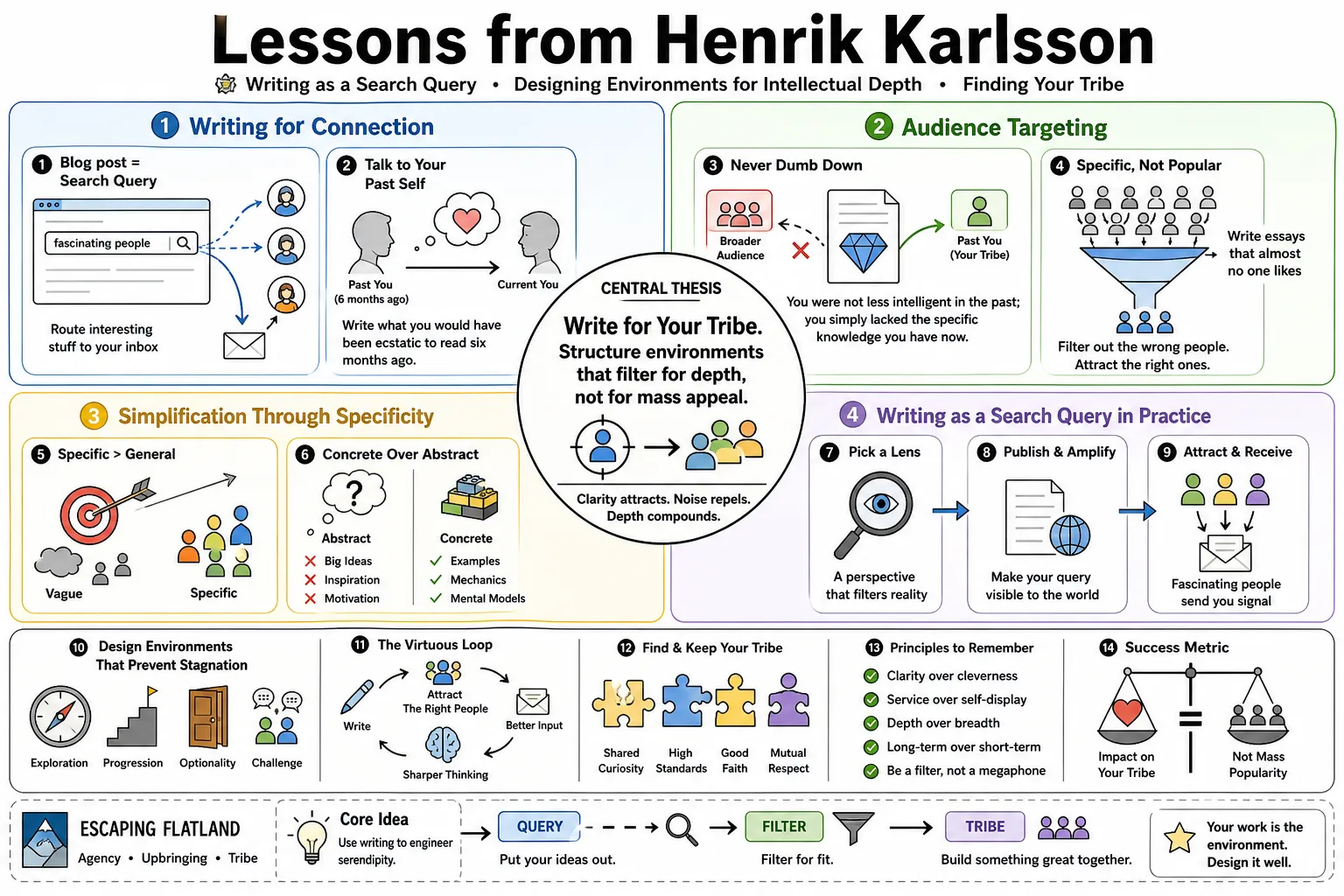
Part 1: Writing as a Search Query
- On Writing for Connection: A specific public essay can work as a social search query: it makes the writer legible to people who care about the same unusual questions. — Escaping Flatland — Search Query.
- On Audience Targeting: Karlsson suggests writing something his earlier self would have been excited to read, using that remembered curiosity to identify an audience. — Escaping Flatland — Search Query.
- On Simplification: Clarity matters, but stripping every obscure reference can remove the details that help compatible readers recognize the writer. — Escaping Flatland — Search Query.
- On Specificity over Mass Appeal: A subject can matter deeply to a small audience even when it has little mass appeal; online scale makes that audience worth addressing. — Escaping Flatland — Search Query.
- On Upward Aim: Karlsson writes toward demanding readers whose interests he hopes to share rather than flattening an essay for the broadest possible audience. — Escaping Flatland — Search Query.
- On Digital Discovery: Publishing specific interests online gives distant readers a chance to discover a writer they might never meet locally. — Escaping Flatland — Search Query.
- On Removing Friction: An odd example or tangent may be the detail that tells a particular reader this writer is worth knowing; edit for clarity without automatically deleting it. — Escaping Flatland — Search Query.
- On the Mechanics of Luck: Writing publicly creates opportunities for unexpected readers to make contact, although the writer cannot predict who will respond. — Escaping Flatland — Search Query.
- On Personal Growth: The people Karlsson met through writing changed the conversations around him and, over time, influenced what he learned and became. — Escaping Flatland — Search Query.
- On Information Flow: Once readers understood his interests, some sent Karlsson books, links and observations that helped him continue his inquiries. — Escaping Flatland — Search Query.
Part 2: The Architecture of Exceptional Childhoods
- On Historical Geniuses: In Karlsson’s selected sample of 42 exceptional biographies, at least two-thirds had substantial home education; the pattern is exploratory, not a causal proof. — Escaping Flatland — Childhoods of Exceptional People.
- On Adult Integration: Many people in Karlsson’s sample spent significant childhood time around capable adults and their work rather than only age-segregated peer groups. — Escaping Flatland — Childhoods of Exceptional People.
- On Cognitive Apprenticeship: Some children in the biographies learned by observing and participating in adults’ meaningful work, alongside more formal instruction. — Escaping Flatland — Childhoods of Exceptional People.
- On One-on-One Tutoring: Individual tutors could adapt instruction to the child’s interests and pace; Karlsson treats that attention as a recurring feature of his sample. — Escaping Flatland — Childhoods of Exceptional People.
- On the Absence of Distraction: Unscheduled time appears in several biographies, but some isolation was painful; Karlsson’s examples do not make deprivation a general prescription. — Escaping Flatland — Childhoods of Exceptional People.
- On Intense Obsessions: Self-directed stretches gave some children room to pursue unusually deep interests before their path had been fixed for them. — Escaping Flatland — Childhoods of Exceptional People.
- On Being Taken Seriously: Adults in several cases engaged children’s questions and work seriously, giving them access to demanding conversations. — Escaping Flatland — Childhoods of Exceptional People.
- On Natural Ability: Karlsson recognizes striking natural differences in some cases while also emphasizing environment; his selected biographies cannot isolate either contribution. — Escaping Flatland — Childhoods of Exceptional People.
- On Replicability: The practical opportunity is to offer children more individualized attention, meaningful adult work and self-directed time—not to assume one childhood formula guarantees excellence. — Escaping Flatland — Childhoods of Exceptional People.
- On Enforced Boredom: Karlsson later clarified that he means reducing external stimulation so quieter curiosity has room to emerge, not forcing children to feel bored. — Dialectic — Henrik Karlsson, Part 2.
Part 3: Intellectual Loneliness and Finding Your Tribe
- On Isolation: Karlsson’s niche interests were difficult to share locally; public writing helped him make those interests visible to distant readers. — Escaping Flatland — Search Query.
- On the False Remedy of Crowds: Finding compatible company is not only a matter of meeting strangers: Karlsson discovered he had misread a familiar friend for years. — Escaping Flatland — Friends We Miss.
- On Shared Context: An essay can show a reader how the writer thinks before they meet, making a subsequent conversation more specific from the start. — Escaping Flatland — Search Query.
- On Mutual Recognition: A person need not have read the same obscure books to be worth knowing; Karlsson advises looking again at the character of people already nearby. — Escaping Flatland — Friends We Miss.
- On the Internet's Promise: Online publication can connect someone with a small, geographically scattered audience for interests that are hard to discuss locally. — Escaping Flatland — Search Query.
- On Sustaining Connections: The people and ideas flowing into a social graph shape it over time; Karlsson treats those exchanges as something one can cultivate deliberately. — Escaping Flatland — Social Graph.
Part 4: Redefining Relationships and Dating
- On Rejecting Checklists: A predetermined partner checklist can hide what is distinctive about an actual person; Karlsson suggests attending to the individual first. — Escaping Flatland — Looking for Alice.
- On 'Not Dating': Karlsson recommends approaching a person with genuine curiosity before deciding what category the relationship must fit. — Escaping Flatland — Looking for Alice.
- On Gertrude Stein's Lesson: Karlsson uses the Stein–Alice anecdote to illustrate a simple point: affection for a particular person need not begin with a category. — Escaping Flatland — Looking for Alice.
- On Deep Conversation: His relationship with Johanna grew in part through conversations that generated new thoughts rather than merely confirming a checklist. — Escaping Flatland — Looking for Alice.
- On Shared Curiosity: The partners Karlsson describes built a shared world through sustained attention and conversation, without needing identical interests in every respect. — Escaping Flatland — Relationships Are Coevolutionary Loops.
- On Organic Development: Karlsson describes a relationship finding a shape fitted to the people in it through ongoing adjustment rather than a fixed template. — Escaping Flatland — Relationships Are Coevolutionary Loops.
- On Mutual Shaping: He calls relationships coevolutionary loops: partners’ questions, habits and choices alter each other over time. — Escaping Flatland — Relationships Are Coevolutionary Loops.
- On the Inadequacy of Apps: Watching a friend use Tinder, Karlsson saw a series of filters that could make it easy to miss a person’s less legible qualities; he presents this as an illustrative case, not a study of all apps. — Escaping Flatland — Seeing People Clearly.
Part 5: The Mechanics of Reading and Learning
- On Reading as Endurance: Karlsson treats reading demanding work as a skill built gradually, much as endurance develops through sustained practice. — Escaping Flatland — How I Read.
- On the Comfort Zone: He advises starting at a sustainable reading difficulty and gradually extending capacity instead of burning out on an unprepared leap. — Escaping Flatland — How I Read.
- On Citation Trees: Following an admired author’s references can reveal the books and ideas that shaped that author’s work. — Escaping Flatland — How I Read.
- On Scraping Training Data: Karlsson compares reading and observing excellent work to collecting training data for the mind: examples alter the patterns one can recognize and produce. — Escaping Flatland — Training Data for Your Mind.
- On Syntopical Reading: He reads several books around a live question, including works that disagree, to compare models rather than inherit one account unexamined. — Escaping Flatland — How I Read.
- On Abandoning Books: Karlsson samples far more books than he finishes and drops many when they are not useful for the question he is pursuing. — Escaping Flatland — How I Read.
- On Active Reading: Notes, marginal responses and reflection help him turn a book into an active exchange rather than a stream consumed once. — Escaping Flatland — How I Read.
- On Rereading: Karlsson says Anna Karenina felt difficult at 17 but reads more easily to him now because his background and capacity changed; a reader can change what a book yields. — Dialectic — Henrik Karlsson, Part 2.
- On Following Curiosity: He begins reading from questions he genuinely wants answered, then lets those questions guide which books he opens next. — Escaping Flatland — How I Read.
Part 6: Cultivating Agency and Independence
- On Defining Agency: Karlsson and Johanna define agency as both autonomy in choosing ends and efficacy in acting toward them; their essay uses this as a specific working definition. — Escaping Flatland — On Agency.
- On the Danger of Scripts: Inherited plans can be useful, but Karlsson and Johanna urge inspecting the real problem before accepting a familiar solution as mandatory. — Escaping Flatland — On Agency.
- On Building Intuition: Karlsson describes attending to what his own experience and values reveal, then testing that perception against the world rather than simply adopting a crowd’s judgment. — Dialectic — Henrik Karlsson Interview.
- On Taking Ideas Seriously: A fragile, initially confusing idea may need patient attention before public evaluation; the Karlssons describe creating space for that inquiry. — Escaping Flatland — Where New Ideas Are Born.
- On Environmental Design: Karlsson treats his information milieu as something he can shape: whom he reads and talks with changes what becomes salient to him. — Escaping Flatland — Social Graph.
- On Rejecting False Constraints: Exploring new options can reveal that an inherited mental model is wrong; Karlsson recommends stating assumptions and testing them against reality. — Escaping Flatland — Think More About What to Focus On.
- On the Role of the Subconscious: He describes keeping a writing question active while doing low-demand tasks, allowing ideas to continue developing below conscious attention. — Escaping Flatland — Think More About What to Focus On.
- On Financial Independence: Karlsson and Johanna used frugality and a deliberately fitted life to make more room for their relationship, children and curiosity; this is their choice, not a general investment rule. — Escaping Flatland — Relationships Are Coevolutionary Loops.
- On Small Bets: Small experiments and fast feedback have worked well for Karlsson, though he later clarified that a carefully validated long-term vision can work too. — Henrik Karlsson — Unfolding Correction.
Part 7: Escaping Flatland and Inner Life
- On the Metaphor of Flatland: For Karlsson, Flatland names a narrow sense of what life can be; encounters with different people and ideas can enlarge it, while ordinary life may still remain valuable. — Dialectic — Henrik Karlsson Interview.
- On Expanding Reality: He recalls people whose ways of living expanded his own sense of possibility rather than merely giving him new facts. — Dialectic — Henrik Karlsson Interview.
- On Noticing Anomalies: The Karlssons describe staying with a confusing question long enough to notice what a quick, familiar explanation misses. — Escaping Flatland — Where New Ideas Are Born.
- On Private Notebooks: Karlsson values private notebooks for showing a thinker’s unfinished, uncensored intermediate thoughts, before they harden into public arguments. — Escaping Flatland — Private Notebooks.
- On Inner Quiet: Reducing external stimulation can give quieter, self-generated curiosity more room to surface, as Karlsson explains in his later interview. — Dialectic — Henrik Karlsson, Part 2.
- On Cultivating Taste: Choosing one’s informational and social influences helps shape what one notices and values; Karlsson presents this as a directed milieu, not an infallible compass. — Escaping Flatland — Social Graph.
- On Art and Poetry: Karlsson says ambiguous art can demand the viewer’s contribution and bring them back into contact with their own thoughts. — Dialectic — Henrik Karlsson, Part 2.
Part 8: The Role of Boredom and Solitude
- On the Utility of Boredom: Karlsson later preferred “understimulation” to boredom: after external rewards recede, attention may turn toward self-generated curiosity and nearby details. — Dialectic — Henrik Karlsson, Part 2.
- On Constant Entertainment: He worries that continuous external stimulation can crowd out quieter interests before they have time to develop. — Dialectic — Henrik Karlsson, Part 2.
- On Solitude as a Skill: The Karlssons distinguish physical isolation from the mental room needed to stay with a fragile idea; some solitude can help, but it is not a universal prerequisite. — Escaping Flatland — Where New Ideas Are Born.
- On Sitting with Hard Problems: Their account values staying with an unresolved question instead of rushing to a neat answer; insight is not guaranteed by a fixed number of silent hours. — Escaping Flatland — Where New Ideas Are Born.
- On Withdrawal: Karlsson sometimes steps back from his social-information graph to regain perspective on which influences he wants to keep. — Escaping Flatland — Social Graph.
- On Designing Friction: Karlsson deliberately avoids a smartphone and other unwanted inputs to protect attention for priorities he values. — Dialectic — Henrik Karlsson Interview.