Henrique Dubugras built Pagar.me in Brazil as a teenager, dropped out of Stanford after less than a year, and co-founded Brex, a fintech company that reimagined corporate credit for startups. Known for his candid views on founder psychology, talent density, and the necessity of owning the technical stack, he challenges the traditional Silicon Valley playbook with a focus on deep vertical integration and high-agency culture. This collection synthesizes his perspectives on scaling businesses, navigating rapid growth, and the personal evolution required to lead them.
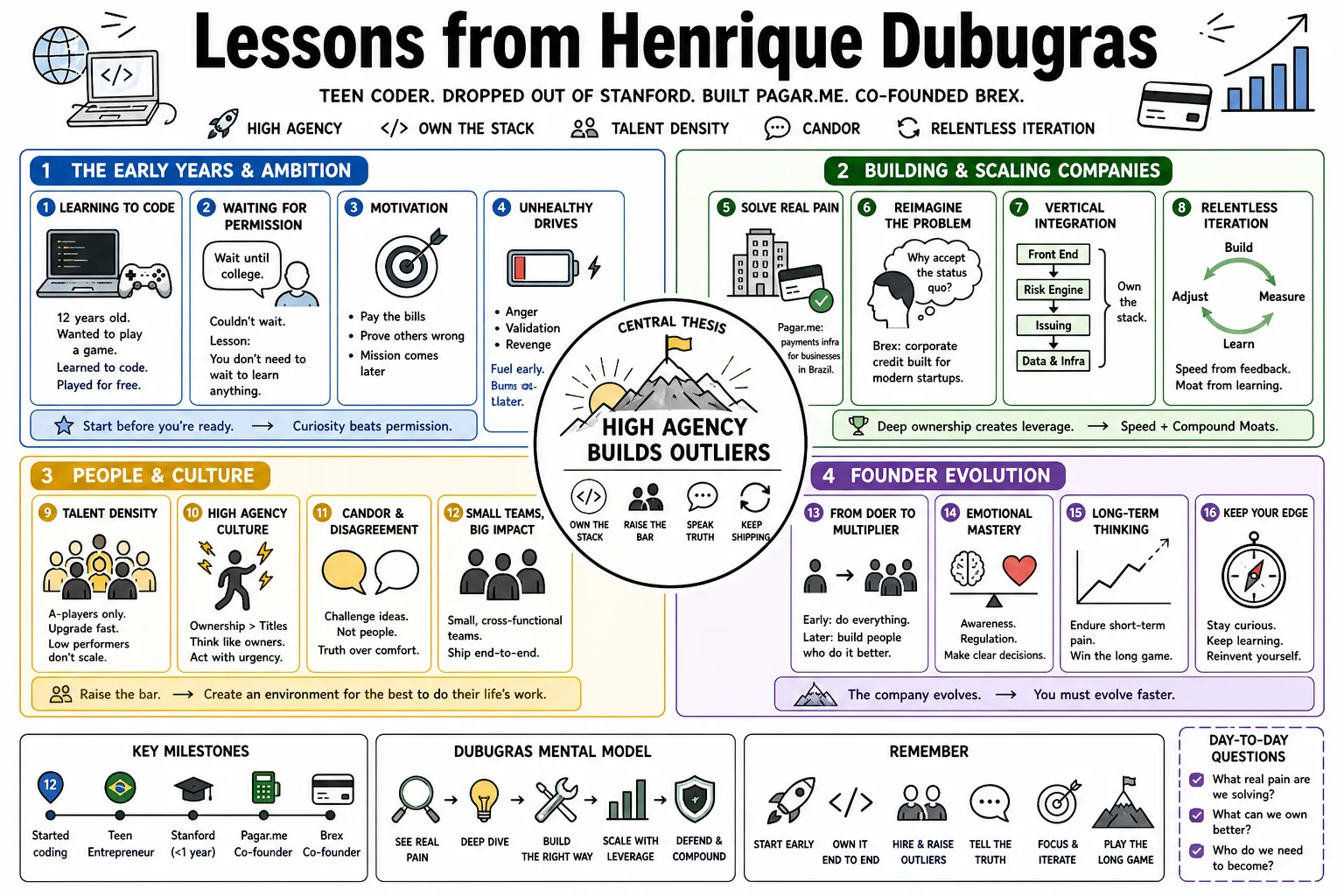
Part 1: The Early Years & Ambition
- On Learning to Code: "I started coding when I was 12 because there was this game I wanted to play... I figured out that if I learn how to code, I could play for free." — Source: [Thirty Minute Mentors]
- On Waiting for Permission: "My dad told me I had to wait until college to learn, but I couldn't wait that long. The lesson is: you don't need to wait to learn anything." — Source: [Thirty Minute Mentors]
- On Motivation: He acknowledges that being strictly "mission-driven" from day one is over-glamorized; sometimes the initial motivation is just to pay the bills or prove others wrong. — Source: [Grit Podcast]
- On Unhealthy Drives: Many successful founders are driven by "unhealthy" things like insecurity rather than a pre-ordained mission, which can be harnessed effectively in the early days. — Source: [Latitud Podcast]
- On the "Ignorance" Advantage: Being 16 when starting Pagar.me was an advantage because they didn't know how hard it was supposed to be, allowing them to challenge industry norms. — Source: [YouTube Interview]
- On Solving Real Pain: In emerging markets like Brazil, customers won't pay for marginal improvements; you must solve a problem that is a literal "burning pain." — Source: [Nasdaq Center]
- On Privilege and Luck: "Putting yourself in the right place materially increases your odds of success. I know so many more talented people in Brazil that were a lot less successful than some people I've met in Silicon Valley." — Source: [Adam Mendler Interview]
- On Early Inspirations: His obsession with attending Stanford was heavily influenced by the TV show Chuck, which featured a Stanford-educated hacker protagonist. — Source: [Frederick.ai]
- On Global Opportunity: "Today, we're building solutions that break down those walls... helping build a world where regardless of where you're born, you have the same economic opportunity." — Source: [Brex Blog]
Part 2: Defying Expectations & The YC Pivot
- On Dropping Out: He and Pedro dropped out of Stanford after eight months because the academic time commitment was the "antithesis of going all-in." — Source: [Entrepreneur]
- On the Reality of Stanford: He hacked his way into Stanford by trading coding work for application coaching from an alum. — Source: [Forbes]
- On Y Combinator Entry: They initially got into YC intending to build a Virtual Reality startup called Veyond, not a fintech company. — Source: [Y Combinator]
- On the Courage to Pivot: "The important thing is not being afraid to leave the good and pursue the great. When you build conviction... you go without looking back." — Source: [Thirty Minute Mentors]
- On Recognizing an Edge: They abandoned VR quickly upon realizing they lacked a competitive advantage in the space. — Source: [Forbes]
- On the "Unfair Advantage": "We had an unfair advantage in building Brex because we had built a payments company before. We knew the domain-specific fintech expertise." — Source: [Medium]
- On Discovering the Brex Idea: They noticed fellow YC founders with millions in funding couldn't get corporate credit cards because traditional banks didn't understand how to underwrite them. — Source: [Forbes]
- On Gatekeeper Problems: Brex succeeded by identifying and solving a gatekeeper problem where legacy institutions blocked startups from functioning efficiently. — Source: [Y Combinator Podcast]
- On Building Fast: They successfully built the first functional version of the Brex card within the 12-week YC program timeframe. — Source: [Wikipedia]
Part 3: The Co-Founder Dynamic
- On Meeting Pedro: The two founders famously met as teenagers over a Twitter argument debating whether Vim or Emacs was the better code editor. — Source: [Y Combinator]
- On the Core Pact: They made an early agreement to always prioritize their personal relationship over the business, treating it as the foundation of their success. — Source: [Latitud]
- On Ego in Roles: Henrique stepped away from technical roles when he recognized Pedro was the superior coder, taking on sales and management instead. — Source: [Grit 121: Henrique Dubugras]
- On Role Separation: Maintaining a strict functional split prevents friction; Pedro focuses on product and engineering while Henrique handles strategy, fundraising, and external relations. — Source: [Latitud]
- On Staying "In the Weeds": Despite their titles, they maintained a hands-on approach early on where the CTO still coded and the CRO still sold. — Source: [Business Model Canvas]
- On Evolving Leadership: To eliminate decision paralysis as Brex scaled, they transitioned from a Co-CEO model to Pedro as sole CEO and Henrique as Board Chair. — Source: [Banking Dive]
- On the Need for Tie-Breakers: The shift away from Co-CEOs was driven by the necessity for a single tie-breaker to maintain agility approaching an IPO. — Source: [Banking Dive]
- On Complementary Strengths: A CEO should focus exclusively on what they are uniquely great at and hire or partner to cover every other weakness. — Source: [SaaStr]
- On Shared Vision: Their alignment on the 10-year vision allowed them to divide and conquer without drifting apart operationally. — Source: [Inc]
- On Trust: True co-founder dynamics rely on implicit trust, knowing the other person will handle their domain with absolute competence. — Source: [Brex Blog]
Part 4: Psychology, Ego, & Self-Awareness
- On Early Arrogance: "I had an ego the size of a Manhattan skyscraper... journalists were calling me the next Mark Zuckerberg and I totally believed them." — Source: [20VC Podcast]
- On Managing Entitlement: He acknowledges that early financial success led to feelings of entitlement, which he had to actively unlearn. — Source: [Grit 121: Henrique Dubugras]
- On ADHD as a Superpower: He credits his ADHD for his ability to hyper-focus and spend 12+ hours straight coding on problems that genuinely interest him. — Source: [Grit 121: Henrique Dubugras]
- On Medication: After trying Adderall, he stopped because it killed the creative, hyper-focused superpowers that made him an effective entrepreneur. — Source: [Grit 121: Henrique Dubugras]
- On Reading Books: "I feel super bad because I don't read so much and all these other CEOs are reading so many books... but the fact is, I can't read books but I learn a lot through people." — Source: [20VC Podcast]
- On Authenticity: "The best CEOs are extremely authentic to themselves. If you try to emulate being Elon Musk and you're not like that, you're just gonna fail." — Source: [Grit 121: Henrique Dubugras]
- On Therapy: He credits therapy and mentors for helping him transition from a "hacker with an ego" to a mature, professional leader. — Source: [Grit 121: Henrique Dubugras]
- On Inputs vs. Outputs: To manage anxiety, he focuses on daily habits and inputs rather than fixating on distant outcomes, heavily influenced by Atomic Habits. — Source: [Grit 121: Henrique Dubugras]
- On "The Silicon Valley Mold": He actively resists the pressure to conform to the standard founder archetype, preferring to build an organization around his specific eccentricities. — Source: [Grit 121: Henrique Dubugras]
Part 5: Product Strategy & "Full Stack" Execution
- On Vertical Integration: "Try own everything yourself, otherwise your product will be slowed down by the bank." — Source: [SaaStr]
- On Building from Scratch: "When we're redefining the experience, there's no way you can just build an app on top of an existing thing." — Source: [Fintech Magazine]
- On Avoiding Technical Debt: At Brex, they spent a full year building infrastructure correctly before launching, a lesson learned from scaling pains at Pagar.me. — Source: [Nasdaq Center]
- On Doing It Right: "One thing I believe in wholeheartedly is doing things the right way, not the fast way. Silicon Valley has this tendency of building things as fast as you can, but, at Brex, we're building for the long term." — Source: [Medium]
- On Speed as a Feature: Building their own underwriting models allowed them to offer instant onboarding—getting a corporate card in 5 minutes—which legacy APIs couldn't support. — Source: [Medium]
- On Co-building: Brex’s first MVP was co-developed closely with 70–80 pilot customers to ensure it solved a real, verified need. — Source: [Reddit AMA]
- On Confirmation Bias: He advises founders to try to prove the opposite of what they believe during customer interviews to avoid building the wrong thing. — Source: [Reddit AMA]
- On Tools vs. Platforms: Products are either tools or platforms; Brex transitioned from a simple card (tool) to Empower (platform) to create stronger moats and multiple revenue streams. — Source: [Reddit AMA]
- On The "Middle" Strategy: Many founders have a small product and a 10-year grandiose vision but nothing in between; the key is defining and battle-testing the steps that bridge the two. — Source: [Latitud]
- On Counter-Positioning: Offering corporate cards with no personal guarantee was a classic counter-positioning move against banks that couldn't easily adapt their rigid risk models. — Source: [IVP Podcast]
Part 6: Growth & Unconventional Marketing
- On Choosing Battles: "The toughest thing at our speed of growth is just choosing what fires you are going to let burn." — Source: [Medium]
- On The Billboard Strategy: Spending $300k on San Francisco billboards created instant brand legitimacy, which dramatically increased the success rate of their cold outreach. — Source: [Reddit AMA]
- On Sales Conversion: The billboard campaign was so effective it helped them achieve up to 75% demo booking rates when emailing local founders. — Source: [Reddit AMA]
- On Retention: He emphasizes a 50/50 focus on acquisition and retention from day one, recognizing that a churning customer represents a massive compounding loss. — Source: [Substack]
- On White-Glove Service: In the early days, they used high-touch, concierge-level support for any customer with a subpar onboarding experience to prevent churn. — Source: [Substack]
- On The "7 Powers": He actively applies Hamilton Helmer’s "7 Powers" framework, specifically looking for scale economies and switching costs to lock in growth. — Source: [IVP Podcast]
- On Listening in Sales: Listen to what the other party believes in first, then show them the specific part of the company that aligns with their excitement. — Source: [SaaStr]
- On Building Moats: Relying on third-party banking platforms might be faster initially, but building proprietary infrastructure creates the ultimate defensive moat. — Source: [SaaStr]
- On Negotiation: "Your power comes from having other options. If you aren't comfortable walking away, you aren't really negotiating." — Source: [SaaStr]
Part 7: Hiring, Talent, & The Brex Culture
- On Paying for Talent: A major lesson from his first startup was that being cash-constrained led to losing great people; at Brex, the policy became doing whatever it takes to secure top talent. — Source: [Grit 121: Henrique Dubugras]
- On Hiring for Complexity: Unlike most tech startups that only hire engineers first, Brex hired a General Counsel and a CFO among their first five employees to navigate fintech regulations safely. — Source: [Substack]
- On Hiring Urgency: "Do not let the urgency of the hire reduce the quality of people." — Source: [Medium]
- On "Scale" Executives: He advises hiring leaders who have already seen a company scale from your current stage to the next level, leveraging their pattern recognition. — Source: [SaaStr]
- On the Founder Mentality: Brex's Employee Value Proposition is "Be the founder of your career," actively cultivating people who operate with high agency and autonomy. — Source: [Brex Blog]
- On "Hard vs. Difficult": The internal culture promotes work that is "Hard" (complex and intense) while aggressively eliminating what is "Difficult" (politics and red tape). — Source: [Brex Blog]
- On Global Hiring: "Hiring in many locations gets you the best talent and diversity of thought — and saves you money." — Source: [Brex Blog]
- On Mentorship: "Mentorship is super important — it's the mentors... that have helped guide us through some of the toughest decisions around hiring, product and fundraising." — Source: [Medium]
- On Culture as Execution: He views company culture not as a set of perks, but as a functional, scalable component of execution that dictates how decisions are made when leadership isn't in the room. — Source: [Business Model Canvas]
- On the Talent Flywheel: Brex is a known "founder factory," with over 100 alumni leaving to start their own companies, a rate roughly 4x the industry average. — Source: [Brex Blog]
Part 8: Fundraising, Evolution, & The AI-First Future
- On Fundraising as Clarity: Fundraising is not a dark art or a sales trick; it is an exercise in clarity—articulating where the company is, where it’s going, and why it makes sense. — Source: [Latitud]
- On Identifying Tailwinds: Talent matters, but being in the right market with a structural tailwind is often the deciding factor for massive, outsized success. — Source: [Adam Mendler Interview]
- On Evolving the "Why": While early motivation might be just paying the bills, the "why" must evolve into a larger mission as the company and its impact grow. — Source: [Grit 121: Henrique Dubugras]
- On Long-term Orientation: "There are two ways of thinking about the world. One is: let's see what's short-term working and keep doing it. The other way is being willing to be more long-term oriented." — Source: [Latitud]
- On Work-Life Boundaries: "I am Brazilian so I appreciate a long lunch. Even during the busiest times I still find the opportunity to sit down and have a proper lunch to clear my mind." — Source: [Medium]
- On the "iPhone" Model: He realized that a vertically integrated, closed system ultimately provides a better, more seamless business finance experience than a fragmented platform. — Source: [Substack]
- On "Brex 3.0": He pushed the company to adopt an AI-first intent, making artificial intelligence a core part of the product and internal operations to serve global enterprises. — Source: [Brex Blog]
- On Extreme Intensity: For his latest AI investment venture, he explicitly sought talent willing to work 8am–10pm, seven days a week, signaling a return to hyper-intense execution models. — Source: [CFO.com]
- On Full-Stack AI Execution: He believes the future belongs to "full-stack" employees who use AI to handle operational tasks while they focus entirely on high-level strategy and implementation. — Source: [CFO.com]