Henry Kravis co-founded Kohlberg Kravis Roberts (KKR) with George Roberts and Jerome Kohlberg in 1976. In interviews and writing, he describes the firm’s long-term approach to buying businesses, working with management, cultivating trust and teamwork, and supporting education, medicine and the arts. These lessons draw on those firsthand accounts. — Voices of Oklahoma Oral History.
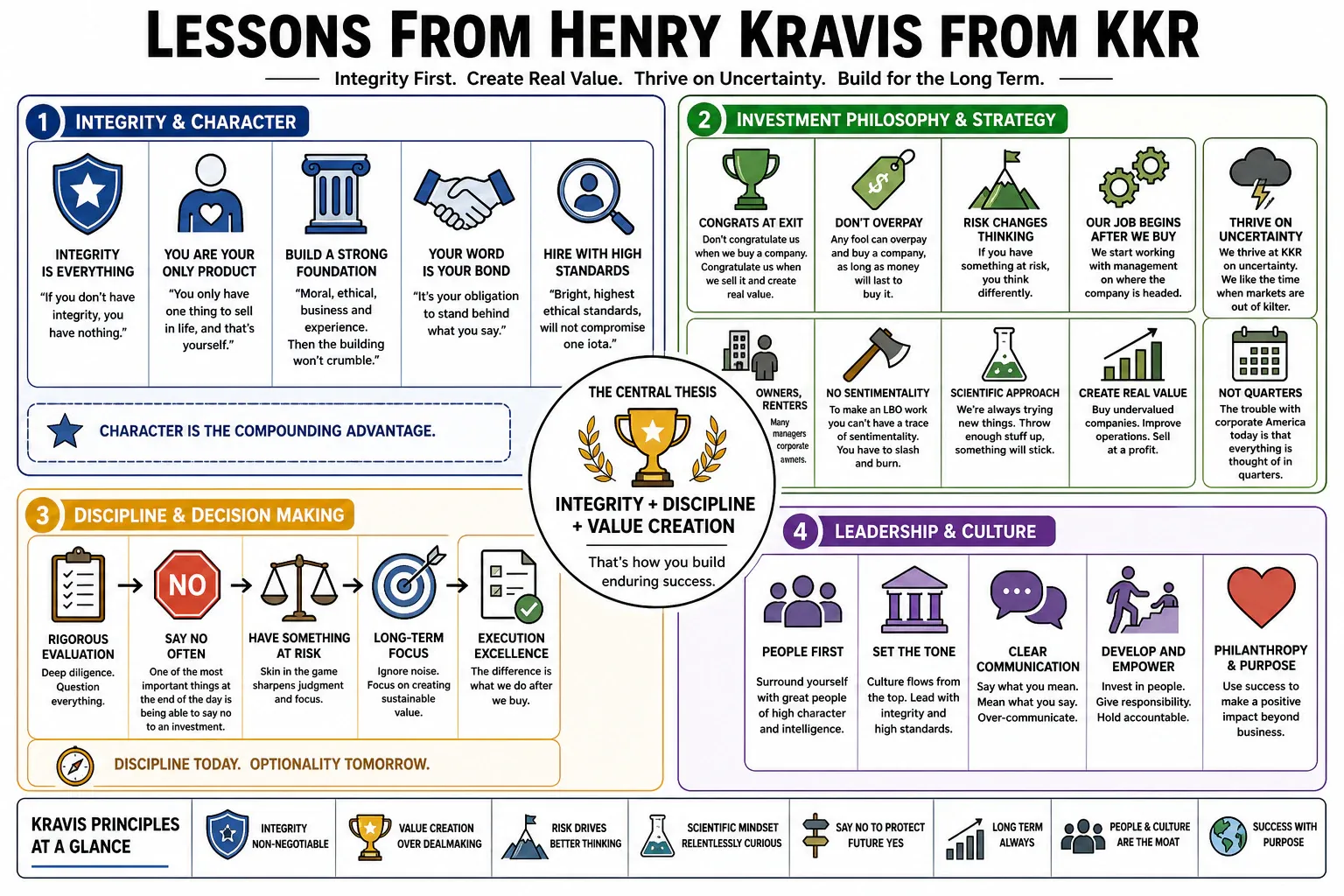
On Integrity and Character
- Integrity Cannot Be Purchased: Kravis treats integrity as indispensable to personal and professional credibility; wealth cannot substitute for ethical conduct. — Academy of Achievement Interview.
- Your Reputation Is Personal: He argues that the character and trustworthiness one brings to a relationship are ultimately what one has to offer. — Academy of Achievement Interview.
- Build an Ethical Foundation: Kravis recalls his mother’s advice that business experience needs a moral and ethical foundation if a lasting enterprise is to hold up. — Academy of Achievement Interview.
- Keep Your Word: Kravis describes trust as the basis of KKR’s business and says employees must honor commitments they make on the firm’s behalf. — KKR — Strong Company Culture.
- Hire for Candor and Ethics: Kravis says he looks for bright, creative people with uncompromising ethical standards who will tell him when they disagree. — Academy of Achievement Interview.
On Investment Philosophy and Strategy
- Judge the Work After the Purchase: Kravis asks people to judge an acquisition by the value created and the eventual exit, not by the announcement that a company has been bought. — Academy of Achievement Interview.
- A High Bid Is Not Investment Skill: He warns that almost anyone can buy an asset by paying too much; the harder task is buying sensibly and creating value afterward. — Academy of Achievement Interview.
- Ownership Changes Incentives: Kravis argues that managers behave differently when they invest their own money alongside the owners of the business. — Academy of Achievement Interview.
- The Job Begins at Closing: For Kravis, acquisition starts a partnership with management to set direction, improve operations and ensure a suitable capital structure. — Academy of Achievement Interview.
- Dislocation Can Create Opportunity: Kravis says KKR looks for opportunities when markets are unsettled, while recognizing that uncertainty also exposes weaknesses in businesses. — Goldman Sachs Exchanges Transcript.
- Turn Renters Into Owners: He contrasts managers who merely oversee corporate assets with managers who hold equity and therefore bear consequences alongside investors. — Academy of Achievement Interview.
- Experiment With New Structures: Kravis says KKR’s experiments, including its public-market structure and later listing, helped it adapt; mistakes were occasions for learning rather than reasons to stop trying. — KKR — Making Mistakes.
- Give Management a Longer Horizon: Kravis criticizes quarter-to-quarter corporate thinking and asks portfolio-company managers to plan toward where the business should be in five years. — Academy of Achievement Interview.
- A Listing Should Serve the Institution: Kravis says KKR’s public listing was meant to help institutionalize the firm, attract talent and supply capital for new businesses—not simply to mark an exit. — KKR — Making Mistakes.
- Be Willing to Pass: Kravis calls the ability to reject an investment important, even after substantial work has been spent evaluating it. — Academy of Achievement Interview.
- Invest Across Business Lines: Kravis describes KKR as a multifaceted alternative-investment firm spanning private equity, infrastructure, real estate and credit rather than one kind of buyout. — Goldman Sachs Exchanges Transcript.
- A Company Is Not a Stock to Flip: Kravis rejects mentor Ed Merkle’s suggestion that a disappointing acquisition can simply be sold like a stock: once a firm buys a company, exiting is much harder. — Academy of Achievement Interview.
On Leadership and Building a Business
- Invite Dissent Before Deciding: Kravis says he wants colleagues who will challenge him, and recalls asking junior associates for their views before senior partners stated theirs. — Academy of Achievement Interview.
- Entrepreneurship Removes the Safety Net: Kravis describes an entrepreneur as someone who pursues a conviction without an institutional safety net and accepts that attempts can fail. — Academy of Achievement Interview.
- Persist Through Rejection: Kravis urges entrepreneurs to hold to a vision through setbacks rather than avoid attempts because they might fail. — Academy of Achievement Interview.
- Culture and Values Must Be Practiced: Kravis argues that a firm needs shared values governing everyday conduct, not just talented employees or a statement about culture. — KKR — Strong Company Culture.
- Participation Builds the Team: Kravis says KKR was designed to involve people across the firm in decisions and to reward collective outcomes rather than narrow individual ownership of ideas. — Goldman Sachs Exchanges Transcript.
- Put the Team Ahead of Individual Credit: Kravis frames KKR as a coordinated team in which members have different roles but aim at what is right for the firm rather than personal advancement. — Goldman Sachs Exchanges Transcript.
- Share Success, Own Mistakes: Kravis says he and George Roberts made decisions together, gave the wider team credit when they worked, and accepted responsibility when they did not. — KKR — Making Mistakes.
- Use Arrogance as a Warning: Kravis keeps a framed “Arrogance kills” sign as a reminder that arrogance erodes the trust on which KKR depends. — KKR — Strong Company Culture.
- Like and Trust Come First: Kravis says counterparties must both trust that KKR will try to keep its commitments and want to continue working with its people. — KKR — Strong Company Culture.
- One Compensation Pool: Kravis says KKR uses a firmwide compensation pool so established businesses help seed new ones and teams have reason to collaborate. — KKR — Looking for Talent.
On Learning and Curiosity
- Curiosity Helps Investors Connect Dots: Kravis says investment judgment benefits from curiosity about history, literature and other fields, which helps one connect information across contexts. — Goldman Sachs Exchanges Transcript.
- Learn From the Portfolio: Kravis says owning businesses across industries lets him visit factories and management teams to understand unfamiliar operations firsthand. — Academy of Achievement Interview.
- Prove Yourself Through Work: Kravis describes being in a hurry to succeed and establish an identity beyond his successful father, while taking pleasure in building KKR with George Roberts. — Academy of Achievement Interview.
On Failure and Resilience
- Treat Failure as a Test: Kravis says people cannot know their capabilities without trying and facing possible failure; a failed attempt calls for learning and another try. — Academy of Achievement Interview.
On Philanthropy and Legacy
- Philanthropy Requires Involvement: Kravis says he and Marie-Josée focus much of their giving on the arts, medicine and education, and that getting involved matters more than merely writing a check. — Goldman Sachs Exchanges Transcript.
- Giving Was a Family Lesson: Kravis credits his father with teaching him to give back to society and with modeling the joy of helping others. — Academy of Achievement Interview.
- Contribution Can Be the Reward: Kravis says some of his most satisfying moments came from contributing money, time or effort to people less fortunate. — Academy of Achievement Interview.
- Recognize Nonprofit Leadership: Kravis founded and sponsored a prize at Claremont McKenna College to recognize sustained, innovative leadership in the nonprofit sector. — Claremont McKenna — Kravis Prize.
On Life and Perspective
- Do Your Work Instead of Watching Rivals: Kravis advises focusing on one’s own work while remaining aware of competitors, rather than obsessing over their activity. — Academy of Achievement Interview.
- Design the Right Capital Structure: Kravis says he enjoys shaping a capital structure suited to a particular company rather than treating every acquisition alike. — Academy of Achievement Interview.
- Partner for the Long View: Kravis says he wants to work with good managers, align their incentives and help them plan beyond the next quarter. — Academy of Achievement Interview.
Learn more:
- KKR — The Importance of a Strong Company Culture
- KKR — Making Mistakes Is the Mother of Innovation
- Voices of Oklahoma — Henry R. Kravis Oral History
- KKR — Looking for Talent Beyond Skills and Track Records
- Academy of Achievement — Henry R. Kravis Interview
- Goldman Sachs Exchanges — Henry Kravis Interview Transcript
- Claremont McKenna — Henry R. Kravis Prize Announcement