Henry Oliver is a writer, literary critic, and the author of Second Act: What Late Bloomers Can Tell You About Success and Reinventing Your Life. Known for his Substack newsletter The Common Reader, he explores how people discover their talent, pivot in their careers, and draw practical wisdom from classic literature. This profile outlines his core ideas on defying the tyranny of early achievement, mastering the art of the second act, and reading widely.
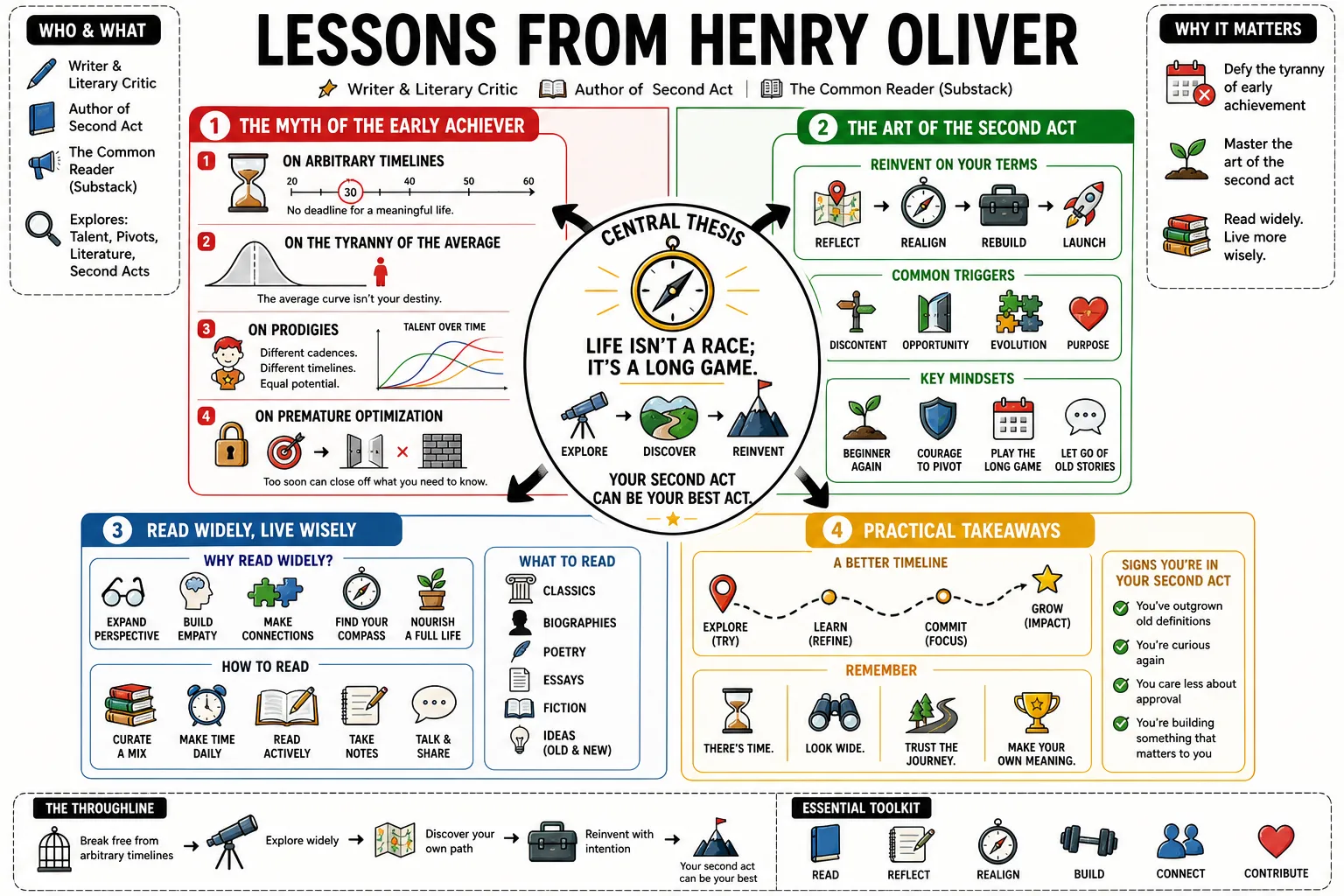
Part 1: The Myth of the Early Achiever
- On Arbitrary Timelines: "We have built a culture that worships early achievement, making anyone who hasn't succeeded by thirty feel as though they are out of time." — Source: [Second Act]
- On the Tyranny of the Average: "The tyranny of the average: it might be the curve for many, but it doesn't have to be for you." — Source: [Double Win Show]
- On Prodigies: "Focusing entirely on child prodigies blinds us to the different cadences at which human talent actually develops over a lifetime." — Source: [Second Act]
- On Premature Optimization: "Committing too early to a single career path can lock you out of the experiences necessary to discover what you are actually good at." — Source: [The Common Reader]
- On the Expectation of Youth: "The idea that your cognitive peak happens in your twenties is a statistical artifact that ignores the compounding value of experience." — Source: [Second Act]
- On Hidden Trajectories: "Many of the most successful people spent decades looking like failures to the outside world while they were quietly building their foundation." — Source: [The Common Reader]
- On Standardized Measures: "Standardized testing and rigid career ladders are designed to identify compliance, not the kind of jagged, uneven talent that produces original work." — Source: [Second Act]
- On the Thirty-Under-Thirty Illusion: "Lists of young high-achievers celebrate potential, but they often ignore the long tail of endurance required to actually produce a lasting body of work." — Source: [The Common Reader]
- On Delayed Returns: "Sometimes the work you do in your twenties doesn't pay off until your fifties, and we lack the cultural vocabulary to explain that gap." — Source: [Second Act]
Part 2: The Architecture of the Late Bloomer
- On Defining Late Bloomers: "A late bloomer isn't someone who suddenly gets lucky; they are someone who finally aligns their accumulated skills with the right environment." — Source: [Second Act]
- On Preparation: "What looks like a sudden reinvention in midlife is almost always the result of decades of quiet, unnoticed preparation." — Source: [The Common Reader]
- On Subsurface Growth: "Talent often grows underground. You cannot see the root system expanding until the tree suddenly shoots up." — Source: [Second Act]
- On Accumulated Advantage: "The primary advantage of age is that you have a larger database of patterns to draw from when solving new problems." — Source: [Double Win Show]
- On Lateral Thinking: "People who bloom later tend to have collected a wider variety of disparate ideas, which allows them to combine concepts in ways specialists cannot." — Source: [Second Act]
- On the Value of Wandering: "Periods of feeling lost are often necessary data-gathering phases for your eventual career." — Source: [The Common Reader]
- On Midlife Crises: "Your midlife crisis might be because you're unhappy with your job, and you should change it." — Source: [Double Win Show]
- On Identifying Untapped Talent: "Look for the things you do voluntarily on a Sunday morning; that is often where your second act is hiding." — Source: [Second Act]
- On the Advantage of Age: "Older individuals bring a sense of perspective that makes them immune to the trivial workplace dramas that derail younger employees." — Source: [The Common Reader]
- On Patience: "Flourishing later in life requires the discipline to ignore the timeline of your peers and trust your own internal clock." — Source: [Second Act]
Part 3: Literature as a Living Idea
- On Engaging with Classics: "Great literature is not a museum exhibit; it is a set of ideas walking and talking amongst the mess of the real world." — Source: [Conversations with Tyler]
- On Reading Shakespeare: "Shakespeare endures because he understood human psychology better than most modern psychologists, long before the vocabulary for it existed." — Source: [The Common Reader]
- On Literature vs. History: "History tells us what happened, but fiction tells us what it felt like to be there when it happened." — Source: [The Common Reader]
- On the Messiness of Reality: "The best novels refuse to give you a clean moral lesson, because life refuses to give you a clean moral lesson." — Source: [The Common Reader]
- On Jane Austen: "Austen is often misread as writing cozy romances, when in fact she was writing sharp, unsentimental analyses of economics and social survival." — Source: [The Common Reader]
- On the Purpose of Fiction: "We read fiction to inhabit minds that are smarter, stranger, and more observant than our own." — Source: [The Common Reader]
- On Intellectual Isolation: "Reading classic literature is the best cure for the specific type of temporal isolation that comes from only paying attention to the present moment." — Source: [The Common Reader]
- On Re-reading: "You do not read the same book twice. The book stays the same, but the reader brings a different self to the text every time." — Source: [The Common Reader]
- On Escapism: "True literary escapism doesn't take you away from reality; it equips you with better tools to face it when you return." — Source: [The Common Reader]
Part 4: The Art of the Common Reader
- On Virginia Woolf’s Concept: "The 'common reader' reads for their own pleasure and instruction, entirely free from the academic obligation to produce a theory." — Source: [The Common Reader]
- On Snobbery: "Literary snobbery actively harms the culture of reading by turning books into status symbols rather than tools for thought." — Source: [The Common Reader]
- On Practical Criticism: "Good criticism should act as a bridge between the reader and the text, rather than a wall built to show off the critic's intelligence." — Source: [The Common Reader]
- On Reading for Pleasure: "If you are not enjoying a book, put it down. Life is too short to read out of a sense of misplaced duty." — Source: [The Common Reader]
- On the Self-Help Trap: "Mining great literature purely for life hacks diminishes the art and usually results in terrible advice." — Source: [The Common Reader]
- On Literary Criticism Today: "Much of modern commentary prioritizes the author's identity or the political moment over the actual mechanics of the text itself." — Source: [Liberties Journal]
- On Broad Reading: "To be a common reader is to read promiscuously across genres, eras, and disciplines without worrying about staying in your lane." — Source: [The Common Reader]
- On Reading Habits: "The most effective way to read more is to stop treating reading as a special event that requires perfect conditions." — Source: [The Common Reader]
- On Difficult Texts: "Some books are difficult because the ideas are complex, but others are difficult simply because the writer was lazy. Learn to tell the difference." — Source: [The Common Reader]
Part 5: Career Reinvention and Pivoting
- On the Pivot: "A successful pivot rarely involves jumping into something entirely new; it involves translating your existing skills into a new domain." — Source: [Second Act]
- On Sunk Costs: "The fear of wasting the time you have already invested in a career is the single biggest barrier to starting a successful second act." — Source: [Second Act]
- On Transferable Skills: "When you switch industries, your technical knowledge resets to zero, but your judgment, taste, and work ethic carry over entirely." — Source: [Second Act]
- On Leaving Advertising: "Working in advertising teaches you how to communicate clearly and hold an audience's attention—skills that are universally applicable, especially in writing." — Source: [Marginal Revolution]
- On Identity and Work: "You have to detangle your personal identity from your job title if you want to have the freedom to change course later in life." — Source: [Second Act]
- On Starting Over: "Starting over at the bottom in your forties requires a high tolerance for looking foolish in front of people younger than you." — Source: [Second Act]
- On the Role of Curiosity: "Curiosity is the engine of reinvention. If you stop asking how things work, your career will stagnate." — Source: [The Common Reader]
- On Experimentation: "Treat your side projects as low-stakes experiments. Your second act will likely emerge from something you started as a hobby." — Source: [Second Act]
- On Managing Risk: "Reinvention does not require blowing up your life. The best transitions are gradual shifts in allocation of your time and energy." — Source: [Second Act]
- On Unconventional Paths: "The people who end up doing the most interesting work rarely followed the instructions they were given at graduation." — Source: [The Common Reader]
Part 6: Resilience and the Work Itself
- On Hard Work: "Hard work makes some kind of appearance on every page of this book. That's what resilience is: getting to the end of doing a lot of stuff." — Source: [Double Win Show]
- On Persistence: "The difference between an amateur and a professional is the willingness to push through the boring parts of the process." — Source: [Second Act]
- On Openness: "Openness brings you to new ideas and new thinking, but it can be a trap if you don't exploit it." — Source: [Double Win Show]
- On Avoiding the Trap of Openness: "You cannot remain in the gathering phase forever. Eventually, you have to close the door and actually produce the work." — Source: [Second Act]
- On Daily Execution: "Writing is not about waiting for inspiration; it is about putting your hands on the keyboard at the same time every day until the habit takes over." — Source: [The Common Reader]
- On the Grind: "Everyone wants the outcome of having written a book, but very few people want the daily reality of writing a book." — Source: [The Common Reader]
- On Perfectionism: "Perfectionism is usually just a socially acceptable disguise for fear of shipping your work." — Source: [Second Act]
- On Handling Failure: "If you want to have a second act, you have to learn how to metabolize failure quickly and move on to the next iteration." — Source: [Second Act]
- On Momentum: "Momentum is a fragile resource. Once you have it, you must protect it from distractions at all costs." — Source: [The Common Reader]
Part 7: Network, Mentorship, and Luck
- On Mentorship: "A good mentor doesn't tell you what to do; they point out the blind spots in your own thinking." — Source: [Second Act]
- On Finding the Right Scene: "Talent is individual, but success is ecological. You have to place yourself in a scene where your specific skills are valued." — Source: [Second Act]
- On Social Capital: "Late bloomers often succeed because they spend decades building deep, quiet networks of trust before they ever need to ask for a favor." — Source: [Second Act]
- On Asking for Help: "The reluctance to ask for help is a sign of insecurity. Confident people know they cannot build a second act entirely on their own." — Source: [Second Act]
- On Proximity to Talent: "If you want to improve your own work, find a way to be in the room with people whose standards are intimidatingly high." — Source: [The Common Reader]
- On Luck: "You cannot control luck, but you can increase your surface area for serendipity by publishing your work and meeting new people." — Source: [Second Act]
- On Recognizing Opportunity: "Many people miss their chance to pivot because the opportunity looks like unpaid work or a step down in status." — Source: [Second Act]
- On Asymmetric Bets: "Career reinvention requires making small bets where the potential downside is capped but the upside is entirely unbounded." — Source: [Second Act]
- On Institutional Support: "Institutions are rarely designed to support the late bloomer. You usually have to build your own infrastructure outside the traditional system." — Source: [Second Act]
Part 8: Defiance of Mediocrity
- On Excellence: "Aiming for excellence means you have to be willing to look slightly unhinged to people who are comfortable with the status quo." — Source: [The Common Reader]
- On the Origins of Genius: "If you want to understand excellence in literature, you have to look at the figures who bubble at the source of the stream, rather than the downstream imitators." — Source: [The Common Reader]
- On Contrarianism: "Being a contrarian for its own sake is lazy. The goal is to be right when the consensus happens to be wrong." — Source: [The Common Reader]
- On Writing as Defiance: "Writing deeply researched, thoughtful essays in an age of short-form video is an intentional act of defiance against the decay of attention." — Source: [The Common Reader]
- On Intellectual Ambition: "There is a strange modern taboo against admitting you want to write something truly great. We should normalize high intellectual ambition." — Source: [The Common Reader]
- On Rejecting the Mundane: "You do not have to accept the default settings of your industry. You can choose to play a different game entirely." — Source: [Second Act]
- On the Creator Economy: "The promise of the independent internet is that it allows writers to find their exact audience without having to water down their ideas for a committee." — Source: [The Common Reader]
- On Legacy: "A good second act isn't just about personal success; it is about leaving behind a body of work that is actually useful to other people." — Source: [Second Act]
- On Flourishing: "It's never too late to reinvent yourself and flourish. The human capacity for growth does not expire at forty." — Source: [Double Win Show]
- On the Long Game: "The most important metric for any creative professional is simply whether they are still in the game a decade later." — Source: [The Common Reader]