Lessons from Henry Schuck
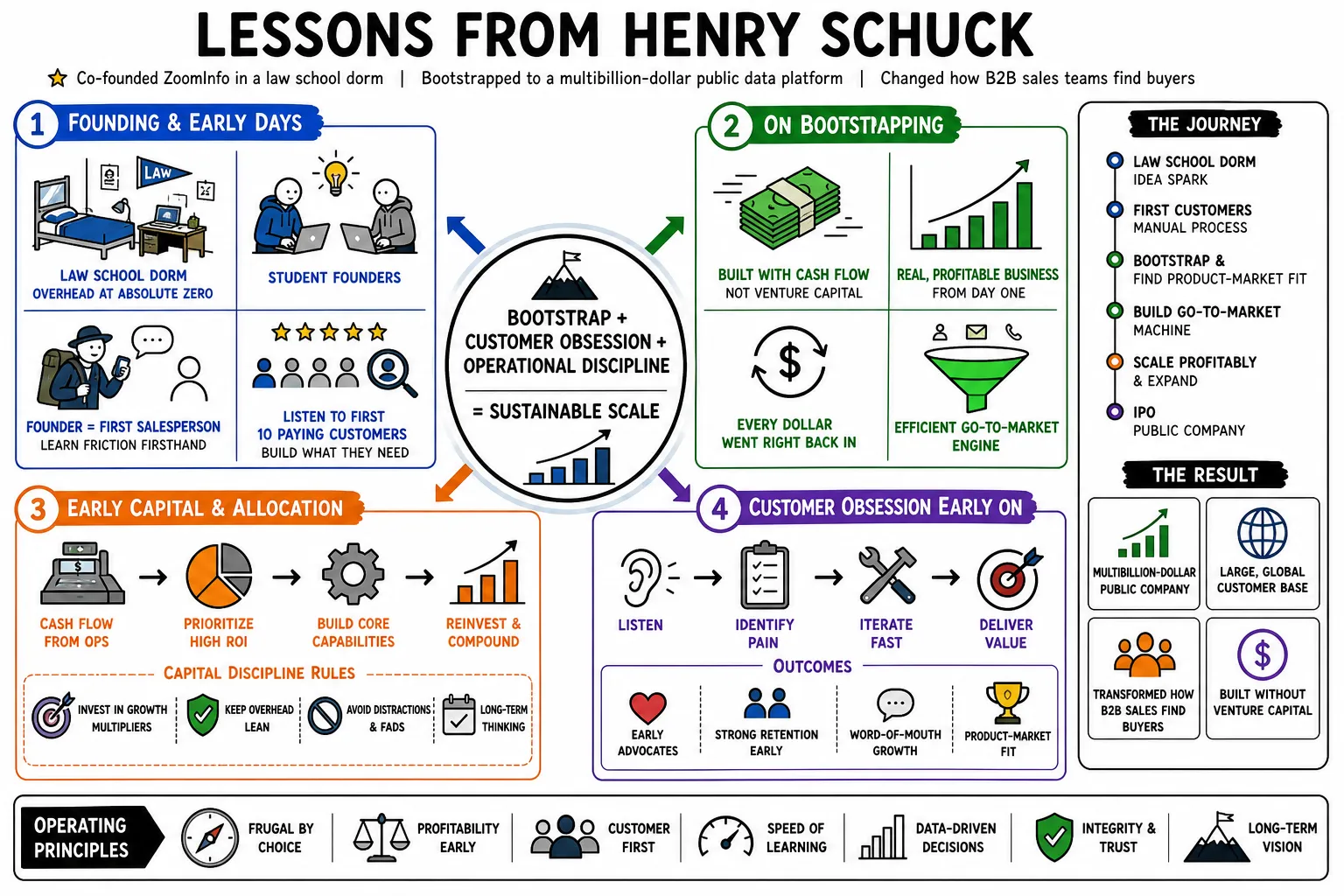
Henry Schuck co-founded DiscoverOrg while in law school, using credit-card funding from both founders. The bootstrapped data business later acquired ZoomInfo, adopted its name, and went public in 2020. His interviews describe the sales, acquisition, and management decisions behind that growth. — PTC Q&A with Henry Schuck.
Part 1: Founding & Early Days
- Bootstrapping: Schuck and his cofounder started DiscoverOrg with $25,000 each on their credit cards. They built a profitable business and did not take outside capital for seven years. — SaaStr interview with Henry Schuck.
- Starting in Law School: Schuck started DiscoverOrg after his first year in law school, bringing five years of experience selling business data at iProfile into the new venture. — Thirty Minute Mentors interview.
- Selling Firsthand: Schuck carried a regular sales quota and sold on the front line during DiscoverOrg's first five years. Sales became the function he knew best, which later shaped his investment choices. — SaaStr interview with Henry Schuck.
- Narrow the First Market: DiscoverOrg's early offering focused on data about technology decision-makers for companies selling to those buyers. Schuck credits that narrow targeting with helping the company find product-market fit quickly. — Thirty Minute Mentors interview.
- Invest Beyond the Familiar Function: Schuck later judged his early spending too biased toward sales, where the payoff was easiest to see. He says that bias delayed needed investment in product, engineering, marketing, HR, and customer success. — SaaStr interview with Henry Schuck.
- Prioritize Without a Safety Net: Schuck connects his early experience of scarcity to focusing on the next most important task when outside funding is unavailable. He and his cofounder began with credit-card financing and, in his account, no backup plan. — Henry Schuck on bootstrapping.
- Start with Useful Data: DiscoverOrg began by supplying company and contact data to business sellers. Schuck later treated that data asset as a foundation for adjacent software and applications used by the same customers. — PTC Q&A with Henry Schuck.
- Learn by Doing Difficult Work: Before founding DiscoverOrg, Schuck took both an MGM night job and a daytime role at iProfile, sometimes sleeping briefly in his car between shifts. He credits the data-company experience with teaching him how the market worked. — Thirty Minute Mentors interview.
- Close Product Gaps Competitors Can Use: Schuck says ZoomInfo's weaker international data once gave competitors an opening with customers who already used it for North America. Improving international coverage helped close that gap; he does not claim to have ignored competitors. — Thirty Minute Mentors interview.
- Choose the Brand the Market Knows: After acquiring ZoomInfo, Schuck commissioned a brand study rather than relying on attachment to DiscoverOrg. The study showed much stronger awareness of ZoomInfo, so the combined company adopted that name despite DiscoverOrg's more premium contracts. — SaaStr interview with Henry Schuck.
Part 2: Leadership & Hiring
- Explain the Decision Logic: As ZoomInfo grew, Schuck began sharing more context about how he made decisions with executives so they could pass that reasoning to their teams. The goal was faster decisions with less coordination overhead. — Think Like an Owner interview.
- Keep Business Data Current: Schuck says company and contact records begin to decay as people change jobs and accounts evolve. Reliable sales decisions require a way to keep that information current inside customer systems. — PTC Q&A with Henry Schuck.
- Keep the Team Aligned in Setbacks: During difficult periods, Schuck stresses a clear strategy, repeated communication, and teams that solve problems together rather than forming fiefdoms or pointing fingers. — Thirty Minute Mentors interview.
- Hire for Values, Even if It Takes Longer: Schuck argues that hiring pressure should not override screening for the principles a company needs. He would rather fill fewer roles on schedule than compromise those standards to hit a hiring target. — Think Like an Owner interview.
- Work Ethic as an Equalizer: Schuck credits his mother, who worked three jobs, for teaching him to treat effort as something he could control. He carried that expectation into his own work rather than prescribing that a CEO must outwork every employee. — Thirty Minute Mentors interview.
- Managers Complement Automation: DiscoverOrg automated many sales-management functions, but Schuck later concluded that investing in strong middle managers, HR, and employee development could produce better outcomes than automation alone. — SaaStr interview with Henry Schuck.
- Make Values Screenable: Schuck wants talent-acquisition staff and hiring managers in each function to define how they test candidates against company values. A principle only affects team quality if it changes the actual hiring screen. — Think Like an Owner interview.
- Push Context Downward: Rapid growth left ZoomInfo with too many meetings for short decisions. Schuck responded by having executives pass decision context to their teams so people closer to the work could act without seeking approval from every adjacent group. — Think Like an Owner interview.
- Make Candor Feel Like Partnership: Schuck says leaders need enough trust that difficult feedback is received as an effort to improve together rather than as judgment. Transparency and willingness to work through the problem shape that response. — Thirty Minute Mentors interview.
- Use Culture Where Process Cannot Help: Schuck distinguishes problems a checklist can prevent from problems that require people to feel ownership. His example was customer complaints that no one but the CEO chose to answer; another monitoring schedule would not create the needed care. — Think Like an Owner interview.
Part 3: M&A Strategy
- Consider Acquisitions Before Confidence Arrives: Schuck says DiscoverOrg had chances to acquire important companies earlier but waited until he felt confident it could execute the deals. In his retrospective account, the delay increased their purchase cost. — SaaStr interview with Henry Schuck.
- Test Go-to-Market Fit: Schuck's preferred acquisition is a product that existing sellers can offer to existing buyers without a much more complex sale or a different servicing model. That fit can make growth synergies easier to realize. — Think Like an Owner interview.
- Choose Leaders Across Both Companies: When DiscoverOrg acquired ZoomInfo, Schuck put ZoomInfo's CTO and CMO in charge of those functions for the combined company because he judged their teams stronger. He framed integration as building the best joint team, not a conquest. — Think Like an Owner interview.
- Communicate Integration Decisions Early: Schuck recommends resolving overlapping roles before an acquisition closes and explaining the decisions promptly on day one. Leaving employees uncertain about their jobs can slow the combined business. — Think Like an Owner interview.
- Test Before Buying a Capability: For an experimental capability, Schuck prefers to license or partner first and see whether customers adopt it. RingLead began as a partner that helped unlock enterprise sales before ZoomInfo chose to acquire it. — Think Like an Owner interview.
- Unify Culture Deliberately: Schuck says he initially let DiscoverOrg and ZoomInfo retain separate cultures after the acquisition. After six to nine months, he concluded the combined company needed a clearer shared culture and acted to unify it. — SaaStr interview with Henry Schuck.
- Leave Room for Integration Risk: Schuck says acquisition pricing should allow room for execution mistakes. His concern was not merely the headline multiple but whether the deal could still work if integration slipped. — SaaStr interview with Henry Schuck.
- Watch What a Partner Unlocks: RingLead emerged as an acquisition candidate after its data-management product repeatedly helped ZoomInfo win enterprise customers. Observed demand from existing buyers gave Schuck a concrete reason to bring the capability inside the platform. — Think Like an Owner interview.
- Account for Software Onboarding: Schuck says ZoomInfo misjudged some software acquisitions by applying its efficient data-product onboarding model to products that required customers to change behavior. Implementation and customer success needed more attention than the company had expected. — Think Like an Owner interview.
Part 4: Sales & Go-to-Market
- Make Go-to-Market an Advantage: Schuck came to view an efficient go-to-market engine as a strategic asset, not just a sales expense. Better lead generation, conversion and expansion can free resources for product, account management, customer success and marketing. — SaaStr interview with Henry Schuck.
- Improve an Existing Workflow: Schuck says ZoomInfo's data product was easier to adopt when it improved prospecting and CRM work customers already did. Software that asks users to change their daily behavior needs more implementation and customer-success support. — Think Like an Owner interview.
- Measure the Sales Funnel: Schuck describes tracking outbound calls and conversion from calls to demos, demos to opportunities and opportunities to sales. He pairs those metrics with the less mechanical skill of telling a persuasive customer story. — High-Growth Companies interview.
- Scale Strong-Seller Research: Schuck says ZoomInfo built Copilot around what its strongest sellers do: learn a prospect's business, watch for relevant signals and decide when to engage. The product ranks accounts using that context so more sellers can act on it. — After Earnings interview.
- Reach Buyers with Context: Schuck's commercial-cleaning example starts with account fit, the decision maker and buying signals, then uses those details to time and personalize an initial approach. — After Earnings interview.
- Build Outbound Deliberately: Schuck argues that outbound prospecting can work, but it takes deliberate systems, incentives, hiring, personalized messaging and KPI maintenance. Relying only on easier channels can mean avoiding the hard work of building that capability. — High-Growth Companies interview.
- Test Pricing in Segments: Schuck says GTM outcomes can be hard to attribute cleanly to software, so pricing changes should be tested with a limited customer segment and expanded only after observing feedback. He describes ZoomInfo experimenting with a prepaid consumption model. — Henry Schuck on SaaS pricing.
- Invest in Post-Sale Retention: Schuck says ZoomInfo focused heavily on sales while underinvesting in account management and customer success. Weak post-sale hiring, onboarding, training and feedback contributed to early net-retention and logo-churn problems. — SaaStr interview with Henry Schuck.
- Connect Signals to Engagement: Schuck describes a selling workflow that combines company and contact data with signals, account ranking and digital outreach. The value is helping sellers decide whom to contact and how to make the first interaction relevant. — After Earnings interview.
Part 5: Data Quality & Products
- Keep Buyer Data Fresh: Schuck says company and personnel records change continuously; a CRM or marketing system starts to decay without a systematic way to update buyers, roles and account events. — PTC Q&A.
- Build Applications on the Data Asset: Schuck says the original contact-and-company data asset gave ZoomInfo a foundation for applications used by the same sales customers. Acquisitions helped move the business into software while leveraging that foundation. — PTC Q&A.
- Put Intelligence in the Seller's Workflow: Schuck's example connects account fit, buying signals, decision-maker details and first-contact messaging so the seller can act on the intelligence rather than merely look up a name. — After Earnings interview.
- Protect Truly Proprietary Data: Schuck distinguishes unique proprietary data from a generic dataset made valuable mainly by manual tagging. He expects the former to remain more defensible as language models make some categorization easier. — Think Like an Owner interview.
- Rebuild a Poor User Experience: Schuck publicly acknowledged that ZoomInfo's Chrome extension had become slow and unreliable. He says the team rebuilt it for faster loading, better matching and a simpler interface. — Henry Schuck on ZoomInfo's extension.
- Combine Algorithms with Human Review: ZoomInfo's 2020 filing describes an AI/ML data engine that processes records at scale, with research analysts checking anomalies and gaps that automated methods alone cannot resolve. — ZoomInfo 2020 Form 10-K.
- Pair Contacts with Trigger Events: In Schuck's telecom example, knowing the CIO and other decision makers is only part of the job. Changes such as a new CIO or a buying cycle can signal when outreach is timely. — PTC Q&A.
- Watch Use and Renewal Together: Schuck reported stronger early engagement among Copilot users and better first-cohort renewal trends than for legacy-product customers. Those were ZoomInfo's 2025 observations, not proof of a permanent retention effect. — After Earnings interview.
Part 6: Artificial Intelligence
- Build Agents on a Shared Data Layer: Schuck says ZoomInfo combined product, finance, customer-conversation and internal communication data into a central layer, then built agents on top for recurring work such as account plans and meeting materials. — After Earnings interview.
- Check Whether Employees Actually Use AI: Schuck reported that more than two-thirds of ZoomInfo employees used its internal agents daily soon after rollout. He saw that adoption as encouraging but still wanted to know how the efficiency would show up in business results. — After Earnings interview.
- Supply Agents with External Context: Schuck argues that an internal CRM often lacks current market and buyer information. He describes adding third-party business data to customer systems so sales and marketing agents can act on more complete context. — After Earnings interview.
- Measure the Boring AI Work: In a signed account of ZoomInfo's AI spending, Schuck says practical returns came from daily prioritization, outreach, call analysis and routine engineering work rather than showy demos. His reported ROI is a company estimate. — Henry Schuck on AI ROI.
- Turn Signals into Account Priorities: Schuck says Copilot studies a customer's market and uses fresh business events to rank which accounts sellers should approach each day. — After Earnings interview.
- Write Outreach for a Specific Buyer: Schuck describes AI-assisted outreach that uses account history and competitive context to address a particular person rather than an entire broad segment. He presents it as support for more relevant selling, not full automation of judgment. — Henry Schuck on AI ROI.
- Fix the Data Before Automating: Schuck warns that poor or disconnected customer and prospect data can make AI move faster in the wrong direction. The supported point is data quality, not a broad claim about an AI-ethics governance program. — Henry Schuck on AI ROI.
- Configure AI to Each Customer's Market: Schuck says Copilot learns a customer's products, buyers and relevant signals during onboarding, then uses that context to deliver account priorities inside the selling workflow. — After Earnings interview.
- Move Routine Work to AI: Schuck describes AI handling account prioritization, structuring calls and engineering boilerplate, leaving sellers and senior engineers more room for customer interaction and design. That is narrower than the captured one-to-one AI-SDR prediction. — Henry Schuck on AI ROI.
Part 7: Going Public & Scale
- Understand What an IPO Sells: Schuck says a first-day share-price rise is not by itself proof the IPO was mispriced. Only a fraction of the company is typically sold at the offering, while the remaining shares and the business continue beyond opening day. — GetLatka interview with Henry Schuck.
- Make Public Metrics Legible: Schuck recounts that more flexible customer payment terms during the pandemic complicated ZoomInfo's billings metric in its first earnings report. Public reporting required explaining the metric change, not just running the business well. — GetLatka interview with Henry Schuck.
- Listen to the Board Without Deferring: Schuck says he initially offered to follow his new board's instructions outright. An investor-operator reminded him that the board lacked daily operating context and that the CEO must weigh its advice before deciding. — SaaStr interview with Henry Schuck.
- Reduce Decision Drag as Headcount Grows: After ZoomInfo grew rapidly, Schuck found that cross-functional decisions could require too many meetings. He responded by sharing decision context through leaders so teams could move faster without repeatedly escalating. — Think Like an Owner interview.
- Allocate Capital Across Opportunities: Schuck describes capital allocation as a founder and CEO task throughout the company's life: deciding when to fund a team, redirect resources or buy an adjacent business while considering customers, employees and shareholders. — Think Like an Owner interview.
- Separate Stock Price from Business Health: Schuck says a rising stock can tempt leaders to believe their own hype, while a falling one can undermine conviction. He argues for judging the underlying business, communicating a strategy and continuing to improve it through both periods. — Thirty Minute Mentors interview.
- Invest When International Coverage Falls Short: Schuck says customer complaints about weak international contact data led ZoomInfo to commit resources to improve it. He reported a sixfold increase in coverage, quality and depth over subsequent months; that figure is his company claim. — Henry Schuck on international data.
Part 8: Personal Philosophy & Growth
- Learn from Failed Experiments: Schuck expects leaders to take consequential risks, examine why an effort failed and change how they operate. Repeating the same comfortable behavior while hoping for better results is not learning. — Thirty Minute Mentors interview.
- Take the Extra Opportunity: Schuck says watching his mother work three jobs made holding two jobs seem possible. He took both an iProfile job and a hotel shift; the software-and-data role became the foundation of his later business career. — Thirty Minute Mentors interview.
- Make Candor Thoughtful: After helping coach his daughter's soccer team, Schuck reconsidered how bluntly he gave feedback at work. He still favored calling out problems, but with greater empathy for the person and context. — Henry Schuck on candid feedback.
- Use a Mentor During the Lows: When progress feels stalled, Schuck recommends talking openly with a trusted friend or mentor to regain conviction and keep the team motivated. — Thirty Minute Mentors interview.