Mikitani founded Rakuten around a marketplace designed to give independent merchants their own storefronts and direct customer relationships. — Marketplace 3.0 Excerpt.
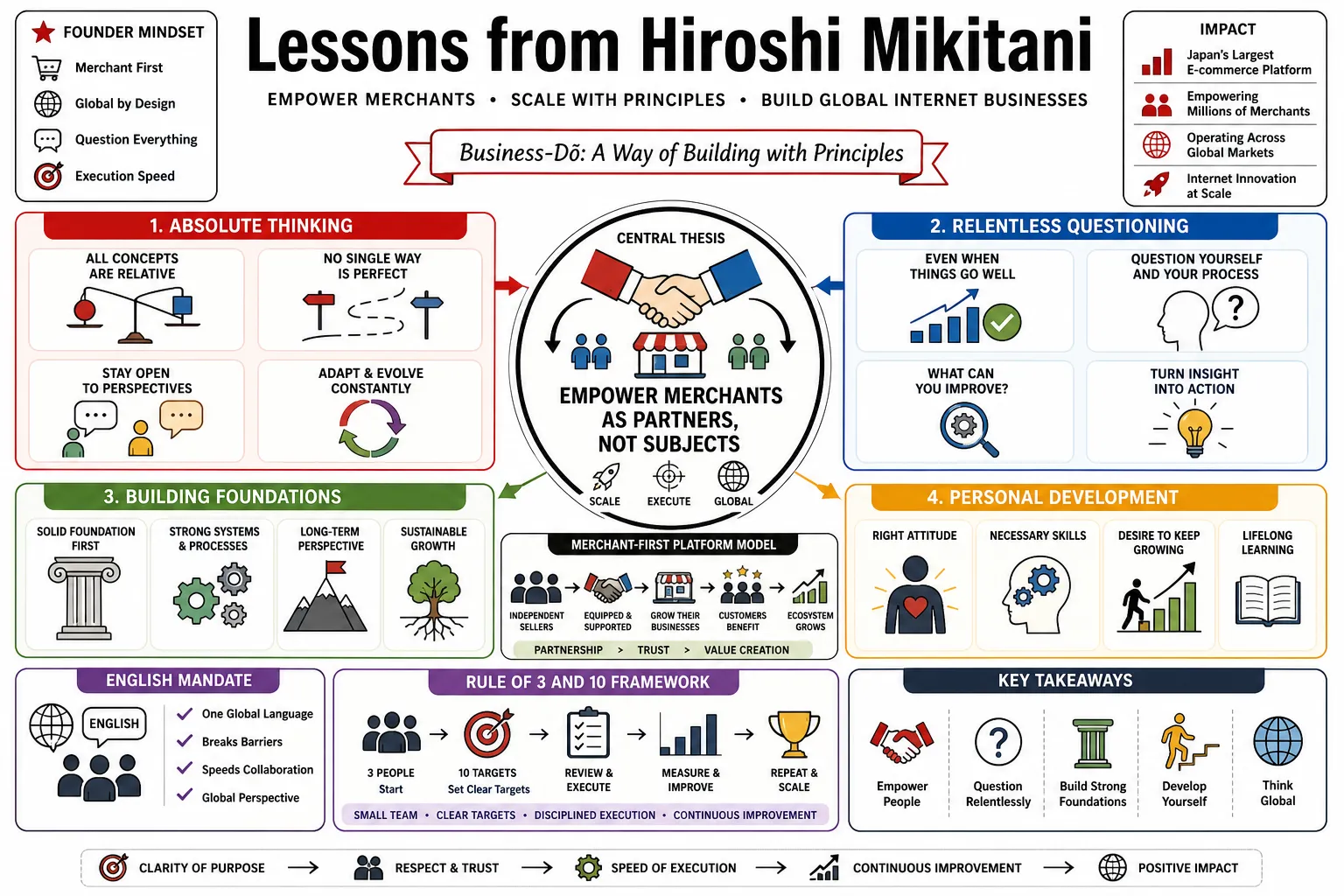
Part 1: The Business-Dō Philosophy
- Question absolutes: Mikitani’s first Business-Do principle warns against treating one way of thinking as universally perfect. — Business-Do: Ten Core Principles for Success.
- Question successful routines: Mikitani advises questioning a process even when it is working, because past success does not remove the need to adapt. — Business-Do: Ten Core Principles for Success.
- Brand as a values signal: Mikitani compares a brand to a flag: it communicates the values a company chooses to stand for. — Business-Do: Ten Core Principles for Success.
- Build from principles: Mikitani uses a building-foundation analogy to argue that durable ambitions need clear core principles. — Business-Do: Ten Core Principles for Success.
- Mindset, skills and learning: Mikitani names attitude, skills and a willingness to keep learning as complementary ingredients of personal success. — Business-Do: Ten Core Principles for Success.
- Act while life permits: After the 1995 Kobe earthquake killed relatives, Mikitani wrote that life’s fragility pushed him to pursue his venture rather than defer it. — Harvard Business School: Hiroshi Mikitani.
- Know your strengths and gaps: Mikitani argues that success depends less on being flawless than on recognizing where one is strong and weak. — Know Yourself — Or Else.
- Position around self-knowledge: Mikitani recommends using an honest view of your strengths and weaknesses to choose situations where you can contribute effectively. — Know Yourself — Or Else.
- Challenge conventional wisdom: Mikitani’s principles invite entrepreneurs to question accepted limits and act on ambitious ideas rather than assume an established approach is the only possible one. — Business-Do: Ten Core Principles for Success.
Part 2: The Speed of Execution
- Start with speed: For a new venture, Mikitani favors moving quickly enough to test an idea in the market instead of postponing action indefinitely. — When in Startup Mode, Embrace Speed!.
- Launch before perfection: Mikitani warns that waiting to perfect a product before launch can take too long; a launch creates information for refinement. — When in Startup Mode, Embrace Speed!.
- Learn while competitors iterate: Mikitani argues that competitors can learn from market feedback while a company is still refining its idea in isolation. — When in Startup Mode, Embrace Speed!.
- Build momentum through learning: Mikitani pairs action with continuing analysis and learning, using small tests to inform whether a new venture should grow. — Taking Action Leads to Deeper Thinking.
- Test a small hypothesis: Mikitani describes analyzing an opportunity, running a small proof of concept and scaling when the evidence supports it; the old 60% threshold is not in this source. — Taking Action Leads to Deeper Thinking.
- Accept mistakes with speed: Mikitani says that insisting on speed also means accepting mistakes and using them as learning opportunities. — Speed + Mistakes.
- Launch and refine: Mikitani describes speed as a cycle of launching, observing and continually improving the product, not as skipping learning. — When in Startup Mode, Embrace Speed!.
- Keep decisions moving: Mikitani says a new venture benefits from speed, repeated launch and refinement, not from rigidly waiting for a perfected plan. — When in Startup Mode, Embrace Speed!.
- Correct quickly: Mikitani’s response to a mistake is to find the problem, improve it promptly and avoid repeating it. — Speed + Mistakes.
Part 3: Scaling and The Rule of 3 and 10
- The 3-and-10 heuristic: Phil Libin recounts Mikitani’s advice that a growing company should revisit how it operates around transitions such as 3, 10, 30 and 100 people; Libin says the numbers are not magic. — The Rule of 3 and 10.
- Communication must change with scale: In Libin’s account, informal communication that works for a few people may need redesign as a company grows to ten, thirty or more. — The Rule of 3 and 10.
- Replace small-team systems: Libin illustrates the heuristic with payroll, accounting, support and onboarding systems that stop fitting when headcount grows substantially. — The Rule of 3 and 10.
Part 4: Marketplace 3.0 and E-Commerce
- Merchant empowerment: Mikitani designed Rakuten’s marketplace to give merchants control over their own storefronts rather than impose a single centrally controlled shop design. — Marketplace 3.0 Book Excerpt.
- Customizable storefronts: Rakuten built tools so merchants, including those with limited technical skills, could customize their online presence. — Marketplace 3.0 Book Excerpt.
- Marketplace 3.0 framing: The publisher describes Mikitani’s Marketplace 3.0 as a move toward personalized discovery and merchant-connected retail; the old Web 2.0-to-3.0 sentence is jacket copy, not a verified verbatim Mikitani quotation. — Marketplace 3.0: Publisher Description.
- A different marketplace purpose: In an interview, Mikitani contrasts Rakuten’s aim of supporting local merchants and communities with a model he sees as replacing large merchants. — LinkedIn News Interview with Hiroshi Mikitani.
- Support small merchants: Mikitani’s marketplace model aims to give smaller sellers tools and direct customer access instead of displacing their identity behind the platform. — Marketplace 3.0 Book Excerpt.
- Beyond the vending machine: Mikitani contrasts fast, inexpensive commodity shopping with a marketplace that also preserves discovery, service and human interaction; he says convenience and price still matter. — E-commerce as a Catalyst.
- Direct merchant relationships: Mikitani argues that merchants should be able to communicate directly with buyers about products, orders and their own stories, without a platform controlling every exchange. — Marketplace 3.0 Book Excerpt.
Part 5: Englishnization and Globalization
- Make a shared language operational: Mikitani describes Englishnization as Rakuten’s decision to use English for company-wide meetings and business communication. — The Answer Is in English.
- Globalization as a national aim: Mikitani presents Englishnization as a strategy he believed could benefit both Rakuten and Japan; that is his stated rationale, not a proven national-economic effect. — The Answer Is in English.
- Compete beyond Japan: Mikitani argues that Rakuten needed global expansion and a shared international language to pursue its ambition beyond Japan. — The Answer Is in English.
- Reduce language barriers: Mikitani says language barriers had made operations inefficient, motivating English meetings and presentation materials; the transition initially made some meetings longer and stressful. — The Answer Is in English.
- Broaden the talent pool: Mikitani says Rakuten’s English-language policy helped it recruit talent globally and build a Tokyo headquarters with employees from many countries. — Englishnization: Embracing a Global Vision.
- Share culture across borders: Mikitani argues that a common working language can support global collaboration without requiring perfect English or abandoning Japanese culture. — Englishnization: Embracing a Global Vision.
Part 6: Empowerment and Omotenashi
- Enable repeated opportunity: Mikitani says empowerment means giving people tools, an environment and encouragement to create opportunities repeatedly—not merely granting one break. — The Best Break in Life Is Being Empowered.
- Empowerment as company mission: Rakuten’s CEO states that the company has treated empowerment of people and society as a core value since its founding. — Rakuten CEO Message: Empowerment.
- Fair access to information: Mikitani calls fairness a core value of the internet because it can lower barriers to information and expand choices for buyers and market access for sellers. — Rakuten CEO Message: The Core Value of the Internet.
- Service beyond the transaction: Mikitani describes omotenashi as an ongoing service mindset, not just help delivered during a purchase. — Marketing a Global Product: Remember the Human Reasons.
- Anticipate customer needs: Mikitani explains omotenashi as hospitality that tries to anticipate what customers want and need, including in digital services. — AI and Personalized Customer Service: Japan’s Omotenashi.
- Preserve the human touch: Mikitani argues that online retail should balance efficiency with merchants’ own stories and direct customer connections. — E-commerce as a Catalyst.
Part 7: Failure and Continuous Improvement
- Try, fail, learn, grow: Mikitani treats an acknowledged mistake as a chance to learn and make the next effort stronger; he cautions against hiding it or apologizing for every imperfection. — Try, Fail, Learn, Grow.
- Define failure by the response: Mikitani argues that a mistake becomes lasting failure when a team fails to learn and improve from it. — Speed + Mistakes.
- Look for value in a stumble: Mikitani’s stone-and-diamond analogy urges a team to examine a setback for an unexpected opportunity instead of only regretting the mistake. — Speed + Mistakes.
- Make experimentation safe: Mikitani warns that punishing mistakes at work can breed fear and suppress creative experiments; his alternative is to fix errors and share what was learned. — Optimism Is More Than a Feeling.
- Recover through responsible optimism: Mikitani recommends responding to setbacks by asking what can be learned, then setting small achievable goals to rebuild momentum. The claimed guarantee of recovery is omitted. — Optimism Is More Than a Feeling.
- Improve by small increments: Mikitani’s Business-Do principle calls for continuous improvement by small fractions rather than waiting for a dramatic leap. — Business-Do: First Ten Principles.
Part 8: Mindset and The Moonshot
- Aim for a moonshot: Mikitani calls for goals higher than seem reasonably possible because stretch goals can motivate exceptional effort. — Business-Do: First Ten Principles.
- Build a team, not just a group: Mikitani distinguishes a team united by a common goal from a mere gathering of people. — Business-Do: First Ten Principles.
- Choose a distinct path: Rather than copying an incumbent’s route, Mikitani’s original marketplace design gave independent shops a way to customize storefronts and connect directly with customers. — E-commerce Lessons from Virtual Shopping Malls.
- Turn dreams into a system: In the introduction to Business-Do, Mikitani says a dream needs specific goals, practical steps and a repeatable system for acquiring skills and executing them. — Business-Do — Introduction.
- Use timely performance signals: Mikitani describes using frequent key performance indicators at Rakuten so teams can see results and adjust operations promptly. This is a company practice, not a proven cure for all bureaucracy. — Why Wait Until Tomorrow for Today’s Results?.
- Start small and adapt: In advice quoted from his own LinkedIn post, Mikitani recommends trusting an idea, starting small, and changing course when new information appears. — HBS: Hiroshi Mikitani.