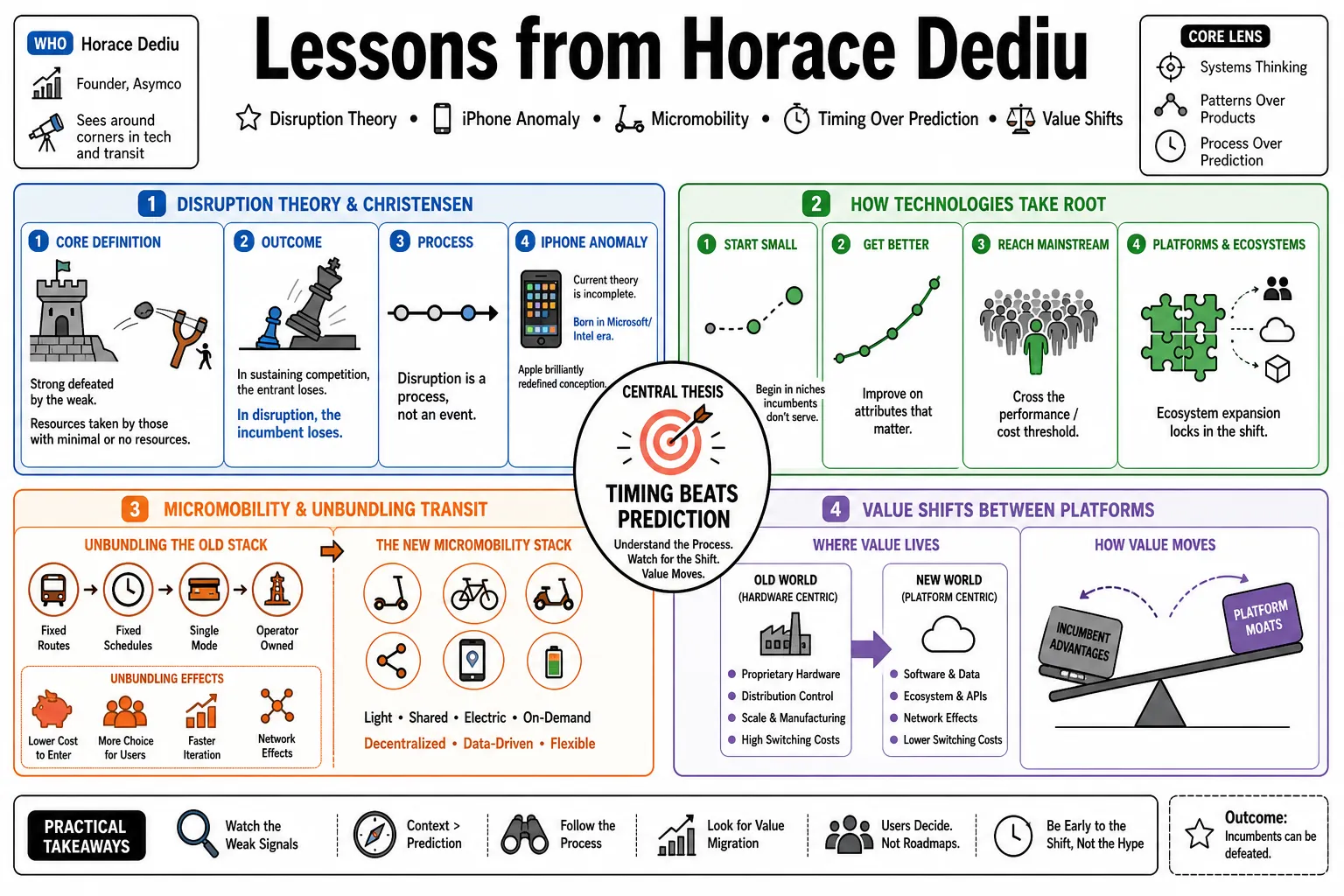
As the founder of Asymco, Horace Dediu applies disruption theory to hardware cycles, most famously predicting the iPhone's success while incumbents dismissed it. He later coined "micromobility" to capture the unbundling of urban transit. This collection gathers his frameworks on how technologies actually take root, why timing beats prediction, and how value shifts between platforms.
Part 1: Disruption Theory & Christensen
- On the core definition: "Disruption happens when the strong are defeated by the weak. More precisely it’s when those with unconstrained access to resources have them taken away by those with minimal or no resources." — Source: [Asymco]
- On the outcome: "In my definition the distinction between disruption (disruptive innovation) and competition (sustaining innovation) is in the outcome. In sustaining competition, the disadvantaged entrant invariably loses. In a disruption the dominant incumbent invariably loses." — Source: [Digitopoly]
- On the process: "Disruption is a process, not an event." — Source: [The Overspill]
- On the iPhone anomaly: "The current theory of disruption is incomplete... disruption theory was born in Microsoft/Intel era. Apple brilliantly redefined conception what was possible from end-user quality and integration standpoint." — Source: [a16z]
- On new market vs. low-end: "Apple is a new market disruptor but much of what is put forward as a threat to it is low-end disruption. I think Apple knows enough about how that happens that it can manage its way around it." — Source: [Forbes]
- On Christensen's correction: "I viewed Apple as a late entrant into the mobile phone business, where in Horace’s view it was an early mover in the ‘computer in your pocket’ business. Horace was right." — Source: [Harvard Business Review]
- On the wealth transfer: "Disruption is the transfer of wealth in an industry from dominant incumbents to disadvantaged entrants." — Source: [Asymco]
- On causality: "Disruption is a symptom, not the underlying disease." — Source: [Praxtime]
- On competitive response: "The concept of disruption is about competitive response; it is not a theory of growth." — Source: [Asymco]
Part 2: Asymmetric Competition & The Nokia Case
- On defining the concept: "Asymmetric competition is when a competitor’s business model is so different that the incumbent cannot respond without destroying their own business." — Source: [Oliver Bruce]
- On Symbian's flaw: "Because Symbian was designed to conform to the needs of device vendors first and mobile operators second. The needs of users and developers were never considered high priorities." — Source: [Quora]
- On the perplexity of incumbents: "Challengers which succeeded to disrupt Symbian found ways to create economic value from user- and developer-centered design. This remains a perplexing and inexplicable set of priorities to incumbents." — Source: [Ribbonfarm]
- On Apple's weapon: "What Apple best contributes asymmetrically is a new experience. The experience allows new behavior, new usage models and hence new loyalties to emerge." — Source: [Asymco]
- On the cost of complexity: "Symbian alone may cost twice as much to develop than the iPhone (including the hardware)." — Source: [AllThingsD]
- On Nokia's arrogance: "Over the years I’ve heard many, many excuses from Nokia, saying they had the market share and that mattered more than Apple’s 'toy user interface.' I kept saying that they were nuts." — Source: [Quora]
- On the hardware trap: "Nokia was a hardware company trying to compete in a software-and-services world, fundamentally misunderstanding the new value network." — Source: [Asymco]
- On the late response: "By the time Nokia switched to Windows Phone in 2011, the 'burning platform' was already consumed, as Android and iOS had already captured the early adopters who influenced the broader market." — Source: [Quora]
- On fragmentation: "Symbian’s architecture was its own worst enemy, operating not as a unified product but as a fragmented ecosystem that created immense friction for developers." — Source: [Asymco]
Part 3: The Apple Phenomenon & Product Strategy
- On the core identity: "Apple is a software company that happens to make its own hardware." — Source: [Stern Strategy]
- On category creation: "The iPhone is not a phone; it is a computer that happens to make phone calls." — Source: [Harvard Business Review]
- On the business model: "Apple doesn't sell products; it sells a way of life." — Source: [Asymco]
- On the trailing indicator: "Profit is a trailing indicator of a job well done." — Source: [Asymco]
- On cannibalization: "Apple decided to build the product that would cannibalize its own iPod business. Then they built the iPad, which would end up cannibalizing its Mac sales." — Source: [Quora]
- On product philosophy: "A great product is one which changes the user... it needs to make us feel we are better for using it." — Source: [Asymco]
- On resilience: "Like a satellite in orbit, Apple is perpetually falling. It just happens to miss Earth every time." — Source: [5by5]
- On profit share: "By capturing the vast majority of the industry's profit share, Apple could out-invest and out-last competitors who had higher volume but lower margins." — Source: [Asymco]
- On subscriptions: "Apple moved from being a transactional hardware company to a subscription company, where the iPhone represents an effective monthly cost to stay in the ecosystem." — Source: [Asymco]
Part 4: Capital Spending & Strategy
- On the true definition: "By strategy, I mean a cohesive response to a challenge. A real strategy is neither a document nor a forecast but rather an overall approach based on a diagnosis of a challenge." — Source: [SK Murphy]
- On discipline: "Strategy is about what you don't do." — Source: [Asymco]
- On hidden success: "The natural state of a business is to become known to its target market, but keep its secrets and success hidden to avoid competition." — Source: [Asymco]
- On forecasting the future: "The best way to predict the future is to look at the capital spending of the companies that are building it." — Source: [Asymco]
- On capital as R&D: "For companies like Apple, capital spending operates as a form of R&D, deploying billions on specialized manufacturing equipment to create competitive moats." — Source: [Asymco]
- On correlation: "Apple's revenue and Capex... have been 97 percent correlated over the past seven years." — Source: [Asymco]
- On reshaped supply chains: "Apple's enormous capital spending is reshaping the global supply chain for the industry." — Source: [Asymco]
- On AI spending restraint: "Apple is refusing to transfer its cash flow to Nvidia. Curiously, it believes that its cash flow belongs to its shareholders, not to Nvidia's." — Source: [Daring Fireball]
- On avoiding the capex arms race: "The others are making $650 billion bets to guard against Christensenian disruption, but Apple relies on its on-device inference to achieve protection without the massive overhead." — Source: [Substack]
Part 5: Causality & The Critical Path
- On corporate governance: "I've often said that corporate governance is medieval, or pre-scientific in its approach to understanding causality. That may be too generous." — Source: [5by5]
- On the nature of data: "Data are not the phenomena. They are a representation of the phenomena." — Source: [AWS]
- On the limits of data: "God did not create data; any piece of data you or I have ever encountered was created by a human being... No quantity, velocity, or granularity of data can solve the fundamental problem." — Source: [Asymco]
- On correlation vs. causality: "Research has found that cows addressed by name produce more milk... The cows produce more milk not because they have names but because they receive better care. In our own research, we've been careful to identify causality, not just correlation." — Source: [Asymco]
- On the necessity of theory: "Theory is the only way to understand causality. Without a causal theory, you are just looking at a pile of data and trying to find patterns that may or may not be there." — Source: [Asymco]
- On shunning sensation: "Tech journalism must evolve to change how commentary is conducted on strategy, shunning sensation while explicitly seeking causality." — Source: [Podchaser]
- On misattributed failure: "When the company fails, everybody says stack ranking is a cause for our failure. I don't think it's causal." — Source: [Asymco]
- On finding speed: "The number one thing a team can do to go faster is to avoid building things that aren't on the critical path to either meeting known demand or testing clear hypothesis." — Source: [Quora]
- On the podcast's mission: "The Critical Path is a talk show contemplating the causality of success and failure in the evolving story of mobile computing and related industries." — Source: [Miraheze]
Part 6: Micromobility: Coining the Category
- On the technical definition: "Micromobility is vehicles under 500kg. The weight limit was chosen to deliberately exclude cars while allowing innovation." — Source: [Transistor.fm]
- On the negative space: "Micromobility is the negative space around the car. It is everything the car is not." — Source: [Micromobility.io]
- On the microcomputing parallel: "Micromobility promises to have the same effect on mobility as microcomputing had on computing. Bringing transportation to many more and allowing them to travel further and faster." — Source: [Asymco]
- On the bicycle for the mind: "Micromobility is a mind for the bicycle. Steve Jobs said the computer was a bicycle for the mind; micromobility is the digital brain added to the most efficient mechanical machine ever invented." — Source: [YouTube]
- On origins: "Nobody invented micromobility. It’s the confluence of thousands of ideas." — Source: [Micromobility.io]
- On vehicle unbundling: "The car is a bundle of utilities... If you unbundle it, you make money—lots of money." — Source: [YouTube]
- On iteration cycles: "Small vehicles iterate quickly, evolve rapidly, and as a result, get all the utilization." — Source: [YouTube]
- On climate impact: "Micromobility is and will increasingly be seen as climate tech." — Source: [YouTube]
- On non-consumption: "The competition isn’t who you think it is; it’s people who don’t use the products—the non-consumers." — Source: [YouTube]
- On moving mass: "We are moving from a world of moving tons to move people to moving pounds to move people." — Source: [Asymco]
Part 7: Urban Spaces & The Future of Transportation
- On the urban experience: "Micromobility is about looking up; automobility is about looking down." — Source: [YouTube]
- On the physical interface: "The physical world is our user interface." — Source: [YouTube]
- On the core product: "You sell miles, but customers buy smiles." — Source: [Drive Sweden]
- On trip distance: "Big trips are not as important as small trips. 80% of urban trips are less than two miles." — Source: [Harvard Business Review]
- On the car's origin: "The modern car is not an urban vehicle. It is a product of a different era, shaped by rural needs and later stretched to fit cities." — Source: [Micromobility.io]
- On the efficiency gap: "We are using 2-ton machines to move 80kg of meat over distances of 2 miles. It is the most inefficient system imaginable." — Source: [Asymco]
- On infrastructure constraints: "As parking goes, so goes the car. Adoption follows infrastructure." — Source: [Micromobility.io]
- On the ultimate victor: "Cities always win. Micromobility is urban mobility, and ultimately, urban freedom." — Source: [Substack]
- On misplaced disruption: "Electric cars represent a technological innovation but not a true disruption to transportation, as they are still just that: cars." — Source: [RAND]
- On the fruit fly analogy: "Small things evolve faster than big things... It’s why we use fruit flies to do our experiments for living things because they have short life cycles. The ability of micro to iterate is much more rapid than the ability of automobility." — Source: [YouTube]
Part 8: Innovation, Timing, & Philosophy
- On predicting outcomes: "Those who can tell the future of technology, we call Futurists. Those who can tell when a technology will reach the market? We call them Billionaires." — Source: [Equal Experts]
- On the limits of consensus: "Analysis might tell you that what you're trying is impossible because it's the encapsulation of expert opinion and consensus. A successful startup must many times ignore this consensus." — Source: [Arctic Startup]
- On large company failures: "The problem with many large companies is that they are very well aware of expert opinion and make the analysis a substitute for intuition." — Source: [Arctic Startup]
- On the knowledge hierarchy: "Data is not information, information is not knowledge, knowledge is not wisdom, and wisdom is not truth." — Source: [Asymco]
- On loyalty: "Loyalty is much more powerful than a signed document. The strongest bonds we hold in life are in our hearts, not in our pockets." — Source: [5by5]
- On humility: "Success can come from many places but once successful, failure can only come from one place: the loss of humility." — Source: [5by5]
- On the purpose of tools: "Let's convert our computers from being tools to being companions... from being utilitarian to being enlightening." — Source: [5by5]
- On the customer's limits: "Product improvements can benefit from customer input because the product is well understood by the customer. Disruptive new products cannot benefit from customer input because the product does not exist in the context of use." — Source: [Quora]
- On making mistakes: "Don't be afraid. It's normal to make mistakes, you have to live with it. You don't make mistakes only when doing nothing." — Source: [Quora]
- On the Innovator's Stopwatch: "Disruption theory provides insight into how and why an industry changes, but what is missing is the when—the precise moment an industry will undergo a turnover in leadership." — Source: [Asymco]